The epithet was actually applied to the Ottoman Sultan Süleymān who ruled from 1520 to 1566 and who ordered the building of this beautiful mosque complex, but the credit really goes to the mighty architect Sinan. On my four visits to Istanbul to date, the Süleymaniye has always struck me as the finest of all Istanbul's mosques for its position on the third of the Second Rome's seven hills, with splendid views over the Golden Horn and the Bosphorus (this from the roof of our Pera hotel);

for the grand scheme which embraces the many buildings around it, in as perfect a symmetry as possible; and for the two mausoleums or türbes I hadn't been able to get inside before this trip, which came courtesy of the Istanbul Classical Music Festival. I've written about the musical side of my experience over on The Arts Desk.
Let the introduction be given by the authors who guided me this time, Hilary Sumner-Boyd and John Freely, celebrated professors at Bosphorus University (the beautiful waterside grounds of which, more like Harvard or Princeton than anywhere in Turkey, I saw for the first time on this visit, courtesy of Idil Biret's recital in the Henry Long Hall. A digressive image, for I can't think of where else I could use it and I like the idea that if you asked most people to guess where, they'd not say Istanbul. Well, it seems that this essentially left-wing set-up is under threat, like so much else, from Erdoğan's ever more alarming government* No headscarves here that I saw, and only a couple in the concerts.

The one hour 20 minute drive through thick traffic from the centre was certainly worth it). Back to Sumner-Boyd's and Freely's summary in Strolling Through Istanbul:
The Süleymaniye is the second largest but by far the finest and most magnificent of the mosque complexes in the city [quick switch to the Blue Guide for a list; 'it consists of a mosque, medreses, a hamam, a library (currently under restoration), a junior school, an imaret (public kitchen), a hospital and mental asylum, and several türbe)']. It is a fitting monument to its founder....and a masterwork of the greatest of Ottoman architects, the incomparable Sinan. The mosque itself, the largest of Sinan's works, is perhaps inferior in perfection of design to that master's Selimiye at Edirne [not been there, alas, except passing through on the train Interrailing in 1981], but it is incontestably the most important Ottoman building in Istanbul. For four and a half centuries it has attracted the wonder and enthusiasm of all travellers to the city.

This time I approached the complex from the south-east, climbing up from the Rüstem Paşa mosque (closed to worshipper and tourists alike for restoration, but I saw its Iznik glories in 1986). The first thing that amazed me was the pristine quality of the Süleymaniye's wide open spaces, the greenness of its grass (no need for human watering; storms were frequent), both from beyond the wall of the cemetery where the important türbes are located (pictured above) and on the north-east terrace, with its trees for slumbering and picnicking under and its superb views over the Bosphorus and the Golden Horn


The second and third of the above images are taken from the second visit on this trip when I brought J and our not very mosque-interested guide Basana, after a terrific thunderstorm during our visit to the Chora Church (in the middle shot's distance is an enormous new mosque on the Asian side of the Bosphorus). Happy on the first visit to be on my own; that way you're the outsider, rather than one of a group commenting on the strangeness or 'exoticism'. Of course the Süleymaniye operates very much like our own great cathedrals and their precincts, though the worshippers are more prolific.

I first visited the türbes which I hadn't seen on other visits; maybe they'd been shut or under restoration.

Süleymān's octagonal resting-place with its columned porch and double dome is crowded with other cenotaphs alongside the big cheese's (centre)

but still they don't take the eyes away for long from the inner dome, still in its original colours of 'wine-red, black and gold'

nor the abundance of Iznik tiles between and below all the marble, granite and porphyry - 'twice as many in this small room as in all the vastness of the mosque itself'.
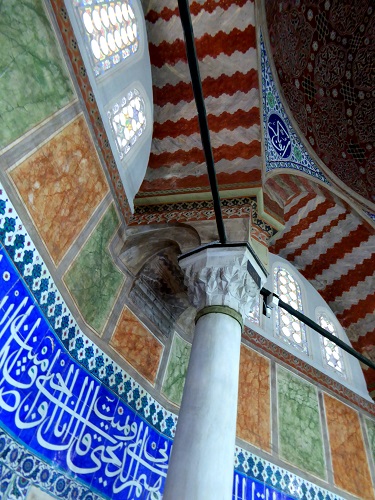


To the east lies Süleymān's 'powerful and sinister' chief wife, Haseki Hürrem, known in the west as Roxelana and infamous for getting him to kill his eldest son on false premises so that her own would succeed to the throne. The mausoleum has an inscription around the cylindrical dome on the outside, set back slightly from the octagonal cornice.

Roxelana has a better cenotaph than she deserves

and an even more substantial array of Iznik tiles on the walls than in Süleyman's türbe.


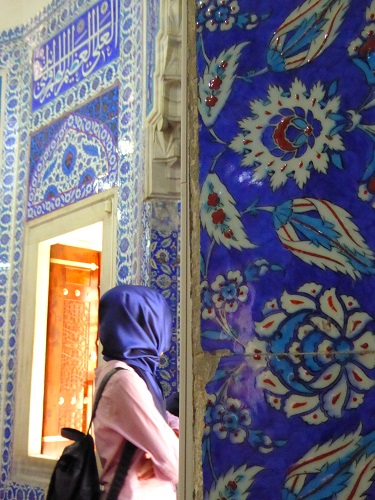
I shared both türbes with only a handful of pious visitors until a horde of noisy but pleasantly spirited schoolchildren arrived,

tearing down the cordons and charging around. The guard was absent.
Took a pleasant walk around the cemetery and its rose garden


before heading for the mosque along its handsome north-west flank

and more shady green space

and entering the courtyard via the western portal.

Rumour has it that the four great minarets banded near the top with turquoise

represent Süleymān as fourth sultan of Turkey, and 10 balconies denote that he was the tenth sultan of Osman's line. The courtyard was all the more overwhelming for being well-nigh deserted in the mid-afternoon heat, both in shadow and out. It was fresher after the storm two days later.


Around the infidels' entrance to the nearly-square room, though, many were clustered - though western tourists seemed remarkably few everywhere up on this third hill; J told me the Aya Sophia and Sultan Ahmet Mosque experience was very different.
Polite girls were on hand at the bar between the public walking space and the area of worship 'to answer any questions you might have'. I joined a trio of Indian Hindus and we three religions - you can call me a nominal Christian - engaged in a dialogue on what (so much) we all have in common. Wasn't sure whether the girls really wanted to proselytise or not, but I took their leaflets and a Quran from the stand of free literature (time I read it all rather than the selected wisdom quoted by Karen Armstrong in her excellent A Short History of Islam).

At any rate I was delighted that we were welcome and we talked about how some Muslim countries welcomed visitors to their mosques (Syria when I went there, Lebanon, Iran up to a point) while others were exclusive and hostile (I remember a bad experience in Hyderabad, in Mali you're expected to pay quite a lot to see inside the Djenne Mosque and the Maghreb, surprisingly, tends to keep its mosques out of bounds).
No point in regurgitating all the facts and figures, let alone some interesting stuff on Sinan's buttress-masking, in Strolling Through Istanbul; you can get some sense of the size, the light and the interaction of the main dome with lesser curves (not least up top), very beautiful.
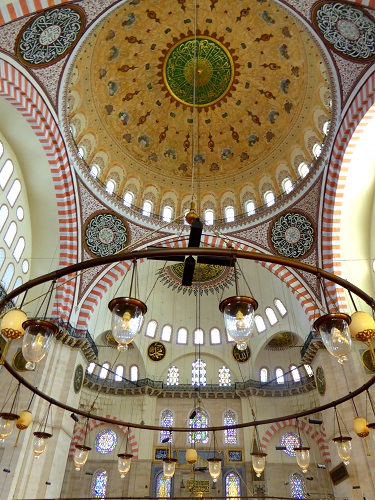

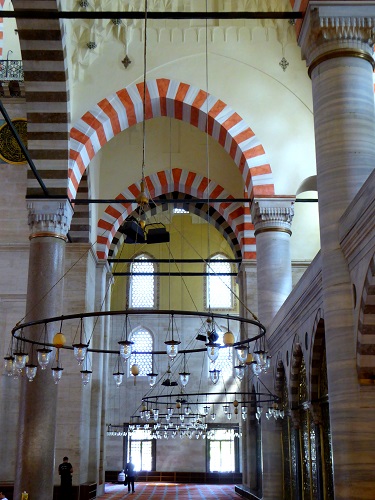
I strolled back out to the main front,

envied the families picnicking and/or snoozing under the trees - notice the difference in generational activity here -

and so was delighted to find that the Imaret across the cobbled street, another caravansaray type construction in a line of three, was now run as a cafe and restaurant, the Darüzziyafe, complete with bad art on the walls. Its welcoming space is the icing on the cake of a a visit to the Süleymaniye.

Thus it had returned to the more exclusive of its original catering purposes: built as a kind of soup kitchen offering sustenance not only to poor pilgrims but also to several thousand people dependent on the Sülemaniye, it had served as a banqueting hall in the last years of the Ottoman Empire. Then it was turned into an Islamic and Turkish art museum, then nothing, until 1992 when it became a plush centre for Turkish cuisine. The menu didn't seem expensive; but all I wanted at 3pm were a rice-and-onion stuffed aubergine, water and a Turkish coffee

which I enjoyed so much sitting in the arcade looking across to the fountain and main entrance. I brought J and Basana here on the day after my visit, and we had a similarly easeful time among the trees and the domes.

Then, on the initial visit, I passed Sinan's tomb in a triangular space


and descended the hill to make my way back to Pera. We'd crossed the Galata Bridge, of course, earlier in the day - J had to start there, and the fishermen did not disappoint -

and I returned via the new bridge with its rather handsome pedestrian walkway by the metro line. looking towards Pera and Galata.

Cormorants were sitting by the water's edge on the Süleymaniye side

and at the midpoint, feeling the space and light in what is often a crowded and traffic-choked city with an ever ballooning population, I heard all the muezzins commence their polyphony. The whole of the northern shore of the old city stretched ahead, terminating in a last view of the Süleymaniye.

And so to a very short rest before the drive to the Bosphorus University and the revelations of the great Idil Biret.
*I couldn't think of anything valid to add to the horror of the Orlando shootings, but preparing this article I came across a headline declaring that a Turkish right-wing newspaper with links to Erdoğan had celebrated the killing of '50 perverts'. Please remember that this great city has as wide a range of opinions and as strong an intelligentsia as any of the other great capitals, and note how popular the rainbow umbrella is. J bought one in the Chora Church during the storm and we'd earlier walked through a street in the Fener district where that Byzantine glory is to be found where the brollies were rife. Of course I'm not claiming that the sellers are aware of what it means to many of us, but let this be used as a mark of colourful solidarity in grief.
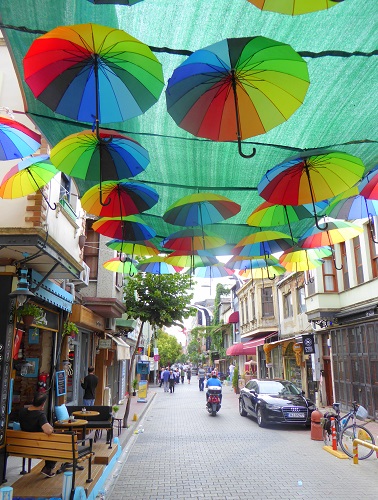
14/5 And just when you thought all this couldn't get more hateful, there's news from The Interpreter that two men laying flowers outside the American Embassy in Moscow to show their solidarity with Orlando were arrested and are to be charged for 'holding a public action without a permit'. The police were summoned by an ultra-Orthodox group, Bozhaya Volya (God's Will, what a joke), attacking the mourners with mockery and jeers.


 Posts
Posts