Showing posts with label Lieutenant Tango. Show all posts

Friday, 13 September 2013

The beauty of retrospective


It looks like an end-of-term line-up, though in fact this photo by the indefatigable Chris Christodoulou of cast, conductor and director of the Proms Die Walküre was taken at the mid-point of a Ring that no-one will ever forget (who ever forgets any Ring, for that, matter, but this one was special from the very first low E flat). There's an even better version, without Barenboim - who hardly stands out as the only unjolly one above - and with the immensely likeable Justin Way seemingly doing a Rhinemaiden on the laps of Terfel, O'Neill and Halfvarson, to head my Arts Desk retrospective on Wagner at the Proms.

I knew I had to honour it, having been stunned quite as much in different ways by Tannhäuser and Parsifal as I had by Das Rheingold and Die Walküre (the reason I had to miss the last two Ring instalments and the Tristan is, as I've been at pains to point out before, Norfolk and Britten related). Surely the artists would have as awed a perspective as I did? Well, they're an eminently more practical bunch, thank goodness, but I think I got some interesting results. I'd been a bit reluctant to do phone interviews as time was short, but when it seemed like the only option for a very busy Donald Runnicles, Sir John Tomlinson and Way, I took it on board and loved the results.


Runnicles, pictured in a photo from Chris's extraordinary gallery of conductors in extremis for The Arts Desk which we instigated in 2010, was a consummate pro, giving me the 200 words in almost perfect straight-off-the-top-of-the-head form. Courteous, too: 'You will be very welcome, sir, at the Deutsche Oper'. Sir John belied his title and was instantly so amiable and friendly. He'd been on a family holiday in Rome, so we talked about the new film hymning that great city, La Grande Bellezza, which I can't wait to see. He told me he'd been doing Gawain in Salzburg, and was flabbergasted when he found out that the director had a whole new concept - not working with the singers. So in effect he had to help out others who'd not done it before with the staging.

This led to the Proms's great virtue - putting the performers first, really focusing on the one to ones. Neither of us would usually say that such a context is better than a full-scale production at its best, but that special magic doesn't happen often enough in the opera house. It did with Kupfer's Bayreuth Ring, where JT cut his teeth alongside Daniel Barenboim and which occasioned my only visit there so far (and that would be enougn; I had my Bayreuth vision). There was plenty more fascinating chat once I switched the mike off.

And the beauty of retrospective? Well, I'd been thinking earlier about how much more interesting it can be to interview artists AFTER they've done something. The only reason it doesn't happen more often is because publications are reliant on the pre-performance publicity machine. But I treasure both of Richard Jones's visits to my City Lit opera class once his Welsh National Opera Meistersinger and Royal Opera Gloriana were up and running (still got to write that last up here).

It always strikes me as dishonest when critics talk about 'the best Prom of the season so far' when they won't have seen so very many;  only the most fervent of season-ticketed Prommers has the right to say so. I managed 14, and the peaks stand out. Of the Wagners, which were one long high, Act 1 of Walküre was possibly the most electrifying I've encountered live (Way's personal highlights were the whole of Walküre and Act 2 of Gotterdämmerung, where I'm told Nina Stemme really came into her own, though she's never less than dependable). Otherwise, no question: the late night Malians and Azeris, Lisa Batiashvili with Oramo in the Sibelius Violin Concerto and Yannick Nézet-Séguin's Prokofiev Fifth, the best I've ever heard. His sheer, unfeigned delight and energy shine in another of Chris's best pics.
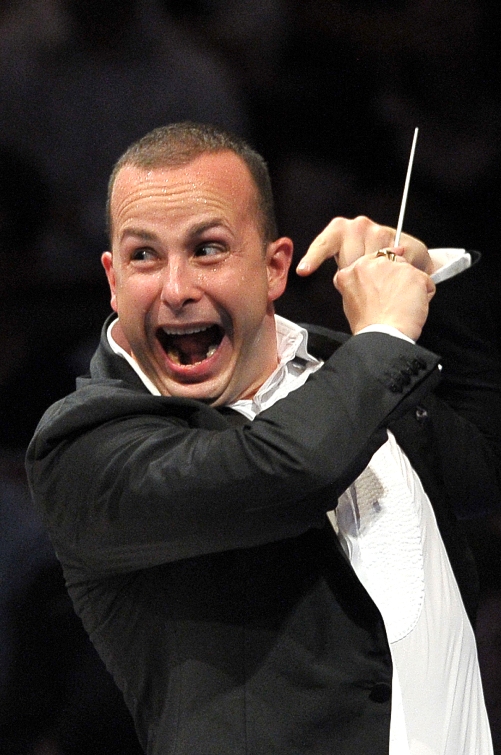

Amazingly that whole performance, as televised on BBC Four, is up there on YouTube (not for long, I shouldn't wonder, but enjoy it while you can).


Wish I'd been there for the Spanish song and dance - astonishing to think it blazed out in the middle of the big Wagner week - and no regrets about missing the Last Night (three-line whip for friend Father Andrew's 50th birthday dinner in an excellent Nepalese restaurant). We caught it on the iPlayer on Sunday night. My, the final jamboree goes on these days, as a sort of extended showcase to the world. But Alsop's discipline and her focused energy were always impressive.


Joyce DiDonato - what a trouper, looking great, plastering over the cracks in an instrument which I've never found hugely individual, but it's still a demonstration of what artistry is all about.


Nige - well, even the Diplo-mate, usually unamused by musical comedy and like me a bit troubled by the ongoing Kennedy persona ('like a down and out Irish navvy'), was in stitches at the fun and games of the much-treated Monti Csardas. Spot all the references?


New seasons have been opening and stunning in the meantime. What a scorcher is the National's Edward II, a Young Vic kind of show in a usually much more conventional space.


Attractive John Heffernan (pictured for the NT by Johan Persson) didn't dominate, but only because it was such an ensemble production. On Monday lunchtime, heavenly Anne Schwanewilms's Schumann Op. 39 Liederkreis was a perfect partnership with Roger Vignoles (only connect: when I met him after Kozhukhin's Prokofiev triple bill, he expressed his surprise at the connection between the Seventh Sonata's Andante caloroso and Schumann's 'Widmung', and here he was playing it). Anne's website man and a loyal student of mine, Howard Lichterman, introduced me to her and I took a shot of the perfect duo which wasn't professional enough to appear on TAD.


A renewed Weill crush has just been put on hold as I rediscover Paul Bunyan in the wake of the British Youth Opera staging (which was good, but not as dazzling as their staging of Cimarosa's The Secret Marriage). I fiercely defend the total brilliance of the collaboration with Auden, which given that I've also been listening to The Rise and Fall of the City of Mahagonny strikes me now as a determinedly optimistic riposte to Weill and Brecht. If you have any criticisms about the poetry, just ask who apart from Da Ponte, Hofmannsthal or Brecht could come anywhere close to the best of this genius text.


I went back to the Plymouth Music Series' 1988 classic recording, coinciding with the epoch-making Aldeburgh revival, and I don't think it can be beaten for American authenticity. Love Pop Wagner as the balladeer. And isn't this Britten's most unambiguously joyous stage work?

New seasons elsewhere: the now old chestnut about the 'show solidarity' petition and the Met opening rumbles on, with signatures being added all the time and further dissatisfaction with Gergiev, who now echoes Putin's equation of homosexuality with paedophilia: disgraceful (scroll down the Onegin piece and the comment at the foot of the companion article on The Arts Desk for an update). Michael Petrelis and his loyal companions have been making the right kind of stand at the San Francisco Opera opening gala - ie no disruption of the performance itself, in which married lesbian soprano Patricia Racette stars - and have got a very decent statement out of the San Francisco Symphony Orchestra (how could it not so reply with Michael Tilson Thomas at the helm?)


I love this photo of a grande dame* showing her solidarity with the friendly protest before the opera gala - from Petrelis's blog, courtesy of him and the photographer Bill Wilson. What a great redemption of that famous Weegee shot in which two overmadeup socialites with tiaras sweep in to the Met past a gaping pauper.

So towards an annual interlude: our walk for the Norfolk Churches Trust. Jill has planned out a route of 15 or so miles and 13 churches. The forecast, alas, is for less good weather than we've had over the past few years. Maybe that will encourage folk to give more generously - though I hope I don't have to invoke the kind of disaster scenario we experienced back in 2006. By way of reminder, here's last year's report and a photo of St Margaret, King's Lynn, alongside which we stay each time, so it's always our starting point.


And, at last, another sunny farewell. This one will mean going over to a page on the Emerging Indie Bands site where godson Alexander's Lieutenant Tango has just been feted. Makes me wonder why he never enlightened me over the 'kwela beat', and what it is. Happy to plug away at a third track, 'So, Go', because, while the million-sellers J sometimes plays on his iPad - following a Facebook commendation, just dipping - sound like dross to me, this is dance music with a genuinely creative edge.

*The lady, Michael now tells me, is glamorous grandmother Joy Venturini Bianchi, owner of San Fran's Helpers House of Couture, at 74 still a redoubtable socialite and staunch friend of the gay community. For the charitable origin of 'Helpers', read the linked article. What a woman! I love the comment on fashion's Alexander the Great: 'McQueen, Jesus Christ almighty. I have a dress by him with a hood so chic that I can't even stand it.'

Friday, 23 August 2013

Malians before midnight


Azeris too: all of them great and serious musicians, which more or less confirms the evolved consciousness of there being no such thing as 'world music', only 'world pop' and 'world classical'. Actually the inspirational Bassekou Kouyaté's ensemble of ngonis (West African boat-shaped lutes) and percussion, Ngoni Ba, crowned last night's late 'World Routes Prom' with a real pop festival to which those of us in the arena all danced or jigged around unselfconsciously (the band pictured above in the first of the irrepressible Chris Christodoulou's shots for the BBC, Bassekou in what looks like a bogolan design from Sophie's MaliMali workshop). Godson Alexander was down from Glasgow, so I think this was a good introduction to promming for him.

As I've written before, Bassekou is every inch as much a classical master of his craft as Lassana Diabaté, the balafonist pictured below on the left with the deliciously communicative lady they dub the 'Mahalia Jackson of Mali', Hawa Kassé Mady Diabaté, and Bassekou's youngest son Mamadou Kouyaté, who plays both in the first group of the evening, the Trio Da Kali, and Ngoni Ba.


All these names! But once you hear the sounds, they'll never be forgotten. The tone of the balafon, a very distinctive kind of bass xylophone, is something that went straight to our hearts in Vienna, when our widely-travelled friends Tommi and Martha - whom we met in Eritrea - took us to a heurigen to hear a fusion between another interpreter of this redoubtable instrument and a schrammel band of accordion and violins. Even then we didn't quite witness the kind of so-fast-you-can't-see-it strokes Lassana Diabaté wielded. Looking him up on YouTube introduced me to another divo, Kassy Madé Diabaté - relation to Hawa, presumably - and the young man who sings first is very fine, too. Couldn't download that one, for some reason - watch it here - but at least I can feature the balafon solo.


It was good to get the contexts of the songs and dances in the excellent programme; as I've written before, too much 'world music' can pass in a haze of uncomprehension. You'd probably have got the message that the Trio Da Kali's first number was a field-work song when Hawa Kassé took up a scythe and did an imaginary cropping dance around the stage. Then there are the recently-topical references to the violence of the Islamist extremists in the north. Ngoni Ba's 'Sinaly' is based on a song about a 19th century royal protester against Islamic oppression, and 'Ne me fatigue pas', as exuberant as the group's other three numbers, protests the problems of Malians at the time of the 2012 military coup.


'A single heart may share itself with a thousand people. Let's be friendly and mindful human beings, let's be friendly to each other'. That's the gist of Tasnif Mehriban Olaq by Azer(baijan)i composer Shafiqa Akhundova, who died last month, and it was another upbeat end to a generally more introspective sequence from the group gathered together by mugham singer Gochaq Askarov. Here, too, are masters of their art: not just Askarov with his highly inflected and ornamented poetics, but also Mirjavad  Jafarov on tar and oud, Shirzad Fataliyev playing the double-reed balaban, veering from mellow to raucous, and violinistic microtonal refinement from Elnur Mikayilov (I liked, too, the unblinking seriousness of percussionist Kamran Kamirov on naghara).


Most touching, though, was the core of BBC Radio 3 World Routes Academy's scheme to twin a maestro (in this case Askarov) or maestra with a young British-based immigrant musician. This was the beautiful 18 year old Fidan Hajiyeva with highlights in her long flowing hair, looking very apprehensive until she opened her mouth, and there was the soul of another true artist, uninhibited in the difficult coloratura. She didn't sing as much as Askarov, but her future looks bright. See how proudly and encouragingly Askarov looks at her below. Must be a nice man.

Today I wept at individual stories of dignified Syrian refugees on the BBC World Service's World Have Your Say, probably because it's been so hard to take in the scale of the chemical attacks, but I rejoiced at a Turkish reporter's news of how devout followers of Islam had joined hands in true brotherhood and sisterhood with gays, transexuals and political activists near Istanbul's Taksim Square. The good news of the Malian election, despite certain anomalies, should have made a bigger impact in the UK media than it did, and this concert was another symbol of closer understanding, how joy and humanity can connect us all.


In any case, the event doubled the evening's pleasure. In the night's first concert, which I've written up for The Arts Desk, spunky Yannick Nézet-Séguin twinkled and moued his way through much the best - by which I mean the most multi-faceted and the deepest - Prokofiev Fifth Symphony I've heard in concert.


And I've heard a lot  - too many, I was thinking before the performance when I joined James Jolly and late lamented Noëlle's perfect successor at the now ill-starred Prokofiev Archive*, Fiona McKnight, for a 5.15 talk in the Royal College of Music.

James's chairing was very accomplished, especially in steering us back to base from a rather oblique question from a member of the audience, and Fiona impressed me by covering points that I'd just realised I'd missed. Where there's deep knowledge and love, the expression of both should flow freely. Anyway, a 20 minute version of our 45 minute chat was swiftly edited by Janet Tuppen and co - how do they do it? - in time for the interval broadcast. You can hear it here for nearly a week. Less pressingly, the Discovering Music I 'did' on the symphony is available long-term here. More important than either, watch the concert - well, at least the Tchaikovsky and the Prokofiev - while you can on the BBC Four iPlayer. You'll be entranced.

Only my pre-Prom duties brought us back from the Swedish wilderness, where we'd been blissed out by the simple life for the last three days of our three-centre (Stavanger, Lake Siljan, Särna) holiday. Had it not been for that and a few other commitments - those might have been shiftable - we would have ditched our £50 return flights from Stockholm and stayed on another week. While I hang fire downloading photos and writing up aspects,  there's a bit about the final idyll on serendipitously-met friend Susannah Finch's blog. In which I am embarrassed to be cast as tough child of nature. I take the liberty of reproducing her husband Jamie's shot of a morning lake dip (for me one of five in varying places and temperatures).


We did indeed meet up with Sophie for our central sojourn in Dalarna. She'll  be back in London to host us in her reclaimed Ladbroke Grove flat for a Notting Hill carnival afternoon. I hope we'll be able to listen to the Malian bits of the Prom then, too. Catch it now**, too, while you can, and dance.

18/7 Our wonderful godson departed yesterday, well satisfied, I think, with my Proms triple bill and with J's exhaustive London walking tour on Friday while I caught up with some work. He was regretful about the late announcement of a Saturday night gig with his band, Lieutenant Tango, in Edinburgh's Grassmarket, which meant he had to leave earlier than planned. The group really has something, as I wrote before: sunny, upbeat numbers with a lot of creativity (though Alexander wants to write meaningful lyrics rather than the nonsense sounds-good ones we've had so far). Having posted the infectious 'Charlie Brash', I now give you 'Geronimo':


*The news is it's moving from Goldsmiths College to Columbia University, New York, in a year or so. Nothing on earth, it seems, we faithful few can do about it. 
**Radio only. My TAD colleague Peter Culshaw, who also reviewed the concert, has just written an excellent piece on how TV has failed so-called 'world music' here.

Tuesday, 7 May 2013

The rest is tonal


As the Southbank Centre works its way through the development of 20th century music along the lines of Alex Ross's The Rest is Noise, I've been hearing so much to remind me that, loudly though the twelve-tone boys and their disciples may have shouted and slavishly though the acadamic establishment may have followed them, tuneful and direct serious (and, as Prokofiev put it, 'light-serious') music kept going.

My feeling that all these ways of finding new ways to say old things, properly absorbing the past - it's hardly reactionary - are just as valid as the work of the so-called pioneers, was confirmed by an interview Benjamin Britten (pictured above with Pears and Poulenc in Cannes, 1954) gave Donald Mitchell back in 1969. It's reproduced in The Britten Companion (Faber; more on the context, taking the City Lit opera class through Gloriana, anon).

Praising the emerging John Tavener - pity that promise never went further than it did - Britten said 'I think he and many of his generation are swinging far, far away now from what I call the academic avant-garde, who have rejected the past. He and many others like him adore the past and build on the past. After all, language is a matter of experience. When we're talking together, we're using symbols which have been used by the past. If we rejected the past we should be just making funny noises.'

Mitchell asks him if he is conscious of the burden of tradition. 'I'm supported by it, Donald,' comes the reply. 'I couldn't work alone. I can only work really because of the tradition that I am conscious of behind me. And not only the painting, and architecture, and countryside around me, people around me....I feel as close to Dowland, let's say...as I do to my youngest contemporary.'


Steeped in Poulenciana, and happily ploughing my way through the correspondence, I'm always aware of the sheer joy in his tradition-conscious music. He loves what he absorbs. But he also realised his limitations. He writes to a friend in 1942: 'I am well aware that I am not the kind of musician who makes harmonic inventions like Igor [Stravinsky], Ravel or Debussy [always the top names among living composers he tended to cite, along with Richard Strauss and Prokofiev, occasionally Hindemith]. But I do think there is a place for new music that is content with using other people's chords. Was that not the case with Mozart and with Schubert? And in any case, the personality of my harmonic style will become evident.'

It's been a joy to discover the Trio and the Sextet in Pascal Rogé's collaborations with marvellous French colleagues, even to hear the strange Aubade in a vintage recording where Poulenc is the pianist. In his own piano pieces, he's an interesting one: determined to capture a speedy spirit where appropriate without bothering too much about all the right notes.

As for other personal discoveries, after Tippett's Second Symphony, I found to my surprise that the First went just as deep - probably deeper in its knotty slow-movement Passacaglia variations, where there's the sort of selective scoring, in this case for three flutes above the chaconne on muted violas and cellos, which most composers can only dream of hitting on. Indebted to Graham Rickson there for digging out the old Colin Davis recordings for me.


I was heading for the second-cast Mozart Zauberflöte at the Royal Opera on Friday. But the Tuesday before, I listened to Vaughan Williams's Five Tudor Portraits to prepare the class for the BBC Symphony Orchestra concert I thought I was going to miss. I suppose I'd imagined that all five portraits were like the one I knew, the Epitaph for John Jayberd of Diss - three-minute character studies. I hadn't appreciated the brilliance of Tudor poet John Skelton's rapping doggerel and I was stunned to find not only the rollicking variety of 'The Tunning of Elinor Rumming' (a real personage depicted above handing her ale to Skelton and a priest) but above all the 20-minute requiem for Jane Scroop's sparrow Philip, slain by the convent cat Gib.


Such delicacy here, sentiment in the right sense and fresh invention just when it's needed. And this in a rather poor performance conducted by David Willcocks (sadly there's not one on YouTube as yet, though you can catch the BBCSO performance on the BBC Radio 3 iPlayer until Friday evening). I gave up my Flute ticket and went to the Barbican instead, writing about it for The Arts Desk. John Wilson and co confirmed my hunch: a masterpiece. I shed a few tears for Philip Sparrow, I can tell you, particularly in that movement's incandescent epilogue. None for York Bowen's Viola Concerto, simply because like so many second-rank works it lacks a personal identity. But that's been an exception among the 20th century surprises, which I hope just keep on coming.


More of the new-to-me now, which in this case is very much the old, or rather timeless. On Ascension Day (illustrated by Rublev, the illuminator of the Très Riches Heures and Perugino),  I found myself spoiled for choice between the four cantatas on John Eliot Gardiner's Bach Pilgrimage instalment. For consistency's sake, I decided to stick with my Leipzig 1725 sequence and plumped for 'Auf Christi Himmelfahrt allein', BWV 128. In that context the joyous circumstance has to make a new, at long last major-key beginning with two mellow horns dictating G major as Bach weaves a glistening fantasia around the sopranos' chorale.


Innovation appears in the bass's invocation to 'arise and with a bright sound proclaim...', accordingly replacing horns with trumpet and breaking off into recitative and arioso. Since the last of the sustained lines tell us 'not to fathom the Almighty's power', all we get in the ritornello is a brief return of the trumpet, no voice.


Alto and tenor in the ensuing aria-duet declare 'my mouth falls silent', but they instead keep on going until the lovely oboe d'amore has the final word and - unaccompanied - the last note. Even the final chorale, with its rich turn on 'Herrlichkeit', has added grace, this time in the return of the two horns, the first climbing to the heights to fill out the textures in the final gazing 'on Thy majesty for all eternity'. As Rene Jacobs, in his incarnation as one of the worst countertenors ever, is on the Leonhardt recording, let's try a newcomer, Dutch forces under Leusink.


From sacred to profane, finally, here's a plug from proud godfather for Alexander 'Betty' Lambton's sax tootling in his band Lieutenant Tango. Let's hope the irresistible danciness of  their single 'Charle Brash' brings them the fame they deserve. This old hipster-replacement here is already chanting and doofing the refrain 'Charlie Brash (doof, doof, doof)/Where's your cash? (doof, doof, doof).'
