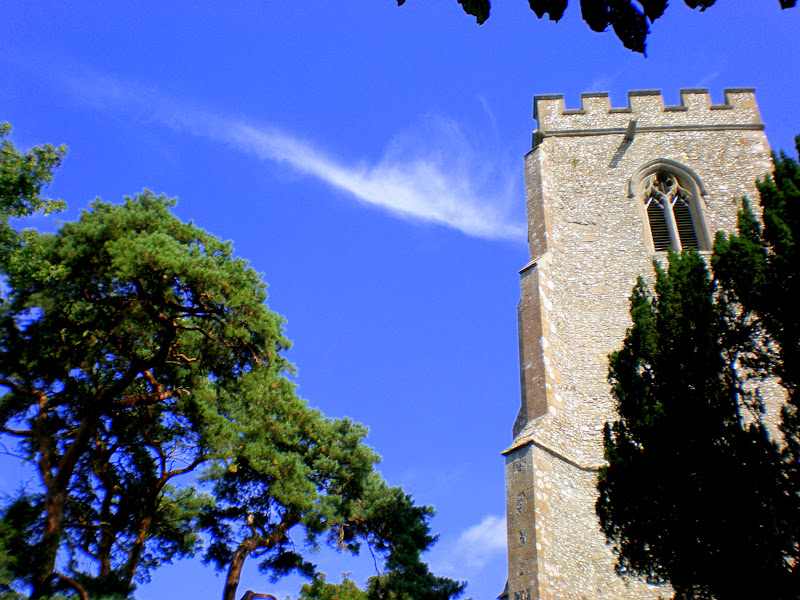

It’s that time of year when a long, long blog entry doubles as an illustrated begging-bowl for our annual church walk in aid of the Norfolk Churches Trust. Last Saturday we covered 19-plus miles and 12 churches, Methodist chapels and ruins (not the more usual 16 owing to a scheduling hitch which I’ll explain later). Numbering from the first walk back in 2002 marks them down as 111 - 122. There's still some way to go, since as Pevsner notes 659 churches in Norfolk date from before 1700 alone.
The hand of Victorian restoration lies heavy or helpful, according to taste, over all the still-functioning buildings we visited. Multitalented Frederick Preedy, cousin of the le Stranges who were the local big cheeses based in Old Hunstanton, added plain chancels and/or self-designed stained glass in every case. Though by no means hostile to all Victoriana, I can’t be as enthusiastic as the gentleman who has a huge online picture gallery devoted to Preedy’s work throughout England. Let’s remember, though, that without the resurrections of the 19th century many of the churches would have quickly become ruinous, and the grandest we saw is unquestionably the better for the late Victorian salvation of its 1430s steeple.
Peer close enough and there seems to be an anomaly in the top two photos:
the clock at All Saints Thornham stands at 10.40, yet I’m claiming it was the
end of our trail. So it was, but well after dark, when we knew this rather
well-stocked interior would have been locked for at least three hours. So King’s Lynn friend Jill left the car outside Thornham’s
Lifeboat Inn, our ultimate destination, and we took a look around the church
before catching coasthopper buses to Ingoldisthorpe and the proper start of the
walk back.
Inside All Saints we found the lady who was to sign us in sweeping a week’s worth of bat droppings from the sheeted stalls (to see the extremes to which the priority of endangered species over endangered buildings can be taken, see the Toftrees section in last year’s entry). She took some persuading that we were indeed on foot, or about to be, and not velociped-bound, but now there's proof on the form that the original ‘sponsored cycle’ has at last become ‘Ride and Stride’ in honour of our peculiar minority. The bus timetable meant we only had ten minutes to look around, which explains why among medieval poppyhead + figure benchends like this

Inside All Saints we found the lady who was to sign us in sweeping a week’s worth of bat droppings from the sheeted stalls (to see the extremes to which the priority of endangered species over endangered buildings can be taken, see the Toftrees section in last year’s entry). She took some persuading that we were indeed on foot, or about to be, and not velociped-bound, but now there's proof on the form that the original ‘sponsored cycle’ has at last become ‘Ride and Stride’ in honour of our peculiar minority. The bus timetable meant we only had ten minutes to look around, which explains why among medieval poppyhead + figure benchends like this

I missed the poetically carved unicorn and headless mermaid
depicted on Simon Knott’s quirky and detailed Norfolk churches site, referenced after the
event. Pevsner, Linnell and Wilhelmine Harrod, sketchy guides, had at least
alerted me to look out for a post mill – the sails are on the side -


and three survivors from a seven deadly sins sequence, each with a transgresser
about to be engulfed in the jaws of hell: here’s gluttonous imbibing.


The late 1400s painted dado of the rood screen, with its sixteen
slightly mutilated but well executed figures, merits an upgrading in the
revised Pevsner from ‘not without merit’ to excellent; maybe the John Miller
(d. 1488) who gave it inspired nameplay in the form of the windmill benchend.


Thornham also boasts an octagonal 15th century
font emblazoned with cusped shields


and (you can just see it behind the font to the left) a
slice of Elizabethan moralizing on the wall.
The second of our two buses crawled through the straggle of
Heacham, where I’d rather hoped we would catch the church’s monument to
Pocahontas; some time after her famous rescue of John Smith, she married the
local squire, became plain Rebecca Rolfe and lived nearby for a while. Still,
this would have been unattractive walking, and our route for the first stretch
lay further inland. St Michael Ingoldisthorpe (pronounced ‘Inglethorpe’) is
tucked away in the middle of an outlying group of relatively recent houses which must have been built on sold-off church land. We
received an ever more ecstatic welcome from the reception committee as not one,
not two, but four of us emerged from the trees – the first visitors at 11.45.


Knott waxes lyrical about both the tlc still lavished on the
church – by no means ‘redundant’ as the revised Pevsner claims – and the
quality of the late 19th and early 20th century glass.
There’s certainly a curiosity in the tracery of one chancel window, which
depicts local boy Thomas Beckett at his desk before sailing to Canada at
the age of 21 where he died in a wood, an unexpected source tells me, after tripping over a log and breaking a
kneecap. This bloody silly way to die is discreetly hinted at in the central
panel, where young Tom lies asleep rather than dead under a tree clasping his rifle. Knott
has better details than my inadequate pocket camera can provide, but this will have to do for a fuzzy hint of the sequence, which ends in a New
Brunswick harbourscape with ships.


The objects of antiquity in Ingoldisthorpe Church are a
wooden screen, a brass of a sharp-featured Jacobean family and another octagonal font, this time originally square in its Norman incarnation but altered a century or so later.


We made our way across fields and a farm full of rare breeds, at which point the soaring spire of Snettisham, rebuilt in 1895, joined the body of the church.

Pevsner declares St Mary ‘perhaps the most exciting Dec parish church in Norfolk’, though the competition is limited, and laments the demise of its 40 foot long chancel, demolished in the 17th century; 300 or so years later Preedy did a tidy job on the east end, which had to be pieced together yet again after a zeppelin attack in 1915. A fairly precise Gothic revival replica of St Mary stands tall in Fredericton, New Brunswick, where as we have seen Beckett Junior of Ingoldisthorpe so prematurely expired. Here’s the real thing in its full glory.

The west front with its six-light window is supposed to be
the glory; not having the book with me, I didn’t take as much note of that as I
should have done. Here sits the great window beneath the nave roof with its ‘sweeping
arched braces up to the collar beams’ (Pevsner).


Of the monuments, a late brass to John Cremer, who died in
1610, his wife and seven children, shows the fashion of the times, especially
in the big breeches of father and sons


and there’s a fine alabaster effigy of Sir Wymond Carye (d.
1612) recumbent.


The greatest treasure of Snettisham, or Snesham in optional
local parlance, is of course lodged not here but in the British Museum – the
Iron Age (c.75 BC) hoard of gold, silver and bronze artefacts crowned by the
neck ring which has had a magical sound to me since childhood, the ‘Snettisham
torc’. Fellow blogger Will Fregosi may be amused to know that it has been
fancifully attributed to Boudicca, subject of his latest post, and the hoard
assigned to her Iceni. This photo courtesy of Johnbod on Wikimedia Commons.


Walking to the next two churches was sweaty work in the heat
of what felt like a blazing August day. There was little shade as we followed
the edges of fields, some of them poppy-fringed,

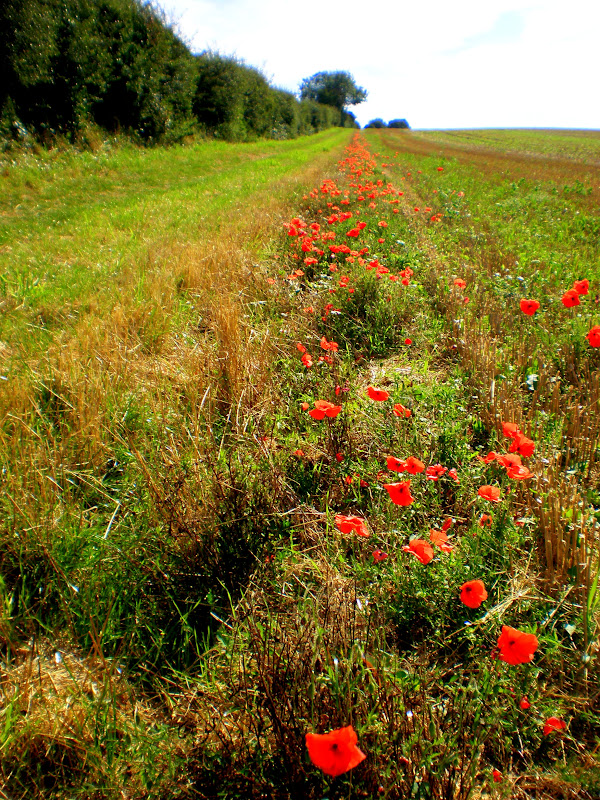
a disused railway track and a stretch of the Roman Peddars Way.
The plunge into the cool of St Mary Sedgeford, hidden away in a hollow, was specially welcome, and all
the more so since another welcoming lady had ice creams on offer, left over
from a village celebration. This was a bonus to the usual offerings of
Robinson’s fruit drinks and biscuits. As I mentioned last year, one day we’ll
find a Norfolk
church where someone has baked a cake or a pie, but that’s ungrateful of me.


Knott warmed especially to Sedgeford Church with its Norman round tower crowned by an octagonal top storey, and so did we. Here was another interior apparently given the stamp of Preedy’s saving hand, but its uncluttered look was more reminiscent of a deconsecrated building looked after by the Churches Conservation Trust. The square Norman font dominates the west end.

There are faint traces of a Saint Christopher wall painting,
and fallen corbels rest on window ledges. The literature would have us believe
they’re medieval, but they look distinctly Victorian to me; whatever the case,
they add character.


18th century headstones dot the churchyard;
here’s Old Father Time as a memento mori.


Having interrupted the next overheated slog for lunch in the
shade of a hedge, we finally came in sight of Ringstead, a rather attractive village
with the church of
St Andrew at the top of
the hill.


Knott’s amusing tirade against the locked door which most
visitors encounter here has a note at the bottom to the effect that his words
are ‘not in any way endorsed by the parish’. We had no cause to complain,
for this much restored church was open on Ride and Stride day, and a local
ancient gave us a lively commentary on
the 15th century brass. More intriguing, perhaps, were the ledger
stones to various Fish (or Fysh) wives and husbands, their characterful arms
featuring three interlaced, sharp-toothed pike.


Ubiquitous glass by Preedy has at least the interest of St Peter
and St Andrew holding the two Ringstead churches.


Only the round tower of St Peter now stands, in the garden of a former rectory. We passed it but – tell it not in Gath, nor to those who sponsored us per church – couldn’t see it; I suspect trespass would have been necessary. Another ruin, St Andrew, was unspectacularly in evidence at the end of our best walking stretch up to that point, the bird-loud valley of Ringstead Downs. I can give you photographic evidence of the remains, but I’d rather post proof that ‘very flat, Norfolk’ is not always true.

By now our late start was giving us problems. It was well
past 5, pumpkin time for Ride and Stride church closure, when we reached St
Mary Old Hunstanton, another Preedified edifice in the heart of le Strange
territory, and the church was decidedly locked.


What did we miss within? Chiefly a very elaborate 16th
century brass to Sir Roger le Strange, but its illustration in the old Pevsner
has to be more impressive than the actuality, as we know from the
hard-to-make-out masterpieces in St Margaret Kings Lynn.
Moving on, around 6pm we hit Hunstanton proper, Norfolk’s only west-facing seaside resort cannily constructed by the Victorian le Stranges, and duly observed a wall of St Edmund’s Chapel just beyond the lighthouse. ‘Not one motif of any eloquence’, writes Pevsner sternly, and he’s right, but this time I guess it should be shown to prove that we gave at least the outskirts of 'sunny Hunny' a nod.

Moving on, around 6pm we hit Hunstanton proper, Norfolk’s only west-facing seaside resort cannily constructed by the Victorian le Stranges, and duly observed a wall of St Edmund’s Chapel just beyond the lighthouse. ‘Not one motif of any eloquence’, writes Pevsner sternly, and he’s right, but this time I guess it should be shown to prove that we gave at least the outskirts of 'sunny Hunny' a nod.

We were now faced with a dilemma. Should we traipse another
half mile into the churchy town centre and the same distance back for the sake
of ticking off the exterior of Preedy’s entirely Victorian ‘New’ Hunstanton
church along with Methodist, Roman Catholic and Unitarian specimens, or should
we proceed directly to our last five-mile stretch along beach and saltmarsh? The consensus
was that we only had another hour or so of light, and so long as we found water
supplies – which we did, just before the beach – we should press on. A bathe would have been ideal, but the tide was so far out, and time was against us. So press on we did, leaving Hunstanton behind and heading for Thornham via Holme-next-the-Sea.


A spectacular sunset was promised, and duly materialized, the sun descending as we walked along the sands

and properly setting as we headed into the saltmarsh


until finally it departed, leaving skies and water
incarnadine, as we took off our boots and waded a creek to reach the final
stretch.


The only sounds were the distant breaking of the waves and
the cries of oystercatchers. Finally we negotiated more or less in the dark the
mix of boardwalk and sandy path with which the Peddars Way winds through the marshland,
having clocked the solid tower
of Holme's
unexciting St Mary. Then we collapsed into the capacious gastropub interior of
the once humble Lifeboat Inn for a generously-portioned fresh fish supper
before the drive back to Lynn.
Previous instalments in the church walking saga: 2011 (around East Rudham) here, 2010 (Nar Valley) here, 2009 (Walpoles to Wiggenhalls across the Fens) here and 2008 (King's Lynn and beyond) here. Earlier walks dating back to 2002 were BB (Before Blog).
Previous instalments in the church walking saga: 2011 (around East Rudham) here, 2010 (Nar Valley) here, 2009 (Walpoles to Wiggenhalls across the Fens) here and 2008 (King's Lynn and beyond) here. Earlier walks dating back to 2002 were BB (Before Blog).


 Posts
Posts