Showing posts with label lake. Show all posts

Monday, 2 October 2017

Around a Swedish lake


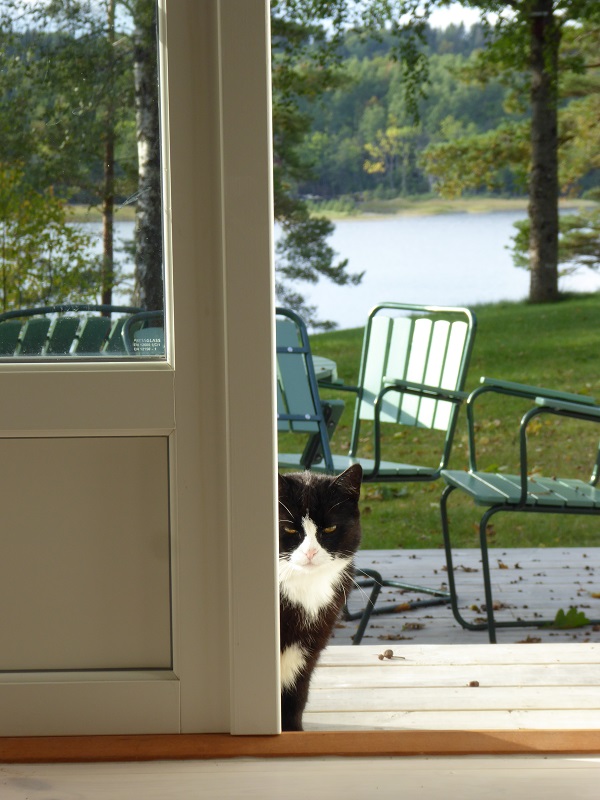
Before the electrifying experience of Santtu-Matias Rouvali's first official concert as Principal Conductor of the Gothenburg Symphony Orchestra - quasi-review here, interview just up on The Arts Desk - I spent just under 24 hours north of the city, in Dalsland at the lakeside home of my friend Lucy and her partner Mats. Plus two cats, one who usually flees but allowed me to get close, Fatty, pictured here at the back door.

They've more or less created a typical red house around the shell of an old building, and renovated the stuga or cottage next door as a perfect holiday home (rates soon to be available on request, if you want perfect peace and quiet, plus steps down for your morning swim and a terrace just above).


The lake, Örsjön, has mostly farmland on one side and wooded hills on the other, We drove round to one of two attractive mills, at Gunvarbyn


and walked up a path behind it.


All walking routes are free-access in Sweden, though the inhabitants of any house you pass might stare more suspiciously than in the UK. This little settlement had recreated a folksy arrangement outside.


Our route took us through woods, with one red autumnal acer in marked contrast to the conifers


and abundant mushrooms. As usual my identification of the browny-greys is fruitless - it was reassuring a couple of years ago, on sending him some of my pictures of fungi in the Göljådalen valley of  Fulufjället national partk in mid-Sweden, to be told by a mycologist at Kew that one would need to provide more than just a photo for correct identification - but this looks more like a Brittlegill, or at least of the group Russula, than a Fly Agaric


while the only correspondent to this phallic specimen is a Shaggy Inkcap


and this is surely a Goblet Waxcap, which like the Brittlegill seems to have had a nibble taken out of it (and discarded beneath).


Lichen foregrounding trees


as well as on them


could be equally spectacular, and black skies over Backen on the opposite shore backgrounded the sunlit shoreline


though it augured inevitable rain, so having reached our destination


we retraced our steps rather than taking the long route back


and having passed this splendid complement of mossy roof and tree


reached the car as it started to pelt. My one great wish was to see an elk, and Lucy had said that one was most likely to appear in the rain. Sure enough, as she drove, a young elk ran alongside the car and darted into the greenery. So you'll have to take my word for it, corroborated by Lucy, that I saw one.

Next morning I took the dip already registered briefly in the Rouvali post - here's a more distant record, courtesy of Lucy -


and toured the grounds.


After an obligatory group shot in the porch,


Lucy drove us to Mellerud to catch the train back to Gothenburg via an old church with splendid iron grave-markers


and, typically, a detached tower
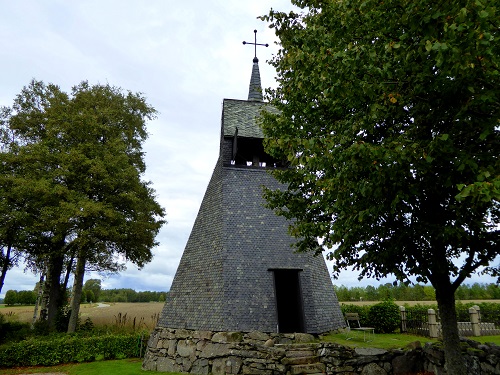

as well as the shores of western Europe's largest lake, Vänern.
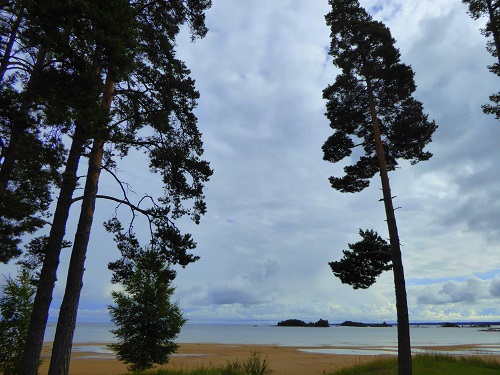

Fungi grew in abundance on the greensward in front of the sands.


The spaciousness of what looked like an open sea, looking across to a wooded island, felt grand and Sibelian, with trees reflected in the water.


though the Sibelius piece with which I want to end, from one of the most individual sets in his huge output of solo piano music, is a hymn to a tree - 'The Spruce' ('Granen'), Op. 75 No. 5. Important to get that space in the wistful tenorial melodic line between upper and lower parts, and I like this performance by Kazumasa Matsumoto. There's a splendid new disc of Sibelius piano music from Leif Ove Andsnes which I'm about to review; the only pity is that it doesn't include all the 'tree pieces' of Op. 75.


Monday, 29 May 2017

The frogs of Göttingen - and Seeburger See


Anyone who's hung around this blog for a long time may remember my account of first acquaintance with the more unexpected choruses of the Göttingen International Handel Festival, when I fell in love with the symphony of brekekekexes in the University of Göttingen's magical Botanical Gardens. On two subsequent visits, their stridency was rather muted - last year's epiphany with a mallard and his drake made amends - but not this past week. It meant a fair bit of hanging around, though, until I finally saw the above fella on one of the lilypads and, in following his progress, got the full sonic works. There's a lot of jumping, but blink and you'll miss the bubble-gum inflating to make the noise early on.


As I explained in last year's blog, the time of the Festival depends on where in the calendar the Germans' Ascension Day holiday falls. This time we were back to the end of May, when the aquilegias are flourishing


and providing a major source of nectar for the bees.


I actually got a double dose of ranine activity on the first full day of my visit to the Festival this year. Not ideal, sleepwise, since I'd got up at 5.30am on Wednesday morning for an early flight and had to do so at 3.30am on Thursday for the GIHF's second 'sunrise concert'. Still, it had to be done: my all-day Messiaenic birdsong experience at Aldeburgh last year taught me that. So after a stunning performance of  a work which came as a revelation to me, Handel's early (and pre-Bach St Matthew and John) Brockes-Passion on Wednesday evening, I decided it made sense to skip Continuum's late-night event and get something approaching four hours' sleep (by the way, all the events I did attend I'll be writing up on The Arts Desk next weekend).

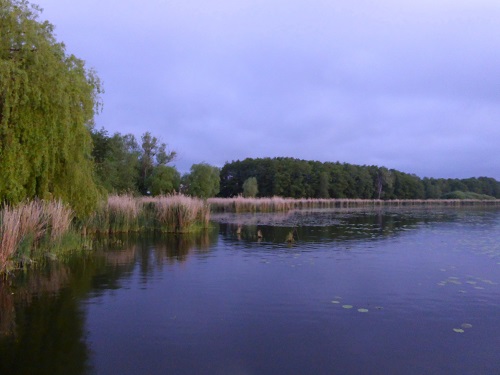
As at Aldeburgh, the dawn chorus was one attraction. It seemed to be starting up in the tree-lined streets of Göttingen as I walked through the near-darkness at 4am to get the coach to our destination. But on arrival at the Seeburger See 45 minutes later, with the red glow of pre-sunrise across the lake,


the full thing was definitely in full spate. You may not see much of what I could, as  I walked through the woods near the lakeside in this short film, but you'll hear what you need to. Of course, our ranine friends soon come into earshot by a small pond.


Then I joined the few other concertgoers who hadn't gone straight into the warm on arrival


seeing this to the left


and some old boathouses to the right.


The one-hour concert began at 5am on the first floor of the Restaurant Graf Isang (est. 1925), with candles lighting our way upstairs and strategically placed in front of the surprise instrument - a clavichord, no less, the first time I've ever heard one live in concert.


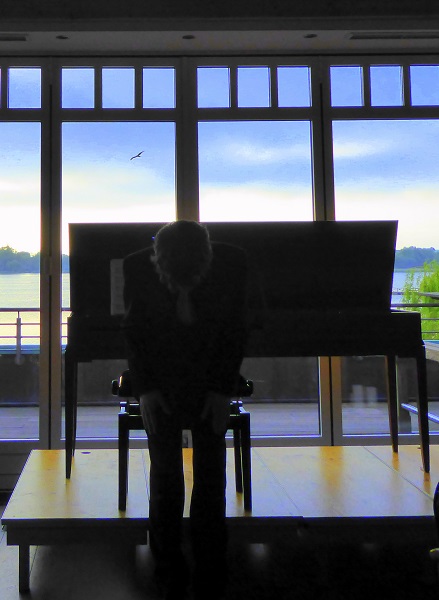
Although the actual programme is the territory of my Arts Desk piece, we must just see young Avinoam Shalev, one of the already more than promising prizewinners in which the GIHF has placed justified faith. Israeli by birth, Hanover trained and now living in The Hague, he led us into a mesmerising meditation on the sounds and colours possible within the quieter end of the dynamic range the instrument inhabits. The sun actually rose behind the willows to our left at about 5.25am, as he was in to the first movement of Haydn's G minor Sonata Hob. XVI: 44. I took this picture, of course, in a break between movements, not during, as no official photographer was present.


A bow to a wildly enthusiastic if necessarily small and select audience: note the bird of prey in the first complete window pane on the left behind our clavichordist.


The sun went behind early morning clouds - by 9am a clear blue sky would emerge - but that didn't deter me from taking my breakfast out on to the terrace.


This turned out to be a good idea, or maybe it was just a case of attracting kindred spirits, because first our coach driver, a very interesting and friendly guy called Jan who'd stood for the whole recital, asked if he could join me. Then Avinoam appeared (pictured left), followed by our chaperone Enno (who said he had to stay out of this picture so as not to block the lake view) and Lisa Kraemer from the GIHF Artists' Office.


So we had a happy time - and there was plenty of it, the coach not due to leave until an hour and a half after the concert - mainly fulminating about Brexit and Trump (the legs you may see in the background belong to a bizarre dummy who had an unfortunate resemblance to the latter). This wasn't the only occasion at Göttingen this year where I have cause to invoke the suitable observation of Kurt Vonnegut's uncle on blessed gatherings in lovely places, 'if this isn't nice, what is?'

In fact that was also true of a last meeting yesterday (Sunday) morning at our favourite haunt in Göttingen, the Cafe Botanik. Pictured here, our wonderful co-ordinator, now a friend, Victoria Viebahn, critic Luca and his friend Christian.


You may also have read on this blog before about the Botanik, still run by an Iranian whose menu is small but perfect. On a hot afternoon I had a refreshing glass of sharbat as well as a hummus plate, and yesterday saffron cake was the only option in the absence of croissants - but delicious.


Inevitably, with less than an hour to go before my train back to Hanover Airport, I had to make a last homage to the frogs, taking Victoria with me, and the inhabitants of the noisiest pond were still to be found.


Their neighbours several blocks to the south set up quite a racket, too, and this time the birds were obliging, both aurally and visually.


So I said this farewell to another inhabitant,


found another bee nectar-sipping, this time in a peony


and noted various positive signs of Germany today - funny, isn't it, how its chancellor is now officially the Leader of the Free World - including this sign in the rather deracinated part of the garden (it's now in need of more finances, and too dependent on volunteers)


and these papers and magazines on a rack inside the Cafe Botanik, snapshotting Obama's meeting with Merkel in Berlin as well as Macron, 'dear friend'*,


 and made my way back to the station via the lovely town museum, currently housing a neat little exhibition on Lutheranism arriving in Göttingen (relatively late, in 1529, with predictably disastrous consequences). Maybe more on that in a future entry, but the ensemble is irresistible.


*It actually turns out to need taking in its other meaning of 'expensive', as two folk have pointed out to me; the subheading is how Macron will cost Germany. But the leader actually ends with the conclusion that togetherness for European countries is the only way ahead.