For the first time in seven years - yes, I even got to go to Estonia last summer, my only foreign travel in 2020 - I had to miss my favourite music festival in the world. Plans were laid, flights (reluctantly, since it's something I'm still trying to avoid) and hotels booked. Then my mother was rushed into hospital and, though much better by the time I was due to leave, still needed daily visits from me: when you're 90, your morale is the thing that most needs sustaining (she's home and in good spirits now).
I have no doubt I did the right thing; I discovered natural beauties on the way to and from the cottage hospital, and I saw wonders operatic in London as some compensation. Every Pärnu concert, moreover, was filmed and streamed live on the website's TV channel for free (last year there was a very reasonable charge). You can still watch until the end of the month (tbc). The images here are all by photographic artist Kaupo Kikkas, an essential presence at every festival and one of quite a few good friends made in Pärnu (I know which are the real ones by now...) OK, the lineup is seriously blokey, but we've had soloists like Lisa Batiashvili and Viktoria Mullova at past festivals.

I'll confess I still have to see some of the events featuring the excellent Academy Orchestra; the first priority was the three Estonian Festival Orchestra concerts under doyen Paavo Järvi (he sent a very nice recorded message to say I was missed via the wonderful Lucy Maxwell-Stewart, who organised everything as usual). I get the feeling that each of the top soloists was inspired to give of his very best, working with that warmest of super-orchestras and conductors. It was vital to Paavo to get the pianist Lars Vogt along; the pianist has spoken so eloquently and with amazing perspective of his cancer here in an interview in VAN Magazine, and we hope with all our hearts that he will pull through. Here are conductor and soloist together.

What follows is nothing like a review - it's some time since I watched the first concerts, after all - but a general impression remains that Vogt's playing in Mozart's C minor Concerto, K491, was on a level of sensitivity and response to everything around that I've not experienced before. Of course the wind, so crucial in the Larghetto, are among the best in the world - but this time I listened as much to the piano as I did to them. What a perfect encore, too, consolation and sorrow side by side so lightly etched in Brahms's A major Intermezzo, Op. 118.

The EFO repeated much of the same programme the following evening, but with Dvořák's Violin Concerto replacing the Mozart. Unlike that masterpiece, the Dvořák isn't among my concerto favourites, and memories of Truls Mørk in the Cello Concerto at the 2019 festival were still vivid.

So I was taken aback by the sheer agile, febrile intensity with which Joshua Bell played it - again, visibly inspired by his colleagues, and sweating more than any of them (it was very hot and humid in Parnu that week, I'm told. You wouldn't hear this work played at a high pitch of brilliance anywhere.

I'll confess I was a bit disappointed in the choice of works announced for the visit of Emmanuel Pahud, the world's finest living flautist (that I know of - if anyone else has other information let me know). After all, Mozart's Flute Concerto isn't even as interesting as the one for flute and harp, and it seemed odd to resort to an orchestration of Poulenc's Flute Sonata. Why not Nielsen?

But Pahud's artistry is compelling in itself, and there was a delicious surprise before the Mozart minuet finale - the perfectly apt interpolation of Arvo Pärt's Estländler (2006/2009). It's a joy to watch the amusement and pleasure of the orchestra's flutes, too, especially the smiles of Maarika Järvi (Paavo's sister, such a lovely person), as Paavo holds up the score for Pahud to follow. I loved the complicity of the EFO woodwind, too, in Lennox Berkeley's Poulenc arrangement. The encore after the whole audience went wild a second time was Debussy's Syrinx - again, hard to imagine a more perfect arrangement.

There was equal magic from the players of the magnificent EFO - I persist in thinking it's like the Lucerne Festival Orchestra when Abbado was alive - in the chamber gala, always a highlight. I was, of course, cheering on my treasured friends Andres Kaljuste and Sophia Rahman, who were honouring the Tubin works in one of the main programmes - more anon - by performing the composer's transcription for viola of his Saxophone Sonata (1951).

Not perhaps a work in which you can spot a clear identity - the second movement is utterly different in style from the first - but these two top musicians made magic of it.

The whole programme was well programmed as a classical/romantic sandwich with Estonian filling - on the other side of the interval came the sublime simplicity of Ester Mägi's Duos in National Idiom (1983). What a supremely subtle artist is Sharon Roffman, someone else I've come to treasure through Pärnu acquaintance, duetting with Maarika.

I'm so proud that we picked a Mägi winner for the Europe Day Concert back in May - everyone loved the compact mood-shifts of The Sea. Any excuse to go back to that great concert, rendered all the more moving in this case by the nearly-100-year old composer's death the following week: I'll post the YouTube film without further comment.
Back at the Pärnu gala, let's just say about the horn quartet transcription of Carmen interludes that the work itself is a terrible mistake - there are other bits of the opera that would actually work in this combination. But it was so delightfully presented by another of the world's best instrumentalists, Alec Frank-Gemmill, and done with such visual panache that I shouldn't be too hard on it.
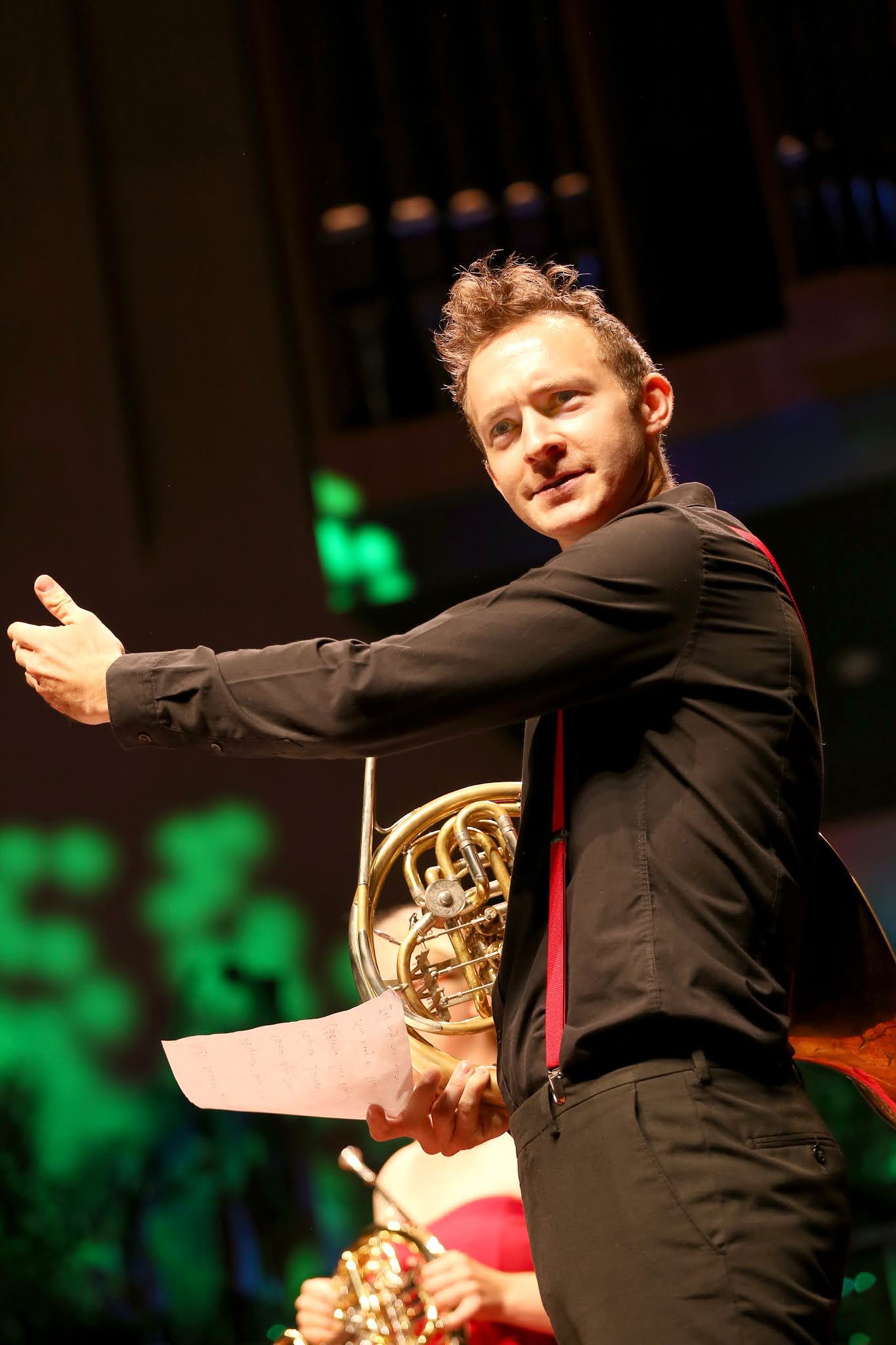
Here's another of Kaupo's best, of Alec in action. Not for nothing does KK have a reputation as the best photographer of musicians in the business.

As for the grand chamber finale, I kinda thought, Mozart Clarinet Quintet again, really? But never underestimate the creative takes of the orchestra's chief mascot, Matt Hunt. What fantasies he wrought with ornamentations on repeats; what freedom from all five players. I've never heard a performance of a great masterpiece quite as alive as this. Theodor Sink - star of last year's festival in Lepo Sumera's Cello Concerto - seemed perpetually tickled and delighted to be playing alongside the great clarinettist

and look at the fun - you may need to click to enlarge - shared between these two, leader Florian Donderer (playing viola on this occasion), fellow front-desker (and leader of the Estonian National Symphony Orchestra, another fine soloist too) Triin Ruubel and second violinist Emma Yoon.

Kaupo also took some great shots of Florian playing - this is just one.

A final note about the other orchestral works in the main programmes. Again, nothing had excited me in the prospectus. But while Tubin's Music for Strings of 1963 is so typical of much sombre music produced around that time, there are some real firecrackers in the suite from the ballet score Kratt (The Goblin, 1938-43, rev. 1960), and a chance for so many of the players to shine. Here's the unique trumpet of Vladislav Lavrik in the lineup.

About the premiere in the main concerts, Ülo Krigul's The Bow, I have nothing more to say than that when a new work starts with bells and dissonant brass, you know how it's going to go. Infinitely more fresh is Berwarld's Fourth ('Naive') Symphony of 1845. I actually used it as a stick to beat an entirely derivative symphony composed a century later, Ruth Gipps's Second Symphony, a waste of 20 well-executed minutes in the CBSO Prom on Thursday. The Swedish composer must have been a happy and wholesome kind of chap. A lot of his best ideas seem to stem from the fairy music of Mendelssohn, but have their own identity, like the quirky syncopated second theme of the Naive's first movement, delectably counterpointed by bassoon second time around. I'm now on a Berwald binge, courtesy of Järvi senior's two-CD set of the four symphonies with the Gothenburg Symphony Orchestra. Not on YouTube, so I give you a mono recording by Igor Markevitch and the Berlin Philharmonic.
This is lovely, but the affection and light-spiritedness of the Estonian Festival Orchestra is even finer. Watch these concerts while you still can.




 Posts
Posts