Showing posts with label Palermo. Show all posts

Saturday, 25 July 2015

Palermo ancora


The Sicilian capital made me love it like no other city I've encountered in the past decade or so when I first went there in April 2013 (among towns, Pärnu on what one might call the Estonian riviera worked a gentler charm to the same end last week, but that's another story). So when we decided, post-wedding, to have a little holiday, to spend time walking and swimming around the Riserva Naturale dello Zingaro further west, a night and the better part of a day at the start had to be devoted to Palermo.

We took a beloved route, with crucial variations, on the first morning, walking along Via Butera from our apartment in the palazzo at No. 28 - a different one this time, looking out on the street -


past the three churches with their splendid baroque facades, the fish shops and restaurants and the more closely-packed dwellings at the south-east end of the street


to the essential bar, the lively Rosanero where the cashiers also sell football tickets (the colours of the team in question are rose and black)


and ice cream comes in massive dollops ('pistacchio' in front of 'bacio' on the left).


Then across the Via Lincoln and back to the old Botanical Gardens, their main 'temple' guarded by two sphinxes.


I waxed lyrical about the flora here back in 2013, so I'll try not to be too repetitive or long-winded. Of course the vegetation was more profuse in June, with the datura blossoms so fatal to poor sweet Lakmé in Delibes's opera (Brugmansia versicolor, originating in the Amazon) in full flower.


Diverse lilies were flowering both in the small pond by the cast-iron greenhouse, largest and most beautiful of the ones here


and in the Botanics' central pride and joy, easily the most fascinating structure here, the so-called Aquarium of 1794-8, where we had found turtles basking around the rim on the first bright day of spring. They were more elusive this time, but still to be found among the lilies


along with a restless baby moorhen.


The massive Ficus magnolides, introduced to Sicily in the early 1800s from its home on Lord Howe Island off the coast of Australia and quickly spreading, is still casting its slightly ghastly influence, though beyond it the reddish-orange flowers from Brachytora acerifolius, also an Antipodean guest and just about visible here, provide warmer terrain as they cover the ground.


There's a nice collection of mimosas in this southern corner, with Albirizza julibrissum in fluffy-flowered abundance


and the outdoor cactus garden looked especially impressive (here with Opuntia pailana in the foreground).


Along with many-berried coffee plants, Bougainvillea glabra graced the iron-cast greenhouse


with the avenue of spiked Chorisias from Brazil beyond


and jacaranda blossom contrasting with fallen clementines just outside the cactus greenhouses.


Then we crossed back into the Kalsa quarter of the old town, the part I know and love the best, and had to pass the beloved Magione


on the way to the major museum we hadn't quite had time to see on the last visit, the Galleria Regionale della Sicilia in the beautifully-sculpted Palazzo Abatellis. The main objective for me was to see the four Antonello da Messina portraits (last time I only got to see the remarkable Portrait of a Man in Cefalù's Mandralisca Museum, then under threat of closure, but going back to the website, it looks as if it's still open). It's easy to overlook the subtleties of three saints - I blush to say I only really noticed them on the postcards, because reflective glass didn't make it easy to see them - but the Mary of the Annunciation is a gem of instant appeal, partly because of the face and mantle,


partly because of the positioning of the hands.


I admit I did what I usually avoid, photographed because of the detail, but of course without flash. Other unpostcarded treasures needed recording, not least where there's individuality in the works of the Gagini clan. Antonello Gagini's virgin and child might have come straight out of a very beautiful workshop


were it not for the trouble he's taken to show her hair behind.


The room with the celebrated 15th century fresco of Death's Triumph was closed, but we could peep in and catch such details as the bony head of the Grim Reaper's horse and the minstrel below it.


The upper rooms seem to have been handsomely restored, not least the great gallery with two superb painted crucifixes in the centre.


After the Antonellos, it was a case of bigger canvases and lesser pleasures, with a few exceptions like an exquisite Jan Gossaert Nativity painted for the Lanzas of Gattopardo fame - the crest of the not-quite-leopard is on the back -


and upstairs a Bronzino on loan and some lovely Sicilian wooden figures of shepherds redeem the decadent dregs. But it was high time for a late lunch, so we headed to the nearby Antica Focacceria San Francesco which had been closed for renovations when we were last here. And now it was summer, so we could sit in my favourite Palermitan square looking out on the facade of San Francesco d'Assisi with its beautiful rose window


while opposite is the old establishment, serving a tasty selection of traditional street food for starters including the notorious Panino alla Milza, veal spleen and lung in a bun, and superb fresh pasta dishes.


Definitely the best meal we had on the holiday, though all the food was good and several others ran the Focacceria close. We strolled back to Via Butera chancing upon the oddities that make Palermo always a pleasure: a vegetable cart with a pre-recorded cry to come buy repeated over and over, a car passing with an accordionist playing away in the passenger seat and a string of shoes hung up to dry.


The meal required a siesta, which J took but I - rather foolhardily - didn't, determined to experience the Via Maqueda from the Teatro Massimo down to the Quattro Canti as a newly pedestrianised zone (albeit a temporary one).


 I approached it via the justly celebrated ensemble of buildings including the Martorana and Arabic-domed San Cataldo churches, quiet two years ago, very busy now


and took an excursion into the more complex streets of the Capo district, not so familiar with the market over for the day, lost my sense of direction and had to run back to Via Butera where our taxi to Scopello awaited. And so it was that within a couple of hours we were strolling around the former tuna factory beneath the village, finding the huge thyrsi of the agaves outlined against a dramatic evening sky


and looking back across the bay towards what we'd left behind.


Next Sicilian instalment, with fewer photos - I promise - must be devoted to Scopello and the wonders of the Zingaro.

Thursday, 25 July 2013

Monreale 2: cloister


History lesson duly despatched in Part the First, I can go straight to the statistics having noted that more beautiful or intimate cloisters exist down the hill in Palermo, not least the one in the church of La Magione and the lived-in one of Sant'Agostino. But the heaven here is in the detail, as well as the devil and sundry underworldly creatures. There are 228 marble columns, many of them inlaid with glass tesserae, in the vast cloister (47m long on each side) which is all that remains of the original 12th century monastery at Monreale. Multiply that (mostly) by two, as double columns support four-sided capitals, to get the number of different carved scenes on the capitals and you have some sense of the colossal work of craftsmanship that went on here in a very short space of time up to about 1200.


For me, it's the ultimate treasury of the medieval fantasy you also get in our own church and cathedral capitals, corbels and misericords, with a dash of the Arabic legacy William II was careful to nurture in his court. That's most obvious in the diaper work on the pointed arches


and in the drinking fountain, surrounded by a kind of mini-cloister in itself in the south west corner.


Most of our time was spent on the east side, where the late afternoon March sun still shone the brightest.


While J put his feet up and took in the rays, I went from pillar to pillar cooing over the sheer variety and range of execution of the subject matter. Literature seems, in my perusal, to be flimsy on chapter and verse: the Monreale book I was planning on buying deals only with the mosaics inside the Duomo. There's a plan of the cloister with some (why not all?) of the details here, which tells me I missed a significant narrative of Norman coronation in the south-eastern corner, but the following should make some amends.

Let's start with the beasties, including harpies with monks' heads,


lions devouring man and beast,


men slaying dragons and serpents,


mermaids among evangelists


and other thingies from the bestiary I'd hesitate to name.


Some of the Biblical scenes look almost Roman in their sculptural quality, like the Massacre of the Innocents.


Many are charmingly naive: Adam, Eve and the Serpent,


scenes from the life of John the Baptist


and what I assume to be Old Testament cultivation


The list-obsessed part of my brain rebels at not having a full guide. If anyone knows where I can find one detailing each and every one of these carvings, please let me know. In the meantime, that leaves me only two more Sicilian retrospectives to go. This could last all year...

Wednesday, 26 June 2013

Monreale 1: mosaics


Dresden's baroque treasures are still glinting in my mind's eye, clamouring for the attention they'll eventually get, but Palermo and surroundings haven't been dislodged since our March visit. To whit, I've just finished reading  John Dickie's Cosa Nostra, which places the city unequivocally at the centre of 150 years' mafia hell recently brought to light. So much for the legend that what turns out to be a precisely rooted secret society, a kind of horrifying shadow state with murder as its main tenet, has been part of the Sicilian mentality for time immemorial.

Dickie - that rare bird*, a scholar capable of writing an impeccably researched book that reads like a series of high-level thrillers - mixes savage indignation with celebration of the heroic men and women who laid down their lives in the hope of a better future, among whom Borsellino and Falcone stand only as the most conspicuous because the most recent.


In every one of the western Sicilian territories there have always been these brave souls, including courageous priests to counter the corrupt ones. Don Gaetano Millunzi of Monreale is merely listed in one of Dickie's remember-this roll calls, but he helps redress the balance of mafioso skullduggery in that town so discrete from Palermo, and yet so inextricably linked with it.

Monreale's greatest glory was born of rivalry at the highest level. Building on the old establishment of a modest bishopric away from Arab-invaded Palermo before the Norman conquest of 1072, King William II created Monreale's supremacy in a power struggle with the English Bishop Walter of Palermo, his former teacher and would-be master.

Walter 'of the mill' (Offamilias) was still having Palermo's cathedral built when William quickly outstripped it with the duomo of a new monastery in his Monreale hunting grounds, finished by the time of the  young king's death in 1189. Without, it's far less remarkable than Palermo Cathedral. What make it one of the wonders of the world are both the mosaics - similar to those in the Cappella Palatina of WII's grandfather Roger II, but on a larger scale if less refined - and, above all, the no-two-the-same capitals on the 216 marble columns in the massive cloister. Since those truly are unique, they'll get an entry on their own in due course.

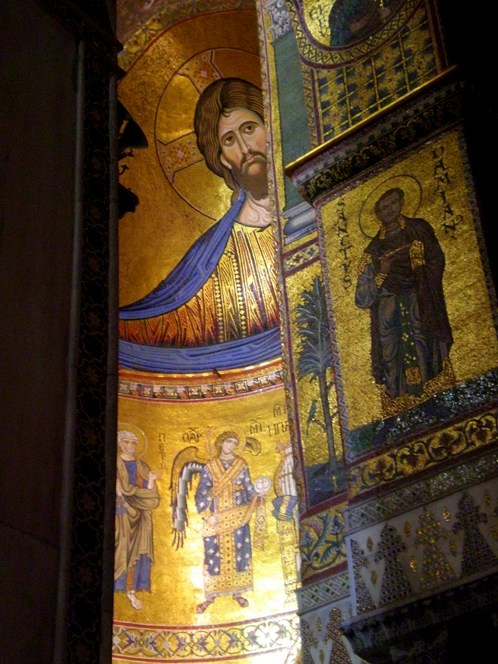
What stunned about the interior on our arrival at around 4pm was that the sun was blazing in through the west window, passing straight through the nave to ligh up the eastern apse with its colossal half-length figure of Christ.


Below the giant figure (13 metres across and seven metres high, if you want to know) are the Virgin and Child, flanked by saints and angels.


Just like the cycle in the Cappella Palatina, the Old Testament narrative in the nave runs first in one strip along the top of the south and north walls, from the seven days of creation to Noah receiving the command to build the ark, and then below in the same sequence, from the construction of the ark to Jacob wrestling with the angel. Thus close to the twin beginnings on the south wall,


a detail of Noah building the ark,


part of the north nave wall


and a segment with Adam, Eve, serpent, God and fig-leaf shame above, angel preventing Abraham's sacrifice of Isaac and Rebecca offering Isaac water below.


and that's only a fraction of the nave's riches; scenes from the New Testament up to Mary Magdalene's washing of Christ's feet similarly enrich the outer arcades. There's even the first known representation of St Thomas à Becket, murdered at the command of William II's father-in-law Henry II of England. The two side apses are mosaic-ed to the respective glories of Peter and Paul; here's one final glimpse of Christ from Peter's side.


But clearly I should have bought at the time a lavishly illustrated, reasonably scholarly volume on the mosaics I found in a bookshop in Palermo; I briefly tracked it down on the internet back home and lost it before I decided to splash out. Anyway, this marks the tenth of 12 'chapters' on the year's Sicilian experience and I am duty bound to see it all through eventually (unlike the Bach cantatas project which, some of you will have noticed, lapsed dismally as soon as we started spending Sundays away. Next year, I promise).

By the time we came to catch our bus back to Palermo, the whole of Monreale was out for a Saturday evening promenade, just like in any Italian town. It seemed so impossible to believe in a population cowed. Nor elsewhere - except, perhaps, for the smashed-up hotel in the Madonie mountains - did we catch a glimpse of mafia consequences. Only in a good way, perhaps, in the results springing from the numerous stickers applied by Addiopizzo, a Palermo organisation fierce in gathering together to refuse to pay the pizzo or mafia 'tax'/protection money. The text reads (if my translation is correct): 'an entire people which pays the pizzo is a people without dignity'.


Many shops now bravely sport the Addiopizzo insignia.


If you have anything to say, do leave a message of support on the website linked to above. And bear in mind the splendid couplet quoted in Dickie's superlative study, written about the lethal Don Calò of Villalba who 'rebirthed' the dormant Cosa Nostra at the end of the Second World War. It might just as well apply to Berlusconi, whose supposed connections with Italy's secret society may yet come to light: 'Cui avi dinari e amicizia, teni 'nculu la giustizia' - 'He who has friends and cash, can take justice up the ass'. Fortunately there's quite a movement in the new Italy, for all its seeming chaos and systematized corruption, which is trying to make sure that doesn't happen. Though it looks as if Berlusconi will never serve his prison sentences.


While I'm on my high-horse campaign to set the world to rights, finally, can I urge you to sign in solidarity with magnificent teenager Malala Yousafzai, about whom I hope I don't need to tell you, in her tireless fight for worldwide children's education? A woolly-liberal old friend of mine, when I sent the petition out to a select few, said 'but I don't know that we in the west should be interfering in other cultures'.

Goddamn it, does a girl have to be nearly killed for wanting the noblest thing in the world? Does one third of the world's married women have to suffer abuse within their relationships, as a recent survey pointed out? Such shame has nothing to do with a truly evolving Islam. Away with false scruples and parallel universes/centuries on the planet we share, please. And it's so easy to offer your name at the click of a button.


LATER: one big wrong in the world righted, 83 year old Edie Windsor and the late Thea Spyer vindicated. Susan Scheid broke it, to me at any rate, giving  the pith of the judge's summing-up before I could check the news. One extraordinary aspect I hadn't realiased was that Clinton introduced the iniquitous DOMA (Defence of Marriage Act - to which I would add, with no idea whether it's been written a thousand times already, there's dumb and then there's DOMA)  now quashed. But I'd rather celebrate with this picture history of a 'great American love story'. Now got to get the above DVD from Bless Bless Productions.

*no wordlink was consciously intended between 'Dickie' and 'bird' when I wrote that.