Showing posts with label Royal Academy. Show all posts

Friday, 26 January 2018

Alone with Charles I's treasures


It hardly seems now that it happened, but for the last quarter of an hour of Tuesday's Private View of Charles I: King and Collector at the Royal Academy of Arts, some of the greatest paintings in the world were available to see with no-one else in the rooms. The above, of course, is Mantegna's Triumph of Caesar, shipped to England from the Gonzaga Collection in 1630, which you could usually see in Hampton Court Palace, but not, of course, like this. Even when I first walked round, there was still plenty of opportunity to get close to the pictures - the clusters of mostly suited gentlemen weren't exactly crowding them out.

But maybe I'm being a bit childish in my delight. The main thing to say is that this must currently be the greatest collection of paintings, sculptures and miniatures on display in the UK apart from the one in the National Gallery, even if it only takes us, for the most part, from the Renaissance up to the 1640s. It has been not entirely jokingly suggested that there should be a portrait of Cromwell here too, without whose intervention and breaking-up of the collection - a Titian Cromwell gave to a plumber is going on show in Sotheby's New York prior to sale - a good many of these masterpieces would have been lost in the Whitehall Palace fire.


Even Room I, 'Artists and Agents', has one gasping. The agents are on the left wall, the court artists on the right in three magnificent self portraits by Rubens, Van Dyck - the adorable one with the sunflower - and Daniel Mytens (also good in this one, by the way).

The bust of Charles dead-centre is thought to be a copy of the one by Bernini lost in the Whitehall fire. It allows for what I hope is interesting composition among the few photos I took (I asked a warden if I was allowed to photograph without flash, and he genially replied  'you can photograph any way you wish, for this one night only'). For I'm assuming that the usual rendering of Van Dyck's Carolingian Trinity will normally be seen, as it is in the exhibition's keynote image, by itself. Fascinatingly, it was sent by Van Dyck to Bernini in Rome in 1636.


The straightforward photos of the paintings here, of course, are not mine - I wanted to show the Van Dyck at closer quarters.


Room II has the National Gallery's Correggio Venus, Cupid and Mercury alongside the National Gallery of Scotland's Veronese Mars, Venus and Cupid side by side, plus the grand Rubens of Venus protecting Pax from Mars (also National Gallery) dead centre.

Then come the Mantegnas in the biggest room and a stunning line-up of Holbein portraits in Room IV including one of my favourites, of Robert Cheseman with a falcon, from the Mauritshuis.


A miniature gem from the Frick, Bruegel the Elder's Three Soldiers, hangs on the opposite wall.


The three Titians side by side in Room V are, for me, the most staggering in the exhibition. Here are the two I'd take if I had a big enough palace to hang them in, the Prado painting of Alfonso d'Avalos, Marchese del Vasto, Francesco d'Avalos, addressing his troops, which has to be seen in the flesh for its grandeur and brilliance, and the Louvre Supper at Emmaus, usually overlooked in Paris because it shares a room with the Mona Lisa.


The compassionate risen Christ here is one of the most moving imaginings I've seen, if not the most moving. And the fabric colours, the general gentle hue, also amaze. The superabundance of Royal portraits in the next room are very fabric-, as in silk-, conscious, too. I remember the portrait of Henrietta Maria always took my childish fancy in the PG Tips card series Costumes through the Ages. The 'Greate Peece' of 1632 hung prominently in Whitehall Palace is the grandest of the set.


To balance the Titians, at not so much lower a level of quality, Tintoretto's Esther before Ahasuerus is flanked by two very fine Bassanos in Room VII.


Room VIII is fascinating if a little odd - those Orazio Gentileschis with their waxy but modern-looking figures - and Cristofano Allori's Judith with the Head of Holofernes leaps out.


Then we're in the Whitehall Palace cabinet of smaller paintings, with more Holbein paintings and some of those extraordinary portraits in black and coloured chalks, bronzes, Hilliard miniatures and the Roman glass-backed sardonyx portrait of Claudius.


From small to great, and tapestries of the Raphael Acts of the Apostles, woven at Mortlake from seven of the cartoons purchased in 1623 from Genoa by Sir Francis Crane. These ones from Paris  complement the ones in the V&A.

The Central Hall has a brilliant assemblage of Charles on horseback - one Van Dyck with which we're very familiar as National Gallery visitors, others less so - while the final room, where the curator was being filmed when I saw it, takes us to later achievements of Van Dyck and Rubens in England; the former's Cupid and Psyche offers a last fling.


There. I feel breathless just going superficially through it. And as a nice coda, I got to press the flesh and feel the feathery dress of Grayson Perry. Brexit, he said, is the gift that keeps on giving for artists railing against it (I wish I hadn't known that two of our artistic national treasures are in favour of it). I told him how tickled I'd been by the display of his costumes, Making Himself Claire, in the Walker Art Gallery on my visit to Liverpool back in November (just before I went off to the afternoon performance of Verdi's Falstaff with Bryn Terfel and Vasily Petrenko conducting at the Liverpool Philharmonic).


He hadn't been. I mentioned the Post-It notes pictured here


and he said that if only one child became an artist as a result of having been to a gallery, it had to be worth it, didn't it?

Since I now realise I didn't get to blog about my afternoon in Liverpool, it's worth noting that the Walker has some very fine British paintings as the core of its collection. Stubbs, of course


and  Gainsborough,


all handsomely hung in the recent revamp. Not so sure, much as I admire her in principle, about Turner Prize Winner Lubaina Himid's cut out slaves, part of the installation Naming the Money, hogging some of the limelight from Hogarth's swagger portrait of Garrick as Richard III.


but the parallel between wealthy patrons and slaves is well made. Anyway, I feel that old art-hunger coming on. Sophie has proposed that we go and look at the Dante-quoting frame for Ari Scheffer's Francesca and Paolo at the Wallace, and I have to catch the Kabakov installations at Tate Modern before the show closes on Sunday.

Friday, 10 February 2017

Still life in a turbulent time


Right at the heart of the colourful riot that is the Royal Academy of Arts' Revolution: Russian Art 1917-1932, in a room devoted entirely to the unique style of Kuzma Petrov-Vodkin, my eye was drawn to this still life of 1918. I knew several others of his, but not the extraordinary treatment he lends to a herring, a couple of potatoes and a lump of bread - the restricted fare of hard times.

It's the artist's prerogative to lend grace to the ordinary in a nutshell. A parallel struck me the day after seeing the exhibition at a point I reached in Péter Esterházy's Celestial Harmonies - not easy reading, but every page of this discursive take on the author's very famous family deserves to be savoured, and a lightness of touch mitigates the difficulty of grasping such allusice richness. His father, under the straitened circumstances in which the family finds itself under Communism, is making a drama of preparing to attack a bone for its marrow by extracting it from the cooking pot.

'The midnight predators gather for the kill,' our father announced mock-heroically, then sat down at the kitchen table with ceremony, the pot in front of him. We crowded around him, buzzing and craning our necks, so we shouldn't miss anything. 'Take your places,' he said, looking at us with make-believe severity and then, like a chief physician at the operating table (or a priest conducting mass), he raised his two hands. 'The scalpel, sweetheart!' he said to mother, who did and did not take part in the show. She was happy that we were happy, we, her children, and also the man who at that moment was busy pretending that life is beautiful and exciting, and he the master of all he surveys, the benefactor of the small group for whose benefit he was demonstrating that this beauty and excitement is everywhere at all times: just look, even in a bone, a leg of beef!

And perhaps it's not even pretending so much as creating, on both the author's and his father's part. By the same token, Petrov-Vodkin wraps magic around the ordinary in the RA room devoted to his work, an exhibition-within-an-exhibition. Of course there are questions around the stunt as a whole: the plutocrats and the Russian governmental propagandists making the exhibition possible with a stunning array of the best - Moscow and St Petersburg galleries must be bare of their post-revolutionary masterpieces at the moment - as well as the questionable aspects of celebrating a vision that quickly soured. A grim 'Room of Memory' at the end, showing 'criminal' mugshots of many who were murdered under Lenin and Stalin, attempts to make amends.


But surely the point is the unleashing of energy, good or bad, into kinetic art. For, despite the stillness in the leading image, all is movement in this exhibition. And there are some impressive novelties which fit the giant RA rooms so well: the recreation of an El Lissitzky workers' room in the 'Brave New World' gallery, which is more coherent than it looks here


and above all the magnificent attempt at reassembling Malevich's room of his own work for the 1932 exhibition 'Fifteen Years of Artists of the Russian Soviet Republics'. Not even the recent Malevich show at Tate Modern managed this.


The RA has gathered together most of those original works - with, I think I'm right in saying, only two substitutions - and recreated the models; the effect is very impressive, possibly more so than the original, of which we do have a photograph.


Otherwise, the revelations to me were the Petrov-Vodkin collection, the ceramics and the work of one artist with whom I wasn't familiar, Alexander Deineka - variable, but this one of textile workers fascinated me.


For the rest, it was a bracing reacquaintance with many old friends, and nostalgic memories especially of many hours spent in St Petersburg's Russian Museum - a more essential gallery for the understanding of the native culture, certainly, than the breathtaking Hermitage.

We leaped from one exhibition to another, the David Hockney retrospective at Tate Britain, for an intimate little gathering of 2000 or so folk thinking they were going to get a close audience with the master. Actually we did, since when we arrived the queues to get in to the exhibition proper were enormous, and - diverted by good company - we suddenly found ourselves with only 15 minutes to rush around. So the first two rooms, with pictures of the ilk of 'We Two Boys Together Clinging', which impacted so much on me as a teenager, were empty, and in the third our only companions were Ian McKellen and Neil Tennant, chatting - appropriately enough - in front of the theatrical 'Ventriloquist' canvas.

The whirl wouldn't have worked if we hadn't already been so familiar with many of the canvases, and seen so many in previous exhibitions, but no doubt about it - this would have to be the most impressive in terms of together-hanging, above all in the room of heyday swimming-pool paintings and double portraits.


Then it's on to the exquisite drawings, his best portraits (Auden and mum especially) followed by the photomontages (mum, again, at Whitby Abbey my favourite) and the last room with stuff I really love, the colourful road pictures.


And these two of still lives - only connect - by the sea; I didn't know them. I hope these people will forgive their featuring in my general impression.


On to the English nature pictures, the paint rather gauchely applied IMO,


and to the less interesting final rooms. As Hockney's old pal and ours (of lesser years) Jonny Brown observed, it must have been the artist's choice not to include his (again IMO) terrible later portraits (the National Gallery wardens must be the worst). Here's Jonny with the ever-amazing wise young bird Thierry Alexandre by Millais' Ophelia


in the dreadfully-hung and badly-lit Tate Britain room mixing Pre-Raphaelites with really superior stuff like several of Whistler's Nocturnes. And Thierry allows me to transition to something I should have written about months ago, beloved artist Paul Ryan's show on the impact of InterRailing at Europe House's 12 Star Gallery. Here's the diva/o's back, in the first of the portraits here taken by the 12 Star's resident photographer,


and further portraits in front of some of the exhibits: the artist flanked by myself on the left and dear Chris Gunness with my goddog (by which I mean I am his godfather) Teddy on the right,


the great Jeremy Deller alongside his InterRail exhibit,


composer David Sawer with the manuscript of an early work written in the wake of an InterRailing experience,


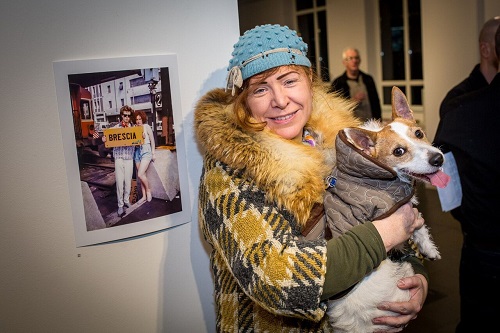
and Lady C with her dog - I had to leave for Richard Jones's production of Once in a Lifetime so didn't get to meet them - in front of hers.


It all brought back memories of happy days in which I discovered the joys of independent travel - first under the organisational aegis of Christopher Lambton, who worked out our train journey to Istanbul and back, with a further loop by other transports in the wake of the military coup around the west coast, in 1981; and then, the following summer, the revelation of how good it was to travel alone, and feel completely free, after I left friend Simon at Ravenna and travelled on to Padua, Venice and Vienna with Bertrand Russell's The Pursuit of Happiness confirming the source of my joy.

Thursday, 7 January 2016

Ten years of the 12 Star Gallery


Andrew Logan celebrated the anniversary on 8 December 2015  with mirror portraits, watercolours and, yes, an installation of 12 gold stars, cutting the ribbon above with Head of the European Commission in London Jacqueline Minor and Fenella Fielding, just turned 88 at the time, a name which will mean most to my generation who saw her in Carry on Screaming and other camporama. One person you won't see in any of these photos - mostly taken by Jamie Smith for the Commission, I'll mark mine with a 'DN' - is spouse J, founder and doyen of the 12 Star since its inception, as he prefers to be an unseen eminence grise. He's not even mentioned in the splendid book accompanying the anniversary, and when prised from the back of the crowd during the speechifying said not much more than Albert Herring's 'Thank you....very much' (though of course he could have drummed up a splendid speech had he wanted to put himself forward).

Even so, the gallery was his idea and has hosted exhibitions not just from all the European countries but also, occasionally, further afield, one on average every fortnight. Alternate Tuesdays are fixtures for art-lovers, diplomats and others: all the world is here. My personal favourite of recent months - not, I blush to say, that I've seen them all - was Thomas Ganter and his portraits, rich on every level. First exhibitor back in December 2005 was our Sophie Sarin with a collection of smashed plates, a splendid commentary on the olde worlde wooden cabinets of the original space - actually a former entrance hall - in Storey's Gate. My invitation is rather scrumpled now, but it still sits on a home shelf.


Et voilà la reine de Djenne on the right below with the equally creative Lucy Hannah and Spectator Books Editor Clare Asquith.


No evening is complete without a minor event, and Sophie provided one for me in the pub afterwards. But since she remembers nothing about it, I'll quickly draw a veil over that entertainment and pass on to megastar Maggi Hambling, also a friend now along with her gracious partner Tory Lawrence, who exhibited back in Storey's Gate days. Maggi marked the move to Europe House in Smith Square exactly five years before the present show opened. An exact mid-point, in other words, and a link with Andrew Logan for obvious reasons.


A series of her magnificent North Sea paintings was the theme in 2010.


Alas, by the time I arrived at Europe House on 8 December, Maggi and Tory had left, but this photo opportunity was too good a one for Jamie to miss.


Another friendship we owe to the 12 Star is that of top sculptor and painter Deborah van der Beek, who appeared on the scene with her Ned Kellys and Don Quixotes we now love so much. That launched the warmest of relationships with Deborah, her husband Andrew the serpent-player/chorus master and two of their three fine children (only Bertie, gourmet pizza king of Brighton, we haven't met). J's 50th birthday party in their Lacock house and garden was one of the happiest days of our lives. We spent a very floody but delightful Christmas with them and one of their two sons, Henry, a couple of years back, and we know Theodora (T D) quite well too. Here are mother and daughter with very authentic spirto gentil and fighter for good causes Thierry Alexandre (my pic, so not so sharp, and Deborah's eyes are shut, but it'll do).


Here also, social-diary style, are Thierry with David Souden and Ross Alley (also DN),


our dear old friend Edward Mendelson, retired architect and  very active artist, in front of Derek Jarman - two who were 'out' long before it became easy to be so -


Cressida Bell, on the left with art historian and editor Caroline Bugler


and Cressida's other half Paul Beecham, a work of vintage art in his own right, sharing a quiff with artist Duggie Fields.


The seasonal adornments in front of giant Maria (DN) will have gone down last (Twelfth) night


and soon to leave the building - in this case the National Gallery, possibly my favourite in the world in terms of contents - will be the astounding assemblage of portraits by Goya. Yes, it's every inch as miraculous as people say. How much you can tell both about the person and the artist's attitude to him or her, though some background knowledge is sometimes necessary. Not least is the man himself, represented here with uncomfortable frankness in Self-portrait with Dr Arrieta.


The inscription at the bottom explains all: 'Goya thankful to his friend Arrieta: for the skill and care with which he saved his life during his short and dangerous illness, endured at the end of 1819, at 73 years of age'. Goya lived on for another nine years, and one of the many wonders of this curation is that the last painting happens to be of Goya's grandson, healthy representation of faith in a future beyond his own life.

It's true to say that every portrait is of compelling, if not always supreme artistic, interest. I especially wanted to show the vital pair Bartolomé Sureda y Miserol, who coached Goya in the art of aquatint, and his wife Thérèse Louse, but they're not online. So let's settle for an aristo, the Marquis of Villefranca and Duke of Alba, holding a score of four songs composed by a 'client', Haydn, and leaning on his violin.


Goya's range of subjects and styles is extraordinary; less so in another exhibition I'd been looking forward to so much, a relatively small one devoted to Jean-Etienne Liotard at the Royal Academy. Yes, his portraits, especially in pastel, have a realistic quality at odds with so much in 18th century painting. But I tired of all those stiff nobs in well-executed silks - a feeling of satiety at the costume-parade I also got with the Moroni exhibition, where I'd have given all the noble portaits up for the final image of a humble tailor. Here, for me, the best was first - the self- and family portraits - the gap-toothed grinner of 1770 from Geneva,


the wife and eldest son in black and red chalk with watercolour washes


and the pastel of daughter Marianne holding a doll.


Among the rest, another child stands out: frail Princess Louisa Anne, short-lived daughter of Augusta and Frederick Lewis, Princess and Prince of Wales, in a dress too big for her. And then the still lives, and the virtuosity in trompe-l'oeil is somewhat. But the whole, perhaps, not quite enough.

I visited the Liotard with Edinburgh friend and artist Ruth while she was here for the 12 Star bash


and on that occasion we didn't have time for Ai Weiwei, but I'm glad I saw that show with J on the penultimate day. A price to pay: rooms absolutely jam-packed, young folk photographing everything so that one always felt in the way. But I'm glad Ai's conceptual art is so easily grasped, as the messages are essential ones about China today, using materials embedded in that country's tradition to make strong political points. Ai is a very great man, and an artist with a sometimes deadly sense of humour; that, and the good use of the huge white RA rooms filled with large-scale constructions, made this well worth seeing. The eight 'dead' trees which meet you as you go through the Royal Academy arch on Piccadilly are joined and bolted pieces of the real things brought down from the mountains of southern China and sold in the markets of Jingdezhen in Jiangxi province: perhaps the most impressive so far of the many successful courtyard installations.


Among monumental shows, though, it seemed to me that the Anselm Kiefer exhibition - my absolute favourite at the RA along with the 'Citizens and Kings' portraits - had deeper things to say, at least in purely artistic terms.