Showing posts with label Sakari Oramo. Show all posts

Sunday, 10 December 2017

Spitalfields' non-Christmas festival


A great idea, in principle: invite in a radical and respected curator, André de Ridder, whose conducting of Prokofiev's The Gambler at Grange Park impressed me so much on a first visit there, and whose adventures in contemporary music have been consistent ever since; combine the old and the new in most programmes; make each event an epic. And, of course, avoid the usual Christmas fare of previous years. Of the opening three-parter, I could only make the first third, in itself a generous hour-and-a-half, before dashing off to the Royal Opera's Cav and Pag. That put an Arts Desk review out of bounds, so I report belatedly on what I witnessed last Saturday here on the blog.

The launch of the Spitalfields Music Festival 2017 (all images here by Robin Savage for the Festival) was in every detail worthy of respect, but a little crepuscular (as a punter said in the Music Discount Centre when I worked there many moons ago, of music from Wagner's Ring arranged for the eight Bayreuth horns). Two of the three works receiving UK or world premieres were minimal to the point of dematerialising: perfect for a late-night concert in the summer, when the body is relaxed enough to go into meditative mood, less so for lugubrious Shoreditch Church 9as immortalised in the wonderful Rev.) on the gloomiest of December days. Much as I love Anna Thorvaldsdóttir's haunting orchestral pieces, Shades of Silence hardy feels like more than a tentative improvisation (it was composed for the Icelandic period-instrument contemporary group I heard in Tallinn Music Days 2016, and so it fitted David Bates and players of La Nuova Musica well).


Much more effective, as I'd have been able to judge more fully had I been sitting comfortably and not with a crick in my neck, was Jocelyn Campbell's THEFT, a very subtle meditation on fragments of Monteverdi madrigals. Beautifully maintained on the cusp of silence by violinist Maya Kaddish and viola da gamba player Gavin Kibble (pictured above), it was true to the composer's definition (Thorvaldsdóttir's title was advertisement enough, too): 'I want the pieces to feel somewhat vacant, still containing much of the beauty of Monteverdi's writing but with none of the sense of progression, and heard somewhat faintly as if from a distance and with elements of soft disruption'.


Dynamic at last, by way of much-needed contrast, was Josephine Stephenson's Between the war and you, a song cycle the words of which were not always audible, nor the tones consistently projected, from The Hermes Experiment's soprano Héloïse Werner. The quartet's admirable aim to commission work for the rare combination of voice, clarinet, double bass and harp (all four musicians pictured above) remains impressive, though, and harpist Anne Denholm wove consistent magic.


The framing madrigals both astounded me (through the course of the evening there were five scheduled, all from the radical Book Eight - I was sorry to miss Ben Johnson in Il Combattimento). I confess I've never heard 'Or che'Ciel e la terra e'l Vento tace' live before - wonderful text, spellbinding start, queasy harmonies. Radical indeed. This is up there with the weirdest of Gesualdo, and all in the cause of creating a mini piece of music theatre. Even more so 'Lamento della Ninfa', with Katherine Manley (pictured above with three musicians from La Nuova Musica) realising the full force of the girl's heart-tugging plaint. Excellent work, too, from The Erebus Ensemble, a group of singers for once as fair of face as voice. Men only, of course, alongside Manley in 'Or che'Ciel'.


Wish I could go on the Schumann ramble around Spitalfields' Huguenot houses tonight - Dichterliebe distributed and, it seems, in some cases reworked; the great Uri Caine is among the range of performers. But since Sakari Oramo's unsurpassable Independence Centenary Sibelius has left me on a high, and Salonen did a wonderful job on the colour in the Four Lemminkäinen Legends the next evening, I have to go tonight to hear what the first as conductor makes of the second as composer. And, I know it's the obvious choice, but I only just watched Oramo's Last Night of the Proms performance of Finlandia, with choir (though it's the revised standard, otherwise, rather than the original with its hair-raising apotheosis, which we heard on Wednesday). Gave me goosebumps and brought a tear to the eye. So good to see so many of my pals in the BBCSO in close-up, too.


UPDATE (13/12): Helen Wallace has done the honours for the Spitalfields Festival on The Arts Desk, catching the final special event, Schumann Street, and making me wish I could have gone. I don't regret what I did plump for - Oramo and the BBC Symphony Orchestra making a brilliant success of four works by Salonen at the end of the Barbican 'Total Immersion' day.

Friday, 3 November 2017

Quiescence: Sakari Oramo and Nan Shepherd


This was serendipity. Last Friday I encountered for a second time the great Finnish conductor's unique way with one of Sibelius's most elusive movements, the hypnotic centrepiece of the Third Symphony with which he also made the 2011 BBC Symphony Orchestra debut that got him the job as Principal Conductor. I was in the middle of reading Nan Shepherd's masterpiece of writing about nature, The Living Mountain (you may remember that I mentioned buying it in the Lighthouse bookshop during my blissful day at large in Edinburgh last month.


Why the connection? Because we all surely have at one time or another the feeling that music and its interpretation are reaching to some hidden truth that we think we glimpse, only for the intuition, revelation, call it what you will, to fade away. Another way of looking at it is that we become fused with the 'thing in itself', Kant's 'Ding an sich'. Shepherd touches time and again on this, and it is not cheating the gist of her small, perfect book to quote from her very last paragraph:

I believe that I now understand in some small measure why the Buddhist goes on pilgrimage to a mountain. The journey in itself is part of the technique by which the god is sought, It is a journey into Being: for as I penetrate more deeply into the mountain's life, I penetrate also into my own. For an hour I am beyond desire. It is not ecstasy, that leap out of the self that makes man like a god. I am not out of myself, but in myself. I am. To know Being, this is the final grace accorded from the mountain.


Shepherd, who lived in the same house outside Aberdeen for 87 years, made the Cairngorms her intimate friend, if that's the right word - she was never sentimental about them, and knew that 'Summer on the high plateau can be as delectable as honey; it can also be a roaring scourge'. In the second paragraph of The Living Mountain, written just after the Second World War but not printed until 1977 and only recently rediscovered as the glory it is, she tells us what her approach is to be:

The Cairngorm Mountains are a mass of granite thrust up through the schists and gneiss that form the lower surrounding hills, planed down by the ice cap, and split, shattered ad scooped by frosts, glaciers and the strength of running water. Their physiognomy is in the geography books - so many square miles of area, so many lochs, so many summits of over 4000 feet - but this is a pallid simulacrum of their reality, which, like every reality that matters ultimately to human beings, is a reality of the mind.


Shepherd moves chapter by chapter from the inanimate, like water* - 'like all profound mysteries, it is so simple that it frightens me...it does nothing, absolutely nothing, but be itself' - to the living creatures created thereby,

for the mountain is one and indivisible, and rock, soil, water and air are no more integral to it than what grows from the soil and breathes the air. All are aspects of one entity, the living mountain. The disintegrating rock, the nurturing rain, the quickening sun, the seed, the root, the bird - all are one.

The most miraculous single chapter, for me, is the one entitled 'Sleep,' about 'quiescence', dwelling 'in pure intimacy with the tangible world' in that moment before losing consciousness out on the mountain, and waking, 'opening eyes that have human cognisance behind them upon what one has been so profoundly a part of. One has been in.'


This, finally, is where the connection with the Andantino con moto, quasi allegretto of Sibelius's Third in Oramo's interpretation last Friday comes in (top photo by Mark Allan). The circling mystery is somnambulistic, and seemingly repetitive, but it takes one to the heart of 'being in'. The more careful the pacing, the more intense the piano and pianissimo of the divided cellos, the deeper it goes. The first two bars reproduced here are their third statement, the most inward of all.


Everything in this work seems to come from a deeper place, even the subtle emergence of what will be the final C major triumph (see also what Oramo had to say about the background around the time of his 2011 performance here). It's always impossible to say which Sibelius symphony has the strongest pull; given Oramo's love and knowledge, and the way those are imparted to players who equally love him - one of theme said they had never been unanimous about a chief conductor before - each one seems to be the greatest at the time of hearing it.


Last Friday's concert was remarkable, too, for Jean-Efflam Bavouzet's thrilling teamwork with conductor and orchestra in a work he can truly call his own, Ravel's Concerto for Left-Hand Piano. I agree with everything my Arts Desk colleague Peter Quantrill had to say about the evening (I went on a night off, so to speak) and recommend that you listen to the concert, or at least its second half, on the BBC Radio 3 iPlayer. Looking forward to the remaining four in this series; can't afford to miss a single programme. In the meantime, I'd say that Leif Ove Andsnes' recital on Tuesday several times touched a similar point of quiescence.

*The two images to go with Nan Shepherd's description of water are taken from our time in Sweden's Fulufjället National Park. Probably the geology doesn't entirely connect to the Cairngorms, which I've never visited except for a bit of ill-advised skiing on Glen Shie's nursery slopes; I do remember seeing the plateau from the plane flying to Inverness a couple of years ago. But for me there was an essence on that walking trip, too.

Friday, 9 September 2016

Proms Last Night 'a celebration of Britishness'?


Certainly not that, or rather not just that. The ghastly Bill Cash just reveals his ignorance by saying so. First, the Last Night is a celebratory party for everything that's gone before, all 74 Proms in the Albert Hall. Which began with Russians (Tchaikovsky and Prokofiev) and an international British master (Elgar) between them and has seen the visits of three outstanding German orchestras in the past week (below, Thielemann and the Staatskapelle Dresden - the image, ahem, is by Thielemann's approved photographer, Oliver Killig; thanks as ever to the wonderful Chris Christodoulou for the rest). It also includes French and Italian music in the finale, sung by a Peruvian tenor and conducted by a Finn.


Indeed, Sakari Oramo (pictured up top) donned a Union Jack waistcoat for the second half of a previous Last Night, and has championed British music, G&S included. But he's as splendid an example of international versatility as anyone who's appeared at this year's Proms.

Crowdfunding supporters have raised enough money for 500 EU flags to be distributed tomorrow night. Of course the disgusting, immigrant-persecuting Daily Mail and Express howl that it's a Corbynist conspiracy - unlikely given his own disappointing if not entirely unpredictable take on the EU - and the Brexiteers wail foul play. But it's our turn now after years of attack from the lunatic fringe.


I won't be there - as on every occasion for the past 10 or more years, we'll be walking for the Norfolk Churches Trust. I'm privileged enough to be admitted to a final rehearsal of the Verdi Requiem before we catch the train tonight; had to hear something of the great Tamara Wilson. If I have to pick my favourite Proms of the ones I've managed to attend, the internationalism speaks for itself: London-based Russian Pavel Kolesnikov with the National Youth Orchestra of Scotland conducted by Israeli Ilan Volkov in Tchaikovsky's Second Piano Concerto (pictured above), a Finnish diva (Karita Mattila) and a Czech conductor (Jiří Bělohlávek) leading a stupendous performance of Janáček's The Makropulos Case


and the Berlin Philharmonic conducted by 'our own' Simon Rattle in Mahler's Seventh Symphony. Oh, and if you want more Britishness, there was Mark Wigglesworth conducting Welsh forces (and American Wilson superb alongside UK soloists, having made her first partial and compelling test of the role of Brünnhilde) in Tippett's A Child of Our Time. No doubt which kind of flag Sir Michael would be waving tomorrow night.

Monday, 14 September 2015

Summer epics


Homer would have nodded not in weariness but approval of his Iliad - if indeed there really is a 'he' and 'his' rather a 'they' and 'theirs' - being read aloud, as it originally was, without a break for 16 hours by over 60 actors at the British Museum and later at the Almeida Theatre. Thanks to the wonders of livestream I saw and heard them all, writing up the experience bleary-eyed the next morning on The Arts Desk; hard to choose a best but certainly none was better than Rory Kinnear, pictured above by Helen Maybanks, and - a revelation to me, since I hadn't seen his Hamlet - Tobias Menzies, in a YouTube clip here reading the crucial Book XXII lines 25-404. Yes, he stumbles a bit at the beginning and gets a name wrong, but please have sympathy with the singular situation and stay with him.


The Almeida's website had promised to put up clips in the weeks following this triumph for Rupert Goold, but none has yet materialised, at least that I can find. Thanks to a Menzies fan for the above.

Pursuing the same line, Henry Wood would have been astonished to see how the BBC Proms now fires on every cylinder - populist and deep, on radio, TV and internet - in 76 Albert Hall Proms and eight chamber music events at the Cadogan Hall (the only statistic that's bad is the number of women conductors, still only three, of whom Susanna Mälkki, pictured up top and wonderful in Holst's The Planets, seems to me incomparably the best). I went to 18, participated in a pre-performance talk for one my self-imposed Gergiev veto wouldn't allow me to attend and heard all or parts of nine, including that Prokofiev Concertos evening, on Radio 3.

There weren't many disappointments (can I cite them quickly? The miking and much of the material in the semi-staged Fiddler on the Roof, the waste of time that is Shostakovich's Orango and Marin Alsop's dreadful "interpretation" of Brahms's First Symphony with the Orchestra of the Age of Enlightenment). On the plus side, the mixed bag of Sibelius symphonies - and I persist in admiring the pell-mell nature of Thomas Dausgaard's interpretation of the First - was followed by Kullervo as I've never heard it before from Sakari Oramo and his BBC Symphony Orchestra plus superb Finnnish voices; I've already written about this here. Suffice it to say that when I met the players over breakfast in Lahti five days later, each one I spoke to is head over heels in love with the partnership. Here's Sakari conducting Prom 1, among the splendid selection that the great Chris Christodoulou sent over for The Arts Desk to choose from in its annual gallery of the conducting unexpected.


The Nielsen component did not disappoint. While Hymnus Amoris is youthful stuff with limited supplies of the indelible Nielsen personality, Springtime in Funen is stuff about youth written by a master. Henning Kraggerud did a wonderful job on the free-flowing Nielsen Violin Concerto, but the soloist highlight - for one who missed all the late-night Bach, despite best intentions - came in a concert remarkable less for its Nielsen than for the Nikolaj Znaider partnership with Fabio Luisi and the Danish National Symphony Orchestra in a Brahms Violin Concerto which came up fresher than I've heard it before.


The day after I'd heard Andris Nelson's stunning new Shostakovich 10 on CD with the Boston Symphony Orchestra, I encountered the team live in the best Mahler 6 I've heard in concert (Nelsons above palpably feeling it all, from the last concert of his CBSO tenure which I wish I could have got to). The Vienna Phil under Bychkov redeemed a torpid Brahms Third Symphony with a revelatory Franz Schmidt Second (an utterly original masterpiece, or so it seemed on Thursday night). The St Petersburg Philharmonic/Temirkanov partnership had lost none of its magic even in the most seemingly conventional of Russian programmes, with the great Nikolay Lugansky matching them for you-never-heard-it-like-this-before in, of all things, the Rachmaninov Second Concerto. There must be honourable mentions in this context for Jeremy Denk's string-breaking Bartok Sonata, Elisabeth Leonskaja's Britten cadenzas in her Mozart concerto and Jean-Efflam Bavouzet's scintillating, playful-deep Ravel G major.


I loved the Etude-Tableau encore too - Lugansky has to come and play them all in sequence, as he did the second set of Preludes.

Too many highlights already; on with the new season, where the heart currently seems to be at the Sam Wanamaker Playhouse. Can't wait for Bjarte Eike's two concerts with his Barokksolistene on Sunday and Monday.

One final epic footnote: we covered our 16 Norfolk churches in 17 miles on Saturday. The torrents that threatened on one forecast until 4pm actually eased up by 11am and from lunchtime to the end we walked in fine sunshine. The usual chronicle will appear when I've got all the photos sorted.

Thursday, 3 September 2015

Cat Kullervo


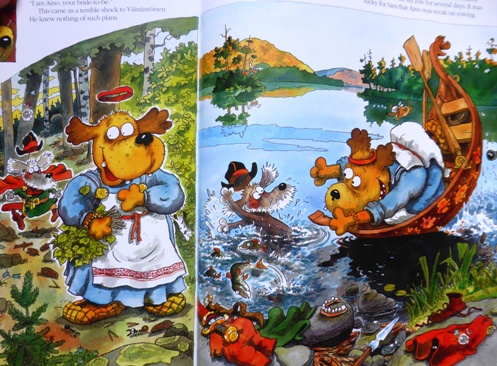
Mauri Kunnas's image of the hero setting off to war in his children's classic The Canine Kalevala is actually used to illustrate another heroic adventure in the Finnish epic, the journey of Lemminkäinen to woo the Maiden of the North, but it's still a brilliant parody of the famous Akseli Gallen-Kallela fresco which I also used as the lead image for Sebastian Scotney's review of a transformative Prom (as my notes were reprinted, it wouldn't have been right to take it for myself).


Because Lemminkäinen's mother is the real heroine of his not terribly heroic tale, there she is in Kunnas's picture trying to stop him setting out. And since this Lemminkäinen is a member of 'a small but tough clan of cats' who live between 'a tribe of wild and woolly dogs' in the land of Kalevala and 'a pack of mean and wicked wolves' in 'the gloomy North', he can't have a wolf as companion, so an old crow takes that place. Why didn't Kunnas tell the Kullervo story? Because a tragic tale of accidental incest followed by the suicides of the siblings would probably be too much for his young audience. Though he doesn't steer clear of Lemminkäinen's gruesome death in the waters of Tuonela and his mother's arrival to bring him back to life. Here's the famous original image


and Kunnas's version. The gormless Swan can just about be seen top left, while the bee is flying in to sting the corpse back into action.


We'll have a couple more of these comparisons at the end, but first I want myself to sing the praises of Sakari Oramo's amazing Proms performance with his own empurpled BBC Symphony Orchestra and nearly 140 male voices from the stunning Polytech Choir of Helsinki singing alongside the BBC Symphony Chorus. I call it 'transformative' because previously I'd had total faith in the second, third and fifth movements of Sibelius's early mythological canvas, but perhaps not the opening call to arms nor the battle. Now I think it's a masterpiece from start to finish. Never have the foreshadowings of  Janáček- whose first great opera Jenůfa was still some years in the future when Kullervo was premiered in 1892 - been more striking in the speech-melodies and especially the scene where Kullervo seduces his sister. Oramo made it all sound fresh, original and gripping, doubling the woodwind parts and making sure every word could be heard from his choir, the Wagnerian lyric-dramatic soprano Johanna Rusanen-Kartano and handsome young baritone Waltteri Torikka, pictured here at a different performance.


I'll keep it general, but I have to show a selection of images from last night's performance at the Lahti Sibelius Festival, because that's where I'm heading shortly - a ceremonial duty at the Tower of London this afternoon kept me in London, more on that in a later post - and because the great Chris Christodoulou wasn't there on Saturday. These pictures, all by Juha Tanhua and uploaded onto Lahti's website with Proms-like swiftness, suggest that it was also a great occasion there too (certainly pics I haven't used of a standing ovation confirm that). The BBC Symphony Chorus men didn't travel to Lahti, but then the hall isn't quite as large as Albert's Colosseum. The Polytech men by themselves still made a huge impression, I'm told.


Sakari with his soloists looks as proud and happy as ever.


One more of the main man. Several of my pals from the BBCSO are in there too.


I ought also to include a picture of BBCSO leader on this occasion Natalie Chee. She's good enough to be a world-class soloist, as we heard last year from her part in Strauss's Suite from Le Bourgeois Gentilhomme, and I think she has what it takes to be a co- rather than just a guest leader.


Roll on the orchestra's 2015-16 season with Mahler 3; before that there's a fascinatingly programmed Nielsen/Ives Prom, and tonight in Lahti they're playing more Sibelius under great but elusive Okko Kamu, whom I see in action on Saturday with the resident orchestra.

Coda: a few more Kunnas parodies: a delicious piss-take of fair Aino pursued by old man Väinämöinen. These are the two panels of the Gallen-Kallela triptych in question:


And here's Kunnas's witty reversal of roles in the central image: Aino pursues the old dog rather than vice-versa.


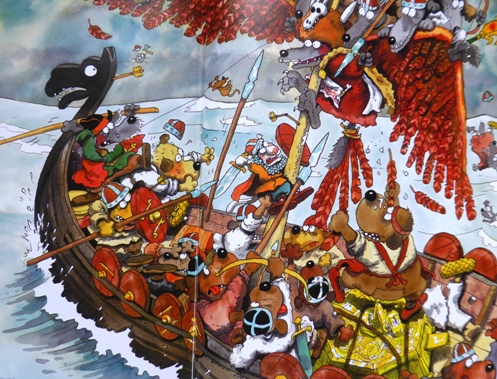
Towards the end of the saga, Väinämöinen and his crew are sailing home with the magical-properties Sampo they forged, gave to the northern folk and stole back when Louhi, crone-queen of the North, attacks them as a giant eagle.


The wolves seem to be in on this one together in The Canine Kalevala.


Still, the Kalevalan heroes all get to live happily ever after, for thanks to the all-providing Sampo, 'all of the heroic dogs' wishes were fulfilled and they were able to bid farewell to 'their wearisome wild and woolly life'. Only the cat Ahti Lemminkäinen, remaining on the outside, manages to aggravate their otherwise calm and overfed lives.

Thursday, 19 April 2012

Chopin list


On the stage of Paris’s Théâtre du Châtelet in June 1909 were Vaslav Nijinsky in a rather unbecoming orangey-blond wig and attendant ethereal creatures including Tamara Karsavina and Alicia Pavlova. Down in the pit the orchestra played the joint creative input of six musical minds, colliding in a pretty mélange of sorts. Since three of them – Chopin, Stravinsky and Glazunov – are to meet in the Royal Ballet’s triple bill of A Month in the Country, A Birthday Offering and Les noces next month, and I needed to knit them together somehow in a programme article, the premiere of Les sylphides seemed like a very good place to start.

Digging out the whys and wherefores made me realize what a complex musical history this more or less plotless ballet, with its romantic poet flanked by long-tutued sylphs, has had. Not only does it tend to be most often performed, when it is performed at all, in Roy Douglas’s arrangement, but since the Russians other orchestrators have included Maurice Ravel in 1914* and Benjamin Britten, in a 1940 effort for an American ballet company sadly lost (and the editors of Britten’s letters must be believed on this, rather than Richard Taruskin, who claims the orchestration to be ‘in current use’. I wish it were).

So I thought as a kind of fridge-magnet memo to self I would attempt as un-drily as I could to list the path to the 1909 Les sylphides. Volume One of Taruskin’s Stravinsky and the Russian Traditions was a huge help, with detail from Lynn Garafola’s Diaghilev’s Ballets Russes.


Glazunov kicked off in 1892 with his orchestral suite Chopiniana, presumably inspired by what Tchaikovsky had done with Mozart piano pieces + the motet ‘Ave verum corpus’ Lisztified in his Suite No. 4. The four pieces in Chopiniana – none of them, note, used in Les sylphides – were the 'Military' Polonaise, Op. 40 No. 1; the Nocturne in F, Op. 15 No. 1; the Mazurka in C sharp minor, Op. 50 No. 3;  and the Tarantelle, Op. 43.


In 1907 Mikhail Fokine – pictured above two years earlier in costume for Paquita – choreographed Chopiniana for the Mariinsky. He asked Glazunov to make an additional orchestration of the C sharp minor Waltz, Op. 64 No. 2 with a bit of the Op. 25 No. 7 Etude to preface it. The waltz did of course survive into the Diaghilev-managed Les sylphides.

Chopiniana the ballet showcased national as well as classical dances – Warsaw ballroom style for the Polonaise, Capri-based folk dance for the Tarantella. That had little in common with Les sylphides. But the music and choreography for Fokine’s second Chopiniana ballet, entitled Grand Pas to Music by Chopin, certainly did. This retained only the C sharp minor Waltz and placed it alongside the six other numbers we know from Les sylphides (I'm getting opus fatigue now, and I'm sure you are, so we'll leave it at that until Stravinsky's contribution pops up).


 When Diaghilev turned to ‘the second Chopiniana’ for his Ballets Russes’ first appearance in the Parisian ‘Saison Russe’ of 1909, he clearly didn’t think much of its arrangements other than Glazunov’s; the rest had been hastily done by a répétiteur at the Mariinsky, Maurice Keller. So Diaghilev turned to Lyadov, Taneyev, Nikolay Tcherepnin and...the 26 year old Igor Stravinsky, who at the beginning of 1909 impressed him with his orchestral showpiece the Scherzo fantastique. I’ve not been able to trace the other arrangements, but Stravinsky’s not especially flavoursome yet historically fascinating versions of the Nocturne in A flat, Op. 32. No. 2 and the Grande Valse brillante, Op. 28 appear in rather poor sound – and with visuals you fortunately don't need to watch – via a performance from Sakari Oramo and the City of Birmingham Symphony Orchestra. Don't ask me why there's a snippet of Beethoven's Fourth Piano Concerto at the start, but don't readjust your sets - it quickly vanishes.


Which provides an excuse very belatedly to congratulate Oramo on his appointment as principal conductor of the BBC Symphony Orchestra, taking up the baton in September. That fabulous Bax/Saariaho/Sibelius concert which was definitely one of the highs of 2011 clearly had its impact - and looking back at the associated blog post, I see there was speculation in the comments about who would take over the reins at the BBCSO. One thing I didn't know at the time was that it was the first occasion on which Oramo had conducted a London orchestra.

And while sounding the BBC note, fullish details of the works at the 2012 Proms (though minus artists) are here on the Arts Desk and here on the BBC Proms website, less easy to take in at once. All I’ll say is that there must be something there to satisfy everyone, and that if another Beethoven symphonies cycle would usually send me diving for cover, the fact that it comes from Barenboim and his West-Eastern Divan Orchestra is a real coup for the world's biggest music festival.

*this added in the light of Shin-ichi Numabe's comment below.

Monday, 31 October 2011

Sibelius's 'Virgin' Symphony?


We’re talking not any of those Kalevala maidens from Luonnotar to Aino, depicted above evading old man Väinämöinen in an early triptych by Sibelius’s friend and contemporary Akseli Gallen-Kallela, but the BVM, no less.

The news was broken to me by that nice BBC man Mark Lowther, bounding up enthusiastically at the interval of Friday night’s concert (which I was reviewing for The Arts Desk, but had been determined to catch under any circumstances). Had I heard what conductor Sakari Oramo had to say about new research on the Sibelius Third Symphony, in which he was about to conduct the BBC Symphony Orchestra? I hadn’t, but Mark gave me the gist and I caught Oramo succinctly mentioning it again in the broadcast between Luonnotar and the symphony.

In short, says Oramo, ‘this music or material of it was originally part of an oratorio project about the Virgin Mary, and you can I think relate to a lot of this music thinking it has a religious – albeit it is a pagan-religious or folk-religious – background, and I think this explains a lot of the chorale textures, it explains the nature of the final hymn.’


Indeed – hurrah for ongoing Finnish scholarship, and how frustrating that unless we master that impossible language, the rest of us are shut out from the more interesting developments until someone like Oramo draws our attention to it. Anyway, that’s enough to justify inclusion of a couple of images from the Barbara altarpiece by the north German Master Francke, which resided in the church in Kalanti from about 1410 to 1883 and is now in Helsinki’s National Museum of Finland.


Not that the news changes the essential character of the symphony, which has the feeling of a journey like the earlier ones in the Lemminkäinen Suite and En Saga. But how difficult to put one’s finger on what makes this music strike so profoundly, apart from its deep-wired structural surprises (what an amazing solution to let the chorale out of the bag in the finale when he does). I found myself in tears minutes into the second movement, which for swathes does little more than oscillate around an intermezzo-like, runic melody. Järvi's Gothenburg performance is one of the few to capture the same sort of inscaped magic.


I’d been in a gloomy mood all week, mostly triggered by ongoing dental surgery, and this lifted me completely as Chailly’s Beethoven on Wednesday couldn’t.


Same goes for Luonnotar, the Finnish creation myth as adapted from the Kalevala, and illustrated above and below by Gallen-Kallela. The depicted stanzas deal with Luonnotar/Ilmatar’s floating on the water and her raising of a knee for a teal to nest on.


From the teal’s egg are fashioned the solid earth, the lofty arch of heaven, the sun (its yolk), the moon (its white) and the stars (its speckled shell). I’ve written enough already in the Arts Desk piece about the BBCSO/Oramo partnership with the wonderful Mrs. O., Anu Komsi, who’s previously dazzled us with twin Piia in Salonen’s Wing on Wing. There’s communication for you. Mattila amid wavescapes will do here (be patient with the opening soundtrack, which fades before the music begins), but Friday night's performance was even more extraordinary, and the communication cried out to be seen as well as heard.


Komsi WAS the Virgin of the Air cast plaintively upon the waters, and earlier she even convinced me that there might be more to Saariaho than what so briefly tickles the ear: here was substance as well as texture. But of course it’s Sibelius who still sounds freshest and continues to give perhaps the greatest spiritual sustenance of any composer I know. I still count those four hours spent last March at his home of Ainola (pictured again below - this of course is where he composed the Third Symphony), prompting four entries starting with this one, as among the most impression-filled of my life. And Sibelius's unflagging genius - the miniatures are as individual as the compressed epics - has come to feel like the strongest of all musical companions through life.