Showing posts with label Santa Lucia. Show all posts

Friday, 23 December 2016

Swanning round the Scandies


Some would argue that Finland isn't strictly part of Scandinavia, but as it seems to be possible to include it, I can add it to a week of visiting embassies or ambassadors also representing Denmark, Norway and Sweden, courtesy of J. I'm not much of a one for too much 'canapes and mingling', a profession for some folk, but the Nordic countries do know how to celebrate Christmas in music as much as food and convivial atmosphere.

I'm not rating them from 1 to 10 as each had something different to offer. Strictly speaking, the event at the Danish Ambassador's residence - I call him Mick because he could have become a rock star and knew Jagger well, his wife Ingrid because she looks like La Bergman - was to augur well for Aarhus as European Capital of Culture next year (I actually missed the proper Christmas bash the following week because of a long and complicated eye test#). The Norwegians boasted a grand Christmas tree - they'd come hotfoot from lighting up the big one in Trafalgar Square -


and tables of sweet delights


as well as the chance to see the pretty lights within from the garden.


Perhaps more important, I met three people for the first time whom I liked a lot.


Ditto at the Finns', where the fish was heavenly.

Inevitably the Swedes has a trump card: the annual Santa Lucia ritual, lovely Swedish carols sung by excellent choristers in candlelight. I experienced it for the first time in Örebro a year ago and wrote a bit about the (rather recent) tradition in the blog entry on that visit.
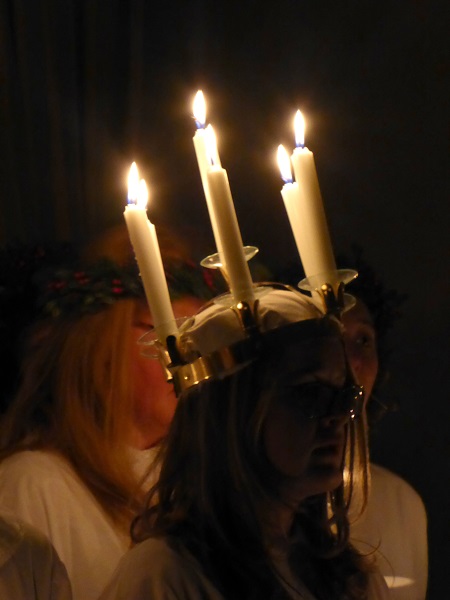

Eventually I succumbed to joining the many pointing their cameras and smartphones at the ensemble and filmed the choir singing "Jul, jul, strålande jul", composed by Edvard Evers in 1921. Unfortunately it's too big a file to be uploaded here. So we'll make do with the pretty visuals.


The Swedish Ambassador's Residence at 21 Portland Place is one of the gems of the Adam brothers' original Georgian designs, with stunning decorative work both on the staircase


and on the ceilings of the main rooms.


Gustavus III , the same assassinated by Anckarstroem in Un ballo in maschera, got the seasonal Swedish getup


and the Christmas tree looks especially handsome below the grand staircase.


One more, this time outside the Richard Rogers restaurant and offices which are my entry-point on my bike to the Thames.


An advantage of neglecting to get out in these short days before the light has begun to fade is catching some spectacular winter sunsets. This one was already well underway when I reached the river


and the bend at Hammersmith revealed an especially fine pink beyond.


Here's a constant wonder of the route, Hammersmith Bridge (by Joseph Bazalgette, an 1887 replacement for the original by Tierney Clark, the same man who designed the Chain Bridge in Budapest)


with ducks


also caught looking back from the bridge to the Harrods Furniture Depository, saved by redevelopment as flats.


Which permits another riverside/sunset diversion, taken the previous Sunday after a very lively gathering at the Hermitage Basin home of the delightful Claudia and Stephen Pritchard. This is their outlook


and just beyond is London Bridge.


Heading east, I retraced steps taken on a Wapping walk with City of London Guide and erstwhile student Julia Kuznecow.


The centrepiece of the Wapping trail is undoubtedly the symmetrical terraces and garden of Pier Head,  once the main maritime entrance of the London Docks (built in 1805).


These were the homes of Dock Company officials, customs officers and merchants; now quite a few celebs live there (someone told me whom last week, and I've immediately forgotten).


Reverting to the day of the big Hammersmith sunset, as I cycled home I suddenly saw the last full moon of the year - still a supermoon - through the trees of Queen's Club Gardens


and in its full glory.


The next night I went out to see it again, and orange was the colour.


As I snapped away, an odd man who thought I was photographing him and stopped to chat told me his theories of how the moon was an illusion, a NASA-dominated conspiracy theory, and how he'd been reading on the internet that the earth was flat. Very Zeitgeisty, and of course the fight back against post-truth online is already under way.

Monday, 28 December 2015

Winter lights in Örebro


Late lunch in the cosiest imaginable cafe of Örebro, Sweden, brought afternoon sunshine on the wall


while only a couple of hours later the sun had set, a colder temperature was finally kicking in after the mild weather and heavy rain of the previous day and the giant straw goat of Swedish tradition, covered in pine branches, glittered by the ice rink in the centre of this extremely likeable town.


I came here two and a half weeks ago to witness the birth of the Swedish Chamber Orchestra's project to twin each of Bach's Brandenburg Concertos with a new work inspired by it; you can read all about that and more on Örebro here on The Arts Desk. It was bad luck for the piece that the next day's recording sessions had been cancelled, and that amiable conductor Thomas Dausgaard was heading to Stockholm on an early train, but lucky for me and an ever curious companion, the delightful Lucy Maxwell Stewart that we had time to explore the delights of what the Swedes call a city but we can only think of as a well-equipped town.


We started off by walking past the concert hall, the pluses and minuses of which in its newly renovated state I've written about on TAD, and to the main church - effectively the cathedral - of Örebro, St-Nicolai. Begun in 1270 in this settlement which was long a valuable trading post, it had a tower added in the 15th century and major 19th century renovations.


Historically it's most famous for the cult of the Swedish rebel Engelbrekt, whose burial place became a site of pilgrimage, discouraged by the removal of his remains to who knows where. Jean-Baptiste Bernadotte, French founder of the current Swedish royal dynasty, was elected here in 1810.


The inside is warm and welcoming, as I've found with every Swedish church I've visited. There are some lively coat-of-arms memorials on the walls, but the chief treasure is the retable of carved saints flanking  paintings of Christ's crucifixion and entombment attributed to the Renaissance German carver Markus Hebbel.


It was given to the church in 1661 and makes a fine backdrop, along with the 19th century east window, to concerts, as we were to find out that evening. Many of you will recognise the Angel Gabriel, designed by a Victorian firm in England, from the upper half I sent as Christmas greetings. Here's his full length


and his solitary position in a north window.


Just as attractive is the Prodigal returning to his father.


Örebro's main square is to the east of the church. The town hall had an attractive digital advent calendar on the go.


Just to the north is the town's most picturesque sight, the castle founded in the 14th century and variously fairy-taled by Duke Carl, later Carl IX, at the end of the 16th and by 19th century romanticisers. Nowt worth seeing inside, I'm told, but the moat and the river Svartån as it rushes through it contribute to the magical external impression.


This reminds me of the rapid waters in Uppsala as punctuating points of Bergman's Fanny and Alexander. Still waiting to see that famous university town, always postponed it because it's so close to Stockholm's  Arlanda Airport by train.

'Old Örebro' in town is simply a courtyard with what might be the town's best restaurant, Kungsgatan 1, where we ate later. But there's much more of that sort of thing a bit further east. A walk in pleasant autumnal-feeling weather


along the Svartån which flows out into huge Lake Hjälmaran


took us to Wadköping, the name nationally-famous Swedish novelist Hjalmar Bergman gave to Örebro. Wadköping is partly like Stockholm's Skansen, and full of tourist-oriented dinky shops, but the buildings all came from the south part of town, thanks to the enterprise of one resident in 1965, and many are lived in, which keeps it all alive. And everything was open on 11 December, lacking only the Christmas market which was clearly happening at weekends since the empty wooden stalls were still waiting for something to happen.


The most impressive of the old buildings is Kungsstugan, King's Lodge, so called because Duke Karl before his royal appointment stayed here several times in the 1580s.


The grass growing on the roof isn't a new design feature; you can see it in late 19th/early 20th century photos (though not this one)


and retains its painted ceiling on the upper level, which you can see on selected occasions.

Next door (here, to the left)


is the house which once belonged to the father of Kajsa Warg, the Swedish Mrs Beeton. Good education for kids to see replica food laid out, but the authentic charm remains in the ceiling decoration here.


In the cafe, 'Kajsa Warg's Must' is to be had at this time of year. Not exactly a must, unfortunately, tasting a bit like cherry Cola, but a seasonal obligation.


To accompany it upstairs in the delightful eatery run by a hostess whose natural charm was typical of all Örebroians we met (and that includes the Syrian newsagent who settled here 26 years ago and was so proud that his son was now teaching at the English-language school), I chose obligatory meatballs with lingonberry sauce - forgive me for doing the boring Facebook thing of putting up the plate of food, but I did the same in Oslo -


and we lingered in these congenial surroundings until dusk. Next door is an olde sweetshoppe, which reminded me a bit of the Terry's Victorian reconstruction in the York Castle Museum, lacking only the latter's enticing smell which has stayed with me ever since I saw it in childhood.


The windowboxes are planted with mini Alpine and heather gardens,


with Wadköping's main street stretching out to the right. It bisects the older wooden buildings typical of the town before the great fire and the bigger new ones (17th-19th centuries), the grandest seen at the end of this alley,


while residents have some enviable dwellings including this one with mistletoe in the porch


and this courtyard.


Darkness had almost fallen by the time we headed back


along the river


where all these buildings are modern blocks of flats, but beguilingly lit in white with an illuminated paper star at each window. These haven't caught on to the same extent in the UK, but I remember them being prevalent in Kerala at this time of year.

We managed to inveigle our way into the university building where an avowedly fascinating natural history collection of stuffed animals hanging over banisters, the Biological Museum, is lodged, but the door to that curiosity was sadly locked.

So back via the now illuminated castle


to a tour of the Konserthuset and a chat with the Swedish Chamber Orchestra's director and animateur Gregor Zubicky, whom I'd met when he gave lively introductory talks at the Stavanger Chamber Festival.


Then a rest, then to the Luciakonsert we'd seen advertised in St-Nicolai. It was a stunner, a programme of 20 variously styled homages to the Sicilian saint so eagerly adopted by Swedes in the 20th century, rendered charming by nearly 100 schoolchildren wearing white with red sashes, holding candles and singing from memory around the chosen Lucia, whose lit-up crown is, of course, the loveliest thing of all. There's a more professional photo to illustrate the TAD article, but this one, which I ventured to take but of course without flash and hence fuzzier, I rather like.


Parents were proud and happy to chat with us, and then we returned to K1, nearly empty only by virtue of this Friday being the time when all employees go out to the conference centre in packs for their office Christmas dinner.

Frost had set in overnight to decorate the station as I waited for the 8.37am train to Stockholm Central, and the sun only just rising.


I missed snapping the flock of swans passing over the train lines, but got one reasonably evocative shot along the way.


So, in absence of the usual longer jaunt at this time of year - it's nice to experience mysa, the Swedish equivalent of the now-trendy Danish word hygge, a form of hunkering-down cosiness - this gave me the most benevolent take on what light means in Scandinavian darkness. You could easily spend more than a day in Örebro during the summer, when we'd certainly have cycled to the lake along the river and gone for a swim. But I'm happy to have experienced something of the real Jul so beautifully Edwardianised in Fanny and Alexander: it's reconciled me to the tawdrier version we have here.