Showing posts with label Denmark. Show all posts

Friday, 23 December 2016

Swanning round the Scandies


Some would argue that Finland isn't strictly part of Scandinavia, but as it seems to be possible to include it, I can add it to a week of visiting embassies or ambassadors also representing Denmark, Norway and Sweden, courtesy of J. I'm not much of a one for too much 'canapes and mingling', a profession for some folk, but the Nordic countries do know how to celebrate Christmas in music as much as food and convivial atmosphere.

I'm not rating them from 1 to 10 as each had something different to offer. Strictly speaking, the event at the Danish Ambassador's residence - I call him Mick because he could have become a rock star and knew Jagger well, his wife Ingrid because she looks like La Bergman - was to augur well for Aarhus as European Capital of Culture next year (I actually missed the proper Christmas bash the following week because of a long and complicated eye test#). The Norwegians boasted a grand Christmas tree - they'd come hotfoot from lighting up the big one in Trafalgar Square -


and tables of sweet delights


as well as the chance to see the pretty lights within from the garden.


Perhaps more important, I met three people for the first time whom I liked a lot.


Ditto at the Finns', where the fish was heavenly.

Inevitably the Swedes has a trump card: the annual Santa Lucia ritual, lovely Swedish carols sung by excellent choristers in candlelight. I experienced it for the first time in Örebro a year ago and wrote a bit about the (rather recent) tradition in the blog entry on that visit.
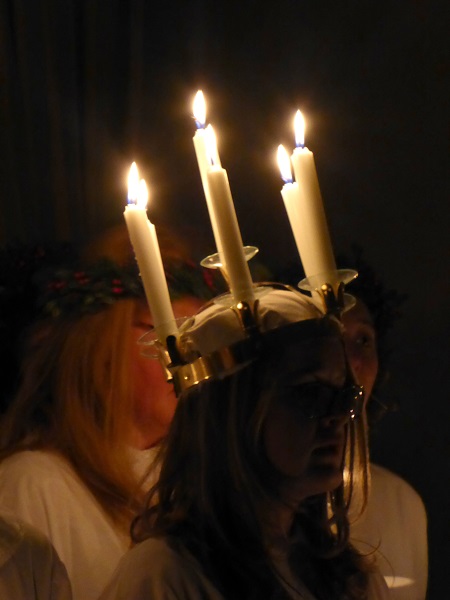

Eventually I succumbed to joining the many pointing their cameras and smartphones at the ensemble and filmed the choir singing "Jul, jul, strålande jul", composed by Edvard Evers in 1921. Unfortunately it's too big a file to be uploaded here. So we'll make do with the pretty visuals.


The Swedish Ambassador's Residence at 21 Portland Place is one of the gems of the Adam brothers' original Georgian designs, with stunning decorative work both on the staircase


and on the ceilings of the main rooms.


Gustavus III , the same assassinated by Anckarstroem in Un ballo in maschera, got the seasonal Swedish getup


and the Christmas tree looks especially handsome below the grand staircase.


One more, this time outside the Richard Rogers restaurant and offices which are my entry-point on my bike to the Thames.


An advantage of neglecting to get out in these short days before the light has begun to fade is catching some spectacular winter sunsets. This one was already well underway when I reached the river


and the bend at Hammersmith revealed an especially fine pink beyond.


Here's a constant wonder of the route, Hammersmith Bridge (by Joseph Bazalgette, an 1887 replacement for the original by Tierney Clark, the same man who designed the Chain Bridge in Budapest)


with ducks


also caught looking back from the bridge to the Harrods Furniture Depository, saved by redevelopment as flats.


Which permits another riverside/sunset diversion, taken the previous Sunday after a very lively gathering at the Hermitage Basin home of the delightful Claudia and Stephen Pritchard. This is their outlook


and just beyond is London Bridge.


Heading east, I retraced steps taken on a Wapping walk with City of London Guide and erstwhile student Julia Kuznecow.


The centrepiece of the Wapping trail is undoubtedly the symmetrical terraces and garden of Pier Head,  once the main maritime entrance of the London Docks (built in 1805).


These were the homes of Dock Company officials, customs officers and merchants; now quite a few celebs live there (someone told me whom last week, and I've immediately forgotten).


Reverting to the day of the big Hammersmith sunset, as I cycled home I suddenly saw the last full moon of the year - still a supermoon - through the trees of Queen's Club Gardens


and in its full glory.


The next night I went out to see it again, and orange was the colour.


As I snapped away, an odd man who thought I was photographing him and stopped to chat told me his theories of how the moon was an illusion, a NASA-dominated conspiracy theory, and how he'd been reading on the internet that the earth was flat. Very Zeitgeisty, and of course the fight back against post-truth online is already under way.

Tuesday, 9 June 2015

Tillykke med fødselsdagen, Carl Nielsen


That's a Danish happy birthday to the mighty and yet oh so human Nielsen, 150 today and, as befits a Gemini, a man of many faces (not just the two). Thanks to the Danish Royal Library via the Embassy for permission to reproduce the photographs here*.


Still ringing in my ears from the last concert in Sakari Oramo's Nielsen symphonies cycle with the BBC Symphony Orchestra, as topsy turvy as Gilbert and Sullivan as well as more profound, the variation finale of the Sixth Symphony strikes me as a quintessentially Geminian endgame. Every mood is here, and Nielsen still can't really decide on what should  have the last word (a burp, or fart, from the two bassoons isn't exactly conclusive). I'm more than ever convinced that this had a huge influence on Shostakovich - above all in the desultory waltz sequence of the Fourth Symphony's finale, not to mention a glock launching another first movement, that of Shostakovich's Fifteenth - also, surely not coincidentally, a symphonic last will and testament.

Anyway, I find myself immensely privileged to be here in Copenhagen on the day, keenly awaiting my first live acquaintance with Saul and David, the most important gap to fill in anniversary or for that matter any year. And last week it was Sibelius melodramas in a stunning programme put together by Leif Ove Andsnes at the Bergen Festival, an even more unrepeatable treat. Tomorrow, off to Funen for house-museums and a concert in Odense (the Vienna Philharmonic under Franz Welser-Möst, not the first name that springs to mind for the fire of the Inextinguishable - they turned their noses up at the Danes' proposal of the Espansiva, more fools they - alongside Sibelius's Four Lemminkäinen Legends). Then back to London on Thursday in time to talk to Vladimir Ashkenazy at 6pm before his all-Sibelius blockbuster with the Philharmonia on the Southbank.


Projects here have an enviable level of funding. This website, along with the associated catalogue put together by the Royal Library complete with full scores to follow, is hugely impressive.  Every letter that Nielsen wrote, and much of what was written to him, has been published in nine volumes to date (one to go, I believe). There will be a two-volume selection in English, translated by my linguistically gifted colleague David Fanning. We know Nielsen was a remarkable writer, thanks to a translation by Reginald Spink - it reads extremely well - of his classic My Childhood (My Funen Childhood, to translate directly from the original title). It's shameful this translation isn't currently in print, but you can probably pick up a second-hand copy. Let me end by quoting from the introduction:

It has often surprised me how little we realise that the moment a child receives a strong impression, one strong enough to remain permanently in the memory, then that child is really a poet, with his own distinctive gift of receiving the impression and reproducing or merely retaining it. Poetic talent, I imagine, is fundamentally the faculty, the gift, of distinctive observation and perception. Thus we have all at one time been poets and artists, each after his manner. The rough way in which life and adults summon the child from its beautiful world of poetry and art to harsh, matter-of-fact reality must, I think, be blamed for the fact that most of us forfeit these talents, with the result that the divine gift of imagination, innate in the child, becomes mere day-dreaming, or is quite lost.

The great poets, philosophers, scientists and artists are only exceptions that prove the rule.

For Danish musicians, Nielsen's special genius is that he kept his childhood simplicity for the extraordinary number of popular songs known and sung by all his countryfolk - albeit unfamiliar outside Denmark - and yet had such radical, unrepeateable visions in his great symphonies, concertos and operas. There's also the question of darkness and depression versus manic energy, but that's a whole other issue for future discussion.

*I learnt only today here in Odense that the series of 'grimasses' were taken in the mid 1880s at a photographic studio far from Nielsen's usual haunts for the benefit of a girlfriend in front of whose family he acted out stories, doing all the voices and faces.