Showing posts with label crested grebe. Show all posts

Thursday, 11 May 2017

Norfolk springtime walk (no churches)


Or rather no interiors, and no pressure to hoof it from church to church as we do every September. This time the wonders were entirely natural: a bluebell wood


and a field full of cowslips


chief among them. We did see one church tower close enough, that of St Mary's Erpingham, but had to turn off up a lane before reaching it. The scene, nevertheless, is one that can't have changed, a bit of wire fencing apart, for centuries.


But before I give more context, I've been owing generous donors a final record of our achievement, and it's a good one - namely £4004 between the four of us (pleasing symmetry) which made All Saints Burnham Thorpe the top fundraiser for the Norfolk Churches Trust in 2016. Many thanks to all who gave. And a bit of shameless self-publicity in that, having won two categories in the photocompetition backed by Cheffins, I reproduce the two pages below from the Eastern Daily Press. The spiderweb framing St Peter and St Paul's Honing I'm pleased with, somewhat more puzzled why they chose the stained glass at St Peter's Ridlington for the detail.


Full context back here.

Our walk with Southrepps-based friend Jill on Bank Holiday Sunday was a delightful and varied circuit around and beyond the Blickling estate. I don't think we've ever walked in Norfolk in the spring, and the greatest pleasure was the light green of the newly-leafing oaks.


The National Trust has maintained the paths around the estate superbly, especially the boardwalks over beautiful marshland.


Part of it should be bright yellow with irises in a couple of weeks' time.


These are wetlands around the lovely river Bure.


Within a short space of time, I clocked four species of butterfly, including a delicate blue, a Brimstone and this Speckled Wood (Pararge aegaria) .


They eventually give way to fields, with the inevitable rape colouring the landscape yellow.


To pinpoint our bluebell wood might be to invite its spoliation - whenever one's identified in the press, everyone flocks to it. This was our first glimpse.


I wish you could hear the intense birdsong and smell the bluebells too.


Coming out of the wood, we took a lane around the edge, again with plenty more splendid oaks


and then a little bunny appeared. From the way it sat there quivering there might have been something wrong with it, but nothing obvious. Anyway, we left it with a question mark


encountering a friendly dog as well as this horse and foal


and then headed towards Erpingham. This is where the church tower led us forward for a bit before we turned left.


No lunch to be had in the pub Jill had planned for our stop - power failure and overbooking, familiar story - so we walked a mile or so further than planned, past a thatched, Dutch-gabled barn at Limetree Farm


to catch some necessary sustenance at Alby Crafts and Gardens. An eccentrically adorned tea room serves good lunch and massive slices of locally made cake.


Here it was that we first heard, then saw the peacocks. And one of the four males faffing around the solitary peahen decided to put on a display.


Reluctantly giving the gardens a miss, we headed back to Erpingham, but by a different route along the lovely Thwaite Common. Then to rejoin the Weavers' Way along what passes for heights in this part of the world, before hitting the cowslip meadow.


We headed back down to the Bure valley


which is very paradisical this side of the Blickling Estate


We eventually re-entered the Estate through a wood leading up to the lake.


I wonder if Henry James had this setting in mind for the outdoor scenes at 'Bly' in The Turn of the Screw. With the now-watery sun it had a faintly sinister feel
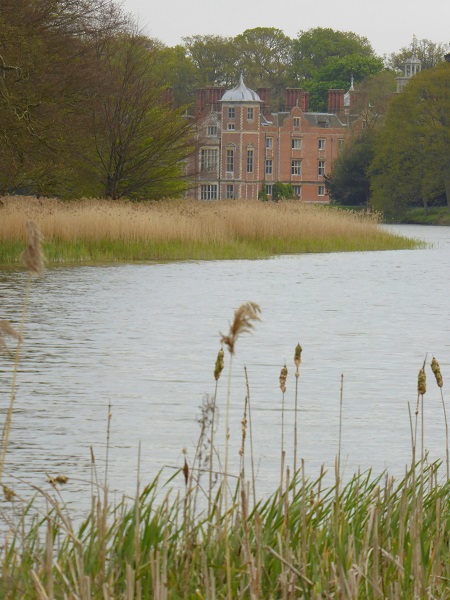

but the waterbird music kept it magical. A crested grebe was leading her brood across the water's surface.


So back to the car and the house, which I visited on a City Lit summer school many moons ago when my beloved Trude Winik was still alive (she took some very lopsided photos in the drive which I still treasure).


Sunday's excursion to see the angel roof of newly restored St Peter and St Paul's Knapton - all scaffolded up and shut down when we visited in September - and then for a fresh crab lunch at the Overstrand shack, followed by a walk along the ever-crumbling cliffs, will have to wait for another instalment. I'm getting bad at keeping my promises of second chapters here these days, but the wonders of Knapton can't be ignored.

Tuesday, 21 March 2017

Under and over the Thames


It started as a very special 'exclusive': an invitation to see the Guildhall School of Music and Drama's sound and video work in the enormous Bascule Chamber of Tower Bridge, 100 steps down beneath the Thames (main installation photos by Paul Cochrane, courtesy of GSMD). The bonus was just as good: a chance to join the tourists and look down from the walkways originally constructed as a Victorian wonder for pedestrians until too many people started throwing themselves off (it's all now very much enclosed, but you still get the views). Rounded off, moreover, by the sexiest machinery I've ever seen: the Industrial Age as a thing of beauty.

Of which Tower Bridge as a whole, constructed between 1886 and 1894 at a cost of £1,500,000, is the best representative I can imagine - and now that I know what it can reveal, I'd make sure any visitor put the paying part of it on a top five list of London sights (the Tower of London, with which I've been mildly obsessed since childhood, has to be number one).The one part the public doesn't usually get to see, other than on one day of the year (I assume during Architecture Open Weekend) or on specially-ordered private tours (which I'd recommend), is the Bascule Chamber, the operational area that houses the massive counterweights lowered when the two bascules are raised to allow big shipping through (which still happens regularly). The two towers clad in stone of Gothic design have a steel frame to support the heavy bascules, each weighing about a thousand tons.


The counterweights, if I remember what we were told correctly, amount to a couple of hundred tons, so it was quite a frisson to think of them, as well as the river water, hovering above our heads once we'd made the descent 'Down the Rabbit Hole', as the first part of the Guildhall School's live and installed work was called. Photos were allowed on the way up, so here are a couple I took, one of the dramatically lit staircases


and another of the big boiler? engine? towards the bottom. Very cold and dank down there. You could feel the temperature dropping as you descended.


The work was carried out by students from the GS's BA in Video Design for Live Performance and BA in Performance and Creative Enterprise degree courses. And a remarkable job they made of the 'happening'. We lucky few sat and donned headphones with a lively collage of music and quotations from films - most of them identifiable - while the images played with the sense of space. Back to Paul Cochrane for the next three pics.


Inevitably they were of variable quality, coming from so many different sources, but made up an imaginative journey which evoked cinematic travels to the centre of the earth with tumbling rocks, rainbows, spinning London landmarks and a projection of the underground map,


underwater sequences and giant faces.


Did the results achieve their stated objective as 'an imaginative and visual transformation of the space'? Absolutely, though it was also good to be allowed to linger and see the brickwork at closer quarters after the adventure.


As I exited, I saw tourists coming out of the lift that runs up one of the towers. and asked if I could go upwards, having been down. The staff couldn't have been more charming: a jovial Welshman escorted me up, and a nice girl I met at the top in the steel-encased upper part of the tower


told me how much she loved working there and watching people's reactions. My own was, why on earth have I never done this before? First I strolled along the east walkway, from which David Piper, in my first and still favourite big guide to London writes how 'the quintessential Thames opens up, the widening waters claim the sky and reject any further construction by bridges'.


The warehouse ghosts he writes of, though, have now been replaced by mostly undistinguished luxury housing all the way to Greenwich - and then, of course, there's Canary Wharf, undreamed of when the book was published in 1964.

Kids loved lying and taking selfies on the glass which gives way to views of the bridge and Thames below (it was half-term week and the hot, stuffy enclosure was rank with schoolroom smells).


And the information is good throughout, though there are rather too many photobooths and naff refreshments machines; whatever it takes to get extra money out of the visitors, I guess.

On the west walkway there's so much to see, familiar and yet not from this height or angle: the City Hall 'Armadillo' and the Shard,


the skyline along to St Paul's and beyond


with zoom shots of Wren's dome


and the Monument, which is higher but still surpassed by this for interest.


And of course, at the end of the walkway, there's the splendid Tower below


with a view of Traitor's Gate that's very unfamiliar


and Billingsgate Fish Market a bit further along.


I descended by the steps until I had to take a lift.


Having had my curiosity piqued by the electric machinery for the bascules which replaced the original in 1976,


I wanted to see the original hydraulic works by Armstrong-Mitchell Ltd, and was very kindly 'connected' to the last stop by another incredibly friendly attendant. I asked him if the employees had been offered a special showing of the Bascular spectacular. They hadn't; I wrote to the management to ask if that could be arranged, but never got a reply. Anyway, the glistening, repainted machinery is all worth seeing just from the aesthetic point of view. As I have no knowledge of what was pumping and turning for what (or would have been, were it still in use), I'll leave it at a parade of images.


It was one of those February days which give promise of spring, and of course the sunset was spectacular as I cycled homewards over Westminster Bridge*


with a Chinese wedding on the other side of the road.


The tourist closest to the bride has the staggered look of the bedraggled lady at the New York socialites arriving at the Met in one of Weegee's most famous images.


I decided to leave the cycle path in Hyde Park and walk with my bike along the Serpentine


where swan activity was strong, but peaceable


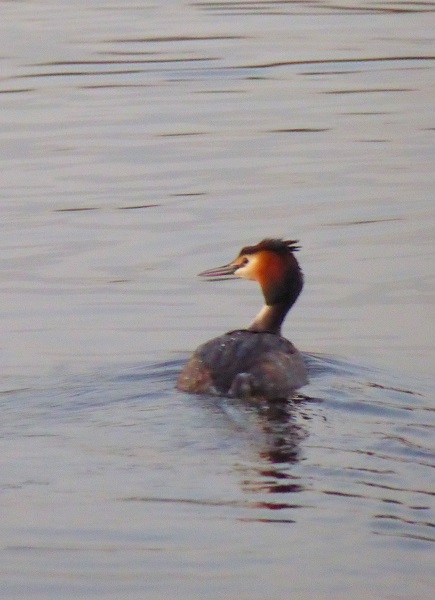
and a solitary Crested Grebe's head caught the last of the sun.


At times like this I enjoy both being a tourist and taking a proprietary pride in my inexhaustible city.

*23/03 Coincidental that I posted this a day before the attack. The last words above hold true more than ever.