Let's be honest, I was wary of devoting even three classes, rather than the usual five, of my Opera in Depth class to Handel's Agrippina. Could I do much more than just play various performances of the arias, touch on the loosely-adapted history? Would I find a good version on film? The answer to both questions, happily, was a sì, certo.

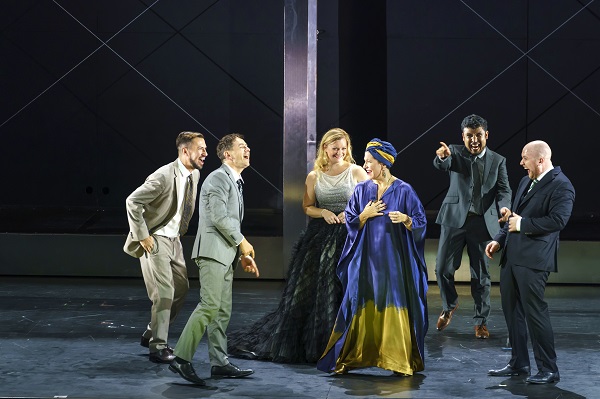
You can't help regretting the sometimes lumbering succession of arias in later Handel operas compared to the dramatic speed and agility with which, for instance, he deals with Agrippina's manipulation of the crowds in Act One or the swift reversal in Ottone's fortunes on the Capitol in Act Two (those three ariettas, albeit called arias, in which the two leading ladies and Nerone in quick succession kick him when he's down, one of the best things about Barrie Kosky's hit and miss Royal Opera production, pictured up top by Bill Cooper with Joyce DiDonato in the title role). This is true music-theatre, partly thanks to Cardinal Grimani's agile libretto: closer to L'incoronazione di Poppea than to a later Handel opera like Ariodante.

Filling its energy rather than overdoing it like Kosky is Robert Carsen's ever-stylish production for the Theater an der Wien (pictured second down), and having got hold of that on DVD I decided in the second class that we'd actually have four, and trim Gluck's Orfeo ed Euridice back by one (making four, four and two - on Weill's Der Silbersee - in a rather unusual term). For screening, I took sequences from each act in the Carsen production - Agrippina's deception of Poppea with Claudius's first visit to the younger woman's bedchamber (Patricia Bardon and Danielle de Niese, amazingly good, Mika Kares as a Berlusconi emperor, pictured below); the desertion of Ottone (countertenor Filippo Mineccia, new to me, is well complemented by Jake Arditt's well-acted, kid-psycho Nero); and the bedroom farce of Act 3. Never thought I'd find myself objecting to cuts and re-ordering, but I missed the arias Carsen axes, and some of the dramatic sequencing.

Aria-wise, there was one top recording to use as a benchmark, orchestrally the liveliest of the lot from John Eliot Gardiner and the English Baroque soloists -

and a good chance to catch great Handel voices, among them Ann Hallenberg, Lorraine Hunt Lieberson, Catherine Robbin (whatever happened to her?), Veronique Gens and Philippe Jaroussky. Most interesting to me were the comparisons to be made with Handel's later adaptations of many of the arias, already drawn from his many Italian cantatas. For these, I'm immensely grateful to Winton Dean and John Merrill Knapp in Handel's Operas 1704-26 (Oxford), providing a table at the back showing just what was re-used where. Admittedly this only got me as far as Rodelinda, but I was already tying myself in knots searching for correspondences. Three are particularly interesting, only one of them, I think, as successful as the original: Agrippina's 'Alma mia', splendid in itself - this is Anna Bonitatibus, vocally splendid at the Grange Festival, though the orchestral support is not ideally well sprung -
only needs a couple of notes turning around as Armida's 'Molto voglio' in Rinaldo (Carsen's durable Glyndebourne schoolroom production, with Brenda Rae - a marvellous Lulu at ENO).
Postscript: listening around, as I often do when I don't want to let a subject go, I found an old LP with Janet Baker singing two of Handel's Italian cantatas, a labour of love between her and the late Raymond Leppard conducting the English Chamber Orchestra. Contrary to his assertion that 'Ah! crudel, nel pianto mio' 'was probably composed in England towards the end of Handel's life', it's one of the many Rome works dating from 1707. And here, in the extended Sinfonia which has very little to do, mood wise, with what follows, is what can safely be said to be the first version of the oboe tune used in the two arias above. With apologies for the artwork, here's that performance on YouTube.
Ottone's aria which marks the high expressive point and lowest ebb of fortune in Agrippina's Act Two, 'Voi che udite', loses the emotional twist of the first oboe so important throughout the opera (was there a master exponent in Venice?) and some of its depth as Teofane's 'Affanni del pensier' in Ottone; while Claudio's 'Io di Roma' - magnificently rethought as a moment where everything turns nasty for Poppea in Carsen's production - is just the right length, but becomes over-extended as Polyphemus's 'Cease to beauty' in Acis and Galatea. Most surprising is that the splendid and seriously underrated chorus-for-the-principals 'Di timpani e trombe' becomes in part Argante's utterly memorable 'Sibillar gli angui d'Aletto' in Rinaldo (so well sung by Gerald Finley on the Hogwood recording).

There's more, but I mustn't regurgitate everything the students got to hear. Gluck should be a very different 18th century experience. Delighted that Ian Page of Classical Opera, whose performance of the trimmed Orfeo for ducal nuptials was fascinating to hear, and Iestyn Davies - Ottone in the Royal Opera Agrippina (pictured above with the equally fabulous Lucy Crowe ar Covent Garden) and Orfeo in a new recording of the Gluck - will be our very special guests on two of the Mondays.


 Posts
Posts