Showing posts with label The Tsar's Bride. Show all posts

Thursday, 14 April 2011

Tsar's Bride preludial


One thing's for sure: the dying heroine of Rimsky-Korsakov's pseudo-historical melodrama in Paul Curran's new production for the Royal Opera, opening tonight, won't be costumed anything like Nadezhda Zabela-Vrubel in the 1899 production at Mamontov's Private Opera. Dare I hazard a guess that the silent role - what the Greeks used to call the kophon prosopon - of Ivan the Terrible might be portrayed by a Putin lookalike in a sharp suit? There'd be a precedent for that in the purpled parody of Yeltsin's embarrassing disco-dance executed by Paata Burchuladze's Tsar Dodon in Zambello's Golden Cockerel. Anyway, it's going to be oligarchs and mafia, I imagine, in sets that will look nothing like the old Bilibin design for Act 4:


No, if that's the sort of thing you want, you can see it done at not quite the highest level in the valiant efforts of the Moscow-based ballet company calling itself Les Saisons Russes du XXI Siecle at the Coli, where on Tuesday our princess even ended up with the sort of wedding headdress envisaged on the frontispiece of my Tsar's Bride vocal score (I don't dare reproduce it again here, but I think they've included a shot in the programme alongside my article). I'm very curious to know whether Curran can make cogent contemporary drama out of a very silly revenge plot.

In the meantime, having seen a perfectly traditional production at the Bolshoy starring a veteran Obraztsova, I know it's not boring and that most of the music presses the right buttons, even while it's not Rimsky in fantastical vein. The overture's a nimble corker, for a start, and I've already waxed lyrical about Borodina and Hvorostovsky in the Act 1 duet. We ought to hear the classic Arkhipova performance of Lyubasha's lovelorn aria:


And here are two clips from the rather good 1966 Russian film, which I was pleased to be able to show the students in a Kultur DVD import. Note that the good-lookers, especially the dishy Gryaznoy, are actors miming to a Svetlanov-conducted soundtrack. First let's have the lovely quartet in Act Two, modelled on a very Beethovenian moment in Glinka's A Life for the Tsar:


And finally the scene of Marfa's poisoned delirium, using the medium of film to create the illusion inherent in the music.


15/4 The results: a bit of a disappointment, though the updating started out pretty well. Full Arts Desk review here - plus a belated glimpse of what we're talking about below, one of Bill Cooper's production shots of Act 4.

Saturday, 12 March 2011

Those Figners


That's the by all accounts outstandingly musical but - on the recorded evidence - not exactly rock-solid tenor Nikolay and his Florence-born wife, Medea Mei-Figner. There they are flanking Tchaikovsky, for whose Queen of Spades they created the roles of Hermann and Lisa (they were also the first Vaudemont and Iolanta).

Why my interest all of a sudden? Because having embarked on Rimsky-Korsakov's vocally rewarding Tsarskaya Nevesta (The Tsar's Bride) with the City Lit students, we were all smitten with the invention as well as the performance of the Act 1 Lyubasha/Gryaznoy duet as sung by Borodina and Hvorostovsky. Of course the descending scales must be indebted to Tchaikovsky's example, but it reminded me of something else, which eventually came to me - Amneris and Radames in Act Three of Verdi's Aida. Checked performances in Russia, and found that not only was Aida first performed at the Mariinsky in the mid-1870s - dates conflict - but that the Figners sang in it together on one of the many revivals.


I'm assuming that the plumptious Medea sang Aida, though since she was trained as a mezzo, it could have been Amneris. On recordings kindly copied for me by the indefatigable Roger Neill, she emerges - in Lisa's midnight aria - with greater honours than her husband, who gets rather amusingly shouty at the end of a number from The Oprichnik. But we're lucky to have these recordings, from 1901, at all. And thanks to Roger, and his friend Roger Beardsley, for another splendid disc I'm listening to at the moment, of great folk and classically-trained singers, from Plevitskaya and Kruszelnicka to Chaliapin and Smirnov in traditional numbers. And here, as I write, is Chaliapin in 'Stenka Razin' - I had no idea that was the original of 'The carnival is over'.


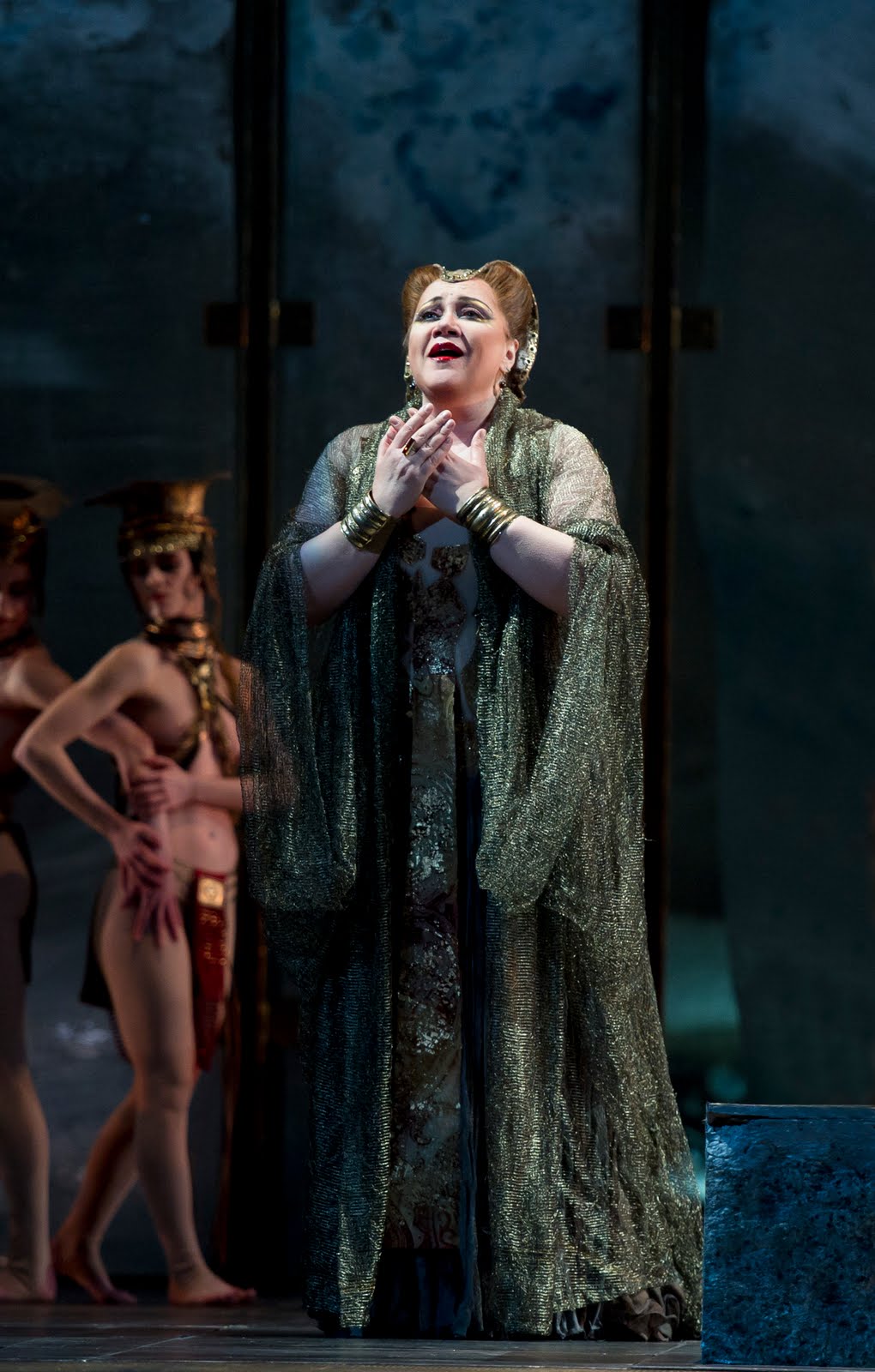
Anyway, The Tsar's Bride (can't resist reproducing again the gorgeous cover of my vocal score) has so much good music tied up in an impossibly melodramatic, why-should-we-care plot. Much like Aida, in fact. And there last night at Covent Garden, in the revival of one of David McVicar's less interesting efforts, was Borodina producing her usual incredible vocal lustre but barely moving. Ditto Alagna - see the Arts Desk review. Here's our stately Amneris, anyway, in the first of two production images for the Royal Opera by Bill Cooper.


You could hardly, on the other hand, blame Liudmyla Monastyrska for doing the bare minimum; she was a last minute replacement for the Aida of Micaela Carosi, who pulled out pleading pregnancy(?). Monastyrska's is a major voice - I haven't had such a thrill from a laser-soprano in an ensemble since Dame Gwyneth, and she can do all the soft stuff too with what seems like a rock-solid technique. That augurs well, as I wrote, not just for her Lady Macbeth, due later this season, but also for a potential Brunnhilde. And when did that last happen? Here she is with Alagna in a visually unatmospheric but musically transporting tomb scene.