Showing posts with label lilac. Show all posts

Wednesday, 24 April 2024

Reclaiming Palestinian gardens in Battersea


The title is somewhat oblique: the gardens in question are those remembered and symbolised by Palestinian weavers in a treasure piece of embroidery which had fallen apart, due, I gather, to too much exposure to the sun. So when I learned through my friend Cally that a work colleague of her godson Sasha (wonderful human being) had set up a collaboration with traditional weavers in Beirut - where both of them lived and worked for a time I jumped at the chance of a repare. Back in November Cal and I went along to see Larissa von Planta showing her work and taking commissions on the top floor of a gallery in Dean Street. Most of the commissions were to add embroidery to existing garments, but Larissa was very much 'can do' re the cushion cover.

She was impressed with the provenance, Al-Inaash, known as the finest in Lebanon. We'd bought the design at a gathering with the Beirut Ladies Who Lunch, and having paid very little for fine Syrian work, were a bit taken aback by the price. But I'm glad we went for it. Larissa guaranteed to have the repair back from Beirut before Christmas - it was going to be a surprise present for J - but, as she later told me, wasn't satisfied with the work, sent it back and then did further work on the detail in London. She wouldn't take any more money for the extra labour. And I got to visit her in a part of London I didn't know, the area around Battersea Square. There's a splendid Dicksonia antarctica in her garden whiich formed a suitable backdrop to the presentation.

I decided to take the afternoon off and explore the area. So I took a bus down to the south side of Wandsworth Bridge and walked along the Thames Path from there (not a stretch I've done before). Even the unwieldy roundabout has had some rather splendid muralling, which includes a cubist version of my favourite bird, the goldfinch.

The luxury flats, despite their colourful names referencing the spice warehouses which had been here before, are characterless, and to judge from the folk walking along there, house Eurotrash/drugs trade folk when there's anyone there at all. But at least something has been done to reclam nature on the river side of the path

and there are plenty of unafraid ducks about.

A helicopter was coming in to land - noisy, expensive brute - which made me realise the heliport is on this side of the river. Quite a few folk had gathered to gape through the fence at whichever celebrity was landing; I moved on, enjoying the sem-glimpse from the north side

and various bridge views to offset the general tedium of the architecture. 


At last I came in sight of St Mary's, Battersea Parish Church, a place apart.


on a site occupied by a religious building as early as 800. Westminster Abbey was granted ownership and, the guidebook tells me, 'devoted the revenues from "Batricescie" to the support of the Convent Infirmary'. The present church of 1775-7 is more or less what we see now, and though there are many additions inside, not least since WW2 bombing, harmony rules.


The oldest glass is in the east window, its framework imitating the pointed opening of 1379. The panels painted by Bernard van Linge were inserted in 1631 by Sir John St John on his succession to the Lordship of the Manor. Pompously, it outlines his 'ancient and noble descent', with Henry VII, Margaret Beauchamp and Queen Elizabeth I marking connections to the House of Tudor.

To the left is a circular window with the holy Lamb, one of two made by James Pearson in 1796 (the Dove window's fragments were collected and added to new painting by Joan Howson in 1946).

Most interesting, perhaps, not least for the church's links to the great and good, are the four windows added between 1976 and 1982, designed and made by John Hayward of Edenbridge, Kent. If you walk clockwise, the first is to J M W Turner, who lived opposite for a time and took a boat over to the church to paint from there.

The church and the river feature in the bottom right hand corner. 

Next along celebrates the wedding in the church of William Blake and Catherine Butcher (featured in the double portrait bottom left).

The detail here is especially fine in referencing Blake's art and poetry (though of course it doesn't quote the 'signs of weakness, signs of woe' he detected on the London scene.

Less well known to me are military man Benedict Arnold, of dubious fame (I'll pass over him) and the botanist William Curtis, framed with a chapter of flowers from his book Flora Londoniensis.

To the left are the arms of the Society of Apothecaries, which can also be seen on the other side of the river atop the south gate of the Chelsea Physic Garden. It shows Apollo, the god of healing, victorious over the serpent of disease (I framed a postcard of it for a friend in hospital several years ago). The rhino is not so sound a symbol, given the mumbo-jumbo about its horn containing healing properties.

After coffee with Larissa and friend in nearby Battersea Square, I resumed my river walk. The modern build-up continues, but at least there's still a glimpse of Lots Road Power Station, whatever it's used for now, between the high-rises

and the slightly more distinguished new edifices on the south side are used for enticing-looking offices, one clearly for a firm of architects.


Familiar territory came into view beyond Battersea Bridge

and then I was back in the park, full of spring planting (looking across here to Albert Bridge).

The English Garden, never over-frequented, is getting better by the year. It's still early, but irises are flourishing,

the first pulsatilla I've seen in flower this year at the end of the pond,


 and a lilac, with peonies growing up fast.

More lilacs and others around the London Peace Pagoda (the dog was delightfully lively).


I always enjoy catching a sight of the ring-tailed lemurs through the fences of the Children's Zoo.

Then out past fern plantation

and over Chelsea Bridge, with Battersea Power Station - now a mecca of mammon - on one side and louring clouds on the other.


Finally on the north side, with plenty of spring foliage in front of Chelsea Hospital,

and up to Sloane Square tube. The kind of afternoon that keeps me in love with London.

Saturday, 15 April 2017

Easter interstitial


So here we are still in London, and not in Norfolk as planned - J has a cold. No matter; it's good to be at home after a week of rushing around Europe. And I always love the reflective period before Easter itself. Very happy, in looking for images to accompany my review of the Dvořák Requiem on Thursday, to have rediscovered a masterpiece which stunned me when we spent Christmas in Prague back in 1990, the altarpiece from the Vyšší Brod Monastery. My Czech friend Jan reminded me of it in sending a postcard of the above, taken from the depiction of Christ in the garden of Gethsemane.


The mourners at the cross are expressive, too.


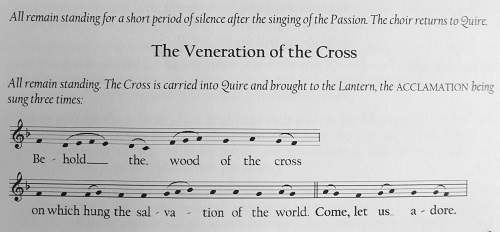
We spent an hour and a half of contemplation on that theme yesterday afternoon in Westminster Abbey. Our dear Spanish friend María Jesús wanted to meet up, and though I fear we let her in for a longer ritual than any of us had expected, I hope she found it a treat. Anyway, we did get to chat over tea afterwards. That's Giotto's great crucifixion on the order of service cover, of course.


Certainly it was surprising to find that the congregation queueing and then packed in around the central tower didn't consist of casual tourists, but a plethora of believers (among which I do not count myself, however much I take from the Passion narrative). Indeed, the number of folk wanting to venerate the cross meant the whole service took much longer than expected (the Communion was more streamlined, with priests serving both aisles). Never come across this business before - nor has J, with his Catholic upbringing - and found it all a bit mumbo-jumbo-y, but then I guess so are the rituals which I've grown up with since I was a choirboy, and I say the Creed without a second thought.


The order of service cannily embraced a diversity of styles and nations - plainsong, Lutheran and Anglican hymns, and composers Spanish (Victoria - the central St John Passion, in which 'composition' is not much present, but it was splendidly delivered by two tenors, bass and choir), Italian (Lotti) and Austrian (Bruckner). Much as I love anthems like Locus iste, which we sang at Stephen Johnson's and Kate Jones's wedding, I blush to say I didn't know the latter's Christus factus est, and it's a masterpiece, covering so much of the composer's mature style in such a short span. The Westminster Abbey Choir sang it with magnificent fervour in the climaxes. Here it is performed by, of all things, a Japanese high school choir, and very well, though you need to look away from the gurning individual among the boy-men...


Some of the details in John 18 and 19 took me by surprise. Hadn't realised, for instance, that Pontius Pilate did what he could to avert the sacrifice. And this I love: 'When Jesus saw his mother and the disciple whom he loved standing beside her, he said to his mother: "Woman, here is your son." Then he said to the disciple: "Here is your mother". And from that hour the disciple took her into his own home.'

On which note, there's a marvellous poem on the Stabat Mater theme by Joseph Brodsky in his Nature morte. I came across it as the third of Estonian-based, Ukrainian-born composer Galina Grigorjeva's settings gathered together under the same name. It was high time I listened to the disc by the Estonian Philharmonic Chamber Choir which had been sitting here for too long. Grigorjeva calls the poem 'Who are you,' and here it is.

Mary now speaks to Christ:
'Are you my son? - or God?
You are nailed to the cross.
Where lies my homeward road?

'Can I pass through my gate
not having understood:
Are you dead? - or alive?
Are you my son? - or God?'

Christ speaks to her in turn:

'Whether dead or alive,
woman, it's all the same - 
son or God, I am thine.'

Alas, this setting isn't available on YouTube, but there's a marvellous film there which includes the second setting, 'The Butterfly,' remarkable especially for capturing Grigorjeva's spirit as she talks to the choir about it. I'm waiting for her score of the new and remarkable Vespers I heard premiered in the Niguliste (Church-)Museum last week by the stupendous Vox Clamantis choir. She sent me a very polite email saying she couldn't send it or hand it over just yet because she'd noticed some mistakes. A composer of obvious and rare integrity.


Finally, a few more seasonal flora shots from the cycle home after the service yesterday - tulips in the meadow arrangement in front of Clarence House


and wisteria backed by white lilac - both out already - in Launceston Place, the magical street which runs parallel to Gloucester Road.


Wednesday, 7 July 2010

Holy German art


Yes, that would certainly include - and right at the top of the list alongside Wagner - Gustav Mahler, whose 150th birthday we celebrate today (and I still haven't got to the omphalos, Jihlava).* As Paul Steinberg's brilliant dropcloth for Richard Jones's still simmering-in-the-mind production of Wagner's Meistersinger left us in no doubt, 'heilige Deutsche kunst' extends from Bach and Beethoven to Brecht and Bausch, embracing all German-speaking 'imaginers', as Jones calls them. You can enter the Welsh National Opera competition to guess (or know) all the faces in the collage by e-mailing the answers to marketing@wno.org.uk or post them to WNO. As the above photo seems to be cropped you'll need to get hold of the original postcard. And I confess I still haven't by any means sussed them all.

Great Jones, only visionary of our British theatre (as I keep saying, and I mean it), came to talk to me and the students on Monday. He raised so many interesting points I hadn't even thought of, and here's no place to ennumerate them, but I will add that he told us - in response to one of many articulate questions from my bunch, of whom I was inordinately proud - how a couple of German intendants who came to see the show found this all-inclusive perceived 'apology' for Wagner's definition harder to swallow than we Brits. While we heave a sigh of relief and say, at last we've moved on from the Wagner-and-the-Nazis question, they still seem to be mired in it, perhaps because they haven't been able to discuss it in their own art properly until recently. And then what do you get? Stodgy, trad films like Downfall. Hate to sound superior, because it's their issue, but they still have some way to go.

Had to raise the old 'is Flieder lilac or elder' question again. Richard didn't face it directly, but by talking of the heady sex-magic - my phrase, not his - which the scent seems to work on Sachs, he would seem to incline to the elder-as-aphrodisiac theory. Anyway, having been in enchanted Visby, I can tell you that Sweden, or at least Gotland, is a place where lilac and elder DO flower simultaneously around midsummer; everywhere else, including Nuremberg, lilac is over. But here's the ocular proof:


My thanks to the quietly brilliant Jan Brachmann for drawing my attention to the lilac as I walked around Visby in a bit of a daze.

Can anyone identify this plant, another heady smeller, high on the hill above the Baltic?


I reckon Visby would make a marvellous setting for an outdoor production of Meistersinger, moving from venue to venue. We could start in the Domkyrkan (seen behind the elder in the first picture) - though the modern glass might be a bit of a problem - and move on to Transhusgatan near the botanics for Act 2. No linden is close to hand, but I do think Magdalena-as-Eva could appear at this rose-flanked window.


Then it would be out on to the flowery heath for the final pageant.

And if you want to celebrate Mahler's birthday, what better way to do it than to watch what is bound to be the deepest, most meaningful First Symphony, a just-released DVD of last summer's Lucerne Festival/Abbado performance. Better not enlarge on it now, since my BBC Music Magazine review hasn't yet appeared, but I'll just say, buy it and watch it over and over: you won't regret it.


The third in the great triumvirate, Richard Strauss, also deserves a mention. I hadn't intended to see the revival of David McVicar's very bloody, Salo-esque Salome, but as I was talking before it last night and the Arts Desk hadn't covered it in my absence, I went on to the show after my half-hour Linbury 'performance', and marvelled, as with the ENO Tosca, how a great performance makes you respect the score as the real mover and shaker. Angela Denoke redeemed the tonally awful Nadja Michael performance from the first run, too. More over on The Arts Desk.

Led me to think of all the Salomes I've seen. In a crude nutshell, the ones I can call to mind are: Behrens (goddess), Barstow (goddawful), Tierney (not bad at all), Barker (vocally lustrous, good acting too), Some American in Wales (forgettable, but did bring a bit of tenderness to the final scene), Ewing (dreadful), Gwyneth (vocally tops, acting less good), Malfitano (squally, bit wild in the acting too), Michael (vocally the pits). And now Denoke (almost as good as Behrens, not quite, but probably the most detailed characterisation I've seen).

Finally, on a sobering note, my NBB (New Best Blogfriend) Minnie reminded me in the most eloquent way possible that today may be Mahlerday, but it's also an occasion of sober commemoration. Her focused anger is, at least in my opinion, fully justified. Do take time to read what she has to say.

*but hang on - is it just me or is Mahler really missing from that assemblage of just about all Austro-German greats? Unmoeglich!