Sunday, 31 January 2021

60 days of London autumn: 3 - November


No apologies needed for lingering in 2020. As we head towards the first anniversary of lockdown, a full year in London nature needs chronicling, if only for my own satisfaction. This post shines a special light on the London Wetlands Centre, my then -new escape but now closed until further notice now that we're in Tier 4 (Kew Gardens has been the weekly excursion of choice on big-day-out Fridays in January).

First, though, one of the rare escapes, and of course that isn't London at all but country-house opera with an umbilical cord to the capital. First time I've been to Glyndebourne for ages to find it wet and grey and deepest Sussex, but there was still something beautiful about it. As I gave myself lots of time to get to Lewes owing to rail disruption and bus replacements, I was able to stroll up and down the hill, have a coffee and late lunch in a super new cafe on the high street, and see a few things I'd never noticed before, like the 15th century gateway which is all that survives of the Grey Friars Monastery near All Saints Church (it seems to have been relocated, but it leads to some planting which complements it beautifully.

At Glyndebourne, where I was to see a superbly-cast 90-minute version of Mozart's The Magic Flute (worth the trip), the grey was offset by autumn colours and a few floral survivors, dahlias included.

Purple-flowering sage is another late-autumn survivor, and there was plenty of it on the sides of the walk alongside the house.

The lake is always magical, come rain or shine,

and some of the lilies were still thriving.

So to the LWC, and a first acquaintance with the 'Wetlands of the World' zone, taking the path straight ahead once through the entrance rather than to the right which leads to the biggest of the two 'wild sides'. So happy to see the Barnacle geese I met everywhere in Svalbard - I gather they were a starting point for Peter Scott's big project. They share the tundra zone with the beautifully variegated Red-breasted geese and high-couture Emperor geese (though I haven't seen those there recently).

Further on are sea-ducks stranded inland: unquestionably the most fascinating are the hooded mergansers, which also makes comical noises as distinctive as the eider ducks.

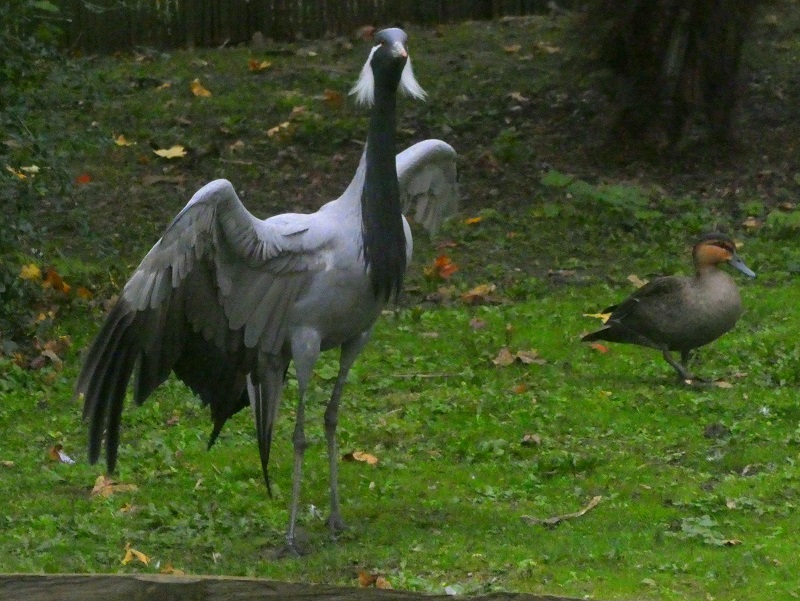
The demoiselle crane I saw out on the marshes in October seems to be a denizen of the next zone - wonder how it got so far, since I think all these 'zoo' birds have their wings clipped.
The ones with whom I like most to converse - yes, I'm becoming a weird old twitcher, or so people must think as they pass me at the LWC - are the whistlers in the Brazilian Pantanal zone, appropriately planted. 

The fulvous whistlers tend to hang out in threes and come close to inspect

and they also whistle to the most adorable of all, the white-faced whistling ducks

whose back plumage is so intricate

and who hang around in packs, coming up to you whistling and eventually waddling away. The albino-ish one seems to be tolerated, but not much associated with.

Potentially more formidable a noise-maker is the southern screamer, but I've not heard it resound; still fascinating to look at, though,

and especially so in autumnal reflection.

Out on the 'wild side', wigeon have arrived to graze and swim in large numbers

The landscape here, all planted (with the exception of the larger trees, I'm guessing) from 1995 onwards, looks like parts of Norfolk and Suffolk; only the high-rises in the distance, not visible in these shots, give the game away.

At this point the hides were still open. I was lucky to share one - at a good distance and masked. of course - with an expert observer, all set up with better camera equipment than mine, and he pointed out a bittern among the reeds opposite. This is as good as I could do, mere proof that I could see it (to the right of the mallard duck).

And then the first of many great sunsets caught here over two months began, and it was time to leave.

On 5 November London went into a one-month lockdown. So lucky, then, that the previous day offered two live musical events, both wonderful. Sophie, former Queen of Djenne, joined me for another City of London Sinfonia special in Southwark Cathedral in the afternoon.

The idea, and you can read more about it in the review linked to above, was to build towards a bracing performance of Haydn's Symphony No. 104, and it began with a walkabout to hear various CLS musicians playing their music.

Afterwards we even found a well-distanced table just inside the door at the Borough Market branch of Brindisa, and then parted company as the late afternoon sun shone on the cathedral tower.

I had hours to pass before the evening event - a predictably outstanding performance by Imogen Cooper of Beethoven's Diabelli Variations, the last before the Fidelio Orchestra Cafe had to shut (heavenly Imogen is due back in April). Headed first east along the river, with pink clouds above the Tower  opposite

as well as Tower Bridge further along.

Spent a happy time reading - what? I forget now - in the spacious depths of Fuckoffee (!), BoBo (Bohemian Bourgeois) hang out in trendy Bermondsey High Street, which I love nevertheless,

especially for the branches of my favourite commercial gallery, Eames Fine Art, which keeps up a good online show while currently closed.

Then back along the river, past Shakespeare's Globe, which I missed so much last year, and which has the nice quotation 'if we meet again, why, we shall smile' with the 'if' crossed out and replaced by 'when',

and across the 'wobbly bridge' to make my way up to the Fidelio Orchestra Cafe in Farringdon.


 Nature soon compensated for the new shutdown. Friday 6 was a mackerel sky day - outside the bedroom window in the morning

and persisting above Old Brompton Cemetery's imitation of St Peter's Piazza as I cycled south.

The light was perfect for autumn colours: copper beech above my favourite 'patience on a monument'

and, down by the embankment at Cheyne Walk, casting floral shadows on one-time resident Vaughan Williams.

Battersea Park, my most consistent new attachment of 2020, was shown at its autumnal best.

The English Garden, closed during the first lockdown, also shone and glowed, the gingko in the centre its star attraction,

while roses still bloomed in the shadows,

papyrus enhanced reflections in the pond


and spent artichoke flowers foregrounded autumnal yellows

I've found my way around the paths that cross the various outlets of the main lake, which must be the biggest in any London park. Each seeming creek has its own identity. Deciduous conifers, easily seen in the main central spaces looking across to Battersea Power Station

 inform this one

while a greener shade persisted here.

At last I found my way round to the rockery which you can see from the main cycle path round the edge of the park. A chimney of the former industrial cathedral reflected in the water:

and one of two great crested grebes gliding gracefully back and forth (and not diving as frequently as the one I kept trying to capture on the Serpentine.


 Feeding frenzy with young swans and seagulls round the corner

while other birds were more aloof. Here's an alternating pattern in a tribe of mandarin ducks (they like trees, apparently, and this group emerged from one, colourful men and their less brilliant but still nicely marked ladies waiting to take the plunge)

and the irresistible plumage on one handsome chap

contrasting with the ever-still and aloof heron

I made my way back via the Peace Pagoda at sunset

across Albert Bridge

to home on the north side of the Thames. Back to Chiswick House and Gardens the following day - still beautiful, though it's more a spring and summer place. The house near the next sunset

and still-vivid planting, entirely of purple-flowering sage, either side of the central avenue leading to the camellia glasshouse.

The Ionic Temple of 1726 from the pathway (part of my usual circuit - I walk around with the bike in an anti-clockwise direction)

and, crossing the humpbacked bridge,

from the other side of the lake,

The route back: roses still blooming in one of the gardens separated from the houses of Chiswick Mall, recently subject to the highest waters I've seen.

Return to the wetlands, 13 November: just one shot of the channel that leads to the mere. With all the hides shut, the main lakes couldn't be seen unless you stood on a bench near the Peacock Tower. But still a walk on the wild side without much spectacular birdlife was a joy.

And that takes us just over the 60-day mark, which means I still have the rest of the year to cover. But maybe I'll go easier on that, and select a few aspects both of the wetlands in winter and Kew over three January Fridays.

Wednesday, 20 January 2021

2020 reading

Out of the new books last year, I got to review Hilary Mantel's The Mirror & the Light and Elena Ferrante's The Lying Life of Adults for The Arts Desk, and found, as usual, that neither novelist disappoints; the standards of both are too high for them ever to lower the bar (so far, and I can't see that changing). Since this retrospective also admits discoveries of other masterpieces that have been around for longer, I can plunge in with the most inspiring book I read in 2020: Isabella Tree's Wilding.

I long for the time when we can get down to Sussex and see what Tree and her husband. Charlie Burrell, have achieved on the Knepp estate, partly by process of trial and error and with a great deal of input from eco-experts (which of course these two have now become; but they were also able to benefit from DEFRA when it had funding from the EU for arable reversion, and from EU reform of the Common Agricultural Policy). First stage was restoration of the Repton landscape, and then the realisation that primeval Britain was far from all woodland - that much of it was grazed meadows and scrub, or 'wood pasture' - hazel, birch and above all oak need much direct light to thrive and cannot regenerate under a closed canopy.

I love Tree's descriptions of unforeseen consequences - the way one part of nature helps another in ways unanticipated, like the consequences of taking on Tamworth pigs: 

ants began to use the clods of earth turned over by the pigs to kickstart anthills that have grown, in some places, over a foot in eight years - their colonies thriving in micro-climates of sun-warmed, aerated soil, The anthills, in turn, attract mistle thrushes and wheatearers, and especially green woodpeckers, whose diet, particularly in the winter, can consist of as much as 80 per cent grassland ants....The pigs were having an impact on vegetation, too. They have a penchant for plants that other grazers cannot find or stomach, like the stubborn, subterranean roots of docks and spear thistles. Unlike other ungulates they can also eat bracken and its rhizomes, neutralizing the toxins and carcinogens in their gut.

Not using fungicides and pesticides had a knock-on effect on rare bats, new species of moths, even new bugs in cowpats and horse-dung. Purple Emperor butterflies (one was seen in Richmond Park and photographed by Sherry Pentek - photo above on the Friends of Richmond Park website) thrived on unpopular sallows. Nightingales increased and turtle doves returned.

Bird points out the failure of British conservation in focusing too much on the preservation of a single species, which may well return of its own accord to a more diverse ecosystem. 'Rewilding the Soil' is a specially fascinating chapter, with a wonderful epigraph from a Sanskrit scripture of c. 1200 BC: 'Upon this handful of soil our survival depends. Husband it and it will grow our food, our fuel and our shelter, and surround us with beauty. Abuse it, and the soil will collapse and die, taking humanity with it'. Bird adds later in the chapter 'The great concerns of our time - climate change, natural resources, food production, water control and conservation, and human health - all boild down to the condition of the soil'.


Bird's is a mostly optimistic book. Naomi Klein's On Fire is more horror than hope, but culminates in potential optimism, as its subtitle intimates: 'The Burning Case for a Green New Deal'. The new 2020 foreword even covers the relationship of Covid-19 to all this. The book takes a journey through earth-shattering as well as hopeful events over decades, many of which I didn't know about. The chapter titled 'A Radical Vatican?' shows how Pope Francis's attempted shift in thinking from the 'other life is better, don't worry about this one' anthropocentrism which starts with the flaws in Genesis (that God created the world for man to dominate) to treating the earth as 'sister, mother' inculcated by his namesake; Klein calls his move 'an evangelism of ecology'. 

Her own diary of how the 'summer of smoke' affected her family rams things powerfully home in the dark flipside again. The ultimate message reinforces Gandhi's assertion that 'there is enough in the world for everybody's need, but not for everybody's greed' - though fleshed out in chapter and verse of how saving the planet might be achieved. I'm indebted above all to Klein for pointing me in the direction of this wonderful seven-minute film by the artist Molly Crabapple projecting the aims of the Green New Deal into the future. It's co-written by the already great Alexandria Ocasio-Cortez (whose cartoon double appears in it) and Klein's husband Avi Lewis. A little masterpiece, Please watch all of it - I find it especially apt today (though unfortunately Biden shows no signs as yet of following the GND).

Prescient aspects of ecology appear in the four novels of Willa Cather I referred to in my necessarily brief and slanted survey of my discovery (thanks to Alex Ross in his flawed but fascinating Wagnerism, like it or not a book of the year, for devoting so many pages to this great writer). The journey continues, and I was hoping to have finished Hermione Lee's so-called biography of Cather (A Life Saved Up) by now. Lee is a wonderfully informed and enthusiastic writer, but the volume offers more detailed literary criticism of each work than biographical detail (the two are inextricably linked in all the Cather novels I've read). That also involves plot spoilers, so I've come to a temporary halt as she deals with The Professor's House and the shorter books (novellas?) either side of it, A Lost Lady and My Mortal Enemy), having already paused to finish One of Ours.

Each of Cather's novels inhabits a different world, and the contradictions in her extraordinary personality find their way into most of the main characters. One of Ours is no exception. The protagonist isn't even especially likeable, and Cather seems to have had some contempt for the lost farmboy on whom she partly bases Claude Wheeler. It's depressing that as a woman she came in for so much stick from so many male novelists and critics: when they imply - quite wrongly - that she glorifies war (a classic case of confusing the author with her creation), they suggest it's really man's stuff and/or that she can have no idea what the trenches were like. 

Well, she did her research, and as I wasn't there, I can't say. But it all comes across evocatively in description, as does every territory she captures. And Lee doesn't seem to pick up on the romantic aspect of homoeroticism implied in the first meaningful relationship Claude strikes up, with a young violinist at the front (this character, too, had a real-life model). I'm getting aspects of that in The Professor's House, too: fascinating that a lesbian writer, so guarded about that aspect of her personality, sees male bonding in a similar, if still coded light.

The world of Victor Serge's Memoirs of a Revolutionary is mostly male, and mostly impersonal in the sense that his private life, and his relationship with his first and second wives, play very little part in the autobiography. What a figure of uncompromising honesty, though, and what a perspective. Born Viktor Lvovich Kibachich to Russian political exiles in Belgium, he was first involved with Anarchist movements in France and Spain before heading for Russia in 1919 (pictured below with Rirette Maitrejean, his first wife, in 1913, at the time of the trial of the 'anarchist bandits' which led to his first spell in prison).

He saw at first hand, and with unflinching clarity, how even as early as 1920-1 with the complexities around the Kronstadt uprising, 'emergent totalitarianism had gone halfway to crushing us.' Fiercely against the death penalty, he saw with horror as a representative of various Internationals how the former revolutionaries turned on each other and how the executions flowed, how truth lost out to orthodoxy, how 'relief and salvation must come from the West,' in its support of the Russians.

That took him back to western Europe in what he calls the 'dark crossroads' of 1922-6. Then he headed back to what he always felt as the motherland, only to find young Communists committing suicide in droves and increasing persecution of the Mensheviks. Literature became official, royalties only possible if you toed the line. 1928-33 he marks out as the 

years of resistance waged by a solitary man - surrounded by his family, that is to say by weak creatures - against the relentless, overwhelming pressure of a totalitarian system. For his daily bread, his ration card, his lodging, his fuel in the harsh Russian winter, the individual is dependent on the Party-State, against which he is totally defenceless. And he who, in the name of freedom of opinion, stands out against the Party-State, bears the brand of 'suspect' wherever he goes. The small amount of liberty that he has left, and even his own courage (which seems quite mad), stand for him as a source of astonishment, mingled with anxiety.

Still he persisted, writing the only literature he regarded as of any value, 'free and disinterested, which is to say devoid of any market preoccupations [at that point in that place, the latter type would be called 'proletarian literature']). He was lucky: he had a name in France, and was able to smuggle out manuscripts which would never have stood a chance of being published in the Soviet Union. 

In February 1933 he was the first to define the Soviet state as a totalitarian state'. He did so in a document where he declared he would remain a dissident on three essential points which he defines in detail: 'defence of man', 'defence of the truth' and 'defence of thought' The letter reached Paris, and he was immediately arrested. Not for the first time in his life, he found himself in prison, but this time as one of the disappeared; only his French connections got him out in the nick of time, in 1936. 

His subsequent life in Europe and finally in South America (pictured above with Wolfgang Paalen in the artist's studio in Mexico in 1942) was one of disillusionment; he died impecunious in Mexico City in November 1947. What a legacy he left behind, though: not only this unflinching autobiography but many novels which I have it on good authority are first-rate; I shall find out for myself when I get round to reading what is supposed to be THE novel about Stalin's Purges, The Case of Comrade Tulayev. No doubt about it: Serge is a major writer, his reputation obscured by his misfortune of being seen as an outsider both in the west and in the Soviet Union.

Tuesday, 5 January 2021

And a darkling thrush sang on New Year's Eve

With a single suggestion, JohnG in his comment below brought a jangling deep in the brain to the forefont: the situation fits Hardy's wonderful poem 'The Darkling Thrush' to perfection. Like Hardy, I had my epiphany, on New Year's Eve when even the walled garden of Fulham Palace seemed bare of interest in the grey and cold; only a few sprouts remained to be taken off their stalks.

Anticipation of 11pm, last midnight for Britain as far as continental Europe was concerned, intensified a plunge in mood, probably the most intense I've felt for a long while.

Then, against the irritation of the parakeets' shrieking, I head a more liquid tone. Two films, too big to upload here, apparently, start with two of those green cheekies high up, though the prolonged singing is worth it. Eventually, I found the songster, and filmed it directly, even if only for 21 seconds. 

The river scene could hardly have been more different from Christmas Day, when I made a quick bike trip near sunset. Thus the 31st 

and below, the 25th - what looks like 'seven swans a-swimming', fitting for the 31st, is in fact seven Canada geese in convoy. I used to berate these populous birds with their nasty poo messing up the lawns at Kew, but I love to see them gliding and flying up and down the Thames.

Xmas evening also gave us a very clear moon.

which somehow I still find more fascinating than the close conjunction of Saturn and Neptune - momentous because of the fact, but not in itself spectacular, two stars close together in the sky. With a telescope that would let you see Saturn's rings, sure.

Meanwhile there was an avian wonder to get excited about in a more recent stroll through Margravine Cemetery, very bird- and tree-rich. This bird, part of a flock flitting from tree to tree, I thought was a mistle thrush, as opposed to the song variety in Fulham Palace Gardens, but my ornithological friend Freddie says it's a redwing, like the ones we saw (but not so close) in the (now closed) London Wetland Centre the other week. In a couple of months, they'll fly back to Scandinavia or Iceland.

Old Brompton Cemetery is more spectacular to wander in than its Margravine counterpart, but less rich in diverse fauna. I did make a conscious effort to search for the first snowdrops, and found some where I always see them, to the left of the main avenue.

I even came across a solitary clump of daffodils; here's the sun lighting up one of them.

But I get ahead of myself, in more ways than one; my autumn photojournals are still not yet done, and I shan't give up. We need hope of more light at the moment, our darkest time in terms of another lockdown that's going to be the grimmest, even though there's more long-term hope. And I'm acutely aware of friends who are on their own. If you need a call and happen to be reading this, let me know.

Sunday, 3 January 2021

Fidelio/Leonore and more Russians: Zoom 2021

Zoom has been my salvation in 2020, and not just in terms of keeping financially afloat. To realise how much it's meant not just to an ever-expanding group of students but also to the great performers who so generously found the time to make special guest appearances has been (and I don't use the term lightly) humbling. We've had wonderful appearances from Sue Bullock, Anne Evans, Richard Jones and John Tomlinson (captured below, looking more Gurnemanz than Wotan - he was in fact talking Hagen - at the class by a student) over the 10 Mondays on Wagner's Götterdämmerung, completing our Ring survey over three and a half years. In the latest Russian music term covering 1910 to 1917 there's been enlightenment on Stravinsky's Petrushka from Gergely Madaras, on his Rite of Spring from Andrew Litton and Catherine Larsen-Maguire (extended to two whole classes), and on Scriabin from Alexander Melnikov and Peter Jablonski.

For all of us involved on a regular basis, it's given a shape to the week, and for many, an alternative to live performances (for which, of course, there's no real substitute, but needs and circumstances must). Take the two one-offs on the Tchaikovsky ballets - The Sleeping Beauty on 30 December and The Nutcracker on the 21st. They came about because one student lamented that she would no longer be able to go to any of the planned, socially distanced Nutcrackers given the third, and severest, lockdown of the year. We could at least share our pleasure in the beauties of these amazing masterpieces. I can't resist featuring again the late, much missed Maria Björnson's most ravishing design for the Royal Ballet Sleeping Beauty that came in for so much stick (I hymned the whole achievement on the blog here). Watched the entire DVD again yesterday and for me it's still the most magical Beauty. This is the Panorama from the second act, turned into a winter's tale.

These were also interludes between terms on Russian music - the first two have taken us from Glinka to Prokofiev's observations on the end of 1917, while the next covers 1917 to 1953, mainly but not exclusively Soviet (we have to follow the adventures of Prokofiev and Stravinsky in the west, too). I planned the Opera in Depth term to begin on 11 January with Beethoven's Fidelio (image up top, of the excellent Garsington Opera concert staging, by Johan Persson) and its original version, Leonore - on the special urging of Mark Wigglesworth, who's just conducted Fidelio for Opera North and wants most of all to 'do' Leonore at English National Opera - before moving on for the following five Mondays to Prokofiev's The Fiery Angel; as far as I can remember - and my records are still stored on the previous computer which went bust - I haven't covered it in over 30 years of Opera in Focus/Depth and it would tie in with what we're doing in the other course. It's also unclear what the main companies will be staging, so why not take advantage of an opera that's not appearing in any repertoires for the foreseeable future? By summer it should be clearer what the two last operas of the season should be.

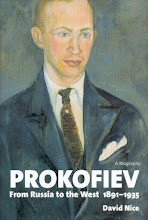
Here's my planned itinerary for Russian music 1918-1953, subject to change depending on circumstances and special visits. Pictured below: Nikolay Myaskovsky and Sergey Prokofiev, friends born 10 years apart, in 1927, detail of a photo taken from the first volume of my Prokofiev biography (sorry to link to Amazon, but my online seller of choice, hive.co.uk, reports it out of stock).


1: Adventures abroad, dark times at home  7 January

Prokofiev travels to America while Myaskovsky stays at home and remains true to his characteristic moods of gloom and pessimism. Myaskovsky's Fourth and Fifth Symphonies contrasted with Prokofiev's shorter works of 1918-19 and the exuberance of The Love for Three Oranges.

2: Stravinsky in Switzerland; the Ballets Russes transformed   14 January

Stravinsky's Russian trilogy begins with the small-scale experiments of Renard (Baika) and L'Histoire du soldat. Ever the seeker after novelty, Diaghilev engages a fresh range of artists to work with composers old and new. With special emphasis on Prokofiev's Chout (Larionov design pictured below) followed by Stravinsky's Pulcinella and Les noces (Svadebka).

3: Enter Shostakovich  21 January

With a prefatory look at Myaskovsky's biggest and darkest symphony, the Sixth, followed by the First Symphony with which the precocious teenage Shostakovich, Petrograd/Leningrad Conservatoire student, burst upon the scene. His first total masterpiece, the Prelude and Scherzo for string octet, is followed by a singular marking of the 10th anniversary of the October Revolution in what became known as his Second Symphony of 1927

4: 1927  28 January

The apogee of Soviet modernism, still strongly connected to developments in the west. We look at machine-age music by Prokofiev, Mossolov and Deshevov, and through Prokofiev's detailed diary entries for his first visit to the Soviet Union in 1927 look at the young musicians whose music he heard while he was there, chief among them Gavriil Popov with his remarkable Chamber Symphony.

5: A Gogol opera and two ballets  4 February

The young Shostakovich's reputation continued to grow with his wildly expressionistic opera The Nose and his two full-length ballets, The Golden Age and The Bolt - though proletarian musicians' organisations were now on the attack.

6: Two edicts, two masterpieces, 1932-6  11 February

The move to bring the querulous proletarian musicians' groups under one banner, the Association of Soviet Music, in 1932, looked like a good thing at the time, though it spelled trouble ahead. Shostakovich's Lady Macbeth of Mtsensk, completed at the end of that year, ran successfully in Moscow and Leningrad for two years before the blow fell with the Pravda attack on it in January 1936. Still he pressed ahead with his outlandish Fourth Symphony, but it was withdrawn before the scheduled public premiere at the end of the year. With special guest Elizabeth Wilson.

7: Soviet film scores, 1929-1938 - from New Babylon to Alexander Nevsky  18 February

Shostakovich worte his first film score for Kozintsev and Trauberg's New Babylon in 1929; Prokofiev worked on Feinzimmer's Lieutenant Kije four years later before becoming a true Soviet artist in 1938 with his music for Eisenstein's Alexander Nevsky. With clips from those films as well as Alone, Counterplan and Volga-Volga.

8: The 'Soviet' Symphony, 1935-1945  25 February

Picking up on the first Russian symphony to cause real controversy, Popov's First, performed in 1935, we see how Shostakovich followed a superficially safer trajectory in his Fifth before ringing the changes in the Sixth. We end with Prokofiev's own special circumventing of socialist-realist formulas in his Fifth, premiered at the beginning of 1945 and seen (wrongly) as a victory symphony. Pictured below; Prokofiev, Shostakovich and Khachaturian in 1940.

9: Chamber and instrumental 1938-45 4 March

Shostakovich's new journey in chamber music began with a kind of neoclassical purity, but Russia's dramatic entry into the Second World War opened up freedom in music again: the Second String Quartet and Second Piano Trio mark a dramatic change in course. Alongside them we also look at Prokofiev's so-called 'War' piano sonatas (6-8).With special guests Steven Osborne and Boris Giltburg.

10: The dangerous path to 1948   11 March

Two more towering symphonies, Shostakovich's Eighth and Prokofiev's Sixth, dare a naked sense of despair. After the war, it was time for the authorities to turn the screw again, which they did with Zhdanov's notorious trials of 'formalism in music', banishing the possibilities of dissonance and anguish expressed in music. Pictured below: Shostakovich in Leipzig, 1950.

I can see from this that I haven't managed to fit everything in: there will be two extra classes on Prokofiev's War and Peace. If anyone wants to join who isn't already on my list of students, just leave a message here with your email address. I won't publish it, but I shall certainly reply.