Showing posts with label Zoom. Show all posts

Monday, 8 September 2025

Fire and water


CDs Adams to Prokofiev after the fire in my London study: Kiefer-worthy, don't you think? Puccini to Zemlinsky safe, if a bit smoke-blackened, in the hall and opera DVDs OK next door. The water input here was necessary but has of course caused further damage. But how glad I was to be by the waters of Lake Vesijärvi a week later, after one of the superb concerts in the Lahti Sibelius Festival.

And right now I'm back in Dublin and immersed myself in the waters of the bay last Thursday, with swimming friend Catherine and visiting artist pal Marcelle happy to look on in the sunshine at Seapoint. 

I see looking back on this that I didn't say how it happened. I'd returned two hours earlier from Dublin, lying on the bed in my t shirt and underpants looking at emails. Smelled burning, checked the rooms four times, then saw an orange light. The curtains by the desk were on fire, ignited by one of those awful tungsten lamps which always got too hot, and the blaze was spreading. Singed my hair trying to pour water on it, then neighbours at the door got me out and had called the fire brigade, which came quickly. I was taken to hospital to check I didn't have carbon monoxide poisoning - I didn't - but the blood tests revealed I had a severe potassium shortage, so I was put on a drip feed for two hours. 

The two weeks of kickstarting insurance action and leading a nomadic existence, shared between my friend Cally's Chiswick place and my late mum's flat in Banstead, in the process of being sold, had many good moments, but I look back on it with a kind of horror, and such relief that I'm temporarily away from the chaos. Contents insurer via NatWest has been on the case, and I'm impressed with the professionalism of the assessor. The buildings assessors have been very slow but are now finally firing on various cylinders. with  news about alternative accommodation now very urgent.

No clearance has begun, so the place still looks like this. A photographer on Bluesky suggested I should get it all snapped in black and white. The burnt CDs could become a kind of installation.

Two big paintings by Ruth Addinall have been completely destroyed, inter alia, but the other two rooms are more or less OK, if smoke-blackened. While the single Adams CDs are also a goner, the Earbox which I kept on the other side of the study is soggy, but JA's personal signature, which he made after I'd interviewed him before a BBC Symphony Orchestra concert, survives.

The smell is overwhelming. There have been silver linings. One is that at Charing Cross Hospital, where I had tests to make sure I didn't have carbon monoxide poisoning, they discovered I needed a two-hour infusion of potassium. And the fact that my precious study as I knew it is gone may affect the decision on where to live when J retires.

I didn't think I'd be able to carry on my Zoom courses as the hifi has melted down - I need the big burner to make clips - but in the back room, in the black filing cases, I found my snippets from the last time I 'did'  Tannhäuser, so that's been continuing, and it's another happy place for me. I even retrieved the Dover score from the other side of the room - books and LPs have been slightly damaged, but not gone. I can do the same with Tosca and The Makropulos Case for Opera in Depth starting in early October, but will need a place and equipment for the late Schubert course. One step at a time...

Monday, 18 August 2025

From Walküre to Tannhäuser on Zoom


 What a spectacular parade of greats we had to visit across 10 Monday afternoons on Die Walküre, which completes my Wagner Ring on Zoom (we started with Siegfried when lockdown meant I couldn't go to Gartmore for my annual course for the Wagner Society of Scotland, moved on to Götterdämmerung, Tristan, Meistersinger and Parsifal before going back to Rheingold). A Siegmund came first (the adorable Jay Hunter Morris, previously welcomed to talk Siegfried and Tristan), then two Sieglindes (Linda Esther Gray and Natalya Romaniw), a Wotan (John Tomlinson, just before we watched the big Act 2 monologue in the Kupfer Bayreuth production, still peerless alongside Chéreau's) and a Brünnhilde (Anne Evans, ditto before the final scene in the same production).  

Natalya's visit was a first. And of course she was a delight, sure of where she's going now but doubtful of the Wagnerian path before Sieglinde came her way (I remember a student from continental Europe who said she was cancelling her Royal Opera visit because Lise Davidsen, expecting twins, had pulled out - I told her the replacement wouldn't be second best). 

Of course the Royal Opera isn't looking too good now, having gone for former Putin supporter Anna Netrebko as Tosca to launch Jakub Hrůša's first season as Music Director in September when it could have highlighted La Romaniw, a Welsh-Ukrainian exponent of the role worldwide. Natalya is in any case singing Tosca for Welsh National Opera, so that's where to see it. I've decided I'll cover the Royal Opera version for The Arts Desk when Aleksandra Kurzak takes over. 


We've now plunged into the Venusberg in the first Zoom class on Tannhäuser, with six more Wednesdays to go. Irish soprano Jennifer Davis, who made such an impact as Elsa in Lohengrin at the Royal Opera, is preparing her first Elisabeth for Geneva Opera, and I hope she'll join us. In dealing with the background for the first class, I compared the original 1845 Overture (Klemperer) and the 1860 elision with a big Venusberg ballet for Paris, very much post-Tristan. John Neumeier's choreography for Gotz Friedrich at Bayreuth is very impressive. I have it on DVD, but it's all here on YouTube with English subtitles.


It's still not too late to join, since I can send the first class on video (and indeed you can always get the instalments that way if live attendance is difficult). Details below (click to enlarge).


Tuesday, 6 May 2025

Debussy, Ravel and Co. on Zoom 2: 1912 to 1937


Our first term with the two French maîtres and their contemporaries brought revelations, to me, at any rate: those which stand out especially, because I didn't really know either, are Chausson's exquisite incidental music for a puppet-theatre production of The Tempest - first ever use of the celesta - and the incredible subtleties of Debussy's piano Images, enriched especially by film of Arturo Benedetti Michelangeli.

There will be less Debussy in this term's 10 Thursday afternoon classes, starting in two days' time, more Ravel, for the simple reason that Ravel lived longer, into the post-war era of Les Six and even that of early Messiaen. We start with Jeux, a score that still baffles me: is it as great and exploratory as so many people suggest? Then there will be the 'late' Debussy sonatas; at the 2024 Sheffield Chamber Music Festival I was amazed at several of the late specimens for wind by Saint-Saëns, which will also feature. Ravel then enters the jazz era, and the ferment of 1920s Paris, an amazing scene. 

Here's the flyer - click to enlarge and contact me if you'd like to sign up. You can get the videos if you can't attend any or all of the classes. Don't forget it's not too late to sign for the Monday course on Wagner's Die Walküre, as I only started last week and yesterday was a Bank Holiday.

Sunday, 27 April 2025

Last hoiotoho for Walküre on Zoom

We begin our ten-week exploration of Wagner's second Ring opera tomorrow in my Opera in Depth Zoom course, tying in with Barrie Kosky's new production at the Royal Opera which opens on Thursday (at 4.30pm, which means I have to postpone Part Two of the Debussy/Ravel course for a week). UPDATE: review now up on The Arts Desk, with photos by our resident Bill Knight. I include two more here: above, Elisabet Strid as Brünnhilde; below, Natalya Romaniw as Sieglinde and Stanislas de Barbeyrac as Siegmund.

Yes, I've been here before, both at Gartmore House in the last live course for the Wagner Society of Scotland and at the Frontline Club, but so many new discoveries have accumulated since then, not least the complete Wagner recordings of the amazing Albert Coates, about whom I gave a talk for the Wagner Society of Ireland. It won't be a repeat, and it WILL complete the Ring survey on Zoom. Full details below (click to enlarge).

You can join live on Monday afternoons or get the videos (or both).  You'll find a very welcoming and lively crowd.

Wednesday, 15 January 2025

French music after Berlioz: the next Zoom step


After a Zoom term and a half on Berlioz, I moved on to Saint-Saëns and Chabrier (total originals, earning their places in the front rank of composers however light they may mostly have kept it), Franck and Chausson, with the adventure in fascinating Fauré launched but to be continued. I'd originally thought of this term on Debussy and the summer spent with Ravel, but because their fellow composers still need to keep making appearances, decided to do both chronologically: this term will take us up to 1914. 

I've discovered some real rarities along the way - Saint-Saëns's early chamber music, Chausson's incidental music to a puppet-play version of Shakespeare's The Tempest (which starts with the first ever appearance of the celesta). I'm sure more will emerge from Thursday afternoon onwards (looking forward, for instance, to discovering more of Mel Bonis). Join us live from tomorrow (Thursday) afternoon onwards or get the videos if you can't attend. Details below (click to enlarge). 


Sunday, 12 January 2025

Opera in Depth on Zoom: Britten's dark heart


Prepare for fleshcreep if you've joined, or want to join, the spring term of my Opera in Depth Zoom course. Inspired afresh by the remarkable achievement of Isabella Bywater's remarkable production of Britten's The Turn of the Screw for English National Opera, with a groundbreaking central performance by Ailish Tynan (pictured above as the Governess with Jerry Louth's Miles by Bill Knight), I thought it was time to turn back to this masterpiece, the composer's most rigorous, which I first experienced as a Hesse student scene-changer at the Aldeburgh Festival in 1983. 

As I've never covered Owen Wingrave in class, and found it more fascinating than I'd previously thought in Neil Bartlett's Aldeburgh production, superbly cast from experienced and young singers and conducted by the great Mark Wigglesworth, I thought I'd do a Britten/Henry James double. That rather reduced the time I was intending to spend on Handel's Giulio Cesare, due a top line-up with Harry Bicket and the English Concert later in the year. But Handel can always be excerpted (heresy! But I do come to love his operas ever more).

Places still available - you can join from anywhere in the world and get the videos if you can't make the classes. The course starts tomorrow (Monday) at 2.30pm UK time. Full details here; click to enlarge.


Monday, 23 September 2024

More Berlioz on Zoom, and what happened next

Ten sessions in the most exhilarating company of Hector Berlioz weren't enough last term, but another ten this autumn would be stretching it a bit. So I decided to frame proceedings with two religious works on very different scales: Berlioz's Grande Messe des morts and Fauré's Requiem. After the first class we can then take the brighter Berlioz, pick up where we left off from the earlier Faust, his amazing Op. 1, to look at the new music in the Damnation, and then see what mark he left on Saint-Saëns. The one area where the master of the orchestra didn't spend much time (because there wasn't yet the French audience for it) was chamber music, so we can look at that side of things at last with Saint-Saëns, Franck and Fauré .

I've made a few further observations in the flyer, reproduced below, but this is to note that the course starts on Thursday week, and if you can't attend in person, I send out recordings. Next week will be rather packed, as I finish the summer Wagner course on Tuesday with the last of the Dutchman, which is absorbing us far more than I'd imagined. It is the true revolutionary opera for music drama as Tristan later was for harmonic language and an unbelievable leap forward from Die Feen, Das Liebesverbot and Rienzi, which just about sustained the single classes we spent on them. Click below to enlarge on the French details, and don't forget that Opera in Depth, which I've already flagged up, starts on Monday. Just heard that Oliver Mears and Wallis Giunta will join us for one of the Trouble in Tahiti/A Quiet Place afternoons, in the thick of rehearsing the Royal Opera's new Linbury Theatre production, so it's all shaping up nicely.


Saturday, 3 August 2024

Sailing towards Wagner's Dutchman

'The Complete Wagner' experience on Zoom actually has its source in the Trossachs, where I stepped in to take over a summer course at the beautifully-located Gartmore House for the Wagner Society of Scotland. With only a week's notice, I had to adapt what I'd already done - an Opera in Depth term on Das Rheingold. The Scottish Wagnerites liked it, asked me back for successive summers on the other Ring operas. I did the same for Die Walküre, but then in 2020 Covid struck, so Siegfried needed to transfer to Zoom. Online, I've since gone through Götterdämmerung, Tristan und Isolde, Die Meistersinger von Nürnberg and Parsifal. Keen Zoomers from America and elsewhere will be able to catch up on Die Walküre in the summer term of the Opera in Depth course, to coincide with the second instalment of Barrie Kosky's Ring at the Royal Opera. Special guests? Who knows, just yet. But I'm so proud and happy that Antonio Pappano and Richard Jones actually overlapped in one of our Puccini Trittico classes (click to enlarge).

Where next, for summer Wagner? Back to the beginning, of course. Die Feen, Das Liebesverbot and Rienzi seemed only to merit one two-hour session each, and Der fliegende Holländer, being much shorter than the big 'uns, needs five classes rather than 10. So it is that next Tuesday afternoon we embark on the early journey. Do join us: if you can't attend live, I can send the videos. Full details on the flyer below (click to enlarge).


Wednesday, 17 April 2024

From Bernstein to Berlioz


No regrets that I postponed the Thursday Zoom-course move to France in favour of Bernstein and so many students' enthusiasm (as well as mine) for Maestro. I did wonder if I could sustain 10 classes on Lenny the composer without much ballast from his conducting and lecturing, but it turned out not only to be easy, but revelatory. I expected to renew my love and awe for the Platonic Serenade and Mass!, one of the great panoramic works of the 20th century; but there was so much more I didn't really know. Portions of all three symphonies and Songfest are of the highest order, but the real surprise was A Quiet Place, so much more than just an extension of the masterly Trouble in Tahiti.  This recording gave me much cause for reflection, 

but I want to see a production in the UK. Surely Opera North could build one around its already peerless staging of TiT? Family grief and the tensions around it are something we can all relate to, and Bernstein drew from a profound well after the death of Felicia. It needs a lot of patience and looking in to, but definitely worth it. I vowed that we'd devote four or five Mondays to it in a future Opera in Depth term. 

Operas we won't be covering in this Berlioz course - strictly concert works only, though La Damnation de Faust has often been staged. I'm not sure at this point if one term will be enough, but let's see. David Cairns' detailed study is obligatory reading, of couse, alongside the beautifully written Memoirs. I've only previously dipped in to Cairns's first volume with reference to select works, but I'm now going through it - there's some repetition but a real bringing to life of a vivid and far from chaotic personality.

We begin tomorrow (Thursday) afternoon, finding out how the future composer's singularly music-starved youth shaped the genius (his upbringing was far from all bad, though, and probably home education allowed his imagination to flourish). There's still time to join. Details below (click to enlarge).


Tuesday, 26 September 2023

Zooming Mahler ii: greater darkness, brighter light


On 12 October, I embark on the second batch of ten classes in my Mahler Zoom course, beginning with the grim marches of the Sixth Symphony, ending in the peaceful resolution of the at-one-with-the-world heartleap in Deryck Cooke's performing version of the Tenth Symphony (and completed it must be). 

The first term led me to the surprising realisation that of the first five symphonies, I love the Fourth the best, simply because it's absolutely perfect. You could say that in the Second and Third Mahler dares more, but it's a harder challenge to make them work. 

Edward Gardner pulled off Saturday night's performance of the 'Resurrection', launching his London Philharmonic Orchestra's 2023-4 season. I was going to give it a miss, because sitting on my special cushion isn't easy at the moment, and I always feel a bit outside the first movement - not a good start. But then our conductor turned out to be a born writer in his First Person on the symphony for theartsdesk. I was sold, and I'm so glad I went. I endorse everything my colleague Rachel Halliburton writes about the performance. The rare spectacle of the whole audience rising within seconds of the end was absolutely deserved, even if the choral climax does tend to have that effect. (Both images by Mark Allan).

Delighted to say that I met Ed by chance on the terrace of Oslo's stunning Opera House while I was there in June for Pekka Kuusisto's Shostakovich one-off with the Norwegian Chamber Orchestra. He was very warm in his friendliness, so I asked if he might come along as guest, as Jonathan Bloxham and Mark Wigglesworth did last term - and I hope Catherine Larsen-Maguire, having pulled off the rare feat of what sounds like a spectacular performance of the Seventh with the National Youth Orchestra of Scotland, will do so for the Seventh. I gave Ed the option of any of the others and he chose Das Lied von der Erde. Let's see who else might come along. 

I know it can never be quite like the line-up during the ten classes on the symphony I ran during lockdown - the busiest of conductors like Vladmir Jurowski, Paavo Järvi and Antonio Pappano actually had the time then - but we've built up a fair bit of goodwill. Do join us - all the details are on the flyer below (click to enlarge).


Wednesday, 19 April 2023

Zoom courses: from Nielsen to Mahler

After four Zoom terms on Russian music, one apiece on Czech and Hungarian, then homing in on great symphonists Sibelius, Vaughan Williams and Nielsen, it's time for the Big One: Mahler, starting this summer (tomorrow - Thursday 20, to be precise) with the first half, Symphonies 1-5, Das klagende Lied and the songs, then continuing in September with 6-10 and Das Lied von der Erde.

Not that Nielsen has any less status in my eyes, now that I've spent 10 weeks with the great but modest Dane. His essential robustness kept me buoyant, along with the sheer joy and richesse of Strauss's Der Rosenkavalier, through those not-too-awful five weeks of radio- and chemotherapy. 

As well as getting to know underrated piano masterpieces like the Chaconne and Theme with Variations, my admiration for Nielsen's consistently original but ever more extraordinary symphonic journey has gone through the roof. The second movement of the Fifth, unquestionably one of the 20th century's greatest symphonies, has long been my favourite finale, infinitely rich, but the continuation of the journey in the opening movement of the Sixth, so misleadingly (jokily?) named Sinfonia Semplice, takes us one step further. Passages from it were running through my head for weeks. Lucky that we have this superb performance from Paavo Järvi with the Frankfurt Radio Symphony Orchestra on YouTube.

It seems beyond doubt, to me at least, that Nielsen's recent heart attack fed into the weirdnesses and frenzies here, no less than Mahler's arrythmia informs the peaks and troughs in the first movement of his Ninth Symphony. But I love equally the way Nielsen takes apart the machinery in the rest of the Sixth, making sure never to lose sight of the first movement's essence. 

So there will be plenty to connect Nielsen and Mahler, even if the timeframes of their works are different. I must say that, still in the thick of Nielsenmania, I found it hard to adjust to the scale of Mahler's Third live at the Festival Hall with the Philharmonia - another Paavo performance, which might have been even more revelatory with one of his regular orchestras. But enough time has elapsed to return to Mahler's own very specific world - even though I'm lucky enough to be returning to Denmark, following the amazing time I had celebrating Nielsen's 150th anniversary, to hear performances of Hymnus Amoris (such an opportunity) and the Second Symphony, as well as to look at the new Carl Nielsen Museum in Odense. 

Here are the full details (click to enlarge) for the coming Mahler term - still time to sign up if you're interested. And you can get the videos if you can't attend on the day.


Sunday, 8 January 2023

Zoom courses: from Lucretia to Rosenkavalier

"S'ist mein Leiblied' - 'it's my favourite song' - declares Baron Ochs in Der Rosenkavalier of his signature waltz-tune. By the same token, Rosenkavalier is probably my Leiboper - certainly the one I know best, the intricacies of which, in both Hofmannsthal's libretto and Strauss's music, seem inexhaustible. This coming term's Zoom course, starting tomorrow (9 January) will be my third visit in the opera classes, but since the last time there have been new recordings and new productions on video (including Bruno Ravella's for Garsington, the exquisite and Grace-Kelly-stylish Miah Persson's Marschallin and Hanna Hipp's fine Octavian pictured in it above by Johan Persson; Irish National Opera takes on this staging in March with a fine cast led by Celine Byrne, the fabulous Paula Murrihy and Claudia Boyle). There's always more to discover. And as always when I repeat a classic, I don't look back on old notes. 

Last term ended rather more positively than I was expecting. I'd been reluctant to revisit Britten's The Rape of Lucretia, so whittled it down to three rather than five classes (Rosenkavalier will have seven, Korngold's Die tote Stadt also three). Ronald Duncan's often excruciating libretto troubled me even more in Oliver Mears' production when I saw it at Aldeburgh. 

I'd always wondered about André Obey's play Le viol de Lucrèce - about which all the contributors to the Rape of Lucretia symposium book I picked up are so cagey that an addendum slip had to be printed giving it proper credit. Then I found that Thornton Wilder had translated it in 1933. Surely Eric Crozier, at least, knew this? It's so much better, in every respect, than the drama Duncan fashioned. For a start there's no Christian overlay. There ARE two narrators, a man who follows Tarquin's progress, a woman who reflects Lucrèce, but they don't appear until Obey's second act (the first has two soldiers relay, chorus-like, what's going on in Collatine's tent). The aftermath is much more acceptable today: Lucrèce as powerful tragic heroine, knowing that her divulging of the rape will trigger Collatine's vengeance and a Roman uprising, not some self-disgusted victim. 

At the beginning of the last and third class I continued the comparison between opera and play. But joining us were Jean Rigby, the most moving Lucretia I've ever seen on stage, and her husband Jamie Hayes, who'd directed the work for British Youth Opera. Jean had already instigated a kind of cast reunion of the original Glyndebourne Albert Herring - since I don't seem to have written about it here, I must boast about the other visitors: John Graham Hall, Alan Opie, Felicity Palmer, Alexander Oliver and Felicity Lott (who sang Lady Billows in a revival) - and I knew what a fun and generous person she is. 

Everything Jean had to say about the circumstances around that remarkable Graham Vick Lucretia at ENO back in 1987 informed what we were about to watch - namely Act Two from the moment Tarquinius awakens Lucretia to the end of the opera. And the film itself was testament to how, when every singer has worked on phrasing and meaning so intensively - not just Jean, but everyone else in an extraordinary cast - reservations about the infelicties of the text vanish in the face of such consummate music-making, such singing-acting. The whole film is available on YouTube but in a fuzzy picture, so I recommend you get the DVD. 

We were blessed with our guests this last term. I'm so happy that John Savournin, our most innovative living Savoyard as singer and director, was able to join us for the two classes on The Yeomen of the Guard (I still didn't manage to persuade two students that G&S is worthy of keeping company with the best). John's brilliant re-imagining of Patience for nine singers at Wilton's Music Hall was the big surprise in my operatic 'Best of 2022' for The Arts Desk. When we spoke he was preparing for the last performance of Golijov's Ainadamar at Scottish Opera, a production I long to see; hence, I think, the moustache.

And right at the end of the five classes on Verdi's Aida, I suddenly remembered that Tamara Wilson, one of the most generous of guests way back when I was still giving live classes at the Frontline Club and she was performing Leonora in The Force of Destiny at ENO, had sung the title role all round the world (but not, sadly, in the UK, and after a bad experience in Verona which I think may have had to do with a refusal to sing it in blackface, as the vile Netrebko recently did, she has retired the role from her rep). 

When we met online, Tammy was preparing to revisit the role of Turandot, this time for Barrie Kosky in Amsterdam (I was so hoping we could go and stay with our friends there, and see it, before Christmas, but too many hospital appointments got in the way). I remembered how revelatory she had been on the previous visit about how she marks up the score, and includes intentions, and so requested she did the same here. The 'intention' behind 'straniero, ascolta!', for instance, reads 'feel pleasure that I'm going to kill him'.

So yes, what fun we had. And I'm hoping we'll be able to welcome at least one Marschallin, Octavian, Sophie and Ochs to the Rosenkavalier sessions; watch this space. Still not too late to join if you can - from anywhere in the world, time depending. And if you can't make the class, you get the video. Full details below; click to enlarge.

Saturday, 25 June 2022

And the Best Tatyana Letter Scene winners are...


...as far as Tchaikovsky's opera is concerned, two: still,  on DVD and in the opera house, Yelena Prokina for Graham Vick at Glyndebourne back in 1994. Here's the reaction of some of the students on my Opera in Depth course after I'd played it to them on Monday. I've cut down the bigger picture to focus on the best responses. One lovely person with a lifetime of astonishing musical experiences recalled emotionally what having seen it at Glyndebourne meant, and how happy she was to see it again now that she and her husband can't get there any more.

Two hours still weren't quite long enough on what turns out to be so many people's favourite operatic scene. Sound recording only wise, there was a strong positive reaction to my personal favourite here, Gabriela Beňačková in a Supraphon disc of Czech and Russian opera arias - I picked it up for a dollar when we spent a New Year in Prague a year after the Velvet Revolution. Vaclav Neumann conducts the Czech Philharmonic.

Parallel with the opera, we're also listening to some of the Pushkin text, in both the English translation of Charles Johnston and the Russian original, in two recordings featuring the very beautiful incidental music provided by Prokofiev for a 'stage realisation' of the verse novel intended for the centenary year of Pushkin's death, 1937, but destined never to see the light of day (Prokofiev repurposed much of the music in War and Peace as well as several other later scores). 

We treasure the reading of Wests Timothy and Same, and Niamh Cusack as Tatyana, in Edward Downes' realisation on Chandos, but I thought it might be most interesting for you to hear Tatyana's letter to Onegin as read by Chulpan Chamatova, with the late Mikhail Jurowski conducting the Berlin Radio Symphony Orchestra in the music that occasionally punctuates the text. You can have your English translation to hand if you need it. I originally found the recording broken into tracks, which would have been most convenient but doesn't work in this format. Here's the whole thing. The Letter begins at 15m32s.

Meanwhile on Thursdays, the Sibelius course is taking us all deeper and broader than I could ever have imagined. The most recent class, 8, featured not only the String Quartet 'Voces Intimae', which I'm getting to know and admire better, but three orchestral works I love most of the so-called tone poems, all composed within a relatively short space of time. I am now obsessed with hearing them all in a single Sibelius half of a concert programme. Luonnotar for soprano and orchestra is the creation myth, and could be followed by The Bard, a voiceless singer strumming his lyre until the sound of primitive lurs summons him, a kind of Ragnarok that goes profoundly within; and then one could have the purification of water in The Oceanides. 

Well, I can dream, can't I? Now there are four more summer term Zoom classes to go, then a break, then the Wagner Society of Scotland wants me to start up with Die Meistersinger on 3 August, another luxuriant course of 10 classes. More of that shortly.

Thursday, 21 April 2022

Zooming Sibelius


After four in-depth Zoom terms on Russian music, one on the Czechs and the most recent on the Hungarians, I decided that Finland had to be next. And while there are plenty of other fascinating musical voices, the name of Jean Sibelius towers above all others. While he only started learning to speak Finnish aged 9 at one of the country’s first national schools – Swedish was his mother tongue – Sibelius’s musical consistency is absolute, from the early masterpieces of the 1890s through to his turning away from all major works in the 1920s.

We’ll be following the adventure from its bracing start - including the programme symphony based on the exploits of one of the many ill-fated heroes in the national epic the Kalevala, Kullervo (depicted above on his way to war by Finland's greatest 19th centurty artist Akseli Gallen-Kallela, like the portrait-plus below, hanging in wonderful house-museum Ainola) through to the supreme concentration of the Seventh Symphony and Tapiola, with excursions to the music of other Finnish composers both contemporary with Sibelius and of later generations.

Hopes are high for the kind of special guests who’ve been a feature of earlier courses – among them conductors Paavo Järvi, Vladimir Jurowski, Antonio Pappano and Robin Ticciati; pianists Pavel Kolesnikov, Alexander Melnikov, Steven Osborne and Samson Tsoy; violinists Alina Ibragimova and Josef Špaček; and harpist Jana Boušková. Certainly I'm wondering if the exceptionally busy Klaus Mäkelä can be persuaded to come along again after his energetic contribution to a Bartók class just before I heard him conduct the suite from The Miraculous Mandarin in Oslo. My rave for his new Sibelius symphonies set with the Oslo Philharmonic, now incontestably one of the world's top orchestras, should be out in the BBC Music Magazine soon. But there already fine cycles to choose from, including those by Berglund (twice), Järvis Neeme and Paavo, Kamu, Oramo and Saraste.

A wide range of works will be illustrated with excerpts on CD, DVD and YouTube. We begin next Thursday (28 May) at 2.30pm with the first of 10 two-hour classes. You don't have to attend live - you can received the video the day after. Either way, the fee is a modest £100 for the whole term (not bad at £5 an hour - and often we take the luxury of running on longer if the case, or the special guest, so demands). Email me at david.nice@usa.net ASAP to confirm a place

Sunday, 9 January 2022

Opera in Depth on Zoom: the oddballs term


After an obsessively wonderful term entirely Czechia-centric - in the opera class, Janáček's Jenůfa and Martinů's Julietta, the bigger picture from Smetana onwards for the Thursday course - it's time to cast the net wider for Spring 2022. Though I was disappointed by much in Oliver Mears' new Royal Opera production of Verdi's Rigoletto at the start of the season - it returns this year with a different cast - Antonio Pappano certainly highlighted the astonishing originality of so much in it. So it's time to return to that masterpiece. And to Britten's Peter Grimes, which inevitably cropped up a lot during our half-term on Albert Herring.  

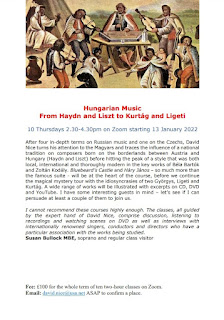
The logistics: 10 two-hour Monday afternoon classes, running from 2.30pm to 4.30pm and starting tomorrow. £100 for the course. If you can't attend in person, I send out videos the morning after. Leave a message here if interested, or use the email in the reproduced flyer for the Hungarian music course below, and I'll get back to you.

On Thursdays we turn from Czechia to Hungary. The details for that are reproduced below. They should be readable if you click on the image for a larger size.