


Been dragging my flu-ridden husk around south-west France, with TLC from the diplo-mate. Maybe not a great idea to have gone as I've been laid up most of this week after returning on Sunday, and spent Meistersinger class day throwing up (I'd struggled to the Frontline Club the previous Monday). Still, an outing to see Théâtre de la Ville-Paris's haunting Six Characters in Search of an Author at the Barbican on Wednesday night proved there's something of a retour à la vie, slowly. Anyway, heading off to Aix-en-Provence the Saturday before last, on the morning after the first sweats, wasn't wise, either, though I got through it and met the interesting company I was supposed to interview there as they began preparation for a festival special.

First impressions: a pretty centre, plenty of fair squares with lovely fountains, not a great deal to see; maybe my slight grumpiness, apart from general indisposition, had to do with the fact that it all looked so Italian but wasn't. And admittedly the clash of my Sunday duties with the noon opening of the Musée Granet meant I couldn't wander round an avowed gem. The only treasure I saw - since Nicolas Froment's Burning Bush altarpiece was closed up, revealing only the two outer panels in grisaille - was the altar of the Aygoysi Family from the Church of the Carmelites, now in the Cathedral (west front and tower pictured above).

The sun shone in Aix; it felt Mediterranean spring-like despite cold mornings and nights. Not so, except for a still-cold hour or two, in Toulouse and Ax-les-Thermes in the Pyrenees, where we met up with the couple of friends I married several years ago, Susannah and Jamie, in a far cry from our carefree summer romp in the wilds of central Sweden. I probably wouldn't have been up to walking if the weather had been clement, but it snowed solidly during our time there, a beauty in itself but not good for expeditions. And the train was cancelled due to a fallen tree on the way back, so we had our only delay of the trip.

Had we been back in Toulouse on time, the idea was to tear off to see the weird and wonderful cathedral at Albi. But Toulouse did deliver two monsterpieces of Romanesque and Gothic art on a vast scale, plus one of France's most delightful museums. In this city of welcoming red brick, lively with students from the university originally founded as a counter to heresy (the Inquisition had a field-day here), there are two major edifices and they don't include the lopsided, dog's dinner cathedral, though that I suppose has interests of its own.

No, clearly the more imposing basilica is St-Sernin to the north, the largest Romanesque building in France (says the Blue Guide) or the world (according to the leaflet in the church). The patron is St Saturninus, infamously dragged through the streets by a bull in 250 AC. The present building was begun another 320 years later, the choir consecrated by Urban II in 1096 just as St Raymond Girard was beginning work on the nave.

The extraordinary cluster of apsidal chapels at the east end look as if they might have been subject to the ubiquitous Viollet-le-Duc's 19th century intervention, at least as far as the corbels are concerned, but that's still a splendid ensemble on the outside.


and within, the grandest effect is in the transepts

where extensive Romanesque murals were uncovered during the restoration of the late 20th century.

Even the plainer Corinthian columns are splendid, but there are others with fine details

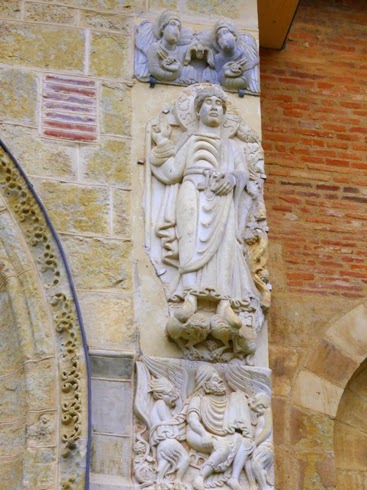
and the glory of Romanesque stonecarving is to be found outside on the Porte Miègeville of c.1120.

Christ ascends between angels on the tympanum

while details on the capitals either side are chunky-quirky


and there are figures of saints James and Peter higher up.

A Renaissance gateway in front of the Porte Miègeville

is the only remaining part of the enclosure; cloisters and abbot's palace were destroyed in the early 19th century and the basilica used, like the other ecclesiastical buildings post-revolution, for storage.
Thankfully some amends were made. The Musée des Augustins converted a superb southern Gothic monastery into an exhibition space in 1793, shortly after the opening of the Louvre, and on the site of the old refectory an eclectic construction was begun in the late 1890s on another idea of Viollet-le-Duc. The modest 4 euro admission is worth the main cloister alone, which matches the various carved capitals - crude but vigorous, like this green man -

with gargoyles from the destroyed Church of the Cordeliers.

The garden in the centre must be a riot in the summer, beautifully planted, though only winter greens and greys were flourishing in the cold.

The Gothic wing houses an obvious treasure of grace and beauty, the so-called Notre Dame de Grasse about which little is known except that the motif of the Virgin and Child turned in opposite directions is fairly unusual (this obviously not my image).
.jpg)
About the picture collection, not much needs to be said: at its best, it's curious, as in Delacroix's Mouley Abd-Er-Raham Leaving his Palace at Meknes (of interest to us who'd been there) and Jean-Joseph-Benjamin Constant's gross Entry of Sultan Mehmet II into Constantinople, an epic which made the artist (briefly) famous overnight.
It wasn't until our return to Toulouse after the snowy mountain interlude that we clocked the city's other great gape-at treasure, Les Jacobins (1229-1350) with its relics of St Thomas Aquinas and, more important, its single row of nine central columns, 29 metres high, originally segregating the monks from the public.

'The painted imitation of the brickwork is unfortunate,' opines my Blue Guide, and it's kind of true, but it does accentuate the fan vaulting spreading out from the easternmost column ('le palmier').

The outside is mostly red-brick massive, like the earlier St-Sernin

but it does have charming animals ferreting around the foliage on the south door.


After this further exploration, we returned on the morning train to Paris, braved the filthy, sleety cold and grey which made the city look rather dispiriting - it seems to me to have lost so much lustre in recent years - and had a jolly tea with friends Hélène and Olivier in their apartment opposite Barbès-Rochechouart metro and the Luxour Cinema before catching the Eurostar back to London.


 Posts
Posts



