

Back in late September, three of us were on the train bound for Tring station in the Chilterns, my plan being that we should walk the ridge of common land above it back to Berkhamstead via the most massive and haunting trees I've ever seen apart from the redwoods of California and the kauris of New Zealand's north island, the grove of coppiced giants known as Frithsden Beeches. Our acquaintance with them two years earlier was due to Beechcombings by that finest of writers about nature, Richard Mabey, who grew up and lived in the area until a severe depression prompted a move to pastures new (the very different landscape of Norfolk).

All that he describes in perhaps his wisest and most pithily poetic book yet, Nature Cure. The actual description of the dark days takes up a relatively small part of his second chapter, 'Lair'. But it hits the spot for me in so many of its paragraphs. Not least the way Mabey describes his (our, though no one experience is entirely the same) depression, throughout which nature was no more a cure in his case than music was in mine:
There's no random physical 'accident' behind it and nothing which benefits, no opportunist virus or evolutionary climber. It seems to have no connection with the biological business of living at all. And what it did to me was unearthly, in that it negated, cut dead, all the things in which I most believed: the importance of sensual engagement with the world, the link between feeling and intelligence, the inseparability of nature and culture.
I couldn't have, haven't, put it better myself. I agree, too, when he takes up Oliver Sacks' definition of 'vegetative retreat'. And what I haven't seen anywhere put better is the way Mabey describes the slow return to life as we know it, the convalescing which one is so unprepared to acknowledge:
If my illness was a vegetative retreat, this was a kind of vegetative advance, a slow, grinding, mindless pull back to some semblance of self-sustaining behaviour.
Well, my own experience took a year in between the Frithsden excursion and this trip, which has since been followed by an all too short return on a brilliantly sunny afternoon towards the end of last year (second picture above of heading towards the model village of Aldbury). On that intended return visit I realised before we arrived that the now-famous wood purchased by Mabey in 1981 and subsequently kept open for all to use thanks to Heritage Lottery Funds after he sold it could be part of a different route, heading south west to Wigginton before recrossing the railway line up towards the ridge.

Mabey writes beguilingly about Hardings Wood in both Beechcombings - now somewhat cynically repackaged, itself an 'opportunist virus' of the publishing world, with a new preface and epilogue as The Ash and the Beech, more fool me for buying it online - and the earlier Home Country, which uses as its cover one of Paul Nash's many emblematic renderings of the beech clumps which distinguish this part of the world. The group which fascinated Nash from 1911 to the end of his life were the groves on top of neolithic earthworks known as Wittenham Clumps.

We saw a presumably younger but still impressive relative group as we headed along what turned out to be part of the Ridgeway from Tring station

before crossing the A41 towards Wigginton. It had always lodged in my mind somewhat mockingly, as the childhood home of an old friend, and truth to tell it's more a commuter village of no great interest, but still it's charmingly situated and we met a humorous old man at the church lych gate who invited us to an afternoon bridge drive. When I asked him if he'd lived in Wigginton all his life, he said 'not yet'; and as it turned out he'd come from Worcester in the 1960s.

St Bartholomew's Church, essentially 13th century with a 15th century west chapel but (over) restored in the 19th, is one of those that would never make the selective guide books (as for Pevsner, I don't know because his guide to Hertfordshire is a serious omission in my collection). Yet as usual with such places it had charms of its own, not least the Victorian archangel windows and a funny old organ with a trompe l'oeil book ready for the organist. My leaflet has vanished and all I could find about it was an English Heritage note that it's painted in medieval style, but thats all. No matter; it's quaint.


The church's mid-Victorian curate wrote a report to the diocesan bishop, kept secret for 150 years as Mabey tells us, lamenting the loss of picturesque Wigginton after the odious enclosures. In 1766, Mabey discovered from an old map, Hardings Wood was part of a much bigger woodland, one mile and a half long and a mile wide, adjoining the Tring and Wigginton commonland which was lost owing to the greed of the landowners. Fortunately we know that the other side of the canal and the railway line, things turned out differently thanks to momentous local engagement stirred up by a London man of the people, preserving wood and meadow free to all from Norman times and now preserved for the same by the National Trust.

Hardings is, Mabey writes, 'slung like a hammock across a dry coombe'. It is 'two woods really, an old and a new':
The ancient part, by far the largest, had both species of native oak, hornbeam, ash, cherry, holly and hazel, mostly grown up from stumps and seeds since the last war...Next to this old wood was a plantation of 90-year-old beeches. It occupied a third of Hardings' seven hectares, but I barely glanced at it in those early days...The trees were magnificent. They had never been thinned, and rose to immense heights.

When we began working in the old wood we ignored these soaring columns. They were out of scale with what we were doing. Too remote. Trees for grown-ups, as they had been when I was a child.
The first change was when the primary school held its Ascension Day service in this 'green cathedral'. And once Mabey had learned to relax and stop thinking of managerial priorities, he came to respect this area's rhythms and unexpected life.

It certainly seemed magical that sunny afternoon, the tracks bright browny-red with fallen leaves but the green canopy still there higher up. Everything felt that much more fragile because we knew that another major storm was on its way which would break that evening, destroying swathes of trees across the south but leaving Hertfordshire more or less undamaged. In any case, as Mabey teaches us, a big hurricane is not the disaster for nature the media whips us into believing.. The spring after the big 'un of 87, regeneration had already begun. Beeches, despite their shallow roots, are extraoardinarily resilient. And so it proved this time and the next.

All this felt very enfolded and secluded. But the main road, to be recrossed, was not far away, And then we wound our way up to join the Ickneld Way in the bigger woods on the opposite rise. Darkness was falling quicker than I'd anticipated, so we carried on to descend into the village of Aldbury, which with its duckpond, stocks, church and pub now very gastro-oriented - but none the worse for that - is quintessentual old Hertfordshire (and, like Lacock, has been used for film shoots so many times). We had tea there before walking back to Tring station in darkness, only to pick up the route a month ago and to approach it from the opposite direction.

This time, too, it was already late afternoon and there was to be no lunch-idling. So we got the very friendly pub staff to make us up some sandwiches, had a quick drink and sped on our way westwards (walking, as it turned out, the last hour past Frithsden beeches, in mud and dark, but none the worse for that). The Church of St John the Baptist, however, I wanted to revisit in brighter light.

The outstanding treasures come from elsewhere - namely the monastery at nearby Ashridge. The gem is the
Pendley Chapel, enclosed by Edmund Verney in 1575. He had the chest tomb of Sir Robert Whittingham (d.1471)

and his wife brought here along with the wonderful stone parclose ('clunch traceried', says one guide) screen.


It seems so wonderfully apt for the way that Aldbury is half-cradled by the forests - and presumably the monastery was encircled by them - that Sir Robert has at his feet a wild man of the woods complete with knobbled club.

The detail on this hairy man is, literally, fabulous.

Lady W has to make do with a now-worn hind, keeping up the forest imagery.

The two look noble enough in repose

and now face Sir Richard and Lady Anderson, deceased much later in 1699 and 1698 respectively as the wigs atop their not too solemn busts tell us.

Also from Ashridge is the Purbeck marble altar tomb with brasses of Sir Ralph Verney (d.1546) and his wife with four shields, the two above clearest here,

and their 12 children (nine boys here, three girls to their right) in between.

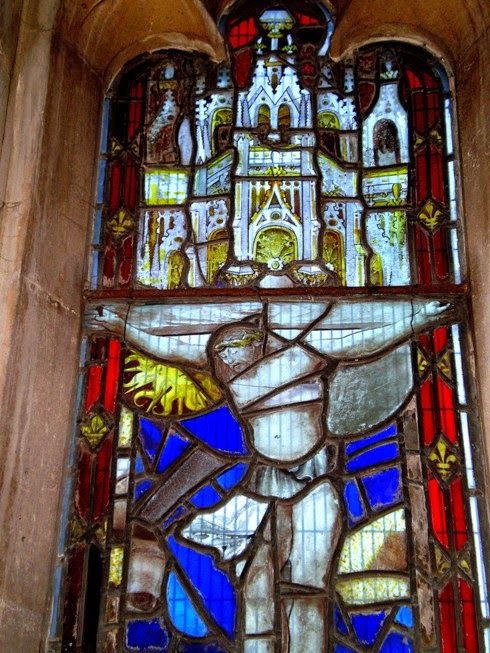
Plenty of other details from various ages catch the eye in various odd places, including - and I missed this on the first visit in the dark - 16th century German stained glass of the Crucifixion and Christ of Piety with original 15th century English canopies in the heads.

There, that's one more church done in cursory fashion, but others have accumulated, so expect the usual punctuation of things musical, literary and dramatic in the months to come. And I've just returned from a post-concert stay in the Scottish Borders with two of the godchildren and my dear friend Christopher Lambton, the ultimate woodsman, so more treestories are bound to follow.

.jpg)


 Posts
Posts



