Showing posts with label Fancy Free. Show all posts

Monday, 26 February 2024

Lenny's literature

We're coming up to the sixth of ten Zoom sessions on Leonard Bernstein, and I think all the students would agree that so far it's been a journey of incomparable richness (West Side Story next Thursday). One of the semi-incidental joys has been the possibility of reading or re-reading some of his sources; over the past three weeks I've finaly read, in Walter Hamilton's vivid translation. Plato's Symposium - on the Greek course at university, we only covered Phaedrus and selected books of The Republic - and Auden's The Age of Anxiety, reassured by John Fuller's Auden Companion that parts of it are as difficult as Finnegans Wake when my attention seemed fitful. 

Loose inspiration from the former yielded one of Bernstein's perfect masterpieces, the Serenade for solo violin, strings, harp and percussion - Baiba Skride's performance in Dublin last year made me wonder why I hadn't heard it for so long - and from the latter the Second Symphony, first-rate in parts. In essence, the composer responds to the poetic general idea much as Strauss did with Nietzsche in Also sprach Zarathustra, but if that yields strong ideas, who's complaining. I've come close to the symphony, at least as far as the opening loneliness for two clarinets and the first set of variations are concerned. Everyone loves the not-so-desultory party music, and that works well with the preceding dirge, but the end I don't buy. Krystian Zimerman is outstanding in this film with Bernstein conducting the LSO (I was there)

while Janine Jansen stole all hearts in the Serenade when I played the final Socrates-Alcibiades sequence in this performance with Pappano (we also heard Gluzman, Midori and Kremer).

I wasn't sure that ten two-hour sessions on Bernstein would hold, at least from the compositional point of view. But so far, they absolutely have. There's been an alternation between serious and relatively light - not that LB ever made the distinction - and some real corkers, such as the second class focusing on Fancy Free and On the Town, from a very special annus mirabilis. Why have we never, in my experience at any rate, experienced Jerome Robbins' vivacious choreography for the half-hour ballet live in the UK? This is Stéphane Bullion of the Paris Opera Ballet in the cheeky third variation, proving that the wiggles in Maestro are vintage Robbins

Fancy Free, like Serenade, is a totally perfect score. So is Prelude, Fugue and Riffs, so rudely ignored by Woody Herman who commissioned it but never acknowledged receipt of the score or paid for it. Much as I find Stravinsky's Ebony Concerto for Herman and Co piquant, this sequence is of a different order. I like the idea with the two in each half of a concert followed by Apollo and Fancy Free. YouTube is a surprising place - I was reconciled to using sound recordings when I discovered the whole thing in a 1955 Bernstein jazz programme (I have a CD with just the talk), introduced and conducted by the composer; it's much the best.

The symphonic suites/dances from On the Waterfront and West Side Story are flawless, too; but it's hardly surprising if the latter as a whole has its weaknesses (the soppier side of the generic young lovers - Tony's 'Something's Coming' was one of the last numbers to be composed, and at least gives him grit). Candide remains, in any version, what Sondheim calls 'a first-class mess', but oh, what numbers. And of course one of the greatest operetta overtures ever, very much in a tradition. Once again I discovered Bernstein's TV performance of it - in one of his Children's Concerts - absolutely the best.

To think that this course would never have come about if it hadn't been for widespread interest in Maestro, a film I love and respect (so tired of those reviews and articles which criticise it for what it doesn't do rather than what it chooses to select). Catching up with Oppenheimer more recently, a fine film in so many ways, I'd say that the real comparison is not between that and Barbie (which I haven't seen and probably won't), but with Bradley Cooper's masterful movie.

While Oppenheimer sprawls and tries to cram in everything, Maestro holds focus. Performances in both are fine, but only Emily Blunt's Katherine Oppenheimer eventually becomes a rounded female character. The brilliant Florence Pugh is wasted, and has to participate in one of the worst Bad Sex Scenes in movies, getting up mid-bonk to survey the bookshelves. Above all I hate the non-stop musical soundrack in Oppenheimer which often serves no point (though it's superb in the nuclear test sequence).  Indifferent to the Oscars, I still won't mind at all if Cillian Murphy wins best actor award. But I really hope Carey Mulligan takes a statue too.

Saturday, 25 August 2018

Bernstein: a toast and a list


Some of my colleagues take exception to labelling an anniversary of a deceased great a 'birthday', so let's say that we celebrate Leonard Bernstein's colossal achievements as composer, conductor, pianist and educator on the 100th anniversary of his birth today. By happy chance I can only imagine doing so with a glass of Swiss Fendant from the cellar of the Schweizerhof Hotel in Lucerne, where I've been staying for two unforgettable nights of the festival (and a privileged tour around Rachmaninov's Villa Senar across the lake). The Schweizerhof claims he was served this very wine on the night he and the New York Philharmonic took Lucerne by storm, 27 August 1968 (coming up to another anniversary, then, the 50th - so he would have just celebrated a significant birthday). Here he is in 1971, the year of what to my mind is his greatest masterpiece, MASS.


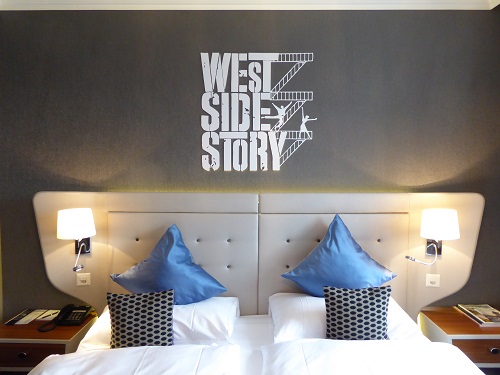
Each room here is 'styled' after a significant guest. I get a celebrated Swiss weatherman, Karl Frey, which has been educational. I did ask if I could see the room where Wagner composed the last notes of Tristan und Isolde - how thrilled LB must have been to know about that - but it's occupied until Sunday, and I'm shortly gone to catch John Wilson's performance of On the Town at the Proms tonight* (Lucerne, sadly, is not playing a note of his music in the official programmes today). But the nice marketing manager did let me have a look in the Bernstein Suite, which has a familiar logo above the bed as well as the above bottles and newspaper cutting in a glass case.


On Tuesday I took a very engaged group of students, courtesy of one of them, Gillian Frumkin, making her home available, through a Bernstein 'snapshot'. Without further ado, these are the examples around which I based my talk. I think the connections are mostly explained, but I won't pad further.

West Side Story (1957) - the tritone/augmented fourth/'devil in music' in Prologue, 'Somewhere', 'Maria', 'Cool' and Epilogue. Film soundtrack conducted by Johnny Green (Sony)

Chopin: Mazurka in A minor, Op. 13 No. 4 (1833) - opening (as source for 'Maria'). Pavel Kolesnikov (Hyperion)

Strauss: Also sprach Zarathustra (1896) - ending (opposing B major - man - and C major - nature as influence on end of West Side Story). Chicago Symphony Orchestra/Fritz Reiner (RCA)

Bernstein on the tritone in Debussy's Prélude à l'après-midi d'un faune in the fourth of his Harvard talks on music, 'The delights and dangers of ambiguity'. Five of the six are complete on YouTube; I have American-region DVDs released by Kultur.


MASS (1971) - Gospel-Sermon: 'God Said'; Hymn and Psalm: 'A Simple Song' (excerpt); Pax: Communions ('Secret Songs'); Gloria in excelsis - Trope: 'Half of the People' - Trope: 'Thank You' - Meditation No. 2 on a sequence of Beethoven (excerpt). Alan Titus (Celebrant), Ensemble/Leonard Bernstein (Sony)


Beethoven: Symphony No. 9 (1817-23) - choral sequence in finale. London Symphony Chorus and Orchestra/Bernard Haitink (LSO Live)

Symphony No. 3. 'Kaddish' (1963) - three excerpts from third movement, Kaddish 3. Felicia Montealegre, Jenny Tourel, Camerata Singers, New York Philharmonic/Bernstein (Sony)

Chichester Psalms (1965) - Psalm 100 (excerpt). Camerata Singers, NYP/Bernstein (Sony)


On the Town (1944) - Subway Ride and Imaginary Coney Island (excerpt); 'Some Other Time'. Frederica von Stade, Tyne Daley, David Garrison, Kurt Ollman, LSO/Michael Tilson Thomas (DG)

'Big Stuff' (1944) - Billie Holiday and band (r. 1946, Proper)

Fancy Free (1944) - opening ('Big Stuff' on juke box, entry of the three sailors; Pas de deux; The Contest; Galop Variation. Bournemouth Symphony Orchestra/Andrew Litton (Virgin)


The 'suggested reading' had to lead with Humphrey Burton's colourful biography, published by Faber. I'm halfway through and hope to finish it this weekend. What already strikes me is how much nicer and more considerate a human being LB turns out to be than I'd imagined: so much support of good democratic causes, so much non-egotistical connection with others (like Koussevitzky, for example, whom he obviously revered). I met him, courtesy of my then editor on The Guardian, Edward Greenfield, at his final recording sessions, for Candide -  Adolph Green, adorable man, was also there - and he held my hand firm while walking towards the gents, which was a bit odd.


Last Tuesday I also quoted some rather strange stuff - including a fantasy story about LB's coup de foudre on meeting Mitropoulos - from the volume Findings. There's also a print version of The Unanswered Question: Six Talks at Harvard. Those are so compelling - do watch or read. I still have some listening to catch up with, too, and Burton makes one want to unearth some early rarities which must be lurking out there somewhere. Favourite recording of a work by another composer? The spacious and partly cut but so, so full and gorgeous Strauss Der Rosenkavalier with the Vienna Philharmonic. And on DVD, of course, the Vienna Phil Mahler cycle. Of the live performances I caught, unquestionably the greatest was his Mahler 5 with the Viennese at the Proms (I queued from midday to get an Arena place). Performances of his more serious works, not so much; but then I'm no great fan of the symphonies. Otherwise, the riches keep on giving. As an unusual and stylishly done anniversary tribute, this from musical saw artiste Natalia Paruz takes some beating.  Deserves to go viral.


*UPDATE: 26/8 And here's what I thought on The Arts Desk. Photo of the 24-hour changeover at the end by Mark Allan for the BBC.