Having deeply admired Hollywood's most 'musical' drama, Humoresque, with its climactic scene of a desperate Joan Crawford drifting along a beach at night while her character's beloved violinist Paul Boray, played by John Garfield, performs Franz Waxman's 10-minute Tristan Fantasia with Oscar Levant and orchestra, I finally got hold of another film in which the score is central. Deception (1946) stars Crawford's arch rival Bette Davis and features another prominent score, this time by Korngold.
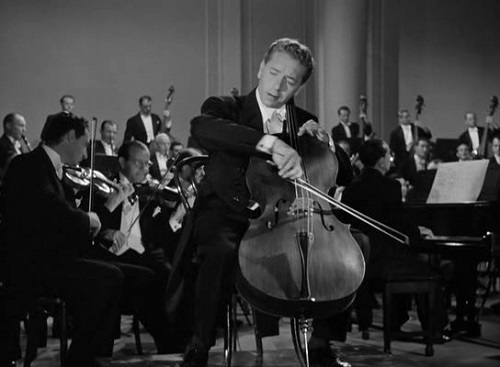
Paul Henreid is cellist Karel Novak, who suffered terrible things in Europe during World War Two before coming to America to make his name. So far, so good. But the woman with whom he's disastrously reunited is Davis in most affected mode, and she's been having an affair with tyrannical if not downright Svengaliesque composer Alexander Hollenius (Claude Rains, third of the winning trio from Now, Voyager: fun but perhaps inappropriately camp as a composer with very bad taste in luxury furnishings).
The silly story revolves around Hollenius wielding the power of his music to get Novak to play his Cello Concerto, for which Korngold provides appropriately acidic/melodramatic/romantic music. The cellist is Eleanor Aller; some remarkably fine Chopin (or is it Beethoven? I've forgotten already), not very convincingly mimed by Davis at the keyboard for a wedding party scene, is played by the great Shura Cherkassky.
The original 1927 play, Louis Verneuil's Monsieur Lambertine, must have been rather dreadful on stage, with a daft denouement, but these high-charisma folk and director Irving Rapper do bring a visual style to it. Unfortunately, whereas Humoresque gave a very truthful account of a dedicated violinist's rise to the heights and plausible concert scenes to show why he deserves to be there - as recounted in the blog on that film, Isaac Stern holds the bow for and someone else does the fingering, and I can assume something similar's going on for Henreid here - Deception regurgitates the usual cliches about a player so hungry for fame that he'll do illogical things (though there's quite an amusing caricature of an orchestral cellist all too ready to jump on to his platform if he falters). Histrionic fun, but not a great movie.
A refreshingly low-key, oblique approach to Hollywood ennui and alienation is taken by Sofia Coppola in Somewhere (2010). The washed-up emptiness of a star's life as represented by the laid-back Stephen Dorff, who has enough easy Jack-Nicholsonesque sexiness for you to understand why his character, Johnny Marco, might have got where he has, offers some amusing scenes, not least the ones early on where pole-dancing twins perform perfunctory routines in Marco's hotel room at the (not too appealing) Chateau Marmont.
The way his 11-year-old daughter Cleo, played with real charm by Elle Fanning, comes back into his life is just as casual. Which makes the final peripetaia all the more affecting. Quite some gem, this, showing Coppola junior's originality as surely as Lost in Translation and the delicious Marie Antoinette.
And now that autumn's here, we must avail ourselves again of the Picture House pass and start catching up with the latest, which haven't been on the agenda over the summer months.
Three came along to my Opera in Depth class at the Frontline Club, head- and heart-devoted this term to Wagner's Tristan und Isolde, and what amazing times we had.
First there was Linda Esther Gray, one of the greatest Isoldes ever as her studio recording and the live performance on YouTube for Goodall testify. We're now long-term friends, as you can perhaps tell.
Relatively new friends are Dame Anne Evans and Susan Bullock CBE, Annie and Sue as I think they prefer it, who visited yesterday, and a better double act I couldn't imagine. See way down this blog entry for another, slightly more embattled Wagnerian duo-chat at a Birmingham 'Brunch with Brünnhildes'.
Linda's talk was very emotional; she didn't mind my playing excerpts from the Goodall recording but inevitably it stirred up deep feelings, and you know from every phrase she says that this is a woman who can't be anything other than she is, a total giver. I'll save the insights until I can reproduce them in her own words from the recording I made of most of that session - a good two hours' talking with a fun photosession at the end.
The plan with Anne and Sue was that they should arrive for lunch - always excellent at the Frontline Club, since the owner stocks it with food from his huge estate in Norfolk - and then talk for an hour and a quarter, after which I could finish Act 3 by going through the last of Tristan's huge monologues with examples all around it and on to the Liebestod (which in fact we got earlier in the shape of Anne's very beautiful performance with Tony Pappano, conducting his first Tristan at the Monnaie). It was clear, though, that not only were the two ladies totally relaxed with my adorable, engaging and loyal students, but that there was no end to what they had to say. Looks as if I'm alarming or boring them here; can only assure you that wasn't the case.
So we heard about the generosity of Anne's coaching Sue as Isolde - SB remembering chapter and verse about what helped her - and their joint memories of Reginald Goodall, complementing Linda's several weeks earlier. About the directors who know the music and can demonstrate it on the piano - David Alden and Richard Jones - and those who arrive at the first rehearsal 'and you hear the spine of the score crack' (ie it's only just been opened). Or the ones who just use a CD booklet; expectations ran high for a Ring at Bayreuth from a distinguished director, who disappointed by doing just that and bringing nothing fresh to it.
To complement Anne's Liebestod, I also played Sue's 'Träume' from the Wesendonck Lieder, on a recital disc I rated very highly for the BBC Music Magazine; such clarity in the text, such marvellous dramatic pauses - Reggie's wisdom, though Malcolm Martineau must also be praised for his part in that. Frida Leider came out tops for her long-term youthfulness and bel canto approach; Margaret Price's peerless recording was also cited, and the advice she gave both singers (a modest woman, she ascribed her success there to Carlos Kleiber). We also, ahem, discussed the problems with the ENO Tristan that's just finished, and what an Isolde needs to do to get through the part and deliver the great Liebestod at the end that everyone's been waiting for.
It also became abundantly clear: these two great ladies should be running ENO. Then Mark Wigglesworth, having achieved a quadruple whammy of musically amazing productions this season, could come back and - how about this? - the Artistic Directorship be shared between David Lan of the Young Vic and Richard Jones (because I didn't think for a minute that Richard would want to do it on his own). Most important, perhaps, they would revive ENO's role as a training ground for young British-based singers, as they both were when they learned their trade there. It seems to me that the flood of talent from the music colleges has never been greater, but how many of these singers are appearing there? Whereas, you just look at the Garsington Idomeneo and see what a difference sensible thinking and wise casting can make.
Not going to happen? Well, as with Brexit, we can dream, can't we?
So, I owe the students a precis of what I would have talked about re the last 20 minutes of the opera in our tenth and final class. But what we did watch was the Tristan fantasia sequence from the best film I've ever seen about the dedication of a great performer, Humoresque (1947).
John Garfield is talented, hard-working violinist Paul Boray, his hands and his sounds represented superbly by Isaac Stern. Joan Crawford strikes a rare note of truth as the married society woman who starts out by thinking of a musician as a plaything, then falls deeply in love but can't share her man with his music.
There are some wonderful moments in the score by Franz Waxman, not least to accompany a giddying New York montage which must owe something to Eisenstein, but the climax of the film - and I don't think there's a spoiler here, as we start in 'the present' with the violinist distraught by his loss - is the suicide of Crawford's character while we hear a kitsch-brilliant arrangement of music from the Act Two love scene and the Liebestod arranged for violin, piano (Oscar Levant, brilliant throughout - I've just bought a second-hand copy of one of his autobiographies) and orchestra.
We get ten whole minutes of music accompanied by telling details in Jean Negulesco's direction like the man on the beach throwing a stick for his dog as Crawford's Helen Wright wanders distractedly, distressedly past and finally into the waves and under the water (whereupon the soundtrack goes temporarily blurred as well). Here's the trailer, which inevitably accentuates the melodrama and underplays the wise, wisecracking commentary of Levant's character - who comes off very well in the screenplay by Clifford Odets and Zachary Gold - but does give you a sense of the musical lushness; sounds like Waxman stitched together some of the themes especially here.
If you'd like to catch more Wagner chat, I'll be in conversation with Stuart Skelton, on recent evidence the best living Tristan, at a Wagner Society event on 21 July. Details here. Before that, I'm offering some Proms-related classes in what I hope will be a mini summer school next week, starting on Tuesday 19 July. Next season's Opera in Depth course is more or less planned if not carved in stone: Don Giovanni (five or six weeks), The Nose (two or three weeks) and Le Grand Macabre (two weeks) in the autumn term; Der Rosenkavalier (six weeks) and The Snow Maiden (four weeks) in the spring term; and Otello (five weeks) and Pelléas et Mélisande (five weeks) in the summer term. If you're interested, email me at: david.nice@usa.net
Finally, we are getting some bitter laughs about our looking-glass land at the moment from the likes of Frankie Boyle, John Crace and Marina Hyde, but for sheer pleasure this treatment of Cameron's farewell ditty comes tops. I noted in sending the link to anyone who might not have seen it - gone viral, apparently - that Cameron hums the tritone, used among other things by Wagner for Fafner-as-dragon and as a dreaded putative 'Stalin subtext' in Shostakovich and Prokofiev (they knew, at any rate, when to use it).
All observations, questions and challenges are welcome: resistant to tweeting and Facebook (though long converted to LinkedIn), I still like to exchange ideas. You don't have to be signed up, and you can be anonymous, but comments are moderated.
Copyright
If you wish to use any of my own photographs featured in the blog, or any of the text, just let me know in the comments. Acknowledgment and a link are all it takes.



 Posts
Posts



