Showing posts with label Ingrid Bergman. Show all posts
Thursday, 14 December 2017
Bergman in fashion
Mighty Ingmar, that is, the centenary of whose birth we celebrate next year, not wonderful Ingrid, though I'll give her a repeat look-in at the end here. The above image of one of Bergman's greatest leading ladies, Eva Dahlbeck, in Smiles of a Summer Night, was used in a colour ad to make me slaver at the prospect of Bergman à la mode at the Hallwyl Museum (Hallwylska museet).To be honest, I wasn't so sure about the mode bit, but anything about the master while I was in Stockholm for the HK Gruber festival at the Konserthuset had to be embraced.
The actuality, curated by set and costume designer Anna Bergman and Nils Harning, teacher of Costume/Props at Stockholm University of the Arts, exceeded my wildest dreams, even if the setting, No. 4 Hamngatan close to Dramaten, the National Theatre, is a fascinating but oppressive monument to often dubious bourgeois taste. It was built for Walther and Wilhelmina von Hallwyl between 1893 and 1898 to designs by Isak Gustaf Clason. The exterior is a fanciful combination of Venetian Late Gothic and Early Spanish Renaissance.
Admission to the main rooms on the first floor - I suppose one should say piano nobile - has been free ever since the Museum, bequeathed by the Hallwyls to the nation on condition that the rooms stayed the same, opened to the public in 1938. Should you begrudge paying 80 SEK for the bulk of the exhibition in the smaller, mostly unfurnished rooms on the second floor - and you'll see further down how that would be a false economy - you may still coo at the very first room you see, shrine to the Ekdahl family Christmas, if you love Fanny and Alexander anything like as much as I do (it's still my No. 1 favourite film). By the way, these are all my photos, with permission; the catalogue doesn't have pictures of the exhibition displays, and it's all in Swedish, otherwise I'd have bought it.
There are the maids' costumes, the one worn by Pernilla August (then Östergren) as the vivacious Maj in the centre; there, too, are the gowns for the ladies of the family (the one for Gunn Wållgren's Helena Ekdahl on the right, and for Mona Malm's Alma Ekdahl in the centre).
There, too, next to an Oscar, are Alexander's sailor suit and his teddy.
J actually met the original, Bertil Guve, at a Bergman Centenary launch in London which, regrettably, I didn't make. Very friendly chap, apparently, now an engineer, there with his real-life sister.Testified to Bergman's infinite kindness and consideration on and off set.
The table is laid as for that sumptuous Christmas.
The taste of the Hallwyls, though, is rather more fustily eclectic; as a distinguished actor, presumably with connections in the artistic world, Bergman's Helena favoured something more along the clean, bright lines of the Thielska Galleriet out near the farthermost tip of the Djurgården island, still my favourite building in Stockholm alongside the art deco Konserthuset. The big showoffy room in the Hallwylska has opulent tapestries, an impressive marble relief of Abraham and Isaac above a for-show-only fireplace
and a Steinway model C delivered in 1896. Doughty Wilhelmina wanted more than just the plain pearwood look, so she commissioned Clason to make a 'Baroque' parquetry case. Restored in 1990, the piano is in fine working order, they tell me.
The exhibition has two costumes from that vulgar mess Now About These Women, one of the few Bergman films I can't stand (because, unlike Smiles, it's not funny. I don't like The Silence either, but I don't dispute its finer points).
As for the paintings in the Hallwyl collection, there are few that show much imagination other than the portrait tucked away in the corner of Walter's smoking room.
Collections of pipes, porcelain and other fripperies didn't do it for me, but at least there are a few more objects of Bergmania scattered around the other piano nobile rooms, like this costume (there's jewellery too) from the austerely masterful The Virgin Spring,
and a model of Bergman's maternal grandmother's home in Uppsala as recreated for the Bille August-directed The Best Intentions.
Costumes from that are in the first room of the exhibition's paying part upstairs
alongside some of Bergman's own working clothes (men do get a look-in from time to time). Of course I love the jacket matched to angel wings,
echoing the treasurable photo of Bergman wearing those from the nativity scene of Fanny and Alexander.
Outside in the hallway there's jewellery worn by Ewa Fröling as Emilie Ekdahl, the mother of Fanny and Alexander.
The generous placard tells us that it symbolises security for the children - the only time Emilie doesn't wear it is when she goes to live with the 'bad father' Bishop - and quotes Fröling: 'I remember when I first saw the "dog-collar"...A piece of jewellery joined together by older pieces. Extremely beautiful'. There's more jewellery, the engagement brooch worn by Bergman's mother (on whom Emilie was partly modelled), placed together with a letter below the striking photo of the parents, not quite easy - just, in fact, as played by Samuel Fröler and Pernilla August in The Best Intentions.
Now we head to the heart of the earlier masterpieces - and, in the case of the black and white films there's the fascination of seeing the actual colours we had to imagine. Thus the dress worn by Bibi Andersson as the old professor's youthful crush in Wild Strawberries
and here's striking colour to match the flamboyance of Desiree Armfeldt, the captivating heart of Smiles of a Summer Night as unforgettably played by Eva Dahlbeck.
The room also has two other costumes. As the helpfully translated panels have it, the dress designer Mago - born Max Goldstein, fleeing to Sweden from Berlin 1938 - found 'a creative outlet for his weakness for 1950s silhouettes, where slender waists, ample breasts and shapely hips dominated. As a type of "master of glamour," Mago turned the film's turn of the century into 1950s couture'. As a result Margot Carlqvist's Countess Charlotte 'is draped in duchess and chiffon with an asymmetrical cut'.
To balance, there's the provocative innocence of Ulla Jacobsson's Anne Egerman (cf Sondheim's 'You must meet my wife').
Dahlbeck's red dress is first glimpsed from a very different room.
This is a little masterpiece of exhibition design - a red room with a white dress, Ingrid Thulin's in Cries and Whispers. It mirrors, of course, the essential design concept of that harrowing work of genius.
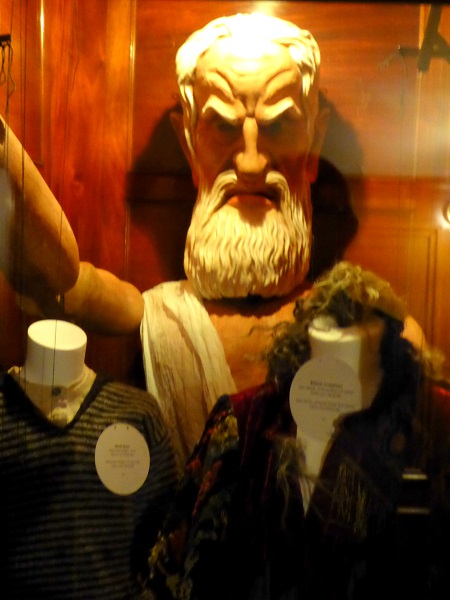
Creepiness rules in the corridor, as two alcoves give us the clown costume from Sawdust and Tinsel - telling us that Bergman was terrified of clowns, and that he thought white clowns 'mean' - and the God-puppet from Isak's shop of wonders, the 'fourth dimension' of Fanny and Alexander.
Pure enchantment, to the strains of the Christmas-tree decoration music in Tchaikovsky's The Nutcracker, opened up in the recreation of the children's room upstairs at grandmother Ekdahl's in the same film.
And there, at the very centre, is the toy theatre with which Alexander is seen playing at the start of the film.
One sumptuous male costume gets a look-in - the kaftan of the caddish actor-seducer played by Hasse Ekman in Sawdust and Tinsel.
Opposite are two more gowns for Gunn Wållgren's Helena - I love that touching photo. Wållgren knew she was dying from cancer when she made the film, which surely gives her superb, still sensuous performance an extra pathos.
Death stalks the next room.
The deepest resonance in the film for me was when Alexander's father is dying and the boy, taken into the room, hides under the bed. It wasn't quite like that, visiting my dad on the last night of his life in hospital - in fact it was a lot worse - but I did identify with him. So I wasn't unflattered when two Swedish ladies told me, unprompted, I was Alexander. Fortunately I didn't exercise any powers on my stepfather, whom I was old enough to tolerate. Anyway, here's another nice composition - the boy's funeral suit, and a photo of young Ingmar similarly attired.
In an excellent final flourish, the corridor back to the staircase has a fine selection of Bergman's boyhood drawings.
No surprise that he already saw himself as a filmmaker at an early age.
Even this little collection would have been worth the price of admission. As it turned out, the whole exhibition was a thing of amazement to me. Oh, and just to give Ingrid Bergman a look-in - we must watch The Visit again some time soon - I take the liberty of repeating one of my all-time favourite magazine covers as symmetry to the Dahlbeck picture at the top.
Friday, 7 August 2015
Ingrid as Fury
Intelligence about an extraordinarily underrated film starring one great Swedish lady came to me from another, Sophie Sarin, who, I hope she won't mind my saying, is something of a cross between Ingrid Bergman and Katherine Hepburn. At any rate I can imagine her taking the place of La Bergman's outrageously attired character on her balcony, sipping Djenne Djenno cocktails and occasionally stroking her pet leopard (they keep saying 'panther' in the movie) as she watches the snare closing around her intended victims. Sophie is, of course, the biggest help Djenne has ever had in terms of protecting its valuable legacy (see her latest blog entry), the opposite of Bergman's dark angel of destruction winging down on the people of fictional middle-European Guellen.
The film in question is The Visit, released in 1964 and directed by Bernhard Wicki. A continental friend was very surprised I didn't know the original play on which it's based, Der Besuch der Alten Dame (The Visit of the Old Woman) by Swiss author Friedrich Dürrenmatt - both title and playwright only names to me, since I'd heard of von Einem's opera (but again, neither heard nor seen it). It was a game role for Ingrid Bergman to assume, since she was not quite 50 at the time - she would have been 100 at the end of the month, so retrospectives are in order - and probably not ready for the label 'old'. Though in fact Wicki allows for Bergman's undimmed glamour in not exactly following Dürrenmatt's description of a 63-year old redhead who's 'a society lady with a rare grace, in spite of all the grotesquerie' and who turns out to be many parts metal following a plane crash in Afghanistan.
Wicked, though, she seems at first, until we get a greater tilting towards sympathy in the reasoning of this tycoon's widow for offering a failing town a million dollars in exchange for the death of the man who ruined her life. We soon learn that the natural corollary of the poster's subtitle 'Hell hath no fury...' is much more than just a woman scorned.
I corrected my ignorance of the play by buying a copy of the translation by Patrick Bowles after having seen the film, in which both Bergman and that ever-surprisingly good actor Anthony Quinn as the 'victim' of her hunt excel. The play does indeed read more as comedy than tragedy - ripe for the Richard Jones or Rupert Goold treatment - but I think I like the extra human dimensions Clara (or Carla, as she's called in the film) Zachanassian takes on in Ben Barzman's screenplay. Without the play's 'conspicuous consumption of husbands' and its false witnesses whom she's tracked down, had blinded and castrated and drawn into her circle of lackeys as Koby and Loby, she seems less absurd, and you have to keep pinching yourself to remember what a terrible vengefulness she intends to extract. The endings of film and play are outwardly different and yet - I can't say more without needing a spoiler notice - the film does not, I think, betray the essence of the situation.
So why was it not a hit? Too harsh, too unsoftened even in its ending to succeed with the public? Did they hate the idea of lovely Ingrid as, in the words of the play's Schoolmaster, not so much a Fury as a Fate, a Clotho 'spinning destiny's webs herself'? At any rate the characterisation, which can switch from deadly hate in the face to charming smiles in a second, is a long way from the usual image of Ingrid Bergman, who does indeed seem to have been the nicest person anyone ever met, albeit with a 'scandalous love life'. She knew the names of everyone on set and always arrived on time, I learn from an amusing 'Bergman vs Bergman' slot, jokily comparing actress and director, in the latest issue of the always beautifully produced Swedish Film which has a lovely photo of young, butter-wouldn't-melt Ingrid on the cover.
There's also an excellent article by Stig Björkman, whose new documentary Ingrid Bergman - In Her Own Words was shown at Cannes this year but has, as far as I know, yet to reach these shores. Disappointingly he doesn't choose The Visit on his shortlist of Bergman's best films, which features three I have to see, The Count of the Old Town (1935), Dr Jekyll and Mr Hyde (1941) and a Rossellini which has somehow escaped me, Europa '51, alongside two firm favourites, Bergman's Autumn Sonata and Hitchcock's Notorious, which has just been made into an opera in which Nina Stemme is to star in Gothenburg.
Furious women and a destructive outsider, if I might make a transition which has a strange hold on my imagination, also figure in an absolute and ever-timely classic of the theatre, Euripides' Bakkhai. Ben Whishaw is a predictably spellbinding Dionysos in James Macdonald ingeniously tradition-conscious production at the Almeida, and the Bacchic choruses are both elaborately set to a cappella music by Orlando Gough as well as stunningly well executed by a group of ten singing actresses (though there are some unmusical theatregoers who just don't get it). Enough; I've written my paean already over on The Arts Desk.
This is just to acknowledge the arrival of Anne Carson's often faithful translation - so good it's made me get my old Greek text off the shelf - as published by Oberon Classics. It's the best homage to Greek tragedy, I reckon, since Tony Harrison's magnificent poetic equivalent for Peter Hall's Oresteia. Hall's Bacchae, by the way, was very good, but the Almeida's Bakkhai is superlative. Can't wait for the whole-day reading of The Iliad next Friday, and Goold's Medea with his wife Kate Fleetwood, an extraordinary Lady in his Macbeth, should be quite something too.
One more fury: myself. I realised in a shrinksession that my anger in the public sphere is spilling over into the private, not the other way around, at least consciously. Every day this government brings in new bills, tries to reverse old ones, in a flaming trail of destruction and dismantling. That includes seemingly trivial things like relaxing aspects of the foxhunting ban and bringing back bee-killing neonicotinoids which we, along with much of the rest of Europe, had already banned; but it also slips them in between major horrors like the so-far-thwarted attempt to make the UK withdraw from the European Bill of Human Rights and the atrocious stand on the endlessly suffering refugees trying to get in to Britain from Calais, where the French, no better, have been treating them worse than animals. Bravo, David Cameron, for the accolade from Forza Italia; you must be very proud.
This country must be so soul-bankrupt if we can't put ourselves in the position of people who've lost everything but now suffer what one of them said on the radio recently was worse than anything he'd ever experienced (that would, admittedly, have to be someone who hadn't been tortured). And you wonder why Jeremy Corbyn is beginning to seem like the only human alternative* (heaven spare us Yvette Cooper et al). Worthy folk like Polly Toynbee and Alan Johnson are constantly telling us that choosing Corbyn as new leader makes Labour unelectable, but in five years' time, if this extreme right-wing behaviour goes on, who knows? What's to lose, anyway? And here's someone who hasn't just come out of the blue as a charismatic contender, rather a politician who always was charismatic but genuinely didn't seek the limelight, was/is palpably sincere and honest - and no, Guardian scaremongers, not extreme. So yes, Mr. Corbyn, I'll take a chance and yes, goddaughter Rosie, I'll join you on the next demo. Rant over - for now.
*10/8 - subject to thorough examination of his stance towards Russia. I can accept that he finds things to criticise about America's and NATO's response to Ukraine, but the warning sign is equating their behaviour to Russia's, and if he gives the simple answer 'yes' to 'did you and do you still support Putin's annexation of Crimea?' then sorry, bye bye. But let's be careful always to get the words from the man himself.
**18/8 - regular appearances on Russia Today, that organ of misinformation and propaganda, as well as the constant allying with dictators and terrorists, are enough to turn me off. So I retreat with my tail between my legs and try and decide which of the others is the best of three not very goods. Not that my ballot paper has arrived yet.5/4/18 - which it never did, and I was told to ring three numbers. So I jumped ship and paid my dues to the Lib Dems, though that's not paid off. And I still remain devoted to our superb Labour MP for Hammersmith, Andy Slaughter.
Tuesday, 20 April 2010
On top of the volcano
.bmp.jpg)
Vivid memories have been rekindled by the Icelandic showstopper: 1984, and my night on Stromboli, weirdest of the Aeolian islands off the north coast of Sicily, with four Australian girls (can't remember their names - probably written down in an old diary. All I can recall is that two designed furniture for the parliament in Canberra). Here we are, glad to be alive after sleepless hours of darkness in the hot stone circle, exhilarated by hourly displays of red-hot lava being hurled into the air from the nearby crater, with concomitant stone falls sounding like applause in a vast auditorium, but tormented by rats. Sadly I have no photos of my own because my camera had run out of film.
Oh, the folly of it. Would I do it now? Probably couldn't: in those days you were discouraged but not prohibited from following the cinder path up the ever-active volcano, and I'm told that's been stopped. We were foolhardy to do it, especially as we began very late in the afternoon, though the risks weren't as extreme as they're made out in the not very good Rossellini film, where poor Ingrid Bergman's only way out from her unhappy relationship with a fisherman is up and over.


In fact, we got lost on the way up because we kept leaving the zig-zagging route and taking short cuts through macchia. One failed to materialise and we were reconciled to sleeping on the lower slopes as darkness fell when a German tour party appeared. They angrily told us we couldn't join their paid excursion, but we insisted we had no choice, and as they carried on over the top to descend the other side, we settled into our volcanotop cairn. The horror, the horror: as we tucked into our picnic, shadowy rodents popped up over the top of the stones. When we settled down to sleep, one of the girls later told me, a rat the size of a dog perched over my head before thinking better of it. The solution to a bit of peace, of course, was to throw out the remainder of our supplies, which had been more or less consumed when we collected the nearly empty bag in the morning.
We weren't alone. Another group joined us in a pensione down in the village for breakfast, including an assistant opera director at the Met. We were all hysterical from our experiences and couldn't stop laughing. Then we sunbathed on the black lava beach before the afternoon boat back to Lipari, and I remember the subterranean rumbles, like the tube train passing under the Wigmore Hall.

I'm glad we did it, but nowadays unpredictable Stromboli - which we were told was perfectly safe, because the hourly displays signalled safety-valve status - is probably best seen from the above distance.
Subscribe to:
Posts (Atom)


