Last time I walked through the old gate to the walled garden of Fulham Palace, a green space-within-a-space in Bishop's Park by Putney Bridge and the river, the greenhouses were dilapidated and broken-windowed, the knot garden still going but scrubby, the rest of what turns out to be an enormous enclosure dating from the 1760s just wild. That must have been four or five years ago, and even back in 1986 the initial view was this (from photos of photos taken on a riverside walk with my Edinburgh friend Ruth). Of course ruins have their own peculiar charm.

And now it's this:

The 'vinery' and knot garden have survived from the 1820s. The wisteria, over a century old, is still going strong. Obviously May would be its peak flowering season but there were some blossoms still on it.

and here you can see how it fringes the glasshouse/knot garden zone.

The gate, with Bishop FitzJames's much-erased coat of arms dating it to the early 16th century, didn't need much doing to it, but it was in danger of collapsing. A rather thin person standing by it in '86

and now (with All Saints Church just over the south-east wall).

Much of the restoration work is due to lottery fund money; the palace, home to the Bishops of London from the 11th century up to 1973 and with main buildings ranging from Bishop Fitzjames' time to those of Bishop Howley (1814-15, the south-east front) and of Bishop Tait (the chapel, 1866-7 - worth seeing, apparently, though it's not been open on my visits), has been a splendid beneficiary. This old map, which I photographed hanging on the walls of the Palace interior, shows the essence of the place with the walled garden clearly defined; the area called The Warren is mostly allotments, generously handed over for that purpose to the public by one of the Bishops, and you see a moat filled with water. Putatively dating from Roman times (!), it's dry now but plenty of work was being done on it when I visited on Wednesday.

At present only a few rooms are open with choice museum exhibits or for rather good refreshments; a further drive for funding will see more visible to the public in the years to come. Already the planting outside the old wing of the palace is a sign of improvement

and within, the offices around the courtyard are to be reclaimed in the further opening-up.

I don't know the proportions for work on the Walled Garden - presumably enough to pay for a head gardener of superlative vision, Lucy Hart, and to encourage the training of apprentices - but the folk I came across all working away in an idyllic setting on a hot afternoon were mostly volunteers. This was the moment of epiphany: ordered glasshouses are one thing, but transformation on this scale, and the evidence of loving human hands on it, brought tears to my eyes.

There are 200 volunteers at Fulham Palace, and I'd like to join the garden team for half a day a week. Fruit and vegetables are sold at an average of £2 per punnet from a 'barrow' just on the edge of the cultivated zone.


I bought tomatoes, a pepper plant, plums and courgettes picked to order. It would have been tempting to pick up and eat the fallen plums from the big tree in the middle of it all, but fair deal - get the folk to gather them for you and pay to support the work.

Returned yesterday, but there was no-one at work, and only baby red onions for sale. So it's a lucky dip. Still, the magic persisted.

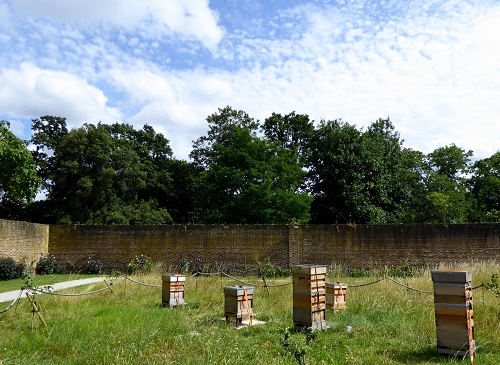
Beyond the barrow are beehives - must find out when they gather the honey and put my name down for a couple of jars, if possible, as I used to do at Chelsea Physic Garden before the yield dwindled.

Thousands of dahlia plants with the dark leaves I love line the area, up against the wall and half the way round. Great for the bees, obviously.


I can't resist two more flower-and-bee shots from the central beds.


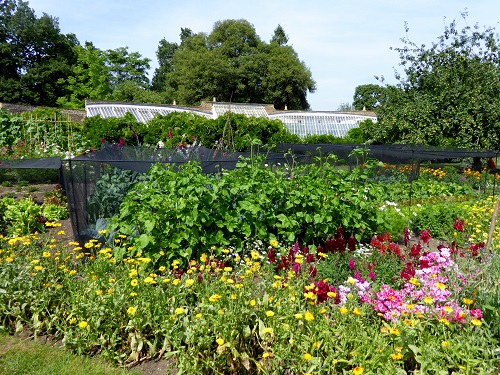
The cultivation is a mix of vegetable plots and lively planting - marigolds round the edge, obviously, to keep off the pests,

but also gladioli,


lilies (with the early 19th century front of the Palace just visible over the wall)

and more splashes of colour.
They've planted young fruit trees in plots hidden by the long tall grass, but the central rows of mature varieties still thrive

and provide a foil to the garden beyond if you walk round to the quiet southern side.

The greenhouses once lodged more exotic species - in 1853 the head gardener was proud of his grape harvests and his pineapples, while nearby there was a melon pit - but the tomatoes and beans are doing very nicely here, with a flavour you just can't get from supermarket purchase.


What's happened here is even more impressive than the restoration of Chiswick House's gardens - my other nearest haunt on biking breaks along the river from work. The journey itself is treasurable.

On Wednesday the tide was low and a variety of birds including a cormorant next to an Egyptian goose and various gulls were lolling peaceably on the little islands.

Those rather cheery creatures the black-headed gulls, so much more appealing than their bigger, noisy, scary sea brethren, were wading and skreeking in the mud

whereas yesterday, with the tide very much in, they were content to bob along

Sanctuary was now to be found on the old wooden structures mid-Thames

with the cormorants perfectly happy here

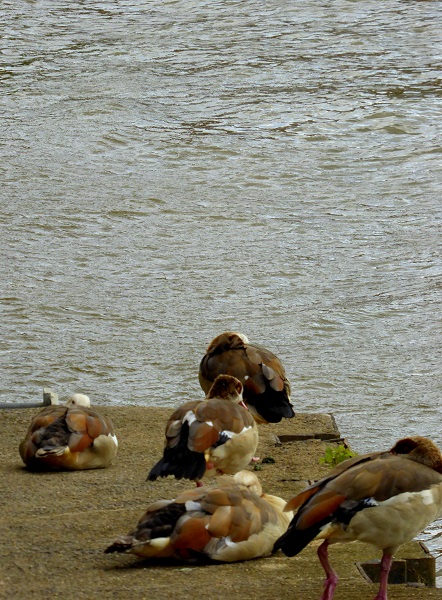
while the Egyptian geese (Alopochen aegyptiacus) - please correct if I've misidentified - now gathered together, looking a bit cold and intimidated, at the foot of steps up to a former wharf.

Let's end on another historic contrast: Ruth by Butler's Wharf in 1986

and how it looks now, gentrified into a gated set of flats, with Richard Rogers' Thames Wharf conversion beyond.


 Posts
Posts