Showing posts with label Lyon. Show all posts

Monday, 17 November 2014

Wagnerian high seas in Lyon


Impressive, isn't it: this must be most people's ideal of a stage picture to go with the Overture to Wagner's The Flying Dutchman, if image there has to be, for it can't add anything in the mind's eye to the musical depiction of turbulent seas. Imagine the reddish-brown rusting hull going from the top of the proscenium arch most of the way down, and the projections on what turn out to be sand banks of rough waves moving vividly, with flashes of lightning in the sky. Those are exactly the kind of visuals we've come to expect from the Catalan co-operative La Fura dels Baus. They suit the opening of the Overture, can afford to calm down for the music of Senta's Ballad, but get a bit monotonous once we arrive at the music of the Sailors' Chorus. The actual scene of rival crews depicted below, one of five images by Jean-Louis Fernandez.


The Opéra de Lyon engaged Alex Ollé of the company on the huge strengths of the Tristan und Isolde and The Turn of the Screw (from Valentina Carrasco) I saw and loved there. So I was eager to catch the latest offering, and the fairest way to do it was to request an interview with Ollé which could appear on The Arts Desk (where we can't really justify one-off reviews of productions outside the UK). It was fun to hang around the office space on the top floor of Jean Nouvel's redesign, but not for that long. A Spanish TV interview wildly overran and I had to fight even for the bare half-hour. And then there was the fact that - though we might have conducted the conversation in French - the Spanish had to be translated by Ollé's very charming assistant.

So I ended up with very little, most of it in Ollé's French programme note. And when I saw the performance a couple of hours later, I realised that the basic premise was a bit of a washout, so I gave the Lyon press office the choice of my two options - to run the interview in a rather negative framework on The Arts Desk, or devolve to here for a more equivocal view of the performance. My chief beef about it was the unclear realisation of Olle's intended mise en scene. Where, he asked, would a belief in magic and a society where fathers sell their daughters still hold good (or bad) today? He decided on the port of Chittagong, polluted 'hell on earth', a graveyard of rusty ships disembowelled by scrap merchants and their workers. That this kind of thing can be done was exemplified in Penny Woolcock's poverty-today staging of Bizet's The Pearl Fishers at English National Opera.


Unfortunately I don't think anyone watching Ollé's production without this vital piece of information would be able to locate Daland's home. The 'spinners' are fiddling around with bits of scrap metal, the costumes are indeterminate. Ollé's chief point is the rather confusing one that Daland's ship and the Dutchman's are one and the same - the 'ghosts' come out of the bowels, and once it reaches harbour the dismantling begins, presumably disturbing the spirits.


The real problem is a common one of concept and design dwarfing the action, which hardly seems to have been worked on at all. So there's the usual stand and deliver. If Magdalena Anna Hofmann as Senta and Simon Neal as her fantasy are good actors, this production doesn't allow them to show it; and the voices are neither of them attractive - Neal's rather occluded, with strained top, Hofmann's useful up there but slightly unfinished. The world-class singers are the Daland, Falk Struckmann - could he not still be singing the Dutchman? - and the revelation of the evening for me, Vienna-trained lyric-heroic tenor Tomislav Muzek as the much-maligned Erik, who's already sung his role at Bayreuth (pictured below in a final tussle with Hofmann's Senta - note the old-fashioned spotlight, which didn't chime well with the designs). Here the acting is with the voice, the sound more lyric than heroic but with all the heft needed in the upper register, flawless in short. I look forward to seeing more of him.


Nor did Kazushi Ono's characteristic clarity and the beautiful timbre of the Lyon Orchestra fall short, with some especially neat handling of the more Italianate moments. Ono chose the revised, redemptive version of the Overture but the original, abrupt finale: fair enough. If only the last moments had been more theatrically effective.

It was the last warm evening of the year in Lyon on my arrival, with just enough time between interview and performance to walk a bit around the Croix-Rousse district, having explored its traboules back in the spring,. Torrential rain overnight eased off a bit on Sunday and I walked from Terreaux all the way down to La Confluence, the massively redeveloped old port area on the lip between the Rhône and the Saône, chiefly attracted by an image I'd seen of the outlandish Orange Cube.


This is the brainchild of Paris-based architects Dominique Jakob and Brendan Macfarlane. There are two large round holes at different levels on a facade of metal mesh, itself covered in circles of various sizes.


Somehow I fancy the uniqueness of the Orange Cube is a little undermined by a green counterpart from the same team which, despite the placement of its giant holes, isn't sufficiently different to let the original newcomer shine.


Since this is a kind of Canary Wharf with architectural imagination, nothing much was happening on a wet Sunday. It all felt a bit deserted and creepy, with nowhere looking very welcoming to stop off for a coffee, but I guess there was one connection with Chittagong - the barges with junk on them, like this one,


and while the Orange and Green Cubes were simply curious rather than fabulous, I loved what had been done, rather more spontaneously, to the old chamber of commerce, soon converted after opening in 1927 to a sugar store


with its anti-capitalist protest art


and its towers (can't find out more even in French).


I walked down as far as the iron bridge and another vast new building


and then turned back in search of somewhere good to eat in the middle of the afternoon. And at last I enjoyed bouchon fare in the tiny and welcoming La Traboulerie - 58, rue Merciere, highly recommended especially at weekends when it doesn't keep the very restricted bouchon hours of the weekdays.

With the clouds briefly clearing, there was time to stroll along a more traditional stretch of the Saône


before heading back to the hotel and, eventually, the airport.

Finally, a Wagnerian footnote: had a fun time moderating 'Brunch with Brünnhildes' in Birmingham the Saturday before last. As I wrote earlier, I've seen Susan Bullock a few times since meeting her at master coach Phillip 'The Sage of Neath' Thomas's 50th birthday party, and I like her a lot. Catherine Foster was new to me, and it's frustrating not to have caught Bayreuth's Brünnhilde of choice in the first and second runs of Frank Castorf's controversial Ring. Indeed, it would have been difficult to have caught her in the UK since after a few early appearances here Catherine went off to live in Weimar, without two beans to her name, as house soprano and has never looked back. Her British record is centred around early performances as Mozart's Queen of the Night - a role which, curiously, Susan sang in her early days, too. By the way, I asked her about the 'Sue' and she told me that everyone in the business calls her that, though she never encouraged it and her mum doesn't like it.


Neither diva had met the other before (nor were they likely to have done so unless one had happened to be singing Sieglinde and the other Brünnhilde). They complemented each other serendipitously in stylish black and gold, both seemed very grounded - essential if you're to survive as a Wagnerian - and gave us some revelatory nitty-gritty about the practicalities of getting through the role: what you do between performances, where you plan the toilet breaks, and how you have to hold on to the way you sing it, regardless of whether the orchestra is too loud or the conductor wilful (if you don't, you won't get to the end).

Catherine made the distinction between regie opera directors, who come with everything mapped out, and regie theatre folk, who ask you to do it twenty ways and then tell you they like them all*. Little wonder if Susan shunned that set-up (she's been lucky to work with directors she trusts: Keith Warner, Graham Vick, Richard Jones, who as she rightly says should win every award going this year for his triple whammy of Rodelinda, Rosenkavalier and of course The Girl of the Golden West in which she was so supremely touching). Did Catherine ever say she couldn't do what was asked? Yes, in the case of Castorf wanting her to whizz down a flight of stairs while singing in a blonde wig and slinky dress, pushing a pram that turned out to be full of potatoes. An actor was persuaded to do the scene in obvious drag.


The knowledgeable fellow-brunchers were delighted when both sang 'hoiotoho's in perfect synchonicity, at the same pitch, to illustrate a point, and we got a bit of the art of phrasing, too. It was a happy hour or so, and all I wanted was then to see both in action. That will just have to wait.

*19/11: Catherine and Susan enlarge upon the whole Regietheater issue in eloquent comments below.

Thursday, 15 May 2014

Traboules de Lyon


From a Renaissance staircase at the mysterious heart of a tenement building sloping up the hill of the Croix-Rousse district


to this amazingly futuristic design of the early 19th century,


the traboules of Lyon are an impressive civic resource I'd failed to access on my previous flying visits to the city. But over the Easter weekend, between Britten performances at the Opera, we managed to explore quite a few. 'Traboule' may come from the Latin 'trans ambulare', and signifies the labyrinthine alley routes between the main streets possibly in existence from Roman times. In the middle ages, they led to water supplies in the courtyard shafts, which accounts for the byways often crossing private housing areas.

The most commonly held perception is that they were created to provide covered access for the transport of the silks woven by the cordeliers/canuts of Croix-Rousse, whose uprising in 1831 followed by even bigger revolts in 1848 and '49 led to improved social conditions. There's a commemoration on a plaque in the cour des Voraces, done up by the the Habitat et Humanisme Association led by Father Bernard Devers in 1995 and illustrated in the second of the photos above.


Later the alleys were of vital help to the Resistance.

Armed with my main source of information, Corinne Poirieux's Lyon et ses traboules, we left our peaceful hotel near the Place des Terreaux and the Opera - despite its rather blingy makeover, the charm of the old, narrow building and the view down the street from our room still worked their magic - and climbed the Croix-Rousse via the second of the city's Roman amphitheatres, des Trois Gaules (AD 19). 'Not of great interest', says my Blue Guide, but its situation and views were welcome on a sunny Sunday morning.


Nearby is the Rue des Tables-Claudiennes, where antique bronze plaques reproducing one of Claudius's speeches were discovered in 1528. I wonder whether the most prominent of the graffiti here marks a Christian protest against the Emperor?


At any rate, it was one of very few reminders in Lyon of the seasonal event passing relatively unmarked.


Our first attempt aller trabouler, from the rue des Fantasques, was blocked by a locked door. It shouldn't have been: by agreement between owners/dwellers, the city and the Urban Community, approximately 60 traboules should be kept open during the hours of daylight. But many are resolutely shut. No matter; we wandered into the little jardin Villemanzy with its splendid view over the Rhône and gawped at a group of tranquil tai-chi practisers.


And then the first mystery opened up, from the montée Saint-Sébastien up to the place Colbert, which meant ascending and then descending the staircase of the futuristic 1830s staircase. Many of Lyon's immigrant population live here, in a kind of echo of the waves that have passed through London's East End.


And then we ambled back and forth from the hilltop place Colbert with its cafe reflecting Lyon's hilly position


down the rue Diderot


finding one entrance in the narrow Rue Capponi shut, but having better luck on the montée de la Grand Côte side, which led to the magic staircase and up to a pretty garden, and sampling one more traboule off the rue des Tables Claudiennes. Note the outside toilets still in use.


Then it was time for an open-air interlude coming down the south-east side of Croix-Rousse. The place Ronville gives views over both sides of the Saône valley, very lush and green going north-west


and along the rue de l'Annonciade is one of Lyon's many dynamic art-projects, the Mur peint Végétal Lumière, frescoes alternating with vertical planting.


Down past more quirky wall-painting on the rue Tavernier


we came across a more familiar tourist attraction, the trompe-l'oeil Fresque des Lyonnais Célèbres down by the quai Saint-Vincent.


The local celebs include the Brothers Lumière alongside the inventors of the Grand Guignol and the Petit Prince (after whom, of course, Lyon's Aéroport Saint-Exupéry is named)


as well as Bertrand Tavernier shooting from a corner.


Then we crossed  the passerelle St.-Vincent


and as we had plenty of time before our late lunch reservation at the Musées Gadagne, we tried a few more traboules in Vieux-Lyon. Nos 7, 8 and 10 of the quai Romain Rolland were closed, but folk were just coming out of No. 17 so we got to see its well shaft


and to look up


before coming out on the rue des Trois Maries (-Salomé, -Jacobé and -Magdalene) where the entrace/exit is surmounted by a smiling woman's head on the keystone.


A quick wander past the Cathedral


via its 'jardin archeologique'


and we walked along the rue du Boeuf, stone-signed


and No. 16 with its celebrated 16th century round pink tower, next door to the hotel which according to Vadim Repin makes the best madeleines (the receptionist denied all knowledge when I asked),


back to the Gadagne, which offers one of the best courtyards and a bit of a traboule.


Its museum of the city's history takes you from the basement upwards via a spectacular winding staircase and architectural features on each floor, including a monumental Renaissance fireplace. Thihs doorway gives a small-scale idea of the decoration within.


The museum hour I saved until after lunch while J went back to the hotel to nap. And the food was good, though it had turned a bit chilly outside - Lyon should have been warmer than Basel and Zurich but our earlier glimpse of summer had vanished and the weather was a typical Easter mix. Britten report (over)due on The Arts Desk on Sunday.

Wednesday, 12 March 2014

Antinoöpolitan trousers


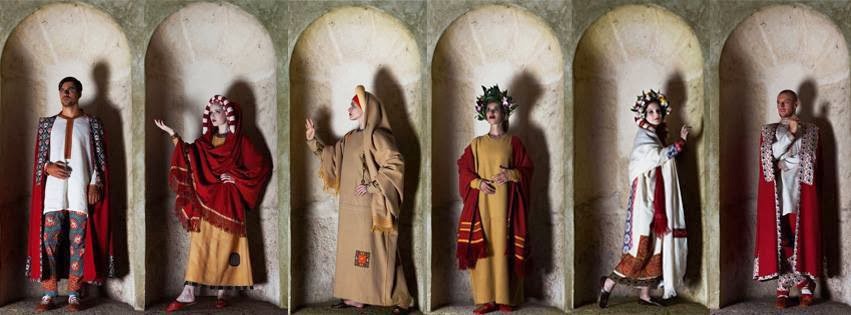
If I have my way, they'll be MY Antinoöpolitan trousers, to be based on the above cotton-and-flax pattern of little roundels with winged horses. It's one of many astonishing Coptic-Roman fabric survivals brought to light on the 13 expeditions to ancient Antinoöpolis, the city founded by Hadrian in memory of his beloved beauty Antinous and more elegantly known as Antonoé in French, under the command of Albert Gayet between 1897 and 1908. Our dear friend Cressida Bell, designer of my prized dressing gown, won't do it as the artwork has to be her own. But wouldn't the jambières look splendid, to judge from the model wearing them behind 'Thaïs' (explanation below) in this leading image for the Musée des Tissus in Lyon, which has just held the most spectacular exhibition of the finds. I don't have credits for all the images, which I think are without exception publicity for the show, though I assume the below is, like the above, by Pierre Verrier.


Returning to the great museum, which we saw on our first visit to Lyon, and discovering this exhibition was serendipitous. It happened to be round the corner from where I'd had my lunch interview with the great violinist Vadim Repin, reason for the visit. I thought I'd look at the Musée des Arts Decoratifs in the same mansion, not having seen it first time round, and asked if there was a special ticket. No, said the incredibly friendly and helpful people at the desk, only a combined one, but when I mentioned how much I'd loved the Coptic fish tapestry in the Tissus, they told me there was a companion piece and much, much more in the exhibition. This still remains the absolute highlight of my four visits to the fabulous French city.


Having just walked round the Viking exhibition at the British Museum, private view last night courtesy of the diplo-mate, I was reminded how selective a view we have of the ancients according to what's survived - for example, I'd love to know if the fierce Norsemen had tattoos, and if so, what they looked like. At least we know they filed and probably dyed their front teeth to look terrible in battle. But the dry middle Eastern climate has preserved not only those sensational encaustic Fayum portraits which are the first painted great ones of their kind (the only labelled specimen from Gayet's expeditions pictured below),


but also the formal and everyday wear of well-to-do Roman Egyptians. Much needs reconstructing, and the Musée des Tissus has done just that with its photographed models,


but the scraps - sometimes more - give an incredible impression of what those people wore. Needless to say I was hooked by the garments of the lady called Thaïs, who may well have been the legendary courtesan - Gayet's sponsor Eduard Guimet certainly liked to think so, as Massenet's heroine was then popular at the Paris Opéra - and above all by the mythological scenes on the shawl belonging to one Sabina, perhaps the most extensive masterwork in the exhibition. Then there were the embroidered slippers.

The last room has three climactic offerings - fabric-wrapped mummies, with hair intact, of three officials including this fonctionnaire à la pourpre (translation, anyone?)


Very well, three mummies may not be as gobsmacking as the largest of all Viking ships, with modern Danish craftsmanship recreating the entire frame, which greets you in the last room of the new exhibition space at the British Museum, but it was an impressively designed way to finish. I have a great deal of digesting to do, as I bought the lavish catalogue, and my French is halting.

The 24 hours in Lyon passed very pleasantly. I went back to my old hotel near the Opéra in the Presqu'ile between the Rhône and the Saône, the very quiet Grand Hotel des Terreaux which I warmly recommend, now rather over-designed but calm and intimate still (even if it's weird to have breakfast in the chlorine-smelling, humid room with the swimming pool). I arrived via the tram from the airport, walking from Part Dieu to the Terreaux, and hit quite by accident the new Les Halles de Lyon, which you'd have to go out of your way to find: shame they knocked the old glass building down in crazy redevelopment in the 1960s, but the smells and the swishness were impressive.

I remedied the bad impression gained from walking down the central Rue Auguste-Comte last time I was here and finding it full of fast-food joints by exploring the parallel streets in the grid plan, full of boucheries, boulangeries and patisseries probably cheaper than the chain names.


I didn't have a great meal this time in the food capital of France, just a good one, but have earmarked places to visit on return. Here are Vadim and I after lunch in his hotel brasserie, photo taken on his phone by the very nice waitress.


Downpours arrived after that, which made the museum a good choice, but my morning stroll took in the usual views. The Place des Jacobins


and the main square, the Place Bellecour, with the not very lovely Notre-Dame de Fourvière on the hill near the Roman remains across the Saône and the statue of Louis XIV by Lemot in the foreground


and the big wheel at the other end.


After the exhibition, I worked my way back in the pouring rain via a patisserie selling superb cannoli, the Romanesque St Martin-d'Ainay, closed by late afternoon


and an alternative route through Vieux Lyon, accidentally stumbling across the hotel which Vadim told me made the best madeleines (he'd admired my Proust watch). But the receptionist shook her head blankly when I asked, so it was back to tea in the hotel before the tram to the airport and a two-hour-delayed late flight). I'm looking forward very much to returning in April.