
Referring, of course, to the action packed world of Mozart’s
Le nozze di Figaro, currently running at Glyndebourne in a very classy touring
version of Michael Grandage’s production, rather than the Study Day before it,
masterminded by Sarah Lenton with a pair of excellent actors (Anna Brecon and Marcus Hutton) to take on
multiple roles and in which I played my part as the morning's musical guide. In the afternoon's session, singers who will take over the roles of Susanna and Figaro later in the tour, Ellie Laugharne and Derek Welton, were joined by Marcellina Jean Rigby for a guided tour around some of the treasures.
Preparing to condense the joys of Figaro into one hour (!) only made me fall head over heels in love
again with this most flawless of all musical comedies – though I wasn’t
expecting so much from the Grandage show as revived by Ian Rutherford;
production photos suggested a facile disjunction between the late 60s costumes
and the crumbling elegance of a Moorish palace (fabulously designed by Christopher Oram and often evocatively lit by Paule Constable).
While I’m not convinced that the chosen era and its fashions went much beyond the decorative, I did suspend my disbelief at the whole shifting of the class boundaries from social to financial – ‘l’argent fait tout’, as Marcellina sings, in this bohemian world – and thought the evocation of the time added mostly a sense of fun. Jiving and twisting lent a groovy weirdness to the behaviour of Bartolo (Andrew Slater, most amusing) as well as a delightful exuberance to the wedding fandango. Floppy hats made the ladies’ disguises in Act Four more plausible than usual, despite the difference in their heights. And a terrific wig + Zapata moustache + funky flares + flowery shirts + a nice array of waistcoats dolled up the Count to make him a mixture of sexiness and absurdity.
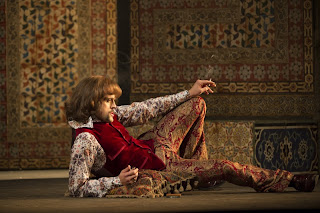
While I’m not convinced that the chosen era and its fashions went much beyond the decorative, I did suspend my disbelief at the whole shifting of the class boundaries from social to financial – ‘l’argent fait tout’, as Marcellina sings, in this bohemian world – and thought the evocation of the time added mostly a sense of fun. Jiving and twisting lent a groovy weirdness to the behaviour of Bartolo (Andrew Slater, most amusing) as well as a delightful exuberance to the wedding fandango. Floppy hats made the ladies’ disguises in Act Four more plausible than usual, despite the difference in their heights. And a terrific wig + Zapata moustache + funky flares + flowery shirts + a nice array of waistcoats dolled up the Count to make him a mixture of sexiness and absurdity.

American John Moore, who plays Almaviva until the tour
shifts base, couldn’t have been better: an assured actor, reining in any
caricatural aspect by striking a fine balance between preening and insecurity, and as a
singer of impressive control never overdoing or forcing the big vengeance aria
in Act Three. Which was where, in this musically brilliant and up until then pacy Figaro, we finally
took a breather and allowed the aristocratic characters their display.

Layla Claire’s Countess, drifting around in floaty dresses and platform shoes, was more than equal to hers, drawing on luscious resources of colour and ornamental prowess so that you felt she could do anything in ‘Dove sono’: likewise, a finer Rosina I’ve not seen on stage (though Dorothea Röschmann at the Royal Opera was wonderful on a bigger scale; but Glyndebourne's is really the ideal for this work - no need to test the singers' projection any further).

Layla Claire’s Countess, drifting around in floaty dresses and platform shoes, was more than equal to hers, drawing on luscious resources of colour and ornamental prowess so that you felt she could do anything in ‘Dove sono’: likewise, a finer Rosina I’ve not seen on stage (though Dorothea Röschmann at the Royal Opera was wonderful on a bigger scale; but Glyndebourne's is really the ideal for this work - no need to test the singers' projection any further).

Joélle Harvey, a petite Susanna with excellent eyes for comedy, followed the distinction of Claire's set piece with a heavenly Act Four serenade. Taking the Study Day folk through it, I’d mixed and matched Reri Grist (regal for very slow Klemperer), Barbara Bonney and Lucia Popp, but Harvey had her own subtle charms to rival them all, including a last-minute gem of gorgeous ornamentation. Only the Figaro pictured with her above, Guido Loconsolo, fell behind the other three principals – and behind conductor Jonathan Cohen’s vigilant beat; the only times in the whole evening where energy levels dropped were in his ‘Non piu andrai’ and ‘Aprite un po’ quegli occhi’. I must say I didn’t mind the Marcellina and Basilio arias being cut from Act Four; to have heard them would have marred what felt like structural perfection. And, as we'd discussed earlier, it makes you realise all the more how Mozart and Da Ponte raise the servants to the level of their masters when their arias stand in similar relief.
Cohen did a superlative job of making the numbers flow so
that the first two acts dazzled with their action: fast tempi, very often, but
with plenty of breathing expression from strings and wind. And the deftness of the Overture was well worth keeping down the curtain for (in the main season, the Count and Countess drove up to Aguas Frescas in a sports car - not a touring option, if you see what I mean, and the revolve which revealed the different rooms of the palace had to go, too. Optional-opulent extras both, I'm guessing).
So much depends, in comic terms, on the right pace from the conductor: I got goosebumps of sheer pleasure when the music slowed to reveal Cherubino hiding, or Susanna stepping mock-innocently out of the closet. The recits were delivered with gilding style from fortepiano continuo player Ashok Gupta, and such quick-witted meaning from the singers that you’d have thought all the members of the cast were native Italian speakers (whom to credit most? Grandage? Rutherford? The conductor? The language coach?)

So much depends, in comic terms, on the right pace from the conductor: I got goosebumps of sheer pleasure when the music slowed to reveal Cherubino hiding, or Susanna stepping mock-innocently out of the closet. The recits were delivered with gilding style from fortepiano continuo player Ashok Gupta, and such quick-witted meaning from the singers that you’d have thought all the members of the cast were native Italian speakers (whom to credit most? Grandage? Rutherford? The conductor? The language coach?)

Kathryn Rudge may not have been quite the most quicksilver of
Cherubinos, but Cohen got such a spring from the furtive ecstasy of
pizzicato strings lining ‘Voi che sapete’ that the spirit of delight steered us
happily through. The superhuman happiness of the great Sextet and the Countess’s
pardon rose to the heights, too. Not much more to ask, then (except a stronger
Figaro); and if the production found no novel ways of expressing the ensemble
oppositions and the comic twists, then we were fairly comfortable with that
since the singers all seemed happy in their characters’ skins.

Glyndebourne rehearsal standards had clearly wrought the usual high-level results. The work's the thing, and thanks especially to Cohen, his Count, Countess and Susanna, we all came out reeling afresh at Mozart’s comic genius.


Glyndebourne rehearsal standards had clearly wrought the usual high-level results. The work's the thing, and thanks especially to Cohen, his Count, Countess and Susanna, we all came out reeling afresh at Mozart’s comic genius.

As for Glyndebourne, it was looking especially enchanting on
a sunny Sunday morning, when I arrived for the soundchecks: dew on the lawns
and mist on the fields. Something of that brilliance had faded by the time I
took these pictures in the late afternoon, but the essence of the early autumn
mood down by the lake remains.

All production photos by Bill Cooper for Glyndebourne

All production photos by Bill Cooper for Glyndebourne


 Posts
Posts



