Two days in a bright Budapest, with unforgettable evening concerts, have happened since, and way too many good London things, but I'm not yet ready to let go of the last of the Mediterranean autumn light. So indulge me in another photojournal to follow the beachcentric idyll, bearing in mind once again that we all need retreats like this to strengthen us for the big fights for democracy ahead.
Memory of what we students did on our Nafplio stopover in 1981 is restricted to a swim and the weird circumstances of an evening meal, and probably we were using the town as a base to explore Mycenae and Tiryns before moving on to Epidavros (where I do remember Prometheus Bound drowned out by a footballish audience and sleeping under pines in the car park). But why on earth didn't we climb the 890-odd steps to the fortress of Palamidhi when we were so young and fit?
Well, it revealed itself in sharp and brilliant light this time, though I confess we didn't do the climb. I was willing, but host Louise drove us up to make the most of the day once we'd idled away a morning on her balcony. We went via the Bavarian Lion, brother of the one in Lucerne (if I remember correctly) and carved into the rock at the orders of Ludwig I to commemorate the soldiers who died in an epidemic in 1833-4.

Near here the National Assembly elected Otho first king of Greece in 1832.

A year earlier, regent Capodistrias had been assassinated on the steps of Ag. Spiridion.The interior is slightly crumbling and mysterious.
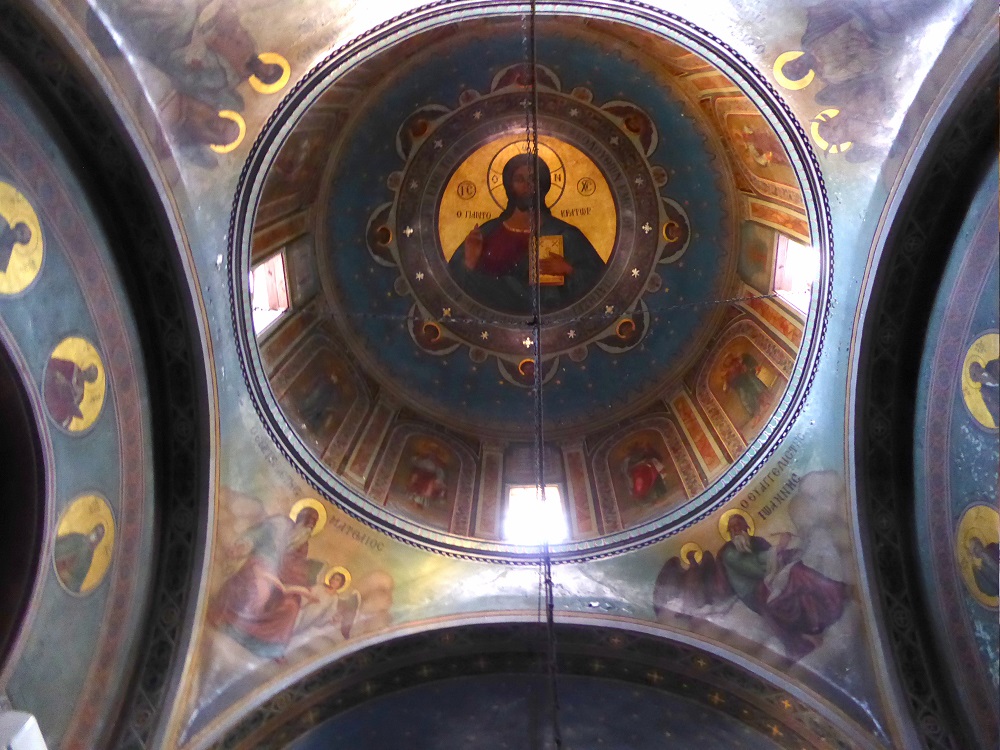
Ag. Georgios serves as the cathedral and boasts a fine early 18th century Venetian portal.

The marble statue of Capodistrias in one of the park-squares beneath Palamidhi is overshadowed by the equestrian figure of another freedom-fighter, Theodoros Kolokotronis (1770-1843), victor over the Ottomans in an earlier battle during the Wars for Independence. The sculpture is by Lazaros Sokos, erected in 1901.

Nafplio's extraordinary possibilities for fortification have resulted in various spectacular castle-ruins: the Greek, Frankish and Venetian ones of Akronafplion, and Palamadhi towering above it at 215 metres. Here's a view from the latter down to the former, which forms an attractive green peninsula beyond the town.

Named after Palamedes, mythic descendant of Poseidon's son Nauplios, putative inventor of lighthouses, dice and scales, pioneer of navigation, the Venetian big 'un was constructed in 1711-14, so not as antique as it looks; it was recaptured by the Turks in 1715 and then retaken by Kolokotronis in 1822. Its layout of multiple bastions is very complex to grasp, and we didn't reach the main gate with the Lion of St Mark

until we began our descent. We spent most of our time around the upper bastions

with the most spectacular views across to the mountains.

Flora and fauna were out in the midday sun: a single crocus,

a Painted Lady butterfly

and this bird - a lapwing, could that be possible?

Slowly and reluctantly we left the peace behind - as on our walks to the beach, total silence apart from the sound of the sea and occasional birdsong - and headed downwards.

If you had to choose between ascent and descent, the latter would win because of the way the old town unfolds as you descend.


Though it's not huge, you can wander for hours. There were very few tourists in November even on the main drags. Louise's Paralos shop

is just as you head out towards the sea, with some very grand buildings beyond.

Some are crumbling, but the swan and dolphin ironwork here is lovely,

and some prime shop territory is lying empty, only sign here of the Greek crisis. There are three attractive Turkish drinking fountains like this

and a lovely triangle with handsome buildings a little higher up the slope.

There are few signs of harbour life, but you get an irresistible seafront view across to Boutrzi, yet another fort, this time on an islet - Castel Pasquaglio was constructed by a Bergamasque architect for the Venetians in 1473 - and with Argos gleaming across the Saronic gulf (I'm told the squalid town belies its legendary name).

The Bastion of the Five Brothers lodges splendidly embossed Venetian cannons, all with the Lion of St Mark on them.

Past the church of Panaghia with a more attractive interior than Ay. Georgios, well cared for, featuring a gleaming iconostasis

and plenty of ex votos (though J resisted buying any this time),

is the handsome Plateia Sindagmatos

where kids kick footballs around the well-placed lumps of ancient masonry. It's dominated by a fine Venetian building of 1713, now home to the Archaeological Museum. As this represents the finds of Tiryns and other archaeological sites around - the main treasures of Mycenae, of course, went to Athens' National Museum - it has some select treasures, many of staggering antiquity. The gem strikes you first: a nearly complete suit of Mycenaean armour from a tomb at Dendhra.

The date is c.1400 BC and there's pottery with clear designs on it from as far back as 5800 BC. Tiryns has yielded some beautiful frescoes and these Seventh Century BC terracotta ceremonial masks which the priests would wear as they did the rounds of local houses.

The pig/boar theme is clearly tied up with Tiryns ritual: there's a selection of votive female figures bearing piglets from the Fifth Century BC.

For the first time I almost found myself admiring the geometric pottery more than the much later red and black vase painting, but of course couldn't resist this red-figure hydria of 440BC showing Orestes and Clytemnestra

while, though not of huge antiquity, the sketchy quality of the Odysseus and Circe on this Boeotian skyphos adds to the suggestive magic of the scene.

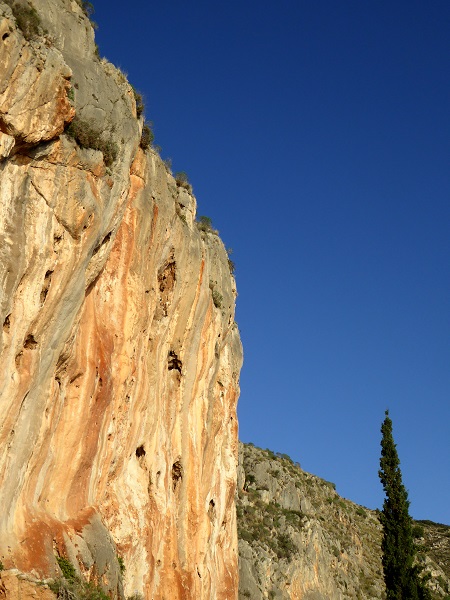
Our tour of the two beautifully-laid out floors over, we met up in the square with our next hosts who were to drive us to the ferry over to their dream island of Spetses, which will be the last instalment of this self-indulgent travelogue. Before we leave the mainland, though, here's an antiquity of sorts which our driver host spotted as we reached the pass of the last mountain before descending to the coast.

He was heading for the road from a layby (where Nikos saw him), so I hope I turned him in a more promising direction.




 Posts
Posts