Showing posts with label Norwegian Chamber Orchestra. Show all posts

Friday, 28 April 2017

Well chosen, BBC Music Magazine


I wasn't able to be at the BBC Music Magazine awards this year - too busy Snow Maidening in Paris - but at the end of my write-up of last year's ceremony, I pointed out that the Smetana Trio's disc of Martinů Trios was already on my shortlist for best of the year already (pictured above, violinist Jiří Vodička, pianist Jitka Cechová and cellist Jan Pálenícek) . It won the chamber music category at the 2017 awards, and Czechia has been going wild with excitement. What it probably doesn't know is the golden thread that led to the nomination - my Czech friend Jan sending me the disc, my pressing it on reviews editor Rebecca Franks so that it made the pages as another glorious Supraphon issue that might have been in for an award, of Martinů's Ariane and Double Concerto mentioned here, didn't.

As a Martinůmaniac, I'm of the opinion that Maxim Rysanov's disc of sonata, duos and Rhapsody-Concerto could also have won the previous year, and this absolutely delicious tetralogy of cantatas ought to do so in 2018 (that review isn't found on the hopeless BBCMM search engine).


Golden times for the reassessment of the last towering figure of the 20th century not to be widely acknowledged as such. And on 9 May you can hear Nicola Said reprise her Ariane in the final scene from that little masterpiece at this year's Europe Day Concert in St John's Smith Square. That's all I'm saying on the subject for now.


Frankly I'd have chosen the trios disc as the top award over Vasily Petrenko's Tchaikovsky Symphonies 1, 2 and 5, though I'm proud that I enthused over that one, too, in the pages of the magazine (again, the search engine on the BBCMM website doesn't locate it). The May issue had a riven choice over raves - which should be Recording of the Month, Paavo Järvi's Strauss Heldenleben and Don Juan with the stunning NHK Symphony Orchestra, or 87-year-old Bernard Haitink's latest Mahler 3? Rebecca went with Paavo in the end. And in the June issue there's going to be a spotlight on another stunner, leader of the Norwegian Chamber Orchestra Terje Tønnesen's transcriptions for string orchestra of the two Janáček quartets, the First also to be heard in the context of a thrilling adaptation of Tolstoy's The Kreutzer Sonata read in both English - brilliantly - and Norwegian by the actor Teodor Janson. It's the luck of the draw - months can pass with only three-star-max discs, and then all these glories come along at once.


Anyway, I'm proud that the magazine continues to flourish in difficult times. And now, on the BBC front, we have the Proms to get excited about - for me, it's one of the best seasons on paper for years. The launch is always fun, and that was another one I had to miss last week. A single highlight for me? Jakub Hrůša's all-Czech variations on a Hussite chorale with the BBC Symphony Orchestra on 26 August. On 13 August, before a double whammy of Rachmaninov's Second Symphony in the main Prom and the Vespers sung by the brilliant Latvian Radio Choir in the late-nighter,  I'll be talking about the composer's use of Russian Orthodox chant in his orchestral music.

Thursday, 30 March 2017

24 hours in Oslo 1: Munch's temple of learning


Well, not exactly Munch's: the Aula of Oslo University, built in 1911 for the establishment's centenary, is in a rather conservative neoclassical style, the central part of the old campus at the north-west end of the city's main drag, Karl Johans Gate. Munch transformed it into something else, a pagan edifice with the sun as its god (the Sarastro scenes of Mozart's The Magic Flute would fit even more perfectly in here than in the main assembly room of Freemasons' Hall in Covent Garden). Thus I beheld the exterior on the sunny but very cold morning after the first concert I've heard there, the Norwegian Chamber Orchestra's Mozart sandwich with Leif Ove Andsnes directing two of the greatest piano concertos, K466 in D minor and K487 in E flat major, from the piano.


Somehow Munch's ambitious scheme of 11 oil paintings accords with the main hall perfectly. Needless to say, the abundance of young nakedness didn't go down too well among the greybeards of the university after the competition which Munch won. But he was in no mood for sobriety in his new-found confidence after leaving the Copenhagen clinic where he was treated for mental illness in 1908-9. The pictures were eventually installed in 1916. As I mentioned in the Arts Desk piece about the concert, I knew of the existence of the amazing sun from the cover of a sumptuous Philips boxed set featuring Ozawa's Boston recording of Schoenberg's Gurrelieder. And here it is, up close, shedding its rays on a recognisably Norwegian stretch of coast, complete with rocky islets.


It glints at you from a distance as you walk through the coffered antechamber.


As you approach the last of the pillars, a triptych is revealed,


with, on the left wall, a long panel symbolising 'History' with an old man reading to a young boy,


and, on the right, a rather less successful execution of a woman breastfeeding and raising a family, as 'Alma Mater'.


This entry from the University gives you a 360 degree view, with titles for all 11 paintings. That helps me identify, to the left of the sun here and moving away from it, 'Awakening Men in the Lightstream', 'Women Turned Towards the Sun' and 'New Rays'.


On the right here is 'Men Turned Towards the Sun'


and, looking past the Mozart scores on the stands here, 'Harvesting Women'.


After the concert, out onto the campus


and so to bed. Earlyish to rise, to make the most of my full day before the flight back to London the following evening. I had either side of an interview with NCO leader/motivator-in-chief Terje Tønnesen in the NCO offices at lunchtime, so first I retraced familiar steps, examining the Holberg statue group at the side of the National Theatre, seen here from behind looking towards the Aula,


snapped again the great theatre with the Ibsen statue on its left side - happy memories of the superlative Peer Gynt I saw there -


and then walked around the magnificently detailed, essentially 1930s City Hall, which I went inside on a first visit to Oslo,


down to the central harbour - the statues, I'm assuming since I can't find the information anywhere, are by the ubiquitous Gustav Vigeland -


and up steps past a statue of Roosevelt, erected in 1950 in gratitude for America's help to Norway during and after World War 2,  currently missing his nose (it should be replaced, properly restored, in the summer)


to the Akershus Fortress,


the heart of old Christiania as transformed from its medieval origins by Christian IV.


Last spent time here in heavy snow, which made everything as silent as the grave. Now, in the sunshine, quite a few tourists were out and about, while the soldiers carried on their duties between chats (having two together and a third posted elsewhere makes it a bit sociable, at least).


Down via the Old Town Hall


and some of the few remaining old buildings in the architectural mess that is Oslo today


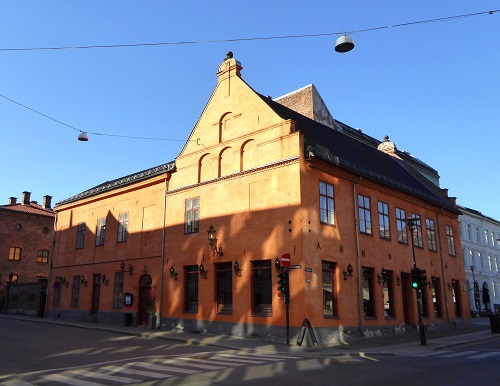
to Sentralen, Oslo's new arts centre and workshop space, converted from the 1901 headquarters of the Christiania Savings Bank. granitic giant with fanciful Venetian touches.


Here, it seems, many of Oslo's major artistic institutions have their office space. The NCO has more spontaneous concerts than those at the Aula - here in a smaller hall there's a bar at the back where drinks can be purchased during the performance.


Strange reference to Auden's 'Stop all the clocks' in a hallway frescoing, though of course I'm always glad to see those lines.


Traces of the old bank remain, like the doors to what was once the safe, maintaining their insignia even though there's more workshop space behind.


So to a delightful lunch round the corner with the NCO's Information and Marketing Manager, Euishin Kim. What happened in the afternoon as I walked to the formerly industrial zone of the city's north eas, previously untrodden territory for me, on my way to the Munch Museum will have to wait until another blog entry.