
Beneath the ground-lapis blue, a man catches a goddess at her toilet and will be transformed into a stag, to be ripped apart by his own hounds, while women are penetrated by a shower of gold (some think that's lovely, I'd still call it rape), chained to a rock to be devoured by a sea-monster until a hero arrives, carried off in a 'rape' by Jupiter/Zeus in bull form. There's still such sensuousnss and beauty in some of Titian's richest canvases for Philip II, who clearly wanted quite a lot of female flesh. The series is a counterpart to the earlier canvases Titian painted for Alfonso d'Este's Camerino. Back in 2003, we doubted if the National Gallery could ever excel itself in its reuniting of the three canvases Bacchus and Ariadne - of course one of the glories of the NG's collection - The Andrians and The Worship of Venus from the Prado; plus Giovanni Bellini's The Feast of the Gods with additions by Titian, courtesy of Washington's National Gallery of Art). But it just has, in another once-in-a-lifetime (or once-ever). All six paintings which may never have graced a single palace room of Philip's are in one splendid gallery, with the earlier masterpiece plus others visible beyond.

Actually there are seven, and I'm a bit confused as to which is the odd one out: the late Death of Actaeon with its very free brushwork, another National Gallery fixture, or Danae from Apsley House? There's also a lot of confusion around whether this is the most 'real' of the many versions, but I'll take it from my great pal Claudia Pritchard, writing in The New European with splendid reproductions gracing her article, that it is, since she's read the catalogue and I haven't. Certainly looks much better for the clean, though apparently it's not the full canvas.

My own pics will have told you that I did get to see the miracle - in fact, on the last day before the National Gallery closed indefinitely, 18 March. I cycled into town and out; J took the tube.Most rooms were empty and we weren't expecting many folk in the exhibition, but there were. Not so many as to make it impossible to avoid the two-metre distancing which we were already taking on board then. I nearly forgot in the thrill (unanticipated, because I hadn't done my homewortk) of seeing the one I'd never encountered 'live' before, The Rape of Europa (1560-2), normally to be seen in the neo-Renaissance setting of the Isabella Stewart Gardner Museum in Boston.

The eye first hits on the best azure sky of the lot - valuable crushed lapis lazuli the pigment, of course - and then to the pink drape that Europe clutches as the bull spirits her away from the shore. I didn't know this when I visited, but the painting had a major restoration in Boston; our friend Jill, picture restorer at the NG, spent three blissful days at the Museum where she was able to see work in progress (for her own most remarkable recent work, see the post on the Mantegna-Bellini exhibition). The sea-life along the bottom part of the picture is wonderful when you get up close, too. It couldn't be more of a contras to the sombre hues of The Death of Actaeon.

I like it that the picture, given one of the two widest unbroken walls to itself, is complemented by the most damaged work of the seven, the earlier (1554-60) Perseus and Andromeda, always a welcome site in the sumptuously revamped long gallery of the Wallace Collection.

We did have an earlier chance to see the two great mythologies with obvious symmetries markig them out to be hung alongside each other, Diana and Actaeon and Diana and Callisto, before they were rotated between the National Galleries of Scotland and London, but there was fresh cause to wonder here.
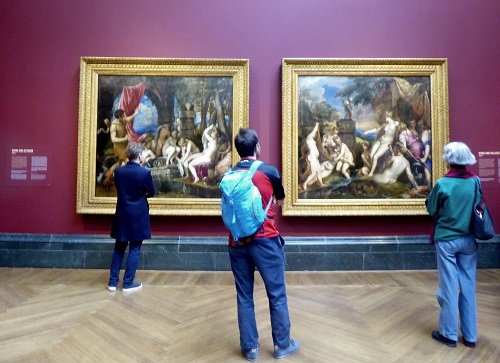
And finally, the original Venus and Adonis (on the right below and up top) is, of course, infinitely superior to the National Gallery copy, which can be seen next door.

We've seen the perspective down to the top Titians with Parmigianinos to the left; here's another great masterpiece, The Vedramin Family venerating a Relic of the True Cross (1540-5, possibly reworked in 1555), hanging on the wall the other side of the exhibition room next to the late Tribute Money.

We also wanted to pay homage to Holbein as J had read, and I had just embarked on, the final instalment of Hilary Mantel's Wolf Hall trilogy, The Mirror and the Light. In which Master Hans appears again to work on the quadruple full-length portrait mural for Whitehall Palace; destroyed, but here was half of it in cartoon form (Henrys VIII and VII), on loan from the National Portrait Gallery while it undergoes renovation.

Well, all galleries are shut now; who knows when they might reopen? But imagination and a good collection of art books at home are sustaing us now. As for Mantel's crowning glory, what a masterpiece, and praise be to this period for the time to take over savouring it. I'm glad The Arts Desk was patient with my slow reading of it; this is the result.
Outside the Gallery, central London felt all wrong. Some have rejoiced in the empty spaces, and Trafalgar Square as a landscape with few figures is certainly unusual,

but the West End is made to teem with life; never again will I curse those crowded narrow pavements of St Martin's Lane and Charing Cross Road. There were still a few tourists about - the Chinese were the first we saw to wear facemasks -

and 'pavement artists' had chalked in expectation of offerings - not great art, of course, yet topical - but were nowhere to be seen.

We quickly gave up; I had a coffee and a bun in Ole & Steen - handwash at the door and on the counters, all cakes carefully covered - and then cycled home. Haven't been into the centre of town since then, and not been on anything more than two wheels for seven weeks. Oddly, I don't mind for now. And the distancing must be maintained for a good while yet, though our disastrous government has once sent out weak signals which will up the death count again.



 Posts
Posts



