Showing posts with label Shakespeare's Globe. Show all posts
Friday, 16 October 2015
A real Oresteia
A false Oresteia is one like Robert Icke's at the Almeida, now transferred to the Trafalgar Studios - rejecting any attempt to translate Aeschylus' tough, dynamic language and setting itself an extra problem in its contemporary setting by starting with the sacrifice of Iphigenia. Magnificent and thrilling as was Lia Williams' performance, you can't slant it all in favour of Clytemnestra; Athena as much as Apollo would be dismayed by that, and the Furies would have too much of a part in civic life.
That there can be a civic life after all that atavistic blood-grudge saga is one of the things that has to fill one with wonder at this oldest of great dramas. Rory Mullarkey makes sure it takes its rightful place in a version which is only an adaptation in that it allows Agamemnon, Choephoroe and Eumenides to be performed in a single evening - in other words, halving the text but keeping the essence of every speech.
Although Mullarkey only studied ancient Greek for a year at school - which sets him at a disadvantage alongside the fabulous Anne Carson, whose Bakkhai in the only faithful-to-the-playwright staging of the Almeida's admirable Greek season was one of the best translations-in-action I've ever encountered, at least where I know the original - he seemed to me to get to the tough heart of the poetry. And I say this as a huge admirer of Tony Harrison's version for the classic National Theatre Oresteia directed by Peter Hall. Mullarkey talks total sense in the programme interview with Heather Neill:
Aeschylus is full of craggy verbal soundscapes, big, chunky language [complex, too - it was a killer to study in the original at university]. It felt necessary to try to capture some of that. Certain writers in English seemed influenced by Aeschylus and I glutted myself with them as I was working on it - Joyce, Shelley, Gerald Manley Hopkins, Allen Ginsberg, Ted Hughes. There's something in the elemental nature of that language, the way the words sing in the air. Later Shakespeare too: the complexity of Leontes' language in The Winter's Tale has something of that muscularity.
If only Icke, and Rachel Cusk in her so-called Medea also at the Almeida, had tried to come up with a contemporary equivalent of 'the way the words sing in the air'. But this kind of verse also needs intelligent, powerful delivery and, by Zeus, it got it in the two key performances.
Katy Stephens as Clytemnestra was all artful command and undercutting irony when she first appeared in a dress of fabulous design by Hannah Clark (top image; all pictures by Robert Day for Shakespeare's Globe). Those raised, sculptured arms, oh my, and that force in the crucial confrontation with son Orestes, which was the first point at which I really got a lump in my throat.
I'm possibly bound to be a bit biased in favour of Joel MacCormack since I regard him as something of a protégé since he participated - entirely on the shrewd instigation of Harriet Walter - in the Hofmannsthal readings as part of the German Opera Discovery Day I curated in Birmingham. There he played a sensitive, almost feminine Octavian and an ardent Composer (in the scene with Zerbinetta, excellently played by Daisy Boulton, culled from the original Bürger als Edelmann backstage scene linking to the operatic Ariadne). Orestes was, on the other hand, going to ask for blood and he delivered it, nervous, volatile and ultimately assured, speaking Mullarkey's pure poetry beautifully. I'd travel to hear his Hamlet, a role he must play soon. Though the Orestes in the Almeida Oresteia wasn't bad, I've forgotten him already; I'll remember this one, and not just because I know the guy.
Electra is more marginal in Aeschylus than she is in Sophocles or Euripides, but I thought Rosie Hilal could have been a bit dirtier of voice and appearance. Still, sparks flew between her and MacCormack.
Elsewhere the acting was variable but never less than concentrated - I was never bored or distracted. Naana Agyei-Ampedu (pictured below with George Irving as Agamemnon) as the spat-upon 'barbarian' Cassandra spoke powerfully, but her words couldn't be made out when she sang.
The sung parts, in fact, were the least impressive part of Mira Calix's often just-right score - not on a level, inevitably, with the extraordinary complexity of Orlando Gough's choruses in the Almeida Bakkhai. But these ones made their point above all in the ritual screwing-up of courage to the sticking-point at the heart of Choephoroe.
Horn, clarinet and saxophone players came down from their box to participate at this point. I liked it that there was no percussion other than what we got from the electronics, much as I miss one of Birtwistle's greatest achievements in his score for the National (unforgettable the shrieking clarinets for Cassandra).
It's difficult to know who was who in the various choruses, though I was especially impressed by the metaphor of the ravening lion devouring an entire household, and the zombie Erinyes, only just a little bit comic, spoke well, too (which actress is this below?).
Still not sure why Adele Thomas' ancient-versus-modern production had the chorus in the first and last plays dressed in what looked like grey-black post-Second-World-War garb, and there was sometimes a home-made look about the presentation, but Clark's costumes usually came to the rescue.
The final Globe jig around an enormous gold phallus was well earned, a cathartic coda to a play which, whatever one may think about its patriarchal concessions, always surprises in its measured speeches after the horrors of the two before it. They'd sold out of Mullarkey's text in the shop, so I've ordered it up along with Anne Carson's proposal of a different Oresteia - Aeschylus' Agamemnon, Sophocles' Electra and Euripides' Orestes. Let my get my hands on a theatre and the right actors, and I'd be back in the director's chair like a shot for that one. Meanwhile, I hope someone reads this in time to rush to the Globe tonight for the last performance. The beauty of it is you can still walk in and buy a £5 groundling ticket to see top quality acting up close and personal.
Tuesday, 15 July 2014
'O's of blood, tears and delight
As in wooden O for Shakespeare's Titus Andronicus and fairground circle for Rodgers and Hammerstein's Carousel, though neither the Globe nor the splendid new(ish) Arcola Theatre in Dalston were quite as I'd seen them before.
William Dudley's splendid designs for a space I thought had thrown at us all the magic it could over the years - how could I have missed this bloody shocker first time round? - swathed the stage and its pillars in black, making characters almost ghost-like as they retreated from the incense-smoked sunbeams that pierced us Groundlings on a hot summer afternoon, and strung black banners from a kind of oculus, half Rome Pantheon, half Colosseum (which I read sometimes appeared to the ancient Roman public similarly festooned).
Further north the company Morphic Graffiti achieved the impossible: staged a spectacular musical which begins with a waltz to accompany that object of childhood wonder, the carousel, by inscribing a circle in the most intimate of spaces. They stinted neither on the choruses - doubling as circus acts - nor on the dancing: imagine it, that whole Agnes de Mille fantasy ballet in Act Two complete. It may have seemed as old fashioned to us as the 'sometimes when a man punches a woman it can feel like a kiss' line (I paraphrase), but neither was passed over. Odd of me to claim delight in both cases, too, but since Shakespeare's violence is almost as strip-cartoony as Tarantino's, there was an element of ridiculous fun to it. Production photos by Simon Kane for Shakespeare's Globe and QNQ Creative for the Arcola.
Both casts were excellent, the Titus team perhaps more variably so despite obviously superlative direction by the dependable Lucy Bailey. Obi Abili as Aaron, the dodgily black-of-face, black-of-heart Moor, didn't send shivers at first with threats of what he might do, but the whole semi-farce of saving the baby Tamara has produced with him
was powerfully undercut by his hideous murder of the Nurse to shut her mouth. I can imagine a few Groundlings swooning at that. One passed out in the first half, at the point if I remember correctly when Titus chops one of his hands off, on the afternoon we went, but there weren't as many faintings as the advertised average. Me, I just looked away when I knew violence was coming and let Django Bates's use of scary percussion do its worst. Bates's score is superb, brilliantly executed by musicians wielding a range of pagan brass instruments - stunning hunt scene - and never more original than in the weirdly off-kilter banquet music, jolly-sickly-doomy, when of course we know what, or rather who, is coming to Tamora baked in a pie.
The women (Indira Varma as Tamora, pictured above right, and Flora Spencer-Longhurst as the grotesquely mutilated Lavinia) both had bags of character, and Matthew Needham carried off the feat of freezing the laughter on our lips as a capricious, half-crazed Emperor (on the left above). But William Houston dominated, as he always has ever since I saw him as a spunky young Henry V for the RSC. Dare I say he's aged rather rapidly? But then roles like Titus now become him.
He sounded at first as if he'd rasped himself out - the voice so magnificently used over several octaves had lost a bit of its cut. But the madder, or the madder-seeming, the abuser abused becomes, the more did he tickle us Groundlings and make our flesh duly creep. In this he gave Anthony Hopkins, never better in Julie Taymor''s stupendous film, a run for his thespian money.
I took godson Alexander for his first taste of the Globe, and he couldn't have had a better one as the violent hordes rampaged within and around us - 'move!!' - in the Groundling arena. I put it up there with the two other best Globe experiences I've had: the all-male Twelfth Night, which we saw three times during its first two manifestations there, and Kathryn Hunter's thrilling realisation of the near-impossible Pericles, similarly imaginative in its use of the space (I shan't forget the creation of the storm-driven ship or the harpies rampaging around the netting above us).
Carousel, of course, is a gentler experience in some ways, but its tough undertow hits as hard as (presumably) did Billy Bigelow his over-patient Julie. The crucial domestic violence issue, seemingly mishandled by Hammerstein from our perspective, was given its edge by updating the action from the 1890s to 1930 for the first stage of the drama (depression-era troubles) and 1945 for Billy's return from Up There (a time of liberation for women tainted in retrospect by the impending back to the kitchen - not for Julie, of course, at least under the thumb of another man, for she ain't going to marry after Billy).
Well, I guess we still have to take it for what it is: and still, in 1945 as the year of Carousel's premiere, that was somewhat. The through-composition of the early scenes, above all the stupendously poetic 'If I loved you' sequence, still comes across as one of the finest achievements of musical theatre (and that tune is, perhaps, only matched by Sondheim's 'Too many mornings' from Follies for sheer love-duet moonshine).
It always amazes me how talent pours out upon the current musical stage, partly due to the fabulous training in the London drama schools. Ascribe to that the note-perfect Julie of Gemma Sutton, emphasising the girl's singularity simply by her stillness and implicit strength, and Vicki Lee Taylor's lovely Carrie. And welcome a great new voice to the stage, Joel Montague's rich baritone as Enoch Snow.
Howard Keel's film performance as Billy - it was supposed to be Frank Sinatra, who even got as far as recording his songs - leads me to expect the same timbre from our lead.
Not so. Tim Rogers, looking just a bit like fellow Aussie Hugh Jackman when he swept so many of us off our feet as Oklahoma's Curly at the National, has a slightly worn tenor voice. But such was his intensity and conviction that high points like the great Soliloquy always hit the mark. Did I weep at 'You'll never walk alone'? You bet, but especially because the intimacy of the space allowed Amanda Minihan's freshly interpreted Nettie (centre below) to sing it as a soft lullaby with Julie held close.
Splendid company work, too - exceptionally good dancing, strong choruses, as I've already intimated, and everything filled with convincing business under Luke Fredericks' expert hand. Impressive how the New England coastal setting can be conjured by the evocative text alone when the imagination has to work overtime. Careful handling meant more tears for the finale: less, in the form of a cappella harmony, was more, when it came to emotional truthfulness, than the big Hollywood/Broadway treatment. The five-piece orchestra emphasised the delicacy and grace of so much in the score, dominated by the sound of Alex Thomas's harp. And look, listen, no miking: Menier Chocolate Factory and others, please pay attention. It just isn't necessary in venues like this.
Yet how amazing that there are so many of them serving musical theatre so well: the Arcola in the north, and that constellation of South Bank gems the Union, the Menier and the Southwark Playhouse. A golden age indeed for off-West End dazzle. You have until Saturday to catch this unique Carousel; my apologies, but Titus has already crept into his unholy grave, and Lucy Bailey has moved on to a very peculiar-sounding Importance of Being Earnest. I'll find out for myself how she deals with a veteran Jack and Algernon tomorrow night.
Monday, 11 February 2013
On the bones of the Crookback
Pausing in the middle of a demented schedule to bring you a topical shot by Simon Annand: the supernaturally brilliant Mark Rylance, whose penultimate Apollo Theatre performance as Richard III I saw on Saturday afternoon thanks to an unexpected return ticket, catches up with the news from a York car park.
I can't wait to burble about one of the great performances I've witnessed in several decades of remarkable Shakespeare (another, of course, was Rylance's Olivia in the Globe's Twelfth Night, which I saw three times on its first and second outings). I count myself lucky also to have witnessed David Troughton's bunchback in a haunting RSC production by the late Steven Pimlott, and Kathryn Hunter preceding Rylance at the Globe in another funny/psychotic characterisation let down by weaker women in her supporting cast (Rylance's team, and Tim Carroll's production, were nigh perfect). Anthony Sher and his thousand and one things to do with a pair of crutches hadn't worked for me in the same way.
Enough: back to the second act finale of Mozart's Magic Flute as I round off six sublimely influenced sessions at the City Lit. More anon on Rylance's theatrical genius.
Friday, 4 May 2012
Cymbeline of South Sudan
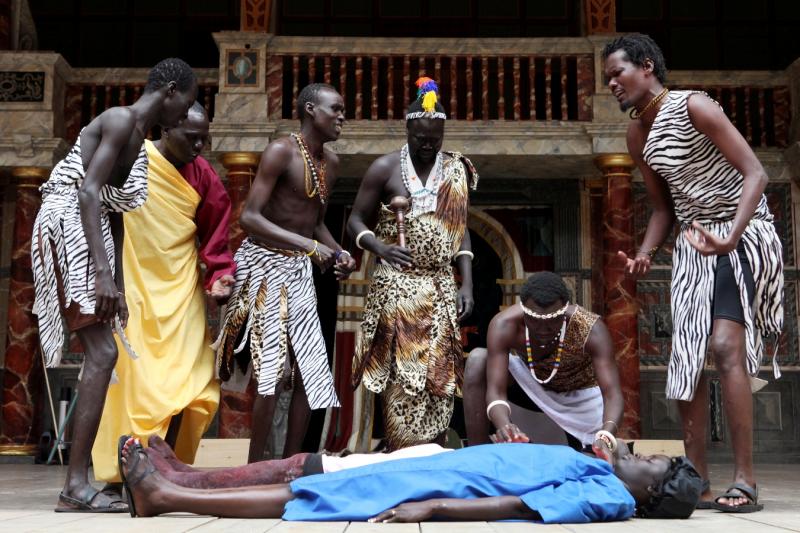
Of all the Globe to Globe ventures, the visit of the South Sudan Theatre Company seemed the most likely to be overwhelmed by its background story: theatre folk and poets coming together in a country less than a year old, still torn by strife when it should be building its new peace, to tackle an unfamiliar text. Not that Cymbeline is among the Bard’s most studied plays anywhere – I discovered a special fondness for it at university - but the circumstances here seem especially fraught. For two decades no English books were permitted by the Sudanese government in the north, so having the text translated into Juba Arabic, a language subject to an oral rather than a written tradition and one formerly suppressed under British colonial rule, was a double victory. This excellent little film draws you in to the newly-formed company's preparations.
How was it, in practice? Very rough and ready: some
tentative entrances, plenty of stand and deliver, actors talking over each
other rather more often than was in the interests of lively drama. But there
was no mistaking these Africans’ enthusiasm and instinct for storytelling, the
way they slipped so easily between punctuating drumbeats into the Globe’s best
house style of engaging the audience and resonantly addressing invisible gods
(I hear the six Italians’ crazy version of Julius Caesar later on Wednesday
needed miking: che disgrazia!) The tradition of strolling players was alive and
well here; you could well imagine this team putting across the essence of the
play vividly to assembled village people al fresco. We don’t find the
raising of a sleeping maiden’s nightdress cause for a good laugh, but cultures
can’t always be expected to agree.
How much does the story reflect South Sudan’s struggle for liberation, as has been claimed? Not a great deal: though peace and reconciliation must resonate in spite of very recent Sudanese evidence to the contrary, the conflict between Cymbeline of the woaded Britons and ancient Rome is, at least until the very late stages of the play, mere background for the wanderings and trials of the king’s daughter.
‘Heavenly Imogen’ I’ve always thought of as a kind of Alice cast adrift in a grotesque wonderland when separated from her beloved Posthumus. She fends off the advances of his scurvy friend Iachimo, who wrests love-tokens from her unknown by sneaking into her bedchamber concealed in a trunk (here he snakes out of a trap door). She wakes from the effects of a death-simulating potion alongside the headless body of her wicked stepmother’s silly son Cloten, killed by a young man under provocation who will turn out to be her brother, and takes the torso to be Posthumus. The lengthy reconciliation scene is full of what a friend of mine calls ‘I was that toothbrush’ moments.
All this was strongly evoked by the South Sudanese actors, with (I fancy) very few cuts and minimal help from the scene summaries in the LED paratitles. It was impossible not to warm to the indignation and passion of Margaret Kowarto’s Imogen (prone in the above photo) or the dignity of Francis Paulino Lugali’s Posthumus. But the festival’s ongoing problem, which can occasionally be a virtue, of not having the text translated back into the Shakespeare original to help the punters made me realize more than ever that the contrived situations of Cymbeline seem merely daft in themselves; it's the poetry they conjure up in the unlikeliest circumstances which gives them sense and wonder.
Here it’s not quite enough to claim that one vaguely feels the force of that poetry in another language without understanding it. The audiences for these shows are incredibly resilient and patient, but they have to be grateful for resourceful mime, jolly dances to clap along to and choice morsels dropped in (non-Shakespearean) English, in which the South Sudanese were as well versed as the Indian actors in the much slicker Twelfth Night. Which of course is far from the whole story, however well that story's told. Shakespeare the poet is largely absent unless you happen to speak the language; Shakespeare the dramatist usually emerges triumphant. Which is enough to keep me going, I hope, to more offerings in this extraordinary world festival.
Production images by Ellie Kurttz for Shakespeare's Globe
Labels:
Cymbeline,
Globe to Globe,
Juba,
Shakespeare's Globe,
South Sudan
Monday, 30 April 2012
Cherokees see Shakespeare slain
Here's a picture which is less remarkable for its execution than for capturing a slice of history not entirely unrelated to the worldwide Shakespeare carnival parading within the Globe. We arrived at the Victoria & Albert Museum the Sunday before last at 2pm, just too late to catch any of the art-college Shakespearean design ‘happenings’ which had by all accounts enlivened so many of the museum’s rooms and galleries. But I and Neapolitan visitor Clara were regaled with fabulously entertaining anecdotes about objects in the theatre collection by curator Geoff Marsh, who’d already given such good value at the time of the Diaghilev exhibition back in 2010.
He gave us the lively circumstantial history of this sub-Hogarthian
artwork by William Dawes, The Downfall of Shakespeare Represented on a Modern
Stage (click on the image for more detail). The darker-skinned spectators in the audience to the far right are two
Cherokee Indians, part of a delegation visiting London in 1762. Chief Ostenaco, diplomatic in
his relations with colonial big-wigs, met George III and sat for Sir Joshua
Reynolds.
What they're watching is an allegorical murder: the triumph of Italian opera in the London of the mid 18th century as represented, it’s thought, by Artaxerxes, over far superior native art (though if we're talking the Artaxerxes of Arne, he of Rule, Britannia! fame, both the libretto and the composer were English, so I'm a bit confused). Which is why Shakespeare lies dead while the operatic hero tramples pages of his plays. The V&A’s website page explains further: ‘In the 18th century Drury Lane and Covent Garden were the only theatres licensed to stage 'legitimate' drama. The popular Italian opera was the province of the King's Theatre in the Haymarket. Things changed in 1761 when the great English tenor, John Beard, took over the management of Covent Garden. He increased the number of opera performances and those of Shakespeare fell.’ More background here.
Needless to say, rumours of our Will’s sudden death were greatly exaggerated, and now visitors once perceived as exotic are more likely to be playing Shakespeare from their own special perspectives rather than missing the chance to see his works on the London stage. I’ve now seen two more offerings in the great Bardic world meeting of Globe to Globe to follow the first play to be performed, Troilus and Cressida in Maori, and I’d be hard pressed to say which of the three was the best. No need to reiterate eulogies on The Arts Desk – on the Swahili Merry Wives of Windsor here and the Hindi Twelfth Night here – but let’s see a couple more images. First, Mrisho Mpoto’s Falstaff nimbly tumbling, if such a thing’s possible, into the buck-basket supplied by Mistresses Page (Chichi Seii) and Ford (Lydiah Gitachu; photo for Shakespeare’s Globe by Marc Brennan).
Now Geetanjali Kulkarni as a feisty Viola in The Theatre Company of Mumbai's earthy - but musically very sophisticated - Twelfth Night. Photo by Simon Annand.
For proof that at least half the audience understood the Hindi, see below. I should hasten to add this was taken before the performance, not during it. And yes, I abandoned my usual groundling place and opted for a seat, since heavy downpours threatened; in the event there was only one.
This week’s Globe to Globe includes a handful of Italian actors taking on
all parts in Julius Caesar; the appearance of the youngest nation, South Sudan,
in Cymbeline; and Richard II from Ashtar Theatre, Ramallah, a staging which
goes some way to meeting the objection of those (including Mark Rylance) who
think Israel’s Habima National Theatre shouldn’t be allowed to appear with its
Merchant of Venice.
Thursday, 26 April 2012
Shakespeare's Maori warriors
With 38 theatre companies and as many languages descending
on the Wooden O across the next six weeks, the least I thought I could do was
to make a long-overdue theatrical outing and honour the Globe to Globe
Shakespeare marathon at the earliest opportunity. I missed the opening, an evidently enchanting dramatization of Venus and Adonis by South Africa’s Isango
Ensemble, but I hied me thither to catch the next event, an extraordinary
Troilus and Cressida from the Maori company Ngakau Toa directed by Rachel House (production photo above
by Simon Annand for Shakespeare’s Globe; shot below featuring Kimo Houltham’s
Troilus/Toroihi and Awhina Rose Henare-Ashby’s Cressida/Kahira from the team’s
admirable website). For a more detailed appraisal of the individual
performances than I’m about to give, read my colleague Matt Wolf’s eulogy on The Arts Desk.
The overall look and sound of it will never be forgotten.
Here were warriors to the life, acting out Shakespeare’s singular and troubling
interpretation of episodes from the later stages of the Trojan war with incredible
vigour, all feathers, bare chests and tattooed buttocks and thighs. They started
with a traditional Maori Haka or war cry to the Prologue’s ‘In Troy [for which
read Aeotearoa], there lies the scene’ - a ritual now on YouTube courtesy of a little Telegraph film -
and there was an impromptu response at the end, too, as our neighbour-groundlings responded with their own earth-shaking tribute. At last we understood just how many audience members had been getting the verbal as well as the physical jokes; the Maori community in London must have joined the actors’ devoted fans from New Zealand.
All this was visceral, goosebump-raising and subtly complemented throughout the play itself by the refined, often spooky taonga puoro musicmaking of participant James Webster. Maybe
the action itself came across as a bit too robust to suggest a war that’s been
dragging on for years; there was little sense of the ‘botchy core’ eating away
at notions of valour and love, though I liked the changes rung by an impish
female Thersites (the chameleonic Juanita Hepi). But one big plus was that the fight
scenes, which are usually the point at which even the best of British
productions buckle a bit, provided a fitting climax, even if the horror of
Hector’s ignoble death at the hands of Achilles’s Myrmidons went for little.
One crucial accompanying element came as a bit of a shock.
The digital panels either side of the stage gave us not a line of Shakespeare
in the original, only the baldest of scene-summaries. So the Bard’s flights of
fancy and disgust had to be semaphored at best, the war-council speeches – and I
was alarmed to find how much of them I’d forgotten since a time when I knew the
play well – passed us largely by, and identification of the warriors on
both sides was even harder than usual (an opportunity missed by the
supertitling in the early parade of Trojans, duly compared to big up Troilus
in Cressida’s eyes by Rawiri Paratene’s authoritatively seedy Pandarus).
Certainly words to the effect ‘Pandarus brings Troilus and Cressida together’ were no substitute for the poetry in
that initially tentative love-scene. So the language, except for those who
understood the impressive Maori translation, was the biggest casualty. I wonder
if the same opacity is to dog, say, the Serbian/Albanian/Macedonian Henry VI
three parter?
Yet it has to be said that the audience went with the general sense of it all; the groundling zone remained as busy after the interval as it had been during the first half. As far as I could judge, this was the most compellingly-realised Troilus of the ones I’ve seen since Howard Davies’s Crimean War version many years ago, with Juliet Stevenson as an against-the-grain Cressida so shockingly bartered and traduced. The unique atmosphere of the whole will resonate in the memory long beyond any of those quibbles.
Full details of the Globe to Globe extravaganza here.
Subscribe to:
Posts (Atom)