The white stuff might seem to be all that connects Orhan Pamuk's dizzyingly rich tale of fundamentalism in Kars, eastern Turkey
and Janne Teller's adult fairy story with a dark core.
But an underlying seriousness of intent and contemporary/timeless commentary underlies both books. They are Snow - the Turkish word, kar, gives an extra layer of wordplay alongside the name of the town and the abbreviation of the protagonist's name Ka - and Odin's Island. Ostensibly the richer, because of its complicated layers, is Pamuk's masterpiece (or one of them - I've quite a few of his still to read).
The framework is semi-playful: Ka is supposed to be the friend of the author, who refers to himself as Orhan, tells us that his hero's key work is a book of poems which has been lost - I was amused to see a critic complain of this as a shortcoming - and takes the liberty of leaping back and forth between Ka's time in Kars and his two spells in Germany. Still very curious how to disentangle fact from fiction, but the internet is no help. Humour is sometimes there in the narrative, too, though it always turns to a heart of darkness.
Nothing is quite what is seems, not idealism, so-called fundamentalism, love, hatred. We have some unlikely revolutionaries in a theatrical couple whose aim is to stage an English classic with a spine-chilling denouement, a poet who pretends to be a reporter and whose ability to see many sides of an argument leads to fatal compromise, love-object sisters who are not quite what they seem. It's a page-turner with plenty of compelling digressions; it speaks both of Turkey's fatal split between those who look west and others who want to preserve Islamic roots. And on it goes, with the latest news the attacks of Erdoğan's right-wing press on Pamuk and Elif Shafak as 'western stooges'.I was going to quote, but it's nearly Christmas and more remains to be done.
Likewise with Teller's Odin's Island. It starts and ends as a Christmas story, with the old chief god lost and forgetful on a Utopian northern island, trying to cope with a reindeer's broken leg. Grown-ups might think this is child's stuff, but when Odin walks across the frozen sea to the troubled mainland, a fantasy with parallels to the Götterdämmerung that is Norse mythology's Ragnarok unfolds compellingly. In between the prologue and epilogue comes the chronicle of an eventful year, presumably the eve of the new millennium, which is when the book was published.
Teller has pure fun as well as tragicomedy with the religious factions who take Odin as a new Messiah (or not). Her semi-mythic boat people are fascinating, too; though the book keeps its feet on the ground with its torn heroine. And the island of the mysterious disappearing act(s) is the other main character. Again, further description would spoil the plot. A thoughtful book to read as we move into what may be the darkest year, at any rate in my life. Good, then, to end with a poem reproduced in full online by the admirable Sam West, Hardy's The Darkling Thrush. The photograph is by Andreas Eichler of Mannheim.
I leant upon a coppice gate
When Frost was spectre-grey,
And Winter's dregs made desolate
The weakening eye of day.
The tangled bine-stems scored the sky
Like strings of broken lyres,
And all mankind that haunted nigh
Had sought their household fires.
The land's sharp features seemed to be
The Century's corpse outleant,
His crypt the cloudy canopy,
The wind his death-lament.
The ancient pulse of germ and birth
Was shrunken hard and dry,
And every spirit upon earth
Seemed fervourless as I.
At once a voice arose among
The bleak twigs overhead
In a full-hearted evensong
Of joy illimited;
An aged thrush, frail, gaunt, and small,
In blast-beruffled plume,
Had chosen thus to fling his soul
Upon the growing gloom.
So little cause for carolings
Of such ecstatic sound
Was written on terrestrial things
Afar or nigh around,
That I could think there trembled through
His happy good-night air
Some blessed Hope, whereof he knew
And I was unaware.
I wish us all some measure of how that 'blessed Hope' may come to pass.
The coup attempt of 15 July failed, as we all know, and though predictably enough President Recep Tayyip Erdoğan has used the fallout to persecute many more than just the infiltrating faithful of Fethullah Gülen's religious movement which launched it, my liberal friends in Turkey persuade me that the Gülenists' success, having infiltrated every institution in Turkey, would have been much worse.
Travelling on Turkish Airlines last week, it was impossible to escape the triumphal literature both in the brochures (pictured above) and on the screen. On the return journey I was drawn back to the time of the last major coup in 1980. Arriving at Bodrum's domestic airport on Sunday, having been discharged from the Acibadem Hospital, I picked up a copy of Orhan Pamuk's Silent House, chiefly because it was set in those days. I suppose four of us had not been so very stupid to travel to Turkey by Interrail the following July; the curfews and the heavy army presence meant we were quite safe (though, terrorists apart, I'm convinced Turkey still is a safe country, and has always been a hospitable one). Friends were more worried that we might be arrested for having drugs planted on us; Midnight Express was then very fresh in most people's minds. Anyway, we were fearless and probably unthinking, but nothing adverse happened to us beyond the clearly malevolent intentions of soldiers around the ancient site of Pergamum.
Dug through the old pics and found some to pepper this entry with - above are my travelling pals Lottie, Christopher and Clive, at Eminönü Harbour shortly after disembarking the train from Thessaloniki at Sirkeci Central Station. All was not entirely well then; I had a massively swollen foot, infected from a cut I'd aquired falling down some steps on the Folkestone-Calais ferry - three days sleeping rough on two trains and one railway platform meant that I hadn't tended to it. Shortly after this, having found a very cheap hotel near Sultan Ahmet Mosque, we walked, or rather I hobbled, across the Galata Bridge, up and along Istiklal Caddesi to the German Hospital (now, I'm told, no more), where I got treatment for next to nothing. Two days mostly resting on the San Hotel's roof saw the foot return to its normal size. So hospital visits have framed my many visits to Turkey to date.
As then, this August trip to the D-Marin Festival was not affected by coup or coup-failure fallout. Once in the relaxed coastal strip around Bodrum, you would hardly have known it had happened, superficially at least. I asked young cellist Cansin Kara, now studying in Munich and kicking off my festival experience at 7am last Thursday morning with Bach's First Cello Suite in a park by the sea, how it had affected him. Apart from postponing his summer return, he said, only in the sensing that people were more anxious. Cansin pictured below on the right at the end of a blissful hilltop early supper above Turgutreis with his contemporary, the equally brilliant violinist Emre Engin.
Fortunately Erdoğan, for all his growing authoritarianism, is no Putin, and there will (inshallah) always be a strong opposition in a country still divided 50/50 between the forces of progress and those of religious conservatism. Just how complicated it all is finds expression in this superb long article by Christopher de Bellaigue in The Guardian. If you don't immediately have time to read it all, this is good for clarification:
Erdoğan trumpets his adherence to the will of his people, but he does not blindly pursue its whims. Having oscillated between Europhilia and Islamic fervour, universalism and isolationism, war and peace, it is clear that his political trajectory is that of a pragmatist who likes to keep his options open. His failure to pursue a ban on alcohol, despite the fact that it would please the base, is another instance of his pragmatism. That he regards secularism as useful - perhaps as a means of averting sectarian conflict - was demonstrated when he urged Mohamed Morsi to build a secular state after coming to power in Egypt in 2011.
I first realised it wasn't all black and white around the coup when my Istanbul friend Serhan Bali, editor and publisher of the Turkish-language classical music magazine Andante, sent me what he'd written on Facebook shortly after the failed coup. No fan of Erdoğan, he pointed out what a disaster it would have been had Gülen come to power. I excerpt:
Why this coup now? The biggest prosecutions for this (Gülen's) movement were to be put into operation in the coming days and when these devotees learned this they wanted to seize power as quickly as possible. As you may guess that was their intention from the beginning, but when they learned that the government intended to close in for the kill, they accelerated their agenda. Thank God they couldn't succeed because it was a half-baked plan, If successful they would have grasped all the power in Turkey, closed the Parliament and invited Fethullah Gülen to the country. He would have descended the stairs of the plane like Ayatollah Khomeini did after the Iranian Revolution.
Erdoğan and Gülen were close collaborators in the early 2000s. Because of this gang hundreds of high-ranking officials in the arms were put on trial because of a pseudo coup attempt. They forged the documents and because of this many generals and colonels were put in jail, accused of having attempted the coup against the Erdoğan government. It was a huge lie. But this partnership deteriorated after Erdoğan felt Gülen's overwhelming presence as a threat to himself and to the country. Gülen had become too powerful a personality. After the war between these two powerhouses increased, attacks from the government began against the Gülenists’ presence in the state and the enormous wealth that they possess in the country.
So much for now; as for then, the atmosphere leading up to the generals' coup of 1980 is well captured in Pamuk's second novel, a polyphony of voices centring on the visit of three grandchildren to a bitter and manipulative 90-year-old woman in the crumbling 'silent house' of the title by the sea near Istanbul. The confused adolescent longing for action in that violent climate is represented by a cousin of the siblings who joins the Nationalists and persecutes the brightest voice in the book, the rather distant one of the intelligent young Nilgün, mostly because he thinks he's in love with her and that she's out of his league.
The characters of the feckless young Metin, who hangs with a vacuous fast set, the bitter grandmother and the compassionate dwarf Recep who runs the household are compellingly drawn. But perhaps the most fascinating figures are the alcoholic historian grandson Faruk, who also gets to speak in the first person, and his grandfather Selâhattin, whose tirades and disquisitions appear through the mouth of his unloving, and unloved, wife. Both, like the invisible figure in between the generations, Faruk's father, are obsessed with trying to pin down the evasiveness of their city and their country through facts and 'true stories'.
Their real-life counterpart, so brilliantly portrayed in Pamuk's Istanbul: Memories and the City, is one of four Istanbullu writers poised, like Pamuk himself, between the influence of western (especially 19th century French) literature on their country and the attempt to find out what it really means to them. They are all in thrall to hüzün, a Turkish word with an Arabic root which Pamuk sets out to define, before devoting an entire chapter to its complexities, as 'a melancholy that is communal rather than private. Offering no clarity; veiling reality instead, hüzün brings us comfort, softening the view like the condensation on a window when a tea kettle has been spouting steam on a winter's day'.
There are so many poetic passages conveying this peculiar state throughout Istanbul, but let's stick to the subject: Reşat Ekrem Koçu, author of the Istanbul Encyclopedia of fascinating facts and unexpected focuses, begun in 1944 but abandoned in 1951 'on page 1000, at volume four, while still on the letter B'.
In just the same way Lonely House's chronicler is destined to fail, to be sidetracked, to have most of his achievement destroyed, and his historian grandson is also destined not to get very far with his amassing of local stories; similarly his notebook is wantonly chucked aside by the negative spirit of 1980. A little of Pamuk on his real-life Don Quixote:
Koçu was one of those hüzün-drenched souls who helped create an image of a twentieth-century Istanbul as a half-finished city afflicted with melancholy. Hüzün is what defines his life, gives his work its hidden logic, and sets him on a lonely course that can only be his final defeat, but - as with other writers working in a similar vein - he did not see it as central and certainly did not give it much thought.
And later:
The real subject [of the far from finished Encyclopedia] is Koçu's failure to explain Istanbul using western 'scientific' methods of classification. He failed in part because Istanbul is so unmanageably varied, so very much stranger than western cities; its disorder resists classification. But this otherness we complain about - it begins, after we have talked for a while, to look like a virtue, and we remember why it is we treasure Koçu's Encyclopedia - because it allows us to indulge in a certain chauvinism.
Koçu was also gay, and Turkish society has always had an ambiguity towards homosexuality when it was not absolutely welcoming of it. I digress to give you a song from one of the greatest singers ever, Zeki Müren, who so amused us back in 1980 (I still have a cassette with treasurable photographic artwork). We didn't appreciate then that he was a great performer of the sanat (classical) repertoire who made it popular with millions. 'Zeki Müren NOT homosexual,' Turks would exclaim in simulated outrage. But he did less to conceal it than his western counterpart, Liberace. And everyone seems to have known that the other great singer of the time. Bülent Ersoy (now 64 - Zeki died in 1996), was a transexual. Take a look at this. Shame, as always, there's no translation, but the hands speak as eloquently as the voice.
My last wish on the Bodrum trip was to visit the Zeki Müren Museum in the town he loved so much. That should have happened before I went to the airport. But the emergency hospitalisation intervened.
Back to hüzun. In Istanbul, Pamuk hints at it before he writes about it, in a wonderfully evocative passage in the fifth chapter of Istanbul.
I love the overwhelming melancholy when I look at the walls of old apartment buildings and the dark surfaces of neglected, unpainted, fallen-down wooden mansions: only in Istanbul have I seen this texture, this shading. When I watch the black-and-white crowds rushing through the darkening streets on a winter's evening, I feel a deep sense of fellowship, almost as if the night has cloaked our lives, our streets, our every belonging in a blanket of darkness, as if once we're safe in our houses, our bedrooms, our beds, we can return to dreams of our long-gone riches, our legendary past. And likewise, as I watch dusk descend like a poem in the pale light of the street-lamps to engulf the city's poor neighbourhoods, it comforts me to know that for the night at least we are safe from western eyes, that the shameful poverty of our city is cloaked from foreign view.
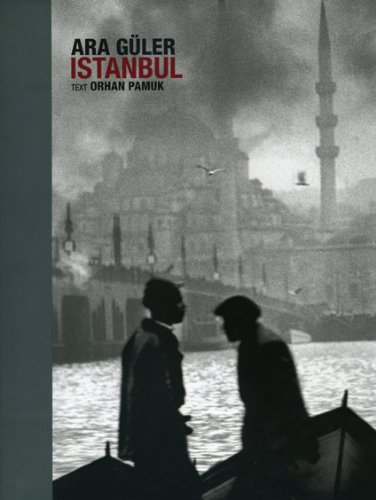
Pamuk finds a kindred spirit to capture the private and public strangeness of Istanbul in photographer Ara Güler, whose archive-library of images from the 1950s and 60s he spent many hours inspecting for images he used in the book.
I ordered this up for J's birthday. Most of the black and white photographs are haunting in one way or another for their street scenes and their panoramas of the Bosphorus and the Golden Horn with the smoke of ships and boats hovering above. Something of this remained in 1981, when Christopher took this photo as we emerged from the station.
If I had to choose one image from the bigger book of Güler's photos it would be this one of Sirkeci in 1956
not least because Pamuk writes about it so eloquently in his introduction. He described it as 'the perfect incarnation of the Istanbul of my childhood,' not for the evocative outward details but because of this:
The way the driver has tilted his head forward, the confusion of the horse as it accommodates this gesture, the clumsy manner in which the cart has strayed onto the tramlines and the way the tram in the background sits waiting, perhaps patiently, perhaps not...what we see here is modernity set against tradition, the ideals of order, discipline and authority set against the disordered helplessness of poverty and technical inadequacy. These are elements at the heart of so many of Güler's Istanbul photographs, and they generate such delightful tensions.
I was surprised, during this June's visit, that so many traces of the old way of life remained - not least those porters carrying such heavy loads on their backs, which first struck me as we headed towards the Grand Bazaar in 1981. There's a fuzzy photo of an overloaded worker in the old album, but this street scene with my three pals at the centre of it is better. It makes a nice counterpoint to my post laden with June photos of Istanbullus.
Did we sense the melancholy then? I think not - youth is too keen to savour what it sees as exuberant exoticism. Soon we were off around the south-west, hitching lifts like this from Didim via Aphrodisias to Pamukkale
and greeted with a friendly curiosity and hospitality wherever we went, not least during an unforgettable evening at a family party during ramadan in Bergama. Fond shot of boys and sheep (soon to be a bairam victim?) in the ruins there to conclude. Those kids will be middle-aged men now.
All observations, questions and challenges are welcome: resistant to tweeting and Facebook (though long converted to LinkedIn), I still like to exchange ideas. You don't have to be signed up, and you can be anonymous, but comments are moderated.
Copyright
If you wish to use any of my own photographs featured in the blog, or any of the text, just let me know in the comments. Acknowledgment and a link are all it takes.




 Posts
Posts



