Showing posts with label rood screen. Show all posts

Tuesday, 18 February 2020

Norfolk churches at New Year


We packed quite a lot into 1 and 2 January up in North Norfolk - a familiar route from Lower Southrepps to Cromer for the fireworks on New Year's Day, starting with the usual perspective of St Michael's tower up across the fields,


and on a duller sequel, weatherwise only, indulgence of my heart's desire to see the famous medieval screen at Ranworth, the most elaborate in the county.


Norwich on New Year's Eve was a disconcerting mix of bleak-midwinter lanes and lights with way too many homeless people, all of the ones I met touchingly friendly (though as I well know Norwich has a big drugs problem). We were there to spend the greater part of the evening at the house of friends Kate and Fairless in Norwich, where I got to meet a poet I much admired, and whose The Photographer at Sixteen I'd just chosen as one of my books of the year, George Szirtes, and his equally friendly and interesting wife, the artist Clarissa Upchurch. Back in Jill's garden, we got simple pleasures from waving sparklers around at midnight - I was thankful not to be in hospital, as I was at the same time a year ago - and then set out not too early the next morning, heading for lunch at the Vernon Arms up the hill in Southrepps village. The sun popped in and out through mists and cloud, eclipse-like.


We spent far too long over lunch, and sunset seemed not too far off when we left. The light was pleasingly on the west tower of St Michael,


and a lingering sunset gave us various lights over the fields.


Walking along a favourite lane parallel with the lovely woods at Frogshall, the moon was apparent


and gnarled trees foregrounded the view back down the hill.


Dawdling a bit, thanks to the camera, behind the others, I took what intuitively seemed a left turn at a road when I should have taken a right. At least I had a good perspective on Northrepps.


After the village, I fell in with a very jolly couple, Sue and David, who had come out for a brief spin with their lively rescue dog, Tyler. They decided to accompany me all the way to Cromer before they turned back along the beach. It was a joy to see Tyler cavorting around the golf course on the way up to the cliffs. We enjoyed the high beam of the lighthouse before descending towards a seaside town that seems to be really on the up again.


They'd loaned me their mobile phone - I'd left mine in the cottage - to contact the others, so we knew we'd meet up at the church where on a previous occasion we'd so enjoyed the party spirit within.


Now I was too late for tea and cakes, but not for the fireworks, which did their usual stuff from the pier,


after which we took a packed train, full of human interest, back to Gunton.

The next morning Jill drove the same route she'd taken to the start of the Churches Walk in September. This time she proceeded beyond Wroxham to a Broadside road towards Ranworth; we were heading for edifices that wouldn't join up so easily on a future walk, due to the disposition of the Broads and channels blocking direct routes. We stopped along the way at the fascinatingly-named Woodbastwick. Bast is a substance found under the bark of lime trees; Danish and Saxon invaders used it for binding in leggings, seen being tied on the village sign.


A green with thatched houses around it is attractive. The church, which goes by a unique dedication to SS Fabian and Sebastian, has a loved, used feel about it, but as it was heavily restored by George Gilbert Scott in 1878-9, there's not a lot to see here, though the Victorian and Edwardian glass is attractive enough. The setting's the thing, the south porch approached via an avenue flanked by some splendid old yews.


The exterior of St Helen's Ranworth barely hints at the treasures within (though why would it? It's handsome enough, not especially grand).


The screen's one of several extraordinary treasures here. You (that is, I) may prefer the angelic ensemble of nearby Barton Turf, with its radiant seraphim and cherubim, which we saw - but not really for long enough - back in September. Undeniably, though, the complete arrangement here is grander, running the full width of the nave. On the main panels in the centre are the twelve Apostles. Left side, with St Stephen to the left, Simon, Thomas, Bartholomew, James the major, Andrew and Peter,


Right side: Paul, John, Philip, James the minor,  Jude and Matthew.


Either side, assorted saints and martyrs both in niched spaces backing altars, seasonably adorned on 2 January. I've clearly missed out on the left altar but here on the right are Mary Salome, the Virgin Mary, Mary Cleophas and Margaret of Antioch.


The angels above come close to the loveliness of Barton Turf.


Indented, and perhaps finest of all, in the centre entrance to the choir are two saints facing each other: George with the dragon


and Michael


with his feet on the seven-headed beast of the Apocalypse.


This saint is especially appropriate in his anniversary year: Thomas Becket, Archbishop of Canterbury.


though the details on Saints Jude, Matthew and Laurence are perhaps more interesting from a painterly point of view.


We have the iconoclasts' habit here of covering the faces in brown paint rather than scratching them out to thank for the saintly ones' survival. Above, on the ribbed coving is a design of local flowers so fresh I assumed it was of a more recent provenance; apparently not, in essence.


The return stalls have a few good misericords


while on the back of the screen behind, a floral design was revealed relatively recently


and the cantor's desk, which I assumed was a later relic, is from the same time, with an eagle and the opening words of St John's Gospel on one side


and on the other a versicle in plainsong.


Looking at the postcards, I was wondering where the obviously wondrous illuminated antiphonary, c. 1400, was lodged. It turned out to be in an unassuming glass case to the left of the south door. You'd have thought this was too precious to remain in an out-of-the-way church and might be more likely to be found in Cambridge's Fitzwilliam Museum, but no, here it is. and open at the most appropriate of the 19 miniature paintings (another featured Jonah and the whale). It's photographed rather well through glass without flash.


We had lunch at a more or less deserted place by Ranworth Broad which clearly caters for mass diners at spring and summer weekends, but at least it had kept a good sign with a design that could almost be by Ravilious.


Then, as gloom and mizzle seemed to be setting in, we abandoned plans for a walk and drove to see two/three more churches on our way to Norwich to catch the train back to London. South Walsham is a long way from North, a small village and not a town, but with two adjacent churches.


St Lawrence (closest in the picture), which was burnt out in 1832 and its chancel rebuilt by 1832; it's now a craft centre where local ladies hardly welcomed us as we walked in with a cheerful 'hello', so we didn't linger. St Mary has a Perpendicular south porch with a Coronation of the Virgin in the niche above the entrance.
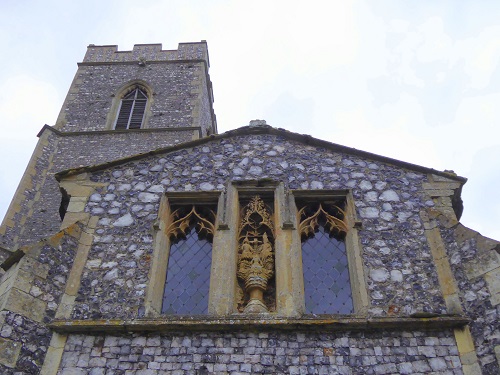

There's also some nicely coloured Edwardian glass, including an unusual personification of Astronomy by R. O. Pearson.


Acle, further south, sounds rustic but no longer is, sprawling along several main roads and its church tower not prominent enough to help you find the building easily. But it lives in its own rather lovely little world, trees lining the pathway to the north porch, and the whole seemingly remote in the gloaming. The round tower has an octagonal 13th century (says Pevsner; 15th century according to Harrod and Linnell) top storey surmounted by statues.


We couldn't find a light switch other than for the porch, so the inspection of St Edmund's gems was also atmospheric, by the light of mobile phones. The font, donated in 1410, is surely one of the best in Norfolk, with four lions and four wild men (wodewoses), identical to the ones in Happisburgh's St Mary, but with remnants of paint still on them.


Around the bowl are (thus Pevsner) 'four angels and the Pietà, the Trinity and further angels with the Emblems of the Trinity and the Instruments of the Passion'.


The rood screen boasts a dado wih pretty ornamentation including multiple IHSes.


This double-headed bench-end looks good by mobile light.


Below the north chancel window are a brass to John Swinne (died 1533)


and above it, not really to be made out in the photo, an early 15th century Latin inscription  from a time of plague.


The translation - for which I'm indebted to Simon Knott's Norfolk Churches site goes thus:

Oh lamentable death, how many dost thou cast into the pit!
Anon the infants fade away, and of the aged Death makes an end.
Now these, now those, thou ravagest, O Death, on every side;
Those that wear horns or veils, Fate spareth not.
Therefore, while in the world the brute beast Plague rages hourly,
With prayer and with remembrance deplore Death's deadliness.

May it not become an incantation in time of Coronavirus.

Friday, 30 October 2015

Norfolk churches 150-166: Cromer to Southrepps


The first of our annual September walks to raise money for the Norfolk Churches Trust back in 2002 focused on the area around where our cicerona Jill's mother lived, Burnham Thorpe. Since then Jill's Norfolk bases have been King's Lynn and now Southrepps, where her moving-in coincided with an astonishingly good August festival featuring top young musicians I'd met earlier in the summer. The plan this time - executed in full despite poor prognostication of the weather - was to cover 16 churches and chapels in 18 miles.

The Friday, when we travelled, was hot and sunny; Saturday, the official 'Ride and Stride' day, was scheduled to be wet until at least mid-afternoon. We persuaded Jill that we could do half of it in sunshine and the other half later on Saturday. But this plan was kiboshed - serendipitously, as it turned out - by the second of several carelessnesses which marked the long weekend: at Norwich we went straight to what looked like the platform where the branch line to Gunton and Cromer has its terminus. Or so we thought until the familiar-looking two-carriage train left five minutes earlier, and as we moved off we saw there was another platform further up to the left where the one we should have caught was sitting.

So we got out at the first stop on the way to Great Yarmouth heading east rather than north, Brundall Gardens, and found out that the next train back to Norwich was in precisely an hour. Phoned Jill, who had to drive a long way to pick us up, and had the chance of exploring two more churches I suppose I could have added to the list. The first was petite St Lawrence Brundall, with its 13th century double bellcote, its lead font and a 16th century roundel of the gridironed saint. The second was hugely impressive and, along with Trunch, the glory of the weekend, St Andrew and St Peter Blofield. Chief of its delights are a tall tower, a stupendous octagonal font with carved scenes from the life of Christ, and some fascinating 1930s windows in memory of local benefactor Margaret Harker, including a scene of fisher girls working at Great Yarmouth.

My own photos of all these treasures and of the day of the walk itself - which turned out absolutely fine much earlier than originally forecast, clear by noon - are lost along with my precious Lumix camera (precious inasmuch as there were other pictures I hadn't downloaded). The hope of its turning up has been the reason for delay in posting here. I'm hugely grateful to our fourth regular walking companion, Cally Brooke Johnson, for most of the shots featured here; I hope she'll forgive me for having fiddled around with them. Her first contribution is of the main temple in Cromer, Britain's best pier according to some poll or other, which we reached by train from Gunton.


We ticked off four Cromer chapels in the rain - one with boarded-up windows in the 'new' cemetery to the south, the one belonging to the Methodists who gave us a warm welcome as they always do, one converted into Cromer's impressive library, and a red-brick Baptist place of worship in the High Street. But the obvious religious high point, in more ways than one owing to its tower (record-breaking for Norfolk), is St Peter and St Paul. This snap courtesy of Discover Norfolk.


A busy coffee morning was in full swing inside, and I'm grateful to the kindness of the local ladies; walking backwards to snap the very odd west window with its bleeding greens, I fell over a step and bruised my spine. By this stage my three companions had exited. The ladies came rushing, sat me down, gave me a coffee and offered me some cake.

Pevsner calls the interior 'a little disappointing' after the external display, but I liked its height and light. The angel roof is Victorian, but splendid. The best glass is William Morris & Co, c.1874, with fine angels and prophets. At the time of posting I'd had no reply to my call for help from Simon Nott, whose Norfolk Churches site always has the most comprehensive images of every church he's visited (just - 1/11 - heard back that I can join Flickr and get access via that, but in the end what I have is good enough). So I settled for this one of the Morris window's lower panels (note the fine angels) posted on Twitter by Caroline Arscott. As I don't do Twitter, I couldn't ask her permission, but I hope she doesn't mind.


Two of the parishioners told me not to miss the early 20th century Catholic church on the road to Overstrand. That meant walking along a road rather than a bit of coastline, but the building's woody, airy interior was worth seeing. Overstrand itself turned out to be quite a religious centre, owing to the Christian Endeavour holiday home lodged within one of three Lutyens buildings in the village. On the way we saw St Martin, ruinous in the 18th century and well restored in the early 20th.


St Martin's one curiosity, not mentioned by Pevsner, is the bread oven in the bell tower. The curious unfolded in abundance when we walked up the drive of the aforementioned CE home, the Pleasaunce. It's an awkward conjoining of two villas into one home for Lord Battersea, the Liberal MP, and his Jewish (Rothschild) wife, a much-loved philanthropist. The family coat of arms, splendid in itself, is somewhat out of proportion to the rest of the facade, worked on by Lutyens in 1897-9, but here I've taken Cal's picture and focused in on it. The motto is 'God tendeth the flowers' - 'not, we hope', says the guide by Monica E Sykes, 'a pun on the family name', but why not?


Opposite are the stables with a massy tower that seems in harmony with the marine surroundings.


Just beyond the porch is one of the Moroccan doors Lord Battersea brought back from his travels, looking good against a background of (I presume) William De Morgan tiles.


We had the CE man in charge's permission to wander the grounds. The present planting has little to do with Gertrude Jekyll's work alongside Lutyens, though the outlines of the circuar sunken garden remain, and the so-called 'cloisters' are rather monstrous but presumably a nice shady spot to sit in the heat of summer.


Although it's not consecrated, we thought we could claim the chapel into which the rather charming gatehouse was converted, with its odd little homage to Palladio inside (no shots from Cal to give a good impression of the interior, sadly).


Returning on Sunday, we tried to see another Lutyens building, Overstrand Hall, but were warned off at the security intercom by the gates. Lutyens' only Nonconformist design, the Methodist Church of 1898, is, as Pevsner says, 'a very curious design', at least in its clerestory with its ten lunette windows, four of which you can see here..


The ladies inside were predictably delightful, and seemingly grateful that their Sunday congregation of nine sometimes got bulked up by the Christian visitors from The Pleasaunce.

Bliss it was to be in Overstrand at lunchtime, because the crab and lobster shack was open and we had lashings of both, probably the best and certainly the freshest I've ever tasted,  in the little yard at the back. I had some rather detailed shots of the fare, all lost; there's the Lumix camera sitting on the table beside me as a sad reminder.


More walking frustratingly close to the coast led us to the real charmer of a church at Sidestrand, moved inland in 1880 from a site now eaten away by the sea. The tower counts in the list of round-tower pursuers - we saw their logo - despite the octagonal upper part.


The inside was so harmonious, making good use of Jacobean panelling. No shot of that, so - having dropped our plan to make an inland detour to St Mary Northrepps, which we saw the next day, in a lovely situation but with nothing to impress inside - onwards towards the coast, looking back towards Overstrand


while here we are making our way along the path to Trimingham, where it hasn't been eroded. As with the so-called 'Jurassic coast' of Dorset, the cliffs are rich in fossils, and the hunters come out in force whenever there's a landslide, which is often.


I have my own photo of the outside of the Church of St John the Baptist, since we walked here from Southrepps on our first visit (though we saved the interior for this time). Its short west tower and the well-kept, very green churchyard make an attractive ensemble.


Strictly this is the Church of the Head of John the Baptist (San Giovanni Decollato), because one such stone reproduction provided a point of pilgrimage on the way to Walsingham; where the head has gone I'm not quite sure. Jokanaan's face does feature in a tiny detail of the c.1500 rood screen with its eight saints. Cally didn't snap that, but here are four of them; note the dragon and beast detail above in the second picture.


We now retraced our summer steps up to a point by heading inland across the mildly hilly country no-one seems to associate with Norfolk - not so 'very flat', pace Coward - and after some miles passed a fine old mill to reach All Saints Gimingham. It looks alluring flanked by trees across a field in the late afternoon light


but apart from its font and a couple of benchends didn't have much to say for itself. There was no-one to sign our forms, and - worse - no refreshment, a black mark, though it seems that everyone was up the road at Trunch preparing for the concert to be led by the vicar as part of a folk band. So we moved swiftly on in the hope of finding St Botolph's open after 5, which of course it was.


And yes, the best of the churches came last. Trunch's treasure in the centre of a triangle which is part village green, notes Pevsner, 'will always remain in one's mind as the church with the font canopy. There is however much else to be enjoyed'. There certainly is: a fine rood screen of 1502 with much of the original colouring which fits into the lofty early Perpendicular whole very beautifully,


fine stalls with misericords and imaginative benchends, their backs now up against the screen


and a fine hammerbeam roof with angels.


The font itself, of 1350, can easily be overlooked, given the glory all around it, which dates, like the rood screen, from half a century earlier..


The cover is one of what Pevsner cites as only four in England, locating the others in Norwich's St Peter Mancroft, Luton and Durham Cathedral, though I'm sure the unique font cover we saw back in 2009 in Terrington St Clement with its 17th century Flemish paintings ough to count.

It seems astonishing that such a treasure of carving in oak is accessible to all within a much-visited church. The eight posts are decorated with vine, lily, thistle and the odd bird and beast - very odd in the case of the monkey holding a crozier, a dig at the vanity of bishops (though of course I praise the one in the Lords who voted against the scale of Osborne's invidious tax relief proposals).


The guide I bought, 'Trunch Miscellany: A Walk Around Guide', told us to look for the pig wearing a mitre. We did, but in vain, for he doesn't exist, as another guide we saw a bit later confirmed.Anyway, the posts rise up to 'a fan-like vault with a pendant and very much cusped fields' (Pevsner)


'The upper stage has eight big, somewhat heavy, tripartite, hanging vaulted canopies' (Pevsner again). And, as in the screen, traces of the original painting.


With the setting sun lighting up the church tower, we set off on the last, green-lane stage of the walk - always a joy, usually yielding a sunset, though we were too much in trees to catch it entirely.


A barn owl glided and swooped around a field just past the oaktree-framed signpost featured up top (I had a couple of good shots, o Weh!). We didn't actually reach St James Southrepps until 8.30pm, having freshened up back at Jill's before walking across the fields in the semi-dark to the excellent pub for supper. Candles lit up the church from within, but here's a bit more from the first visit: another outside shot to add to the one I put up in the chchugging blog notice,


more of the scallops friezed close to the base of the building (only connect, as I remarked in that other post, with the St James trail starting at the Cathedral in Le Puy)


and the one fragment of medieval glass.


Sunday morning dawned bright, and stayed so just in time for me to have a dip in the North Sea at Overstrand - childsplay compared to the waters off Fife back in July. I'd have no shame being caught at closer quarters, but the diplo-mate's usual modesty, though he was fully clothed, forbids anything nearer than this.


Then we went and spoiled the uniqueness of Saturday's crab lunch with more of the same. I look forward to more of that next year, when we strike out from Southrepps further north-east.

I've finally written this up as a belated push for more contributions. It looks as if J will surpass last year's total and put himself in line for another Prince of Wales certificate awarded for raising the most money; my offerings so far are meagre in comparison.  If you want to help, you know where to find me - or you can always leave a message which I won't publish and I'll get back to you.

Previous chronicles:

Mileham to Bittering, 2014
Beechamwell to Gooderstone, 2013
Ingoldisthorpe to Thornham, 2012
East Rudham to Helhoughton, 2011
Wormegay to Castle Acre, 2010
Walpoles to Wiggenhalls, 2009
King's Lynn to Sandringham, 2008

Earlier walks back to 2002 BB (Before Blog)