Thursday, 15 July 2010

Charlie for aye


No, I never called him that, and 'Jack' Lanchbery was the only colleague of his I've met who did know him as the legendary 'Charlie Mackerras', but on the other hand he never insisted on the 'Sir' either. The most comprehensive conductor of our time, and to my mind the world's greatest Mozart interpreter without any shadow of a doubt, has died at the age of 84. It was no shock - that came when I phoned last Summer and Lady M told me candidly that Charles was down in Dartington being treated for his terminal myeloma. I hadn't known, so that was upsetting.

The only surprise was that he went without fulfilling all the engagements in his diary (still pencilled in for the Proms and next season). But miraculously, or perhaps simply naturally and humanly, I believe he did conduct every one of his Cosi performances at Glyndebourne. He'd had to withdraw from the Ariadne-in-English recording for Chandos and from what was advertised as his last Beethoven Ninth with the Orchestra of the Age of Enlightenment, but conserved enough strength to see through Janacek's Cunning Little Vixen at the Garden. Characteristically brisk and colourful, it did, I think, show a few signs of waning power, but then the recording remains, and always has been since I first heard it, a Desert Island Disc.


Ismene Brown just summed it all up perfectly in an e-mail: 'He is the Forester in Vixen - knows better than anybody how life is
fulfilled and then ends'. He felt it painful that his illness wouldn't allow him the stamina to get through complete Wagner operas in the last years, but there was no need to apologise for bleeding chunks at his Wagner concert with the Philharmonia and the divine Christine Brewer last December.

Visiting Hamilton Terrace, I always felt like a student attending a tutorial with a very wise professor (or, let's face it, a son in search of a father). Each time we talked about a specific work or composer: Beethoven's Leonore/Fidelio, Mozart's Magic Flute and Cosi, his Sullivan potpourri-ballet Pineapple Poll, Janacek, Britten's Gloriana. If he was testy - and he could be a bit of a martinet back in the 1950s, I'm told - I never saw it; only total collegial enthusiasm. Prize memory: sitting in with him and Felicity Lott during Edinburgh recording sessions for Cosi as they tried out alternative ornamentations for Fiordiligi's 'Per pieta'. Since she's such a modest lady, too, they asked me which I liked best. And that, in fact, was the one they used on the recording, though I've no idea whether my choice had anything to do with it in the end.

Here, finally, then, is the rest of the postcard from which I took the above sign-off. I'd sent him a card from Janacek's Hukvaldy, so Smetana seemed like a good riposte.


It's all I have from him in writing, though I was going to pay a visit and get him to sign my old LP of Pineapple Poll and the New Janacek Edition score of Katya Kabanova. He did say two priceless things in interview: in passing he talked about 'people like you, who are publicists for music', which is a nice way of looking at a critic, and at the end of one occasion, he said how much he liked the Gramophone interviews we'd done: 'I don't usually read interviews with myself - but yours I do read, because they give a sense of the person'.

But this is becoming All About Me - hell, if I can't stick it here, where else can I? I loved that man, anyway, and his recordings will be with us always. This morning I remembered him with the jolly Prague Mozart 41 and another Jupiter - the one in Strauss's Die Liebe der Danae, which he recorded with BBC forces and Norman Bailey.

A listening postscript - what makes me sadder than remembering a life well lived to its natural end is how many of the great singers on Mackerras's recordings died before their time. Lorraine Hunt Lieberson on his Idomeneo. Jerry Hadley on his Flute and Cosi. Lucia Popp on The Cunning Little Vixen. Philip Langridge on the Gloriana. But, again, at least we have them caught forever. I'm off to listen to the Idomeneo quartet now.

A second listening postscript - thanks to 'Tannengrin' on Parterre for linking to this YouTube sound-only track. I didn't know where to start for Mackerras recordings, but Bryn's rather stylish appropriation of tenor Jupiter's (that name again!) 'Where'er you walk' from Handel's Semele, with our late master conducting the Scottish Chamber Orchestra, makes a perfectly well-tempered farewell.

Wednesday, 14 July 2010

Before and after the storming


Yes, it's Bastille Day (Ingmar Bergman's birthday too, which means I feel an entry of a different sort coming on, as well as that of my dear late friend Elaine Bromwich, who would have been even older than Ingmar). So it's timely to invoke the good exciseman-tobacconist of Lewes again (we were moseying happily around our intended ville d'adoption on Sunday after the Quentin Follies).


I still have to plough through the whole text of The Rights of Man, though at least I've read the Preface in Alasdair Gray's masterly anthology, a book for backofjacketskimmers if ever there was one, though with superlative glosses, and one of the most beautifully produced books I possess.


No end of good stuff still to read about the French Revolution, though I doubt if any will have the flair and the vivid, as-if-it-were-only-yesterday qualities of Hilary Mantel's first masterpiece.


I finished it on the way back from Sussex and came close to shedding a tear or two over the fate of Camille Desmoulins, his shrewd wife Lucile - one of the best female characters in an historical novel, surely - and his pals Max and Georges (Robespierre and Danton). Tried to start an abridged version of Carlyle's The French Revolution yesterday, but the empurpled, engorged prose is just de trop.

Anyway, really ought to pay my erstwhile chums at Maison Bertaux in Soho a visit. On this day they celebrate (or certainly used to) with hourly spectacles of Michelle baring a breast as Marianne, and stalwart Johann as Marat assassinated in his bath by Charlotte Corday with a raspberry ripple ice cream cone. In fact, I might just pop along as I'll be in that neck of the woods shortly.

Monday, 12 July 2010

Liv-ing on Fårö


Finally put up my official thoughts about Prospero Bergman's enchanted island as one of the Arts Desk's Sunday 'letters from...'. Still, there's much more to add. Reassuring the Triestophiles among you that I haven't given up on the Winckelmann or James Joyce entries I promised, I'd better stagger the Fårö afterthoughts too. Note that for once I've bothered with the accents: it really is important to see that it might be pronounced 'Four-er'.

Liv Ullmann came across as a warm and spontaneous human being, crying with a kind of bittersweet happiness about the miracle of being back for the first time since the funeral. Here's the gravestone for the burial-place Ingmar shares with his wife (no relation to the great actress who starred alongside Liv in his Autumn Sonata). It's in a quiet corner of Fårö Church, furthest from both the road and the sea, and fronted by a crazy-paving sweep expressly against the greensward surrounding the master requested.


After the question and answer session with Jannike Ahlund, Ullmann came out the back to speak to the Magnificent Eight, as one of my fellow critics dubbed us (there's my roommate Li standing next to her in the top shot. Shame it doesn't catch her bright blue eyes - there's a better head shot by the official photographer in the TAD piece). I did film her talking about how the scene with the broken glass in Persona wasn't premeditated; nor was the iconic shot of hers and Bibi's faces joining together. Both came about by accident. Stupidly, I shot the little speech in portrait format on my camera, and forgot that films, unlike stills, can't be turned round. Still, I have that little piece of history to treasure and hope we can revisit the interview proper (which was professionally filmed).

Should add just a bit more about the private cinema, too, as not all the photos I wanted could be accommodated in the TAD piece. Here's Liv and Ingmar's daughter Linn talking outside it about her childhood, and how they'd all meet at 3pm and sit on the bench by which she's standing:


And, since she recalled the premiere screening of The Magic Flute - which was edited in the room above the 15-seater, here's the only adornment in the cinema, which seems so modern (and in fact was opened to a very select public when we were there for the first time). It's a rather marvellous tapestry by Anita Grede, depicting characters from the opera against the background of Fårö scenes.


Some of the film's people, especially the Queen of the Night, the Three Ladies and Monostatos, are represented as we see them in the film. But there, of course, is Bergman himself playing Sarastro with the magic flute.


I've just begun Linn's novel A Blessed Child, by the way, partly based on her relationship with her father and the island (dimly veiled as 'Hammarsö' - Hammars is where Bergman's house is situated). It's written with a poetic simplicity that must be well reflected in Sarah Death's translation from the Norwegian.


And that will have to do for now. There were so many stills I wanted to use of scenes and rehearsals for the Fårö five - Through a Glass Darkly, Persona, Scenes from a Marriage, Shame and The Passion of Anna - but since Swedish Film International demanded $200 a shot, that just wasn't possible. Next time, we'll have a look at a few places NOT associated with Ingmar on Fårö.

Thursday, 8 July 2010

Flowers round a lake


When last I rambled on about the stupendous Lago del Predil in the Julian Alps, I took us out of Italy into Slovenia and then didn't have time to continue the flower-strewn circuit of the lake. Much water under the bridge since then, but I take the liberty of doing so now.

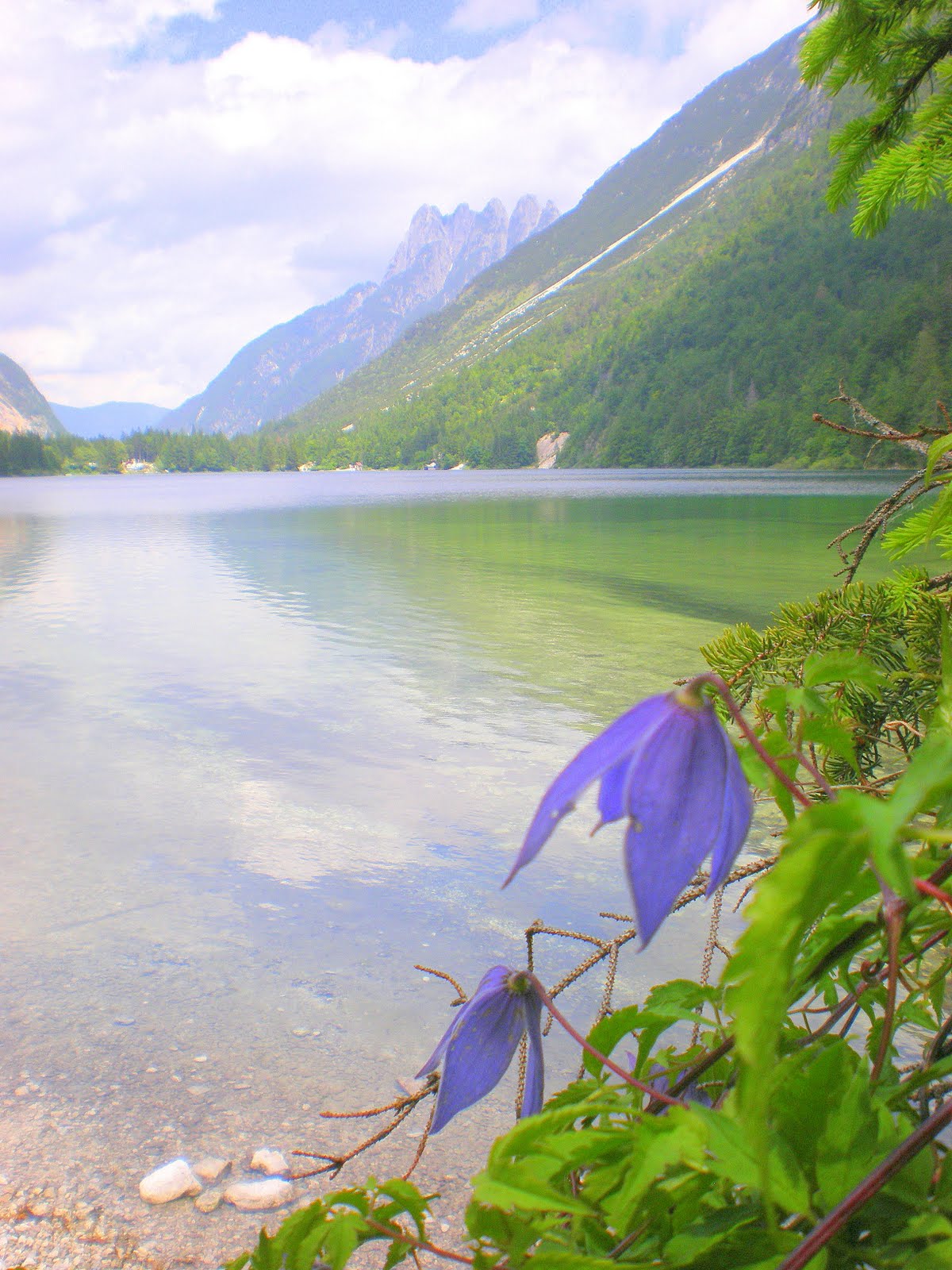
Well, after descending through pine and beech forests, we found one of the most perfect picnic spots ever to eat our salami and tomato panini, at the southern end looking north towards the Cinque Punte. The waters are truly, luminously green in patches. I'm not much interested in the old story of the Virgin and Child seeking sanctuary, only finding it in one house and submerging the rest of the sinful village, but there's certainly something magical about the place.


I couldn't resist trying a paddle but truly, it was so painfully cold that I was hopping after 30 seconds' immersion. In my unselfconscious haste to get out, here I was snapped in balletic mode:


And what millefiori! I don't think that even up on the Piano Grande in the Sibillini Mountains of the Marche in May I've ever seen a greater variety. What happy coexistence of different species: analogous to the co-operative Slovene, Italian and Austrian miners just up the river. I suppose it's foolish to ask anything of the imagined readers - answer usually comes there none - but if anyone can put a Latin name to any of the below, I'd be grateful. I'm aware the catalogue includes wild rose and several types of orchid.


That's it - though I've by no means included everything I saw and maybe I've featured some common species while missing several rarities less exciting to look at. What a marvellous natural counterpart to our walk around the man-made lake at Wotton. Of course it struck me that when Capability Brown and co wanted to make sure that no part of the walk would look the same as any other, in that too they were mirroring nature. A final shot, then, of shimmering waters from the west side.

Wednesday, 7 July 2010

Holy German art


Yes, that would certainly include - and right at the top of the list alongside Wagner - Gustav Mahler, whose 150th birthday we celebrate today (and I still haven't got to the omphalos, Jihlava).* As Paul Steinberg's brilliant dropcloth for Richard Jones's still simmering-in-the-mind production of Wagner's Meistersinger left us in no doubt, 'heilige Deutsche kunst' extends from Bach and Beethoven to Brecht and Bausch, embracing all German-speaking 'imaginers', as Jones calls them. You can enter the Welsh National Opera competition to guess (or know) all the faces in the collage by e-mailing the answers to marketing@wno.org.uk or post them to WNO. As the above photo seems to be cropped you'll need to get hold of the original postcard. And I confess I still haven't by any means sussed them all.

Great Jones, only visionary of our British theatre (as I keep saying, and I mean it), came to talk to me and the students on Monday. He raised so many interesting points I hadn't even thought of, and here's no place to ennumerate them, but I will add that he told us - in response to one of many articulate questions from my bunch, of whom I was inordinately proud - how a couple of German intendants who came to see the show found this all-inclusive perceived 'apology' for Wagner's definition harder to swallow than we Brits. While we heave a sigh of relief and say, at last we've moved on from the Wagner-and-the-Nazis question, they still seem to be mired in it, perhaps because they haven't been able to discuss it in their own art properly until recently. And then what do you get? Stodgy, trad films like Downfall. Hate to sound superior, because it's their issue, but they still have some way to go.

Had to raise the old 'is Flieder lilac or elder' question again. Richard didn't face it directly, but by talking of the heady sex-magic - my phrase, not his - which the scent seems to work on Sachs, he would seem to incline to the elder-as-aphrodisiac theory. Anyway, having been in enchanted Visby, I can tell you that Sweden, or at least Gotland, is a place where lilac and elder DO flower simultaneously around midsummer; everywhere else, including Nuremberg, lilac is over. But here's the ocular proof:


My thanks to the quietly brilliant Jan Brachmann for drawing my attention to the lilac as I walked around Visby in a bit of a daze.

Can anyone identify this plant, another heady smeller, high on the hill above the Baltic?


I reckon Visby would make a marvellous setting for an outdoor production of Meistersinger, moving from venue to venue. We could start in the Domkyrkan (seen behind the elder in the first picture) - though the modern glass might be a bit of a problem - and move on to Transhusgatan near the botanics for Act 2. No linden is close to hand, but I do think Magdalena-as-Eva could appear at this rose-flanked window.


Then it would be out on to the flowery heath for the final pageant.

And if you want to celebrate Mahler's birthday, what better way to do it than to watch what is bound to be the deepest, most meaningful First Symphony, a just-released DVD of last summer's Lucerne Festival/Abbado performance. Better not enlarge on it now, since my BBC Music Magazine review hasn't yet appeared, but I'll just say, buy it and watch it over and over: you won't regret it.


The third in the great triumvirate, Richard Strauss, also deserves a mention. I hadn't intended to see the revival of David McVicar's very bloody, Salo-esque Salome, but as I was talking before it last night and the Arts Desk hadn't covered it in my absence, I went on to the show after my half-hour Linbury 'performance', and marvelled, as with the ENO Tosca, how a great performance makes you respect the score as the real mover and shaker. Angela Denoke redeemed the tonally awful Nadja Michael performance from the first run, too. More over on The Arts Desk.

Led me to think of all the Salomes I've seen. In a crude nutshell, the ones I can call to mind are: Behrens (goddess), Barstow (goddawful), Tierney (not bad at all), Barker (vocally lustrous, good acting too), Some American in Wales (forgettable, but did bring a bit of tenderness to the final scene), Ewing (dreadful), Gwyneth (vocally tops, acting less good), Malfitano (squally, bit wild in the acting too), Michael (vocally the pits). And now Denoke (almost as good as Behrens, not quite, but probably the most detailed characterisation I've seen).

Finally, on a sobering note, my NBB (New Best Blogfriend) Minnie reminded me in the most eloquent way possible that today may be Mahlerday, but it's also an occasion of sober commemoration. Her focused anger is, at least in my opinion, fully justified. Do take time to read what she has to say.

*but hang on - is it just me or is Mahler really missing from that assemblage of just about all Austro-German greats? Unmoeglich!

Tuesday, 6 July 2010

Three Hampshire Oranges


Anticipated my second visit to Grange Park Opera near Winchester very keenly as I wanted to show the diplo-mate the extraordinary, enclosed grounds including wild lake penetrable only by dusty dirt tracks


the ruined neoclassical house in the middle of this nowhere


and the spectacular conversion of the Orangery into a pleasant little theatre, complete with kitsch fluffy Swarowski chandeliers that rise before the show begins and the toy train running under glass in the balcony. The first occasion had been to talk on and see a first-rate production of The Gambler two years ago; this time it was more well-squeezed Prokofiev in the shape of The Love for Three Oranges. The three production photos here are by Alastair Muir.

You can now expect shows at Grange Park more or less on the level of Glyndebourne, a notch perhaps above Garsington. Delighted to see that finest of singing-actor tenors, Jeffrey Lloyd-Roberts as the hypochondriacal prince; little did I expect to hear another Welsh tenor of equal quality, and maybe lovelier sounds, Wynne Evans, as Truffaldino. The production was again the inventive David Fielding's: a bit of this, a bit of that, good basic idea of the Eccentrics who put on the show as stagehands, less well followed through. The magic looked good, with Fata Morgana and Tchelio (Vuyani Mlinde - good voice, sometimes shaky musicianship) as rival latterday magicians, she leggy in stockings and Cabaret/Chicago like attire (though less than voluptuously sung by Rebecca Cooper).


Superb drag cook - Francisco Javier Borda, one of three strong basses in the show - with a giant fridge full of corpses and rotting oranges in the bottom. The ever-waxing oranges are of course cartons out of which pretty French filles pop and flop.


Leo Hussain whipped up a storm from the English Chamber Orchestra in the pit; I've heard it more springily done but never more diabolically.

And, let's face it, culinary opera like this is always going to mesh with the pleasures of the place. We had a superlatively good birthday meal in the restaurant, its crumbling ceiling stylishly netted from harming the punters:


and despite the increasingly noisy, rather unattractive regional crowd - J heard one old man say to his wife in the interval 'you go potty? Me go potty' - it was fun to take tea and macaroons on arrival from the local ladies: still a village-institute feel. But presiding spirit Wasfi Kani continues to do an amazing job, fundraising in hard times to keep the artistic quality, and as I'm a sucker for doggies on stage, I was touched to witness ageing black labrador Ellie following the owner, Lord Ashburton, on to the stage, blinking somewhat incredulously at the audience noise before sitting and lying down patiently during her master's opening speech. Tristan next year, they intend, and why not?

Monday, 5 July 2010

Bergmen


Again, apologies for the unproclaimed absence: I've been in Faro - really should start adopting the accents here, the nearest pronounciation we can get is 'Four-er' - the magic-scary Swedish island of Prospero Ingmar Bergman ever since he landed there in 1960 and decided to film Through a Glass Darkly on the coast near what would become his home.

To Four-er was invited a select 'delegation of international journalists' to observe and participate in the annual Bergman Week. And here we all are, a harmonious bunch of diverse temperaments, outside the Damba barn which served first as the studio for the interiors of Scenes from a Marriage and then became Bergman's private cinema. Can you imagine the awe and emotion of being a dozen or so spectators in the fifteen-seater, sinking into the chairs around the one with the cushion that must always be left empty - that of the Meister?

The assembled company, left to right, consists of Mike Goodridge (Screen International, London, lately the mag's LA man), Jan Brachmann (Berliner Zeitung, the chap to talk music with when film chat became a bit too arcane for me, an amateur in I hope the best sense), Gerald Peary (Boston Globe, genial old-school maker of a well-received documentary about American film critics), some creature in pink minding his head on the threshold of the sacred shrine, Satyen Bordoloi (Indo-Asian News Service, Mumbai, enthusiast and photo-taker extraordinaire), Li Hongyu (Southern Weekly, Beijing, and a tidy roommate in one of the campsite capsules they housed us in for the four days), Peter Rainer (NPR, LA, just assembling thirty years of film criticism into a book and big anecdotalist of time with the greats) and Roman Volobuev (Afisha Magazine, Moscow, brain and memory the size of a planet, chainsmoker, individualist and a former colleague of Anna Politkovskaya, of whom he had some revealing things to say).

Lest you think that the man who made About All These Women would have been sorely disappointed by the all-male clan, we did have feminine company in the shape of the smiley Kajsa Guterstam, International Project Manager of the Swedish Institute, and the fabulously informative Pia Lundberg, Head of the International Department of the Swedish Film Institute, who chose the four new Swedish films we had the privilege of seeing in advance screenings in the private cinema. There were also the very emotional and truthful Liv Ullmann, who hadn't been back to the island since Bergman's death three years ago, and the daughter she had with IB, the novelist Linn Ullmann (I'm looking forward to reading A Blessed Child, which has more than a little of the Faro flavour about it, she told us). Anyway, here Pia and Kajsa join the throng along with Trutz von Ahlefeld, another genial guide around an island he knows well.


No time to download the bulk of my own pics yet, but I must just stick in two to show the extremes of this island, so mediterranean in parts in high summer but with the potential for the ultimate bleakness, the isle of death as IB once called it. The south and west coasts are mostly like this, with viper's bugloss purple-blueing the landscape:


while the north-west coast is lined with rauks - sea stacks - and pebbly beaches with fossilised coral in the stones. They tell us Faro broke away from Africa, hard as that may be to believe, and this is the result.


All these were locations for a clutch of Bergman's most lacerating movies, but I'd better save all that for my Arts Desk piece, due for next Sunday. Now I must get the tenth and last of my Meistersinger classes in shape. We'll whizz through the final revels in an hour because before that Richard Jones is coming to talk. Hope he's just as pleased as I am to know that in the listening room cum study of Bergman's home at Hammars is the (I think) Knappertsbusch recording.


Inevitably an important work for a creator who knew that nothing vital comes about without a touch of Wahn to prompt it.

Tuesday, 29 June 2010

Borderland


'If it rains, you can always go on a tour of the mine', said our Tarvisian hotelier when we asked about getting to Lake Raibl/Cave del Predil on our three-day excursion into the eastern Julian Alps from Trieste. I'd rather...etc, thought I, but having been to Cave, I'd say it would have been well worth it.

Yet the weather held and allowed us to do a full day's circuit above and around this beautiful Alpine lake. I was going to launch into a paean of the thousandfold flora around it, but as I reviewed the photos of our brief jaunt into Slovenia en route, I realised that both the mining village and the border crossing would need an entry to themselves.

So we took the morning bus from Tarvisio to Cave (as usual, there were only one or two other passengers, who sit at the front and glean or give all the gossip from/to the driver). Cave looked mighty grim, but it's beautifully situated and full of interest with its extraordinary history.


Mining of Monte Re for lead-zinc ore started here, they think, in Roman times but was certainly well established by the 11th century. The village of Raibl, as it was then called, sprang up between 1500 and 1800. At the peak of its operation in 1950 it employed about 1130 men. The notice outside the museum told us that here was a unique instance of Austrians, Italians and Slovenians all working together in complete harmony. It closed only in 1991, so I guess you have a very depressed population. Wouldn't have known it from the cheerful activity in the one of the two bars we liked best, run by one of those vivacious Italian women who presumably still know how to keep their men and seem very proud of it. Clearly the older of the bars, its walls are covered with trout from the lake


and photos of keen local as well as Udine mountaineers - these people clearly didn't ignore the nature around them.


My pamphlet tells me that 'the continuous obsession for the cliffs originated the first organised Alpine Emergency Unit (Soccorso Alpino) in the valley as well as a group of the most skilled climbers in the area and the whole region'.

Our own trek was rather more modest, but took us higher than I'd anticipated. At a key point we looked back on the archetypally Dolomitic Cinque Punte which tower above Cave del Predil


and then forward to the lake itself.


When we joined the upward-snaking road, I realised from the map that we really were as close as the path was going to take us to the Slovenian-Italian border, and that a diversion up the mostly empty highway before rejoining our forest route was well worth it.


How exciting it was, for me as much as for the diplo-mate who was duly photographed in front of the signs but won't appear here, to walk across a deserted border crossing, and a moment of pride to see the European Union stars twinkling around the names of the two countries.


That's 'Italija' with a j from the Slovenian perspective. Across the Italians' own sign are more political stickers.


The crossing into the Triglav National Park had a special significance because we'd originally intended to split our holiday between Trieste and Bovec in the Socer vallery, where friends Stephen and Kate had recommended a very singular hotel. But connections between Italian and Slovenian transport seemed more or less non existent, so we'll explore the Triglav zone from Ljubljana in due course. Here, we could just have walked on and got to Bovec by nightfall.


A cafe and a well-kept garden indicated habitation


but there was no-one around. Anyway, we had a lake to see and a picnic to eat, and the rest of the walk was pure heaven. More on that in due course. I should, though, return to Cave, as we did at the end of our circular route, visiting the second bar for final refreshments before the bus back to Tarvisio and taking a look at the two churches, old and new.


The newer one of solid, rather impressive construction,


was apparently built because more miners and their families needed to worship than could be contained in the original. That has a pretty painted illusion of an organ


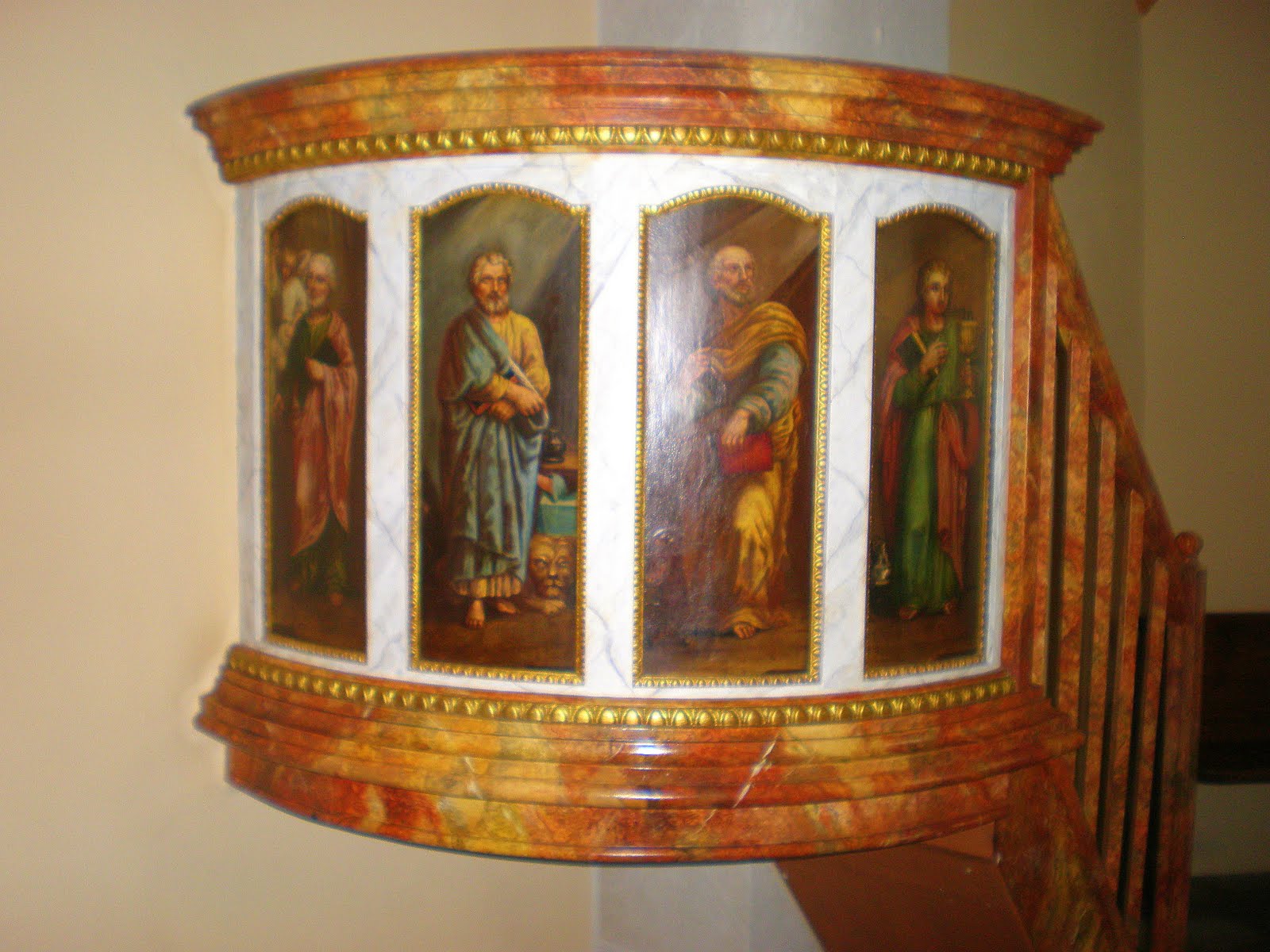
which is rather preferable to the two speaker boxes above left and right of the modern church's altar; and a pulpit with paintings of the evangelists.


We liked Cave, if only because inevitably it has a more authentic feel than tarted-up but exceptionally pretty and well-situated Valbruna a valley or so to the west. But in the afternoon of that second excursion, the weather break-up finally hit and we spent four character-forming hours trudging down the mountainside in the pouring rain. At least we were rewarded at the end by the sight of these brightly coloured beehives.