Wednesday, 17 August 2016
Stefan-Zweig-Weg
Unlike my walk along the 'Julie-Andrews-Allee', this Salzburg jaunt wasn't serendipitous, but I did it the wrong way round, widdershins, as it were, unintentionally avoiding at first the Stations of the Cross. The great writer, and very much my current god in the reading stakes - from a biography by George Prochnik alongside Zweig's own studies of Marie Antoinette and Erasmus to his takes on Montaigne and now Mary Queen of Scots - bought an eyrie on the romantically-titled Kapuzinerberg in what, shortly after the First World War, was quiet, unfestivalled Salzburg. He chose the city for both for its calm and its position as 'the right springboard to [the rest of] Europe'. I'll let the author of The World of Yesterday paint the picture:
The little wooded hill on which I lived was the dying wave, so to speak, of the mighty mountain chain; inaccessible to automobiles [that only pertains up to a point now, though I saw no vehicles and only two other people on my way down]
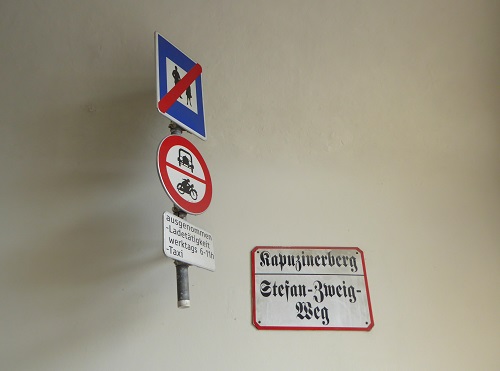
and attainable only by a hundred or more stairs up a way of the Cross that was over three centuries old; the effort was rewarded by an enchanting view over the roofs and gables of the many-steepled city. Indulge me here: the light was good, so I give you three.
Zweig has to point out that the view in the other direction was towards the Alpine chain and - horrid irony - the Salzberg at Berchtesgaden where his oppressor, unknown at the time of purchase, would make his home. The fact that the 17th century Archbishop's lodge was in a ruinous state and well-nigh uninhabitable didn't put him off; nor did the cold in a time of post-war famine and need. It seems typical of Zweig's aristocratic remoteness that he only really got in touch with that on his few excursions a week into town.
The house is now screened on all sides by trees
and, sad to say, some dramatic barbed wire, but you can take the 'Weg' up behind the house into the woods. Had I had longer before returning to the hotel after a fine lunch in the Stiftskeller Skt Peter ('Europe's oldest restaurant'), I should have walked further to see the Alpine range end of things, but I went only so far,
having made the ascent via an obscure alley so that I hit the big view first and the church after.
There, at any rate, was a bust and wall plaque opposite the hidden house
after which I went down past the garden gate
and saw in reverse the Stations of the Cross.
A speedy walk towards the tram stop took me via the magical Steingasse which snakes between the Kapuzinerberg and the river, a mixture of the plush and established
with touches of Bohemianism.
At least Salzburg has a university, which saves it from ossification. Meanwhile, over at the Haus für Mozart where I saw the intriguing second performance of Adès's The Exterminating Angel, Zweig's bust
and Max Reinhardt's flank the entrance to one of the most opulent theatre bars in the world.
I was going on to write about Zweig's Montaigne, but work is pressing and the great French man of letters will have to join proud Mary Stuart when I've finished reading about her ill-starred path to the scaffold.
Labels:
Haus fur Mozart,
Kapuzinerberg,
Salzburg,
Stefan Zweig,
Steingasse
Tuesday, 9 August 2016
BBC Proms: talks and events
Frankly, this is first and foremost a shop-window alert to see if anyone else wants to come along to the remaining two talks I'm giving on Proms-related works: on Janáček's The Makropoulos Case tomorrow (10 August) 2.30-4.30pm at an address in Lancaster Gate, and on Mahler's Seventh Symphony, Thursday 18, same time, in St John's Wood. Addresses supplied on enquiry to me at david.nice@usa.net. Tamara Wilson is also due to return to the Frontline some time in the week of 5 September before her guaranteed-amazing performance in the Verdi Requiem on 9 September. She'll get back to me once she knows her rehearsal schedule. And you'd better believe that Tamara is almost as good a talker as she is a singer (only 'almost' because the singing is something superhuman...). There she is below with Mark Wigglesworth and James Creswell in the closing scene of Act Three from Wagner's Die Walküre.
Back in July we covered Mahler 3 and Berlioz's Roméo et Juliette, and I learned a lot more simply retracing familiar territory - there's no end to what you can keep on finding in the great masterpieces. Nor did the performances disappoint - though I felt a little distanced from Haitink's magisterial and at times very slow Mahler and JEG's Roméo would have been perfect if he'd had a Friar Laurence as good and true-bass-y as David Soar for Andrew Davis earlier in the year.
Highlights of the ones I've caught so far? Unquestionably Mark Wigglesworth's converting me almost completely to Tippett's A Child of Our Time, with fabulous soloists alongside Tamara and an apotheosis that really was levitational, and 27-year-old Pavel Kolesnikov as soloist in Tchaikovsky's glorious Second Piano Concerto alongside the superlative National Youth Orchestra of Scotland under Ilan Volkov (who quite transformed the imperial style into something altogether more humanly joyous).
HK Gruber was a star yesterday lunchtime, too.
The NYO experience the previous evening was a little tainted by Ed Gardner's dim view of Strauss's Also sprach Zarathustra - no idea what he wanted to say, if anything, with the work - and by my neighbour, who sketched throughout. This, inevitably, I didn't mention in the review, but he started by thinking he was some kind of artistic seismograph attached to Iris ter Schiphorst's Gravitational Waves, pencilling squiggles and zig zags as the music took him. You can imagine the resulting chaos on paper. For Strauss and Holst, he contented himself by drawing the players and clearly thinking this would be the main event of the evening for his neighbours, whom he immediately started showing the results.
Halfway through The Planets, I thought that instead of getting into an altercation with him if I asked him to stop, I'd unostentatiously put my rucksack on my knee so I couldn't see his drawing, but this of course impeded his wide-ranging right hand so he got indignant. Then he and his ferocious wife changed seats. I knew she'd be spoiling for a fight at the end, and determined to avoid one, but she got it by sitting and refusing to move as we and a nice, baffled gentleman behind us wanted to get out. 'You are the rudest audience I've ever encountered!' she blustered - having fidgeted throughout and hummed along out of tune to Holst's 'Jupiter' tune aka 'I vow to thee my country' - whereupon I cried shame on her. Oh dear - these conflicts are not to be stoked, but what can one do? Otherwise, the Proms audiences haven't been bad at all, and it was redeemed the next afternoon by my being able to tell the little girls sitting in front the story of The Firebird before it began. Which meant they enjoyed it enormously, if a little actively, playing princesses and ogres, which I didn't mind at all.
Fondest peripheral memory so far: seeing the huge queue stretching around the block ten minutes before Haitink's Mahler 3 was due to start. Even though it may have been mixed up with another waiting for the late-night Bowie Prom (which I switched on the telly back home to watch live, and off when the rapper came on), it reminded me that nothing has changed since I joined the queue for his 'Resurrection' in 1978. As I recount in the Arts Desk review, it was my first Promming season and I arrived too late to be admitted into the Arena; my one and only Gallery experience taught me never to go up there again. Still, it was the summer of Discovering Mahler and Abbado's Chicago recording was the first symphony recordingr I borrowed from Banstead Library.
Thrilled, too, to take dear friend Chris Gunness's 18-year-old nephew Andrew Lavelle to Proms while he was visiting from Houston. His first experience of the Albert Hall - that was good to get - and as he has a very wise head on young shoulders his responses were all perceptive. He soon takes up a place as a very talented viola-player at the Juilliard: what discoveries lie ahead for him. There he is above with uncles and friend.
And this is the Albert Memorial at c.9.30pm. Darkness on emerging from a Prom is a sure sign that the days are getting shorter again - September visits are always tinged with a certain circumstantial melancholy.
The nearby Serpentine Pavilion is a triumph this year, one of the best, from Danish architect Bjarke Ingels. That will last us well into early Autumn.
And I have still to seek out the smaller projects around Kensington Gardens, though I'm told they're not up to scratch.
Proms photos by Chris Christodoulou except lead image of NYO, by Mark Allan. All courtesy of BBC.
Monday, 8 August 2016
Julie-Andrews-Allee
Not its real name, and if it were I doubt if it could compete with the Stefan-Zweig-Weg on Salzburg's Capuzinerberg for sheer historic resonance (more on that in a future post). But the Hellbrunner Allee is an even more beautiful slice of rus in urbe and leads to one of Austria's great gardens.
I saw it on the map as I was looking at where exactly my perfectly comfortable hotel (of the award-winning chain of Motel Ones, if anyone's interested in finding decent mid-price accommodation around Germany and Austria) happened to be situated in Salzburg-Sud. A walk to Prince Archbishop Marcus Sitticus's summer palace 4km from the town centre would be the perfect morning excursion between performances of Strauss's Die Liebe der Danae and Ades's The Exterminating Angel. What I hadn't bargained for was turning left into a road alongside a park and finding this, the Frohnburg Palace, at the end of it.
Looked familiar; and the answer came from the trail of cyclists, very Von Trapp family on excursion, I saw as I took the small road around the building to the Allee.
There they were at the front gate, being lectured by a rather amusing and certainly very well clued-up guide on the exact details of Julie Andrew's Maria's arrival at Baron von Trapp's mansion, including where she tripped up ('and some of you may like to enact that trip on film when I've finished'). Strains of someone practising the finale of Beethoven's 'Hammerklavier' Sonata came from the building by the gate; the building is owned by the University's Mozarteum.
As many of us already knew, the back of the villa in the film with its lake in which Maria and the children capsize with surprise at the Baron's return is elsewhere (the Leopoldskron Palace, which I saw on the somewhat wayward, traffic-avoiding taxi ride from the airport). Salzburgers didn't like this pick-and-mixing but it's standard practice in the movies.
Anyway, the Frohnburg Palace is splendid in its own right, originally built between 1660 and 1680 for Prince Archbishop Max Gandolf.
It makes do with a simple fountain rather than a lake on the garden side.
Now, having been brought up on one of the best films ever - for Robert Wise's The Sound of Music would be in the art-house category if it didn't have all those cheesy-wonderful songs - I don't begrudge this at all. In fact the last time we visited Salzburg, out of festival time, I was very excited by the church and its cloister on the Nonnberg ('Maria's not an asset to the Abbey'). And I had to join the Salzburgers out cycling, dog-walking and strolling up and down the avenue and smile indulgently when the group got on their bikes and 'The Lonely Goatherd' came from a ghettoblaster in one of the baskets.
The great old moss-covered trees of the Allee are a real mix - chestnuts, oaks, alders among others - and some have religious 'icons' on them.
There are also a couple of independent shrines, pleasantly ivy-wreathed.
After a couple of kilometres you arrive at the gates of Schloss Hellbrunn, the pleasure palace of Marcus Sitticus von Hohenems (reg. 1612-19). It's famous for its Wasserspiel, the great play of fountains and water-powered clockwork figures. I postponed seeing them since the part of the garden open for free seemed very beautiful. First thing you see when you enter through the gate nearest the Hellbrunner Allee is another Sound of Music icon, the gazebo in which Liesl and Max strut their 'Sixteen Going on Seventeen' routine and the storm breaks.
It had come into my head the previous evening, walking the long route back to the hotel after Danae, as it started to rain. None of that on this warm, dry day. What a public resource is the garden, with its splendid ponds and statuary.
In one pond there are the expected koi carp, but I was taken aback to see giant sturgeon in another, between faun-tritons.
Elsewhere are unicorns
and you can get a glimpse of the grottos on the Wasserspiel trail.
Seduced around 2pm by the Gasthaus in the palace courtyard, I lingered too long and found that the next tour (guided rituals only) wasn't for another half-hour. The rose-spritzer to accompany my Wiener goulash was too good not to enjoy, though.
Given that I had an appointment in town with one of the Festival's most recent celebrities, I hoofed it back along the Allee to shower and change at Motel One. Black clouds were gathering over the mountains you see from the Allee, though no rain came of it.
The next morning, I took the Allee in the opposite direction, north into town.
Some of the trees here have splendid fungal growth. Can't identify these two.
Where the Allee ends, over the other side of a busy road is a continuation of nature in the form of water meadows and ever closer views of the Hohensalzburg Fortress.
You end up with the Nonnberg beyond,
and so having left the busy Petersbrunstrasse, I found more wonders rounding the bottom of the hill and heading into town for coffee with the delightful Simone Dollmann at the Cafe Tomaselli.
The hub deserves its reputation and probably has more locals sitting outside than tourists. More anon on the mixed blessings of Salzburg, but let's just say that it would be a fine place in which to grow up, with nature on the very doorstep, and of the grandest kind.
Subscribe to:
Posts (Atom)