Showing posts with label Mark Wigglesworth. Show all posts

Sunday, 2 July 2023

Ten days of great Zoom visitors


I rely upon the kindness of great performers for adrenalin highs in my Zoom classes, and a recent run has, though I say it myself, been spectacular on both the Opera in Depth and Mahler 1 courses - I might as well drop the names right now: Anna Larsson, Golda Schultz, Robin Ticciati and Mark Wigglesworth. You may need to click to enlarge a lot of these screenshots, and I've tried to reduce them to a cross-section rather than the full crowd, but above, bottom right, is glorious Golda, part of a very special duo of visits. 

Robin Ticciati decided he'd like to see us between final rehearsal and first night of the sensational (opera production of the year?) Dialogues des Carmélites at Glyndebourne, and for it was better since I wouldn't be prone to gushing about the first night, so overwhelming that I took the liberty of snapping a full company bow, Ticciati and director Barrie Kosky included.

I reviewed that here on theartsdesk; you might conversely say I'd drunk the Ticciati kool-aid, but what I think of as the professional relationships I have with the great and good are based on total respect in the first place. Of course I'm at liberty to say if there was a style mismatch, or I didn't think the work was quite as great as the performer did - The Wreckers, prepared at the very highest level, was a case in point. But we know how Poulenc's masterpiece - one of the greatest in all opera - never fails, even if I wasn't prepared for the cruelty and devastation of Kosky's vision. 

After a very excited RT phoning on Thursday to say he was ready to talk, Friday's visitor was very reflective - clearly tired, but so friendly with everyone, and so eloquent as ever. He talked, among other things, of the joy and necessity of being there at the start of rehearsals, how inspiring Kosky was in his first speech to the company, the special nature of silences (something that had struck me when I first met him, sharing a panel at the end of a study day on Jenůfa, which he conducted on the Glyndebourne tour) and finally - very movingly - the nature of home. Which is now, for him and his wife, very much Sussex. Over six years in Berlin, he loved the experience of living in the city but never felt entirely at ease with the level on which he could converse in German. And the Glyndebourne experience is, at its best, the most enriching you can have in the operatic world.

Golda, whose presence was due to another positive spirit who's just joined my course, Julia Noakes, was bright and bouncy on the Monday afternoon. She'd had the day after the first night to come to herself, and the parallels with the down-to-earth, forthright, empathetic and incorruptible Madame Lidoine, the second Prioress, whose arrival brings a breath of air in to the claustrophobic world so emphasised in Kosky's production, are striking. Golda thought of becoming a nun at 17, but her priest-advisor suggested her gifts might be used on other ways. And so they are. A marvellous human being in every way. I'm going to segue to my next guest via two production shots, cropping to emphasise the connections (credits: Glyndebourne image, Richard Hubert Smithl Garsington image, Julien Guidera, I think - I got sent three different sets of photos). It's amazing how strong an image is a reassuring hand laid on another, and Schultz's Lidoine does that in Kosky's production, more than once.

It's also a very moving moment in Bruno Ravella's Garsington production of Strauss's Ariadne auf Naxos when Young Woo Kim's Bacchus places his right hand on top of the left hand of Natalya Romaniw's Ariadne.

I'd never been more moved by this scene. and never heard a Bacchus as good live. The South Korean tenor is adored by his colleagues, another blithe spirit, as I think one can tell from his performance on stage. In my review for theartsdesk, I suggested that though Carmelites and Ariadne are very different operas, the respective Glyndebourne and Garsington achievements are on the same extraordinary level - thoughtful production, perfect cast, and radical but perfect conducting: in this case from my long-term generous visitor to the classes Mark Wigglesworth. 

I enlisted MW's help in my Mahler 1 course, covering Symphonies 1-5, Das klagende Lied and the earlier songs (the second term, starting in late September, will deal with 6-9, Kindertotenlieder and Das Lied von der Erde). He's conducting the BBC Philharmonic in the First Symphony at the Proms on 18 July, but was heavily involved in Ariadne rehearsals when we covered that. So just before the last of the 10 classes, on movements 3-5 of the Fifth, he visited for a more general discussion, but again with fascinating chapter and verse (I must summarise at some point, but need to watch again).

First of the visitors, and absolutely not least, was the great Anna Larsson. I used a mixture of DVDs for complete movements, and when it came to the Second and Third Symphonies, it had to be Abbado in Lucerne; AL is his mezzo/contralto soloist in both, on stage from the beginning and engaging directly with the audience sans score. and she confirmed that these performances were beyond any others. 

I'm glad my New York student Alan compared her with Christa Ludwig and asked if they'd met, because we had a fascinating chronicle of how Abbado, having first heard Larsson in audition, told Ludwig she must hear her. Intense sessions followed. Here's another performer with feet firmly on the ground, colleagial and warm (we'd become friendly when I visited the musically excellent Rheingold she facilitated in the barn of the family farm in Dalarna, in which she sang both Fricka and Erda). But then I think it's true of (nearly) all artists who are truly at the top of their profession: they are secure in what they do, and generosity flows from that. 

Finally, a sadness. Sondra Arning's son gave his mother the present of joining these classes. She has been a vibrant contributor, with so much to say about all the music she experienced and - as a singer - participated in while living in New York. Soon her husband Patrick also joined up; they both attended both courses this term, sometimes on separate screens, sometimes together (as pictured above). Having made some pithy observations as usual, Patrick had to leave the last Mahler class early to go to see his doctor. On the Friday he felt il in an interval at the Wigmore Hall, where they were regular visitors. He died of a massive heart attack on the Saturday. A huge shock to everyone, above all to Sondra - they had been married for 51 years - but in one way, since he'd reached a great age, a blessing, as there was a lot wrong with him and cancer had just been detected. 

Patrick will be with us in spirit when we embark on the summer course, Wagner's Parsifal, in association with the Wagner Society of Scotland (it's a while back that I began an adventure which began with the first two Ring operas up in the Trossachs, the last two online, followed by Tristan and Meistersinger). More on that, and the season proper, anon.

Wednesday, 28 September 2022

Kosky's Meistersinger: falling at a late hurdle

Wednesday afternoon sees the 10th and final class in my Zoom course on Wagner's Die Meistersinger von Nürnberg, and the end should crown the work, as well as our grand finale: our special guest is Ben Heppner, who for me sings the most beautiful Prize Song of any I've heard (on the Sawallisch EMI recording: glorious sound, though my overall favourite on CD is Kubelik's. The below film is clearly from a gala, but it will certainly do). 

We've also spent a wonderful hour with Mark Wigglesworth, who conducted one of the Royal Opera revivals of Graham Vick's splendid production, and while Jane Eaglen (whom I saw as Eva at ENO, one of her first major roles for the company) had to pull out of a chat because of a crucial meeting about fundraising - she'll visit some other time - John Tomlinson will give of his time when he comes back from holiday, a very welcome postscript.

I previously covered Meistersinger when the course ran at the Frontline Club and Richard Jones's WNO production - still the best I've ever seen - was pending; he also came to talk to us. But every time it just gets richer. I don't look at previous course notes; it's important to start from scratch. This time we've been more preoccupied with the question of Wagner and antisemitism because, although I don't think it figures in this work (the comic villain Beckmesser is seen as a target, but that's been ignored by most UK directors, Jones included), Barrie Kosky, as the first Jewish director of the opera at Bayreuth, felt he had to tackle it. And I felt we had to follow some of the scenes in the DVD of his production (it's also on YouTube, by the way, but only with German subtitles). 

Felt the Wahnfried tableau restricted the scope of the Prelude, and it sets massive problems to solve: Sachs, Walther AND David among multiple Wagners; Cosima as Eva; Pogner as Liszt; Beckmesser as Hermann Levi. To his credit, Kosky makes the scenes between Beckmesser and Sachs laugh-out-loud funny. The ever- brilliant Johannes Martin Kränzle is at his most outrageous in this production. He's not at any point a Jewish stereotype, but Kosky makes the laughter freeze when the crowd turns him in to one. Personally, I'm happier with a view which treats Beckmesser as a Malvolio within a Shakespearean comedy. But I do understand why, in Bayreuth of all places, the peripheral questions need addressing. 

The point where I lose faith is when Eva enters Sachs's study - here the room in which the Nuremberg Trials were held - in Act Three. We lost the sentiment in favour of swift humour in the comparable Act 2 scene, but although I adore Anne Schwanewilms, the silly mock-girlish skipping she's asked to do defuse all the emotion in the situation. And if Michael Volle's Sachs and Klaus Florian Vogt's Walther are both aspects of Wagner, where's the crucial love triangle? I turned back to Lehnhoff's stripped-back production for Zurich Opera, and having doubted the scene's power, the tears flowed again. It was with good reason that Strauss and Hofmannsthal saw in this a blueprint for the Marschallin-Octavian-Sophie triangle in Der Rosenkavalier.

Excellent cast. Real-life couple Peter Seiffert and Petra-Maria Schnitzer keep it real, too. Some find José Van Dam's Sachs too dour, but I like the introspection, the pain is real, and he's very much an attractive older man.

Every class has brought big emotions. As Mark pointed out, every transition is a thing of wonder, and strictly speaking you could say it's ALL transition. I'm especially happy with the two hours we spent on the Act Three Prelude and the Wahnmonolog, with the help of Brian Magee's eloquent words on the Schopenhauer connection in Wagner and Philosophy to help us out. There's also another of the few really good books on Wagner which I re-read with pleasure, because all the elementary points in it are put so well - this brief but pithy journey through the opera by Catholic priest, professor and author of numerous books on literature and music M. Owen Lee. 

The art, ultimately is what matters, and among the many miracles of this great masterpiece is how it bears out all its claims with musical chapter and verse - everything is perfectly executed. Can it really be, as Mark wrote he was inclined to believe, in our initial email exchange, 'western civilization's greatest achievement'? While engaged on it, I'm inclined to believe so, Bach Passions and Mozart operas notwithstanding.

Verdi's Aida, of course, is a different case - the kind of plot all too familiar from early 19th century Italian opera, but ah, the music, the orchestration, the great string of duets! The writing is as masterly as that of its late successors Otello and Falstaff. I've had trouble persuading some students we should spend five Mondays on it, still more that G&S's The Yeomen of the Guard deserves two (I'm splitting the second half of term between that and Britten's The Rape of Lucretia

We start tomorrow (Monday 3 October), probably hitting 'Celeste Aida' before we get to 'Morgenlich leuchtend' on Wednesday. Full details here - click to enlarge.

Thursday's non-operatic course this term is devoted to the symphonies of Elgar, Vaughan Williams (the bulk of the classes) and Walton. I thought after the Russians, Czechs, Hungarians and Finns it was time for British - I hesitate to say Engish - music to have a look in. I wanted some words of commendation different to Sue Bullock's for the opera course - and Mark wrote what I'm sure he thinks, so proud of that. Again, click to enlarge.

Onwards! I hope a few more will be tempted to join up; good numbers for the opera course, fewer for the symphonies, but that's always been the case.

Monday, 28 March 2022

The greatest Grimeses

There was Pears, of course - it was a surprise to me to find how fine an actor he was, as well as a singer, in the 1969 film of Peter Grimes conducted by Britten. But in my opera-going experience no-one can possibly be greater than the late Philip Langridge.

I saw him three times, twice in Tim Albery's very fine English National Opera production, and once in a Barbican concert performance conducted by Richard Hickox, where his pacing around at the foot of the stage before the final scene seemed horribly real. In fact his madness came across as not acted at all, which is why when we watched the scene in Grimes's hut in the fourth of my Opera in Depth Zoom classes on the work a few weeks ago, the students expressed concern for the (surely too young) boy he roughs up.

That of course wasn't a problem in Deborah Warner's production, now running at the Royal Opera, where the character of Grimes is softened to the point of sentimentality and he never manhandles his apprentice; the boy can touch him tenderly but it doesn't work (as far as I remember) the other way around. Cruz Fitz and Allan Clayton pictured below by Yasuko Kageyama.

Surely we're all in agreement that Allan Clayton manages every vocal aspect of the role superbly, but for me this fisherman wasn't a credible character. Note to director: you don't have to love the protagonist to feel pity for him.

The libretto does present difficulties, of course - how to tie up the visionary with the rough, abusive outsider? But not to have him strike Ellen in Act 2 Scene One - he knocks her to the ground in a scuffle as he makes off with the boy - is a step too far. I didn't like the keening over the corpse to the 'relief' of the Moonlight Interlude, either. This isn't the first time there's been a shying-away from the uncomfortable: I was astonished to discover that Jon Vickers changed two of the lines in the hut scene to avoid the physical assault on the boy (thus avoiding the con violenza written into the score)

Anyone coming to Grimes for the first time, or even after a long time of not seeing it in action, is bound to think 'this is the greatest' - that's partly because of the nature of Britten's inspiration, which as Mark Wigglesworth, recording a Zoom chat with me for one of the other classes after we'd listened to his Glyndebourne/LPO performance of the Passacaglia - the most electrifying I know - is 'bulletproof'.

Our first guest was the ever-generous and articulate Sue Bullock, who spoke with shocking frankness about playing Ellen Orford in the first run of the Albery ENO production - she alternated with Josephine Bartstow - to Langridge's Grimes. They both felt that the tension of the scene outside the church had built to such a pitch that to fake the slap diffused it. So SB gave PL the licence to hit her (that's me being astonished as she tells me below). And she remembers standing in the wings crying while Langridge himself wept real tears in the 'mad scene', then going home - still in tears - fretting that she hadn't done enough to save him. 

Talk about the role taking over (but I also remember Simon Keenlyside telling me how he paced the streets of London in the small hours after singing the finest Prince Andrey I think I'll witness in Prokofiev's War and Peace).

I was saving the equal generosity of Richard Jones, another regular visitor, for Samson et Dalila next term, which he convinced me was worth spending four or five Monday afternoons on (as did Nicky Spence, but alas, he's had to withdraw because of the steady convalescence needed to restore his two broken legs to full health). But we were so stunned by RJ's Milan production, which I ended up using the most when it came to playing full scenes on DVD, that I asked if he'd be willing to talk about it. 

Richard always declares that these things were too long ago to remember much, but then he goes and delivers fascinating and unexpected takes with great vividness. He was especially good (and funny) on the disjunct between music and text: 'part of my affection for it is this very extraordinary, eerie and incredibly memorable music combined with this Listen-With-Mother, Ealing vowel text, and I like that disparity very much'. 

Responding to Mark's comment about Grimes being 'bulletproof', he declared that 'there are certain pieces where you can have your day in the sun as a director - one is Jenůfa, another is Grimes'. 

So far he's only directed it once, but would be up for another shot (which, given his capacity for re-imagining, would probably be very different). I just don't think there could a more intense and upsetting experience than what he and his choreography Sarah Fahie get out of the Teatro alla Scala forces and the principals: all the more remarkable given the chorus's threat to walk out at one stage (or perhaps because of it: needless to say Jones enjoyed facing an angry mob). 

The two leading performances are devastating. John Graham Hall may not have the tonal beauty of a Pears or a Clayton, but like Langridge's, his is a Grimes on the edge from the start. 

It's the only time I've seen the Apprentice played by a teenager (Francesco Malvuccio, who spoke no English, but as Richard says, that may have been an advantage). So there's a boy who can stand up for himself a bit, but is still physically dominated by the abuser.

The biggest rethink is the role of Ellen Orford. Jones believes there are no good people at all in Grimes, and she's horribly deluded, an ex-cultist who never notices what's really going on. That doesn't stop us feeling pity for her as she falls apart. 

Susan Gritton sings and acts better than any other Ellen I've seen. Wigglesworth conducted her too, and advised me to get her along. By which time, alas, it was too late in the course and she was taken up with performances on the weekend we might have spoken. But we had a splendid email exchange. 

I was also hoping for another appearance from the supremely eloquent Robin Ticciati, who conducts the La Scala production magnificently, and who was looking forward to telling some memorable stories. But he was taken into hospital to be operated on for a kidney stone, so that was not to be ditto Felicity Palmer, who gives an interesting Auntie, but declared it wasn't a role she felt close to. No matter; we watched so much of the film, and I urge you to do so if you think a Grimes can't be more intense than the Royal Opera one. For me this is the greatest Grimes, while Langridge is the greatest Grimes. Get hold of the Arthaus Musik DVD of Albery's ENO production too, if you can.

These, for me, are benchmarks, and yet there was so much new and perceptive in the latest comer. I just didn't come away from it wrung out. To me it seemed that Clayton was a truly great singer who acted well, not a born singer-actor. But then RJ, who hadn't seen the production at the time of our conversation, reminded me of his astonishing delivery in the Royal Opera 4/4 staging of H K Gruber's Frankenstein!!!, and yes, that did make me think it was the director's job to bring out the best in him. I think the RO should bring back the film complete now that a star is truly born, but this minute is good enough to show you the audacity, weirdness and agility.


Thursday, 21 October 2021

Harp swirls for Czech Music Zoom class 1


My Opera in Depth course this term - half devoted to Janáček's Jenůfa, the other to Martinů's Julietta - had already been under way for three weeks before I launched the Thursday class, a more general survey of a genuinely Czech music from Smetana through to Martinů, with a preludial look at 18th and early 19th century works by Bohemian composers in the European lingua franca of the time. 

The main point, though, was to reach the epic at the heart of Czech musical experience, Smetana's Má vlast, which launches every Prague Spring Festival on the exact anniversary of this founding father''s death. And I was lucky to know the Czech Philharmonic's principal harpist since 2005, the vivacious Jana Boušková, who with her colleague Barbara Pazourová usually kicks off the stirring first symphonic poem in a magnificent sequence, 'Vyšehrad', capturing the essence of the proud castle which stands above the River Vltava.

Jana accepted the invitation without hestitation. I'd become friendly with her at Paavo Järvi's Pärnu Music Festival, the best in the world for connecting with musical hearts and souls; and indeed she was invited there because she'd played in the Má vlast which Paavo conducted in the 2016 Spring Festival.

That year Jana and Barbara played the opening statements of the work's main theme, plus cadenzas, together; as it's written in the score, the second harp plays the melody and the first elaborates. Jana has actually played alongside five of her students in a Prague Conservatoire opener conducted by the late, great Jiří Bělohlávek. The one I had to hand to show the class was with a mere five harpists (students minus Jana). 

Another beauty of our introductory session was that I moved on to the most celebrated of the six symphonic poems, 'Vltava' (still better known outside Czechia as 'The Moldau' - but in the transcription made by the harpist and contemporary of Smetana Hanuš Trneček, in Jana's performance at a Czech Philharmonic fundraiser in the Rudolfinum during the first Covid spare, to help fund Prague hospitals (the number you see on the top right is the figure in Czech korunas, which shot up throughout).On the CD featured up top, Jana has referred to Trneček's work, but the transcriptions of the first three symphonic poems and of the rest of the works on a superb disc are her own.


The students warmed immediately to Jana - how could anyone not? - and there was much emotional discussion of the high level of musical education and literacy in that remarkable country. It was also vital, when Jana grew up, to have music as the world you inhabited when life under the Soviets was not so good - and to think of touring to the unimaginable rest of Europe or America as a top player, as her mother did (her father was a flautist in the Czech Philharmonic, so the couple played beautiful Mozart, inter alia, together). If you click to enlarge the image, Jana isn't difficult to spot - she has the Prague Old Town skyline behind her.

Today we move on to the Hussite chorale used in the last two symphonic poems of Má vlast, 'Tabor' and Blanik', as well as in crucial works by Dvořák (Hussite Overture), Suk (Prague) and Karel Husa (Music for Prague 1968). I'm still mapping out what the other eight classes will bring, though I'll divide fairly equally between 19th and 20th centuries, and the four greats, as depicted in this postcard of which I'm so fond, will have the lion's share.

The 10-week course on Wagner's Tristan und Isolde ended the week before we started this one. We had a virtual post-course drinks on the Friday, to which Dame Anne Evans was able to return, having been voiceless in the final class. Many laughs were had by the small but very vocal group on that evening  (Annie second from left in the bottom row).

I was also  delighted to record a Tristan chat with Robin Ticciati on the heels of his run at Glyndebourne, concluded with an orchestrally unforgettable Proms performance.


Equally thoughtful (and the other great British conductor as far as I'm concerned) was Mark Wigglesworth on Jenůfa, squeezing in the time to speak during work with the BBC Philharmonic in Salford (hence the dull hotel room background).

Just recorded another Jenůfa conversation, this time with tenor Nicky Spence, which I hope to air on Monday. Indebted to Mark for suggesting Nicky would make an excellent guest when I was running the course at the Frontline Club. As he did, and I love the generosity of all these exceptional artists, true Menschen all - that goes for Jana and Anne every inch as much as the men. Further guests, TBC, will materialise on the Czech music course anon. Not too late to join - just comment with your email here; I won't print but I promise to respond.

Saturday, 29 May 2021

The week of opening up

 This (the destination for my second jab last Wednesday)

has, in essence, made possible this,

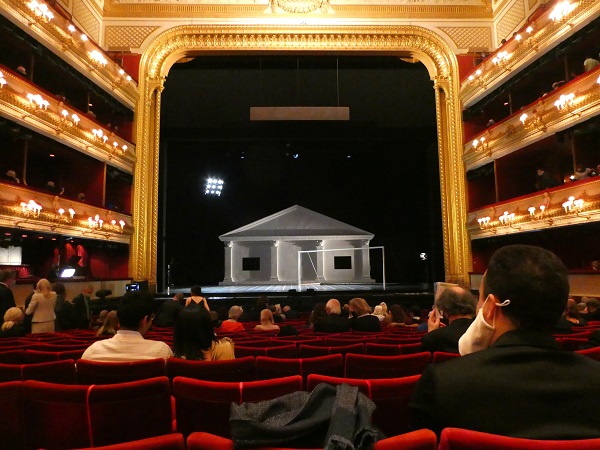
namely my first sight of an auditorium since December, and my first time within the main Royal Opera House since March 2020. Does the classical curia give a clue? It's Richard Jones's production of Mozart's La clemenza di Tito, all of a piece with the superlative conducting of Mark Wigglesworth and a vibrant cast, half of whom I'd never heard of, but all of whom were classy indeed (just heard that Emily D'Angelo, the Canadian-Italian mezzo who sang Sesto, has a contract with Deutsche Grammophon. Seems that RJ wants the Vitellia, Nicole Chevallier, for Weill's Lady in the Dark, as she loves musicals and is a real stage animal). The Arts Desk review of first night is here. Later in a week of wonders, I filmed a Zoom interview with Richard for the fifth of my Zoom Opera in Depth classes on Clemenza this Monday. 

Mark W and Ian Page of the Mozartists, a generous presence throughout the classes, joined us live and we watched the first 22 minutes of the interview; I ran the rest in an extra half hour. Living with this incredible music, Mozart often as minimalist, has been like treading air while dealing with heavier stuff on the Russian Music course.

There was nothing heavy about Tuesday's London Symphony Orchestra concert back at the Barbican (queueing for a very well-organised entry pictured above). Simon Rattle actually prompted the tears that hadn't flowed in the excitement of the previous night in his opening speech (a one-off, he said). The music to excite 'that noise you make with your hands' was celebratory with a dash of wistfulness: Britten's Young Person's Guide to the Orchestra, three numbers from Faure's incidental music to Pelleas et Melisande, Dvorak's first set of Slavonic Dances. Review here and photo below by Mark Allan.

After this, the first of the two LSO concerts, I had time before the 'finissage' of partner J's first exhibition for a year at the 12 Star Gallery, so I paused for a blissful coffee and caramel brownie outside Konditor in Waterloo. Then on to the show, where the select few (or rather more than a few) had temperatures taken before admission. Simone Bergmann's photos of the 1970 Isle of Wight Festival - or rather of the happily naked attendees rather than the performers have created quite a stir, The exhibition finished on Friday, but this little film is still worth watching,

Our lovely friend Katharina von Ruckteschell-Katte, head of the London Goethe Institute, who features in the film, also made a speech on Tuesday evening alongside head of the European Parliament representation in London Susanne Oberhauser. Would you believe it, this photo by the resident expert Jamie Smith was banned from Facebook because of the bottom in between them. And some attendees were irritated that other private parts weren't properly shown (though there are some distant willies). Anyway, this prudishness or prurience are both irrelevant - it's a joyous celebration, a symbol of what we're missing. And they're fab photos.

Susanne used some good lines, but didn't adopt J's 'Arsch for Art's Sake'. And that is probably Best Bottom, but what I particularly like is that the cool dude has round his neck what look like gun cartridges but turn out to be harmonicas.

We were allowed to take our masks off once seated at tables with a good distance between us. So good to be able to meet and talk to friends. I look a touch ernst here talking to Lucy Hannah (on the right) and her surgeon godson.

General shot, good as always from Jamie.

Probably the first time in ages I've been a bit hungover (from several glasses of wine). and there was no lingering on Wednesday morning as it was second jab time. J had booked his for 10.50, mine was at 10.30 so we overlapped and I was able to stroll around the Science Museum for a bit.

It was especially exciting to look a bit closer at the spare section, as I've just finished reading the two Cosmos books by Carl Sagan and his wife/widow Ann Druyan, scientific humanists both: more on those in a future post.

My vaccinator turned out to be opera singer Annabel(le?). We started chatting because she commended my EU mask, and I just happened to have one in my bag to gift her. She seemed very spirited but obviously disappointed because Savonlinna, where she was due to be covering Rosina, had just cancelled its operas for the year, The following week she was auditioning for English National Opera; I hope it went well for her. As I left I heard her calling after me: I'd left my precious vaccination card on the table. That at least meant I could take a shot of her in the main area.

There was a lively protest/bit of street theatre outside against the Science Museum's acceptance of Shell as a sponsor for an exhibition about the environment.

Then we went on to have coffee in the sun outside the South Ken Comptoir Libanais, and I cycled off through the parks to Wigmore Street, where it has another branch, to hear Sean Shibe's lunchtime recital at the Hall: haven't been parted from live concerts there for quite so long. The system for admittance is as admirably rigorous as ever.

The programme was a mesmerising winner; review here. And as, unusually, it wasn't livestreamed/broadcast on BBC Radio 3. I had to take a curtain-call shot of Sean in his ruff. 

Hmm. He can just about carry it off, as he did the reddy-pink boiler suit for his electric guitar shocker the last time I heard him at the Wigmore. Glad that most of the programme, plus magical Rosewood pieces by Irish composer David Fennessy (which he played in the quieter half of the previous Wigmore spectacular), has been captured in his recital for the delightful and enterprising Fiachra Garvey's West Wicklow Festival, also from London but sans ruff.

Here you get some enlightening chat (at 15m6s) before the recital at 28m50s. Love it that one of his earliest memories is his dad (potter Paul Tebble of a great Edinburgh institution, the Meadows Pottery, with Sean's mum Junko Shibe) singing him and his sister to sleep with 'anti-Thatcherite coalminer anthems'. Then there are some deliciously off-piste observations, which briefly fox even Fiachra.

Being in the vicinity of Regents Park, I cycled up there - haven't been for months - and was pleased to find St John's Garden open again. Still some wisteria at the gate,


irises flourishing against an early rose of sorts


 and a beautiful, post-rains light for general views across to the villa which once owned this garden.

Then on, eventually, to divobass Freund Peter Rose around the corner, where his usual mirthfulness was doubled with the presence of director Paul Curran. Photos I have of them aren't very good, unfortunately.

More garden scenes, but also rain again, for the opening of the Glyndebourne season: kudos to the Christies for agreeing to four productions, three new, a concert staging and quite a few concerts too. The decision was taken a year ago - very bold. As was Damiano Michieletto's production of Janáček's Káťa Kabanová, which is not to say I liked it or thought it served high musical values well. Here's why I didn't. If only the angels had stayed in shadowplay; this, among many images by Richard Hubert Smith, makes the production look better than it ultimately was, though focus was retained throughout.

Only wish I'd thought of David Thompson's thoughts when the Act 3 curtain for the storm rose, very predictably, on more gyrations: 'it's raining men'. 

It was raining cats and dogs when my friend Deborah and I emerged to take up our place on a bench at the head of the lake, so we moved our picnic stuff to the wonderful new covered area they've put up on the croquet lane. Gone are the exterior excrescences; this looks good (pictured later, when the rain had cleared away).

We did manage a good stroll before the performance, everything uncut looking lush after so much rain.

Deborah, who has been on a campaign near her home in Lacock to stop the National Trust cutting down bee orchids for a car park, was thrilled to see numerous specimens of the least exciting looking variety by the lake, the Common Twayblade (Neottia ovata; like the Dunnock, it may look ordinary but has a fascinating sex life, as Darwin pointed out). Couldn't decide which shot to choose, so take your pick.

Copper beech beyond the fence at the far end of the lake (quite a few of them in the vicinity) looking handsome

and even once the rains set in, there was a poetry (apart from these people, we had the lake to ourselves).

Windows of the Organ Room through budding mulberry (soon it will be too thick to see them).

Can't resist reproducing Deborah's cartoon in the card that arrived yesterday:


Just joyful to be there - especially as I have finally liberated myself from DJ conformity with my advance birthday present from J, a Nehru jacket - and clearly the staff felt the same; there was a wonderful energy about the peripheral circumstances, and great care too, though people WOULD keep taking off their masks once they were seated.

Friday, Saturday and Sunday evenings were devoted to the white-heat-as-usual Ragged Music Festival of pianists and partners Pavel Kolesnikov and Samson Tsoy. I've written myself out on the subject for The Arts Desk here, but again the peripherals are fun. Hadn't taken the canal path behind the row of buildings before. Usual suspects among birds, Canada Geese and coots, but their offspring were amusing, and Saturday afternoon was the first time I've ever been to the Ragged School Museum when it wasn't raining (it was on Friday and Sunday).


Irises had been planted in front of the graffiti-ed walls

and this was a novel approach (for me) to the building

After the renovation, it will have changed beyond recognition, and I wonder if the atmosphere Pavel and Samson love will have gone. Probably best, though, because there must be health hazards. There's beauty in peeling paint and general decay, though.

One last glimpse of the journey there on Sunday afternoon: geese contrasting with Canary Wharf skyline

and obstructing the towpath. You don't mess with protective parents. I and the cyclist heading for them had an amused chat about it while we waited for them to move.

This week has seen a necessary break from concerts and opera, and a return to more consistent nature here :the London Wetlands Centre, where the hides are now open again, and Chiswick House, where we saw the massive walled garden for the first time. But that's for another time.