Showing posts with label Janáček. Show all posts

Thursday, 21 October 2021

Harp swirls for Czech Music Zoom class 1


My Opera in Depth course this term - half devoted to Janáček's Jenůfa, the other to Martinů's Julietta - had already been under way for three weeks before I launched the Thursday class, a more general survey of a genuinely Czech music from Smetana through to Martinů, with a preludial look at 18th and early 19th century works by Bohemian composers in the European lingua franca of the time. 

The main point, though, was to reach the epic at the heart of Czech musical experience, Smetana's Má vlast, which launches every Prague Spring Festival on the exact anniversary of this founding father''s death. And I was lucky to know the Czech Philharmonic's principal harpist since 2005, the vivacious Jana Boušková, who with her colleague Barbara Pazourová usually kicks off the stirring first symphonic poem in a magnificent sequence, 'Vyšehrad', capturing the essence of the proud castle which stands above the River Vltava.

Jana accepted the invitation without hestitation. I'd become friendly with her at Paavo Järvi's Pärnu Music Festival, the best in the world for connecting with musical hearts and souls; and indeed she was invited there because she'd played in the Má vlast which Paavo conducted in the 2016 Spring Festival.

That year Jana and Barbara played the opening statements of the work's main theme, plus cadenzas, together; as it's written in the score, the second harp plays the melody and the first elaborates. Jana has actually played alongside five of her students in a Prague Conservatoire opener conducted by the late, great Jiří Bělohlávek. The one I had to hand to show the class was with a mere five harpists (students minus Jana). 

Another beauty of our introductory session was that I moved on to the most celebrated of the six symphonic poems, 'Vltava' (still better known outside Czechia as 'The Moldau' - but in the transcription made by the harpist and contemporary of Smetana Hanuš Trneček, in Jana's performance at a Czech Philharmonic fundraiser in the Rudolfinum during the first Covid spare, to help fund Prague hospitals (the number you see on the top right is the figure in Czech korunas, which shot up throughout).On the CD featured up top, Jana has referred to Trneček's work, but the transcriptions of the first three symphonic poems and of the rest of the works on a superb disc are her own.


The students warmed immediately to Jana - how could anyone not? - and there was much emotional discussion of the high level of musical education and literacy in that remarkable country. It was also vital, when Jana grew up, to have music as the world you inhabited when life under the Soviets was not so good - and to think of touring to the unimaginable rest of Europe or America as a top player, as her mother did (her father was a flautist in the Czech Philharmonic, so the couple played beautiful Mozart, inter alia, together). If you click to enlarge the image, Jana isn't difficult to spot - she has the Prague Old Town skyline behind her.

Today we move on to the Hussite chorale used in the last two symphonic poems of Má vlast, 'Tabor' and Blanik', as well as in crucial works by Dvořák (Hussite Overture), Suk (Prague) and Karel Husa (Music for Prague 1968). I'm still mapping out what the other eight classes will bring, though I'll divide fairly equally between 19th and 20th centuries, and the four greats, as depicted in this postcard of which I'm so fond, will have the lion's share.

The 10-week course on Wagner's Tristan und Isolde ended the week before we started this one. We had a virtual post-course drinks on the Friday, to which Dame Anne Evans was able to return, having been voiceless in the final class. Many laughs were had by the small but very vocal group on that evening  (Annie second from left in the bottom row).

I was also  delighted to record a Tristan chat with Robin Ticciati on the heels of his run at Glyndebourne, concluded with an orchestrally unforgettable Proms performance.


Equally thoughtful (and the other great British conductor as far as I'm concerned) was Mark Wigglesworth on Jenůfa, squeezing in the time to speak during work with the BBC Philharmonic in Salford (hence the dull hotel room background).

Just recorded another Jenůfa conversation, this time with tenor Nicky Spence, which I hope to air on Monday. Indebted to Mark for suggesting Nicky would make an excellent guest when I was running the course at the Frontline Club. As he did, and I love the generosity of all these exceptional artists, true Menschen all - that goes for Jana and Anne every inch as much as the men. Further guests, TBC, will materialise on the Czech music course anon. Not too late to join - just comment with your email here; I won't print but I promise to respond.

Tuesday, 21 September 2021

Anyone for Jenůfa?

Everyone should be - I can't think of a more powerful introduction to the poleaxing emotional possibilities of opera than Janáček's first masterpiece, nor a more searing production than the late Nikolaus Lehnhoff's for Glyndebourne (with astonishing performances from Roberta Alexander as Jenůfa, on the right above, and Anja Silja as her misguided stepmother, the Kostelnička or village sexton, left). But what I mean is, anyone else want to sign up for my autumn term Opera in Depth course on Zoom? We have a healthy number already, but the beauty of Zoom is that folk can tune in from anywhere in the world (we have a southern Californian who rises at 6am his time to be there at 6.30 - 2.30pm UK time). And you can always receive the video the day after if you can't attend. We start this coming Monday, 27 September.

Since the curtain fell on live classes in March 2020, I've been running two Zoom courses - the regular opera one and a second related to wider themes. We've covered 'The Symphony' from Haydn to John Adams in 11 classes, with special guests able to drop in like conductors Vladimir Jurowski, Paavo Järvi, Vasily Petrenko and Mark Wigglesworth, and cellist/Russian music expert Elizabeth Wilson; and then four terms on Russian music, quite an epic, with instrumentalists including Alina Ibragimova, Pavel Kolesnikov, Alexander Melnikov, Steven Osborne and Samson Tsoy. 

This term, it's Czechia on both fronts: Jenůfa - concurrent with the Royal Opera's new production - followed by Martinů's dream opera Julietta (scene from the Richard Jones production at ENO pictured above), five Monday afternoons apiece, in the opera course; and Czech music from Smetana to Martinů on Thursday afternoons. I still have three more classes to go on Tristan und Isolde under the aegis of the Wagner Society of Scotland, which is why I won't be starting the second course until 14 October.

For further details, and how to contact me if you want to sign up, click to enlarge the below. I don't need to include the Czech music flyer too - the details, except for the dates, are the same. Each term runs for 10 weeks.

Update (29/9) - I've now seen Claus Guth's new Royal Opera production of Jenůfa, and it will haunt me for a very long time. Review here.

Friday, 14 December 2018

Functional Brno


The beauty of so many of the buildings which contributed to Brno's admitable cityscape in the late 1920s and 1930s is that they serve the same function for which they were created. Mojmír Kyselka's Masaryk Primary School for Girls and Boys, pictured above, is still very much in use, with less security around the perimeters than we tend to get in the UK (though I resisted the temptation to wander in and take a closer look). This is the entrance for boys, says the sign - girls were to come from the other side - but segregation no longer pertains, of course.

Most of the glories are situated in the north and northwestern suburbs of the city, somewhere I'd gladly live for six months to a year to learn Czech (pipe dream), though I did catch one central spectacular, the first big emporium of Zlin shoe king Tomáš Baťa designed by Vladimir Karfík in 1930.


The Tourist Information Centre has produced a series of free booklets, for which one would pay good money, including the one pictured below which helped me plan an itinerary. Clearly the City Spa in Zábrdovice is for a summer visit.


And boy, was it cold, if brilliantly clear. No sooner had I made my way uphill to Jan Víšek's 1927-8 vision for the Czechoslovak Hussite Church - closed despite the notice on the door -


than I felt the need to get indoors and warm, sharpish. It was too early for a coffee break so I found shelter inside the Stadion Sokol and Community Centre.


A summer stadium was built in 1922 to mark the 60th anniversary of the Sokol gymnastics movement, to which President Masaryk was an enthusiastic adherent if Jiří Heřman's ingenious staging of Smetana's Libuše was anything to go by (production shot by Marek Olbrzymek).


Then in 1928 Miloš Laml took over an original design with gyms on one side and a lower hall. The gym is still very much in use - a landing space in front of it had an exhibition of photos of old Sokol adherents -


while the hall on the other side, reached down a long flight of stairs and a generous foyer area,


was being decorated for whatever 'Babylon' might be.


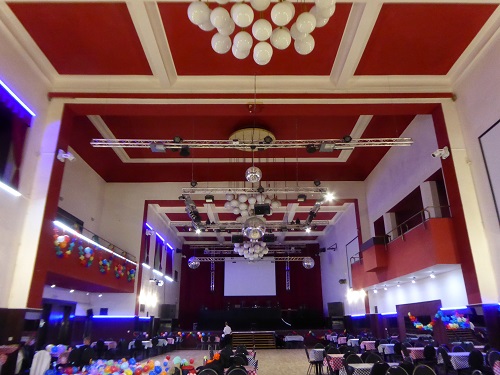
The young people putting up the balloons looked at me warily but communication was limited and I ploughed on inside for a quick peak. This, if I understand it aright, was where the first performance of Janáček's Glagolitic Mass took place in December 1927.


Further along, I nosed my way into a building which contained a theatre space on the first floor (Brno seems full of theatres). A nice girl setting up the bar for a matinee performance showed me inside the studio and served me coffee with delicious poppy-seed cake, which I consumed while enjoying the warmth of the sun as filtered through the big windows.


The only shame about this was that it knocked on the head my plan to have coffee in one of the many trendy cafes that have sprung up in Brno since I was last there, Punkt, in an attractive tree-lined street of shops. I did go in to the antique shop on the corner with the main road and was somewhat horrified to see this reminder of what happened to Brno after its brief period of independent revitalization.


A potent reminder of what sent so many Jewish Czechs into exile if they could get out, including the family of my student Robin Weiss, who was there in Brno with his wife Margaret on a cultural visit. His granfather was taught by Mendel from the Augustinian Monastery; his half-sister grew up in the Villa Tugendhat, THE so-called functionalist building to see in Brno, but I went there before its revamp with Austrian friends Tommi and Martha on our 2007 whistlestop tour.


Opposite the antique shop is a row of apartment buildings with stylish curved balconies from the late 1930s. This area was previously one of factory complexes, including the former Moravia Brewery.


To the east is Lužánky Park, one of the first public parks in Europe and favourite haunt of Janáček, whose later years were spent in a modest home behind the nearby Organ School (visited on our first trip). The other side of that rises the hill of Černá Pole, with a touching celebration of the great composer outside a Seniors' Club housed in a 1913 building.


This road curves round, with plenty of fine 1920s buildings in which I'd happily lodge.


At the top of the hill is the street with my two favourite functionalist buildings along it. First you hit the earlier neoclassicism of the Masaryk University.


At the end is the primary school


and in the middle the ERA Cafe.


Josef Kranz designed it as part of a residential building, influenced by the Dutch movement De Stijl with its reduction to essentials. The exterior minimalism


is offset within by the 'dynamic spiral staircase', blue on the curves against the red xylolite of floor and steps.


The building has undergone various changes, including Soviet incorporation into the neighbouring agricultural college, but in 2011 was restored to its old glory and now serves excellent food.


This would be an early port of call on any return visit to the city. Anyway, refreshed, I needed to get back into the centre of town


 so I took a nearby tram, missing out on several buildings I'll have to see on the next visit, and heading for the Augustinian monastery, which I'll cover in a future entry together with the Jesuitical glories of the old town.

Tuesday, 4 December 2018

Janáček: a more than earthly joy passed this way


A decade ago our Viennese friends Tommi and Martha indulged us on a whistlestop driving tour of Moravia, embracing Janáček territory from Brno via Luhačovice all the way to his birthplace in Hukvaldy as well as architect T's interest in Mies van der Rohe's Villa Tugendhat and the Bata development in Zlin. We stopped in Brno only for an afternoon, so I didn't have time then to take in its full wonders. Nor did it seem as pulsing and vital as it does now, with its thriving art, theatre and music scene and new artisan coffee bars all over the city. On that first visit I managed to visit the garden house in the grounds of the Organ School where the composer and his wife lived in later life, this time other crucial locations including the Augustinian monastery where Janáček was a lonely boarding chorister and music-maker


and the grave in the city cemetery pictured up top (the white chrysanthemums on the left are my offering, bought from one of the flower sellers at the gate). The quotation is from Janáček's setting of Tagore's The Wandering Scholar, with the selective words 'With his strength gone, his heart in the dust, like a tree uprooted'. Quite different from the life-goes-on optimism of his operatic epilogues, most radiant of all that in The Cunning Little Vixen after the heroine's death. where the Forester sings of  forest summer magic, adding that 'men and women will walk with heads bowed, and realise that a more than earthly joy has passed this way'. No wonder Janáček wanted this played and sung at his funeral. And how he loved animals - there are photos of him with a number of pet dogs at his home in Brno. I like this one featuring miniature poodle Cert ('Devil').


The pretext this year was the stunning Sixth International Opera and Music Festival known simply as Janáček Brno, and featuring all the operas for the second time. I'll be writing about my slice of the experience on The Arts Desk on Saturday. But the main point here is to highlight a production I didn't see, by Jiří Heřman, Artistic Director of the Janáček Opera Company. He's the same superb director whose very moving view of Smetana's Libuše, looking from Masaryk's founding of the Czech state 100 years ago backwards to the foundation myth and forwards to a second liberation, was the highlight among the five events I witnessed.


The Cunning Little Vixen was premiered in Brno's beautiful National Theatre (now the Mahen Theatre, pictured above), on 6 November 1924, opened the Janáček Theatre in 1965 and inaugurated the renovated building at the start of this year's festival. Although I didn't get to see an opera there, I was given a tour around the stage, auditorium and newly redesigned foyers.


Heřman's production, screened via Opera Vision and thus, miraculously, available on YouTube indefinitely, offers such a sensitive and profoundly moving interpretation, so detailed and yet doing no fundamental violence to anything in the work's scenario. Its starting point is a historical fact which not many of us outside Czechia knew about: that Rudolf Těsnohlídek, creator of the Vixen stories in his Brno newspaper Lidové noviny, found an abandoned baby girl in the woods near where he lived, in Bílovice nad Svitavou not far from Brno (I intended to take a short train journey there, but still had too much to see in town, so as the Vixen and her Fox sing, 'wait until next May comes'). His discovery led to the founding of the Dagmar Children's Home, designed for free by master architect Bohuslav Fuchs, many of whose buildings I explored thanks to the Tourist Information Centre's excellent little book on Functionalism in Brno. I'll be writing anon on here about my itinerary, which included the Stadion Sokol where the premiere of the Glagolitic Mass took place.


So Dagmar is the setting for the opening scene, illustrated in the first of three production photos by Marek Olbrzymek above, where the children all take delight in their wooden toys (this was genuine, says Herman, from a generation all too used to computer games). Eventually the eggshell walls


crack open to reveal the natural world beyond.


Never in my experience - which so far totals six productions - have the adult and children's worlds been so perfectly in balance, or so beautifully and touchingly united in the final scene. Heřman's many ideas are as thoughtful as those of the (over) intellectual Stefan Herheim, sidestepping or postponing the obvious, but he's far more tender and human with the personenregie, which makes us warm so much to Forester and Vixen. Do set aside time to watch and shed a tear or two.