Showing posts with label Smetana. Show all posts

Wednesday, 18 September 2024

Bernstein and Smetana operas on Zoom

Little did I imagine when I discovered A Quiet Place in the last of ten revelatory (to me) Zoom classes on Bernstein that the opportunity to explore it in greater detail would arise so soon: Royal Opera artistic director Oliver Mears is directing it in the house's Linbury Theatre this October together with the one-act masterpiece to which it forms the unexpected sequel, Trouble in Tahiti. So we start the autumn Opera in Depth term with both. The above image is of Krysztof Warlikowski's Paris Opera production

I may not get the usual numbers of students, as neither these nor Smetana's Libuše are exactly popular choices. But in the 200th anniversary year of the great Czech, and having experienced more of his wonderful operas in lovely Litomyšl, it was high time to pay tribute to a very different magnum opus. Jiří Heřman's stunning Brno production seemed unsurpassable (pictured above; review here), but I was happy to hear this pageant opera in concert this year, conducted by the great Jakub Hrůša.  

Do join us, starting on Monday 30 September. If you can't attend in person, films can be sent. Full details below (click to enlarge).

Wednesday, 8 December 2021

Horror and part-redemption: Ančerl and Haas


The still from an infamous film is not quite what it seems. Conductor, composer taking a bow, orchestra and smartly-dressed audience are all Jewish prisoners in Theresienstadt/Terezin. Two days later - the sickening cynicism of the Nazi propaganda machine! - they'll all be deported to Auschwitz. Few will survive. 

Conductor Karel Ančerl was one who did, though his wife and son were murdered in the gas chambers. Arriving in Auschwitz, he stood in line with his friend, said composer Pavel Haas. Mengele was ushering him on the path to extinction when Haas, weakened, coughed. 'No, that one'. And because of this obscene twist of fortune, the composer was lost to us and the conductor went on to greatness at the helm of the Czech Philharmonic. After the liberation of Auschwitz, he also found the orchestral parts - except the one for double-basses - of the work being performed in the film, Haas's Study for String Orchestra. 

Ančerl features in the film about the film, apparently not downloadable but to be found on YouTube (the title is 'The Führer gives the Jews a city' in capitals). Thankfully it is not the unadulterated propaganda exercise about happy life in Terezin. It's all in German, without subtitles, but an essential watch, if you can bear it. The great man's steely precision about the facts and circumstances is moving in itself. Needless to say several 'students' on my Zoom Czech music course were deeply involved - two had relatives who were in Terezin and/or were murdered in Auschwitz. Pictured below: members of the dressed-up Terezin audience several days before slaughter.

In every class, we've found something profoundly moving or troubling. Just think of the infant mortality and premature deaths which dogged the lives of the great Czech composers. As we moved through the decades, it became such a pattern that I felt I had to ennumerate. Smetana lost three daughters between 1854 and 1855, and his wife, who died of scarlet fever, four years later. Dvořák and his wife lost three children between 1875 and 1877. Janáček wrote in his 1924 autobiography that he would 'bind Jenůfa simply with the black ribbon of the long illness, suffering and laments of my daughter Olga and my little boy Vladimir'. No sooner had Josef Suk begun to mourn the death of Dvořák, his father-in-law, intending a five movement memorial with a triumphant conclusion, than his wife Otilie, Dvořák's daughter, also died. Thus the Asrael Symphony became a monument of almost unrelieved sadness.

Even though Bohuslav Martinů and his wife Charlotte had no children of their own, he had cause to mourn the remarkable young woman who may have been the great love of his life, conductor and composer Vítězslava Kaprálová (pictured above). Like another composer who should have gone on to greater heights, Lili Boulanger, she died at the age of 25. That was in 1940, just as the Martinůs were fleeing the Nazi occupation of Paris and marking the first stages of their difficult journey to the USA.

If, as the late, great Jiří Bělohlávek insisted, we accept Gustav Mahler as a Bohemian - he was born in Kaliště before the family moved to nearby Jihlava - then here's the most devastating chronicle of family loss of all the 'Czech' composers. Apart from the major loss of his life, the death of his four-year-old daughter Maria ('Putzi'), of the 14 children to whom his mother gave birth, six died in infancy, sister Leopoldine of a brain tumour at the age of 26, while 21-year old Otto committed suicide, and the greatest shock of all to the young Gustav, it seems, was the death of his brother Ernst of pericarditis, aged 14. On the manuscript of the work he defined as his official Opus One, the fairytale cantata Das klagende Lied, at the point where one of the two brothers in the forest lies down to rest - his sibling is about to slay him - the composer wrote 'Ernst' in the margin. Below are stanzas written out by Mahler in 1879.


Das klagende Lied got a look-in when I covered fairytales in the sixth Czech music class. Curious how events of great emotional significance have intruded on every instalment. Smetana's Má vlast, the fountainhead in so many ways, could be seen or heard in filmed or recorded concerts of special import: most recently, perhaps, when Rafael Kubelik returned to his newly-liberated country in 1990 (there are Japanese films of all the movements played by a conglomerate orchestra under him in Tyn Square, as wel as the famous sound recording of the Prague Spring Festival concert with the Czech Philharmonic). A thrilling, fast and often rough performance has been preserved from a radio broadcast of Václav Talich conducting the work under German occupation. It's so moving to hear the audience, in the midst of wild applause, break in to the Czech national anthem (which you get at the end of this excerpt - there's a complete performance on YouTube which stops before that point).


The Hussite chorale featured in Má vlast's last two symphonic poems, 'Tábor' and 'Blaník', runs through to Karel Husa's Music for Prague 1968 - I need say no more of the significance of that. Tomorrow we'll be focusing on Martinu in the 1940s but also remembering Haas and other Jewish composers who were murdered under the Nazis. I steel myself once again for a tough time and will try not to blub again. Then, in just over a week's time, it will all be over - the 10 Czech music classes as well as the 10 Opera in Depth surveys of Jenůfa and Julietta (which the students now accept as another of the 20th century's greatest operas). My thanks to visitors Nicky Spence, Mark Wigglesworth, Jana Boušková and Josef Špaček. As for the latest special guest, I can't wait to expound on the three Monday afternoon hours we spent in the company of Gerald Barry, ostensibly covering his latest operatic masterpiece, Alice's Adventures Under Ground, but roving far and wide to embrace, among other things, Miss Marple, Edward and Mrs Simpson, The Power of the Dog and linen napkins daubed with lines from Beethoven's letters. More anon.

Thursday, 21 October 2021

Harp swirls for Czech Music Zoom class 1


My Opera in Depth course this term - half devoted to Janáček's Jenůfa, the other to Martinů's Julietta - had already been under way for three weeks before I launched the Thursday class, a more general survey of a genuinely Czech music from Smetana through to Martinů, with a preludial look at 18th and early 19th century works by Bohemian composers in the European lingua franca of the time. 

The main point, though, was to reach the epic at the heart of Czech musical experience, Smetana's Má vlast, which launches every Prague Spring Festival on the exact anniversary of this founding father''s death. And I was lucky to know the Czech Philharmonic's principal harpist since 2005, the vivacious Jana Boušková, who with her colleague Barbara Pazourová usually kicks off the stirring first symphonic poem in a magnificent sequence, 'Vyšehrad', capturing the essence of the proud castle which stands above the River Vltava.

Jana accepted the invitation without hestitation. I'd become friendly with her at Paavo Järvi's Pärnu Music Festival, the best in the world for connecting with musical hearts and souls; and indeed she was invited there because she'd played in the Má vlast which Paavo conducted in the 2016 Spring Festival.

That year Jana and Barbara played the opening statements of the work's main theme, plus cadenzas, together; as it's written in the score, the second harp plays the melody and the first elaborates. Jana has actually played alongside five of her students in a Prague Conservatoire opener conducted by the late, great Jiří Bělohlávek. The one I had to hand to show the class was with a mere five harpists (students minus Jana). 

Another beauty of our introductory session was that I moved on to the most celebrated of the six symphonic poems, 'Vltava' (still better known outside Czechia as 'The Moldau' - but in the transcription made by the harpist and contemporary of Smetana Hanuš Trneček, in Jana's performance at a Czech Philharmonic fundraiser in the Rudolfinum during the first Covid spare, to help fund Prague hospitals (the number you see on the top right is the figure in Czech korunas, which shot up throughout).On the CD featured up top, Jana has referred to Trneček's work, but the transcriptions of the first three symphonic poems and of the rest of the works on a superb disc are her own.


The students warmed immediately to Jana - how could anyone not? - and there was much emotional discussion of the high level of musical education and literacy in that remarkable country. It was also vital, when Jana grew up, to have music as the world you inhabited when life under the Soviets was not so good - and to think of touring to the unimaginable rest of Europe or America as a top player, as her mother did (her father was a flautist in the Czech Philharmonic, so the couple played beautiful Mozart, inter alia, together). If you click to enlarge the image, Jana isn't difficult to spot - she has the Prague Old Town skyline behind her.

Today we move on to the Hussite chorale used in the last two symphonic poems of Má vlast, 'Tabor' and Blanik', as well as in crucial works by Dvořák (Hussite Overture), Suk (Prague) and Karel Husa (Music for Prague 1968). I'm still mapping out what the other eight classes will bring, though I'll divide fairly equally between 19th and 20th centuries, and the four greats, as depicted in this postcard of which I'm so fond, will have the lion's share.

The 10-week course on Wagner's Tristan und Isolde ended the week before we started this one. We had a virtual post-course drinks on the Friday, to which Dame Anne Evans was able to return, having been voiceless in the final class. Many laughs were had by the small but very vocal group on that evening  (Annie second from left in the bottom row).

I was also  delighted to record a Tristan chat with Robin Ticciati on the heels of his run at Glyndebourne, concluded with an orchestrally unforgettable Proms performance.


Equally thoughtful (and the other great British conductor as far as I'm concerned) was Mark Wigglesworth on Jenůfa, squeezing in the time to speak during work with the BBC Philharmonic in Salford (hence the dull hotel room background).

Just recorded another Jenůfa conversation, this time with tenor Nicky Spence, which I hope to air on Monday. Indebted to Mark for suggesting Nicky would make an excellent guest when I was running the course at the Frontline Club. As he did, and I love the generosity of all these exceptional artists, true Menschen all - that goes for Jana and Anne every inch as much as the men. Further guests, TBC, will materialise on the Czech music course anon. Not too late to join - just comment with your email here; I won't print but I promise to respond.

Tuesday, 7 June 2016

Martinů in Polička


Few childhood homes can have had so chimerical an effect on a composer's music as the small room above the bells in a church tower where Bohuslav Martinů spent the first 12 years of his life alongside four other human beings (briefly six, for two younger siblings died in infancy). I've been wanting to visit his home town of Polička for at least a decade; when our friend Ladislav was at the Czech Cultural Centre, there was a plan, thwarted by the scaffolding around the tower of sv Jakub and the long-term closure of the museum. Even now, on the English version of Polička's Bohuslav Martinů Centre website, it says that the room can be seen, but devoid of furniture.

Happily that turned out not to be the case. We arrived on a Monday afternoon, halfway through a blissful experience of the Prague Spring Festival including the previous night's excellent production of Juliette, which I've written all about on The Arts Desk. I'd planned an elaborate train journey, but thanks to the immense generosity of our hostess's father, we were driven from Prague and had the wonderful pleasure of stopping off for a couple of hours in lovely Litomyšl on the way.


Only 20km from Polička, this town with one of the most beautiful squares in Czechia, sausage shaped with shops under the arcades, is where Smetana was born to a similarly impoverished family - what were the chances of two geniuses springing up within such a short distance of each other in a rural area? Rather similar to the cases of  Janáček and Freud, born five kilometres apart in central Moravia - revelations there were briefly remembered in a very early blog entry. Must cover it in another blog entry, but in the meantime here's the statue of Smetana overlooking the square.


We stayed the night in Polička and rose early enough the next morning to catch the Centre's opening. The blingy Polička pension-hotel in which we were the only guests - thoroughly recommended if you don't mind the gaudiness, and I found it rather amusing - was within earshot of St Jakub's bells, and eyeshot too if you leaned out of the window and looked to the right.


The neo-Gothic church isn't that old - a fire devastated Polička in 1845, leaving only two per cent of the stone buildings standing, and what remained of old sv Jakub had to be torn down. There's a crude 19th century painting in the Centre/Civic Museum which gives an idea of what the town looked like before the fire.


The new church was completed in 1865; Martinů was born in the tower 25 years later. There's a plaque at the bottom


before you ascend 192 diverse steps - stone, wooden - past the big bell


and the four smaller ones above it


to the room where the Martinůs lived, now nicely framed by an iron gateway with a quotation from the cantata about a homecoming, The Opening of the Wells, with its words 'I am home' ('jsem doma'). My thanks to Jan Kucera for clarification on this.


Bohuslav's father, a humble cobbler, had taken on the post of tower keeper, clockwinder, bellringer and watchman only a year before the future composer's birth. Amazingly, many of his accoutrements have survived. I don't know whether the cobbler's tools are original


but the lantern which shone red and was hung outside, and the megaphone through which Ferdinand would warn residents of fire, certainly are.


These and other items of furniture were donated by the Martinů family in 1947 when the room became a museum. It was recently restored with financial support from the Bohuslav Martinů Foundation. There's young Bohuslav's rocking horse


and even the pattern on the new wallpaper was made from the original paper stencils.


The room served as dining room, sitting room and bedroom for five. The tiny kitchen is just outside; drinking water had to be gathered from a fountain at the corner of the 'Rose' house just below the tower; other water supplies could be caught from rainfall. The toilet use to be in the room behind the clock while other supplies, wardrobes and chests were stored lower down the stairs. Bohuslav was a sickly child and frequently had to be carried up the stairs on his father's shoulders.

How much influence could all this have had on Martinů's extraordinary music? Up there, I could understand how the light and flight aspects might have been affected. The tick-tocking of the church clock surely worked its way into passages like those in the scherzo of the Third Symphony. No other composer had a more extraordinary upbringing - and how remarkable that he and his two surviving siblings did so well. Much of this, it seems can be ascribed to the work ethic of his Roman Catholic mother Karolina.

The entire landscape can be seen from the walkway around the entire tower. The town stretches out to the east, with the park and country on the south side,


while to the north-west you now see the Koh-i-noor pencil factory and more recent housing.


Directly to the east, also just beyond the walls, is the 16th century church of sv Michal with its extensive cemetery.


Martinů was originally buried in Schöneberg, Switzerland following his death in the hospital of nearby Liestal on 28 August 1959. 20 years later, the wishes of his widow, already buried in Polička, were realised: his remains were disinterred and he was buried together with her and his parents in sv Michal. The gravestone, erected in 1984, is by Milan Knobloch.


What else is there to see and do in Polička? If your goal is the tower room, then your first stop will be the Bohuslav Martinů Centre, which also houses the excellently arranged Town Museum - all this, especially the glassware room, looking especially handsome thanks to the EU funding to which the Czechs seem so supremely indifferent,


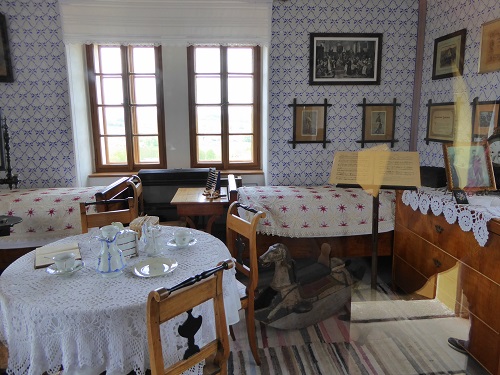
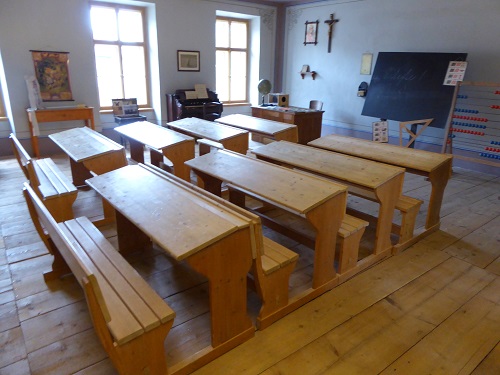
and which served as the boys' school where Martinů was educated. There was a theatre on the ground floor, schoolrooms above, one of which has been expertly recreated above all so that local children can experience something of what the composer did as a child.


The main square has a fine 18th century town hall - we didn't have time to see the chapel - and the highest plague column in Bohemia (22 metres), under scaffolding when we visited.


Here's a photo of a photo of Martinů in the early 1930s standing in the square by what looks like a rather different version in a different place.


The town was deserted on the Monday evening of our arrival; the only eatery we found open was the restaurant-come-beer-hall on the square, proudly labelled Hotel Pivovar. Inside was a fug of smoke and lots of characterful old blokes watching ice hockey on the telly. They didn't stare or make us feel uncomfortable as their counterparts have done in Cornwall and the north of England, and the sole waitress was very friendly, though presumably her man was rather rough since she had a very bruised right arm. Anyway, the meat and potatoes were the hottest and tastiest I had in Czechia, not exactly feted for its cuisine.

Perhaps I didn't nose out all the interest of Polička, but I did manage a spin around three-quarters of the fortifications, very picturesque alongside the park


and had I not crossed the bridge I wouldn't have known about the statue of Martinů in the middle of the arboretum.


That was the final sightseeing before our driver arrived at 11am to whisk us off to the Gothic marvel of Kutna Hora's sv Barbora on our way back to Prague and Janáček's From the House of the Dead that evening.