Showing posts with label Jiří Heřman. Show all posts

Tuesday, 13 December 2022

A Brno Advent dozen


On 1 December, having just returned from an exhilarating weekend seeing two productions by the opera/theatre director I consider one of the most visionary in the world, Jiří Heřman, and steeped in the spirit of a very Czech advent weekend in Brno's centre, I thought I'd mark each December day up to Christmas with an image on LinkedIn from that glorious city. Now that I've reached a dozen, I'll be reverting to London and Dublin, but I thought I might preserve the dozen here. I started above with the big wooden crib outside the New Town Hall. I'll use the original captions for the rest.
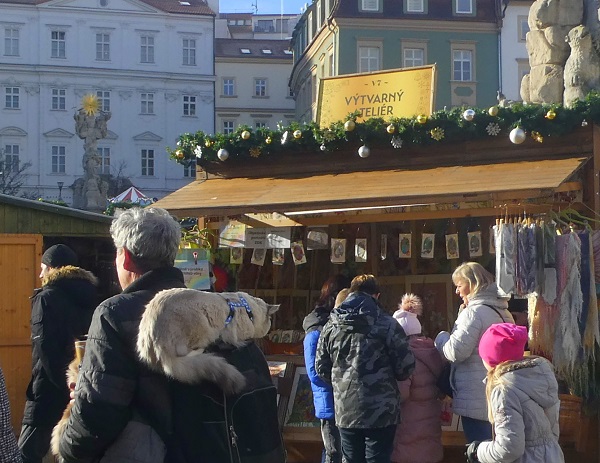
2: the people of Czechia's second biggest city love their animals. Dogs everywhere, but in the Zelný trh (which translates inelegantly as 'Vegetable Market', literally 'green', now given over to Xmas stalls) I also saw a gentleman with two cats - a Persian on his back, another in a basket. He eventually set them down to have a stroll around - the crowds parted and looked on in amusement.

This, by the way, was at the start of a very lovely Sunday spent with friend and Opera in Depth Zoom class student Barbara, who came up on the train from Bratislava. I've added one here above she took of my trying to talk to the unbiddable Persian. Another friend, Juliet, will be amused, because this cat was the spit of one looked after in Jerusalem when she and her partner Rory were there, name of Zorah, always addressed with 'so naughty!'

3:  back to the wooden-figure crib in front of the New Town Hall. Walk behind and you'll be rewarded with these splendid goats (?) and storks.


4: more hustle and bustle in
Zelný trh, and this time from cats to dogs, which the citizens walk around the centre in large numbers. Note the eyeing up of the wee black creature by the canine on the right.


5: third shot of the wooden Nativity - elephant's eye view, looking across to church of St. Michael.

6: barrel organ player in Zelný trh. I remember being struck by the quaint sounds around the streets on my previous visit - a very characterful fellow used to turn the wheel outside the Jesuit Church.

7: returning to Zelný trh after a walk with Barbara to the Augustinian abbey where Janáček received his schooling - covered in a previous post here -  and Mendel made his discoveries (and excellent duck and cabbage pancakes at Skanseen).

8: the rainbow light shimmer in front of the National (Janáček) Theatre, stunningly renovated, has been temporarily replaced by snowflakes. Walking back after Heřman's sunning production of 'From the House of the Dead/Glagolitic Mass', which I urge you to watch for free on OperaVision.


I can take another diversion from the advent 12 just to show you one stand of the exhibition in the foyer relating to both works, taking in some of the audience looks at the same time.


9:  the beautifully-proportioned Mahen Theatre = 140 years old, recently refurbished and still playing host to smaller-scale National Theatre productions - is where all Janáček's late operas were first performed. Nicky Spence's performance with Julius Drake of The Diary of One Who Disappeared was a highlight of this year's Janáček Festival.

10: expert choral sounds emerged from a small 1931 shopping precinct as I walked towards the National Theatre for a performance of Nabucco. These young people were rehearsing with their choir master - superb. Music is everywhere in Brno.

11: street cleaners taking a break in Náměstí Svobody, Freedom Place, known affectionately as Svoboďák. The Christmas tree here springs from a tradition established by the writer Rudolf Těsnohlídek, of Cunning Little Vixen fame, and a rather extraordinary story of a baby girl he found in the woods which led to the founding of a strikingy designed children's home. Full details here: https://lnkd.in/ecadynam 


I found another edition of Těsnohlídek's novelized Vixen, complete with Stanislav Lolek's charming illustrations in the original newspaper serialisation, in Brno's No. 1 bookshop, Janáček ordered up his music here.


12:  this very short tram which travels the centre is so beautifully lit up for Xmas - I'm afraid I didn't snap it twinkling in the dark, but you get the gist. Images 13-25 will first return us to London, then move on to more shining lights in Dubin. 

Previous posts on Janáček in Brno here, the city's churches here and its amazing functional 1920s and 30s architecture here. My last article on the big city festival is here on theartsdesk. Post on the latest operatic experiences due there soon.

Tuesday, 4 December 2018

Janáček: a more than earthly joy passed this way


A decade ago our Viennese friends Tommi and Martha indulged us on a whistlestop driving tour of Moravia, embracing Janáček territory from Brno via Luhačovice all the way to his birthplace in Hukvaldy as well as architect T's interest in Mies van der Rohe's Villa Tugendhat and the Bata development in Zlin. We stopped in Brno only for an afternoon, so I didn't have time then to take in its full wonders. Nor did it seem as pulsing and vital as it does now, with its thriving art, theatre and music scene and new artisan coffee bars all over the city. On that first visit I managed to visit the garden house in the grounds of the Organ School where the composer and his wife lived in later life, this time other crucial locations including the Augustinian monastery where Janáček was a lonely boarding chorister and music-maker


and the grave in the city cemetery pictured up top (the white chrysanthemums on the left are my offering, bought from one of the flower sellers at the gate). The quotation is from Janáček's setting of Tagore's The Wandering Scholar, with the selective words 'With his strength gone, his heart in the dust, like a tree uprooted'. Quite different from the life-goes-on optimism of his operatic epilogues, most radiant of all that in The Cunning Little Vixen after the heroine's death. where the Forester sings of  forest summer magic, adding that 'men and women will walk with heads bowed, and realise that a more than earthly joy has passed this way'. No wonder Janáček wanted this played and sung at his funeral. And how he loved animals - there are photos of him with a number of pet dogs at his home in Brno. I like this one featuring miniature poodle Cert ('Devil').


The pretext this year was the stunning Sixth International Opera and Music Festival known simply as Janáček Brno, and featuring all the operas for the second time. I'll be writing about my slice of the experience on The Arts Desk on Saturday. But the main point here is to highlight a production I didn't see, by Jiří Heřman, Artistic Director of the Janáček Opera Company. He's the same superb director whose very moving view of Smetana's Libuše, looking from Masaryk's founding of the Czech state 100 years ago backwards to the foundation myth and forwards to a second liberation, was the highlight among the five events I witnessed.


The Cunning Little Vixen was premiered in Brno's beautiful National Theatre (now the Mahen Theatre, pictured above), on 6 November 1924, opened the Janáček Theatre in 1965 and inaugurated the renovated building at the start of this year's festival. Although I didn't get to see an opera there, I was given a tour around the stage, auditorium and newly redesigned foyers.


Heřman's production, screened via Opera Vision and thus, miraculously, available on YouTube indefinitely, offers such a sensitive and profoundly moving interpretation, so detailed and yet doing no fundamental violence to anything in the work's scenario. Its starting point is a historical fact which not many of us outside Czechia knew about: that Rudolf Těsnohlídek, creator of the Vixen stories in his Brno newspaper Lidové noviny, found an abandoned baby girl in the woods near where he lived, in Bílovice nad Svitavou not far from Brno (I intended to take a short train journey there, but still had too much to see in town, so as the Vixen and her Fox sing, 'wait until next May comes'). His discovery led to the founding of the Dagmar Children's Home, designed for free by master architect Bohuslav Fuchs, many of whose buildings I explored thanks to the Tourist Information Centre's excellent little book on Functionalism in Brno. I'll be writing anon on here about my itinerary, which included the Stadion Sokol where the premiere of the Glagolitic Mass took place.


So Dagmar is the setting for the opening scene, illustrated in the first of three production photos by Marek Olbrzymek above, where the children all take delight in their wooden toys (this was genuine, says Herman, from a generation all too used to computer games). Eventually the eggshell walls


crack open to reveal the natural world beyond.


Never in my experience - which so far totals six productions - have the adult and children's worlds been so perfectly in balance, or so beautifully and touchingly united in the final scene. Heřman's many ideas are as thoughtful as those of the (over) intellectual Stefan Herheim, sidestepping or postponing the obvious, but he's far more tender and human with the personenregie, which makes us warm so much to Forester and Vixen. Do set aside time to watch and shed a tear or two.