Last year, I only reached the end of February in my photo-chronicle of the lifesaving Fridays shared with friend Cally during the darkest phase of lockdown, when nothing was happening at all on the live cultural scene. We carried it on to mid-June, and those treasured bike rides, leisurely walks, soup on a bench, tea and cake on another bench later, still stand out as a highlight of 2021. I feel I need to pick up the trail now especially because after the big train jaunt, January in London has felt more than usually bleak, despite a few days of brilliant sunshine. Picking and sorting these images has been a tonic - not just nostalgic, but also a reminder that lushness and colour will return.
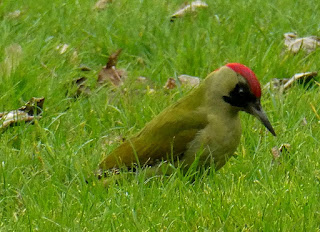
What's a bit hard at the moment is that the winter visitors out back, the goldfinches, and in Margravine Cemetery, the redwings, don't seem to have returned. I felt a spring in my step after seeing one of the two bitterns regularly to be sighted at the London Wetland Centre. But I'm waiting for major colour like this, from two Green Woodpeckers, which greeted us on our 6 March visit.
Other action in early March was slow. The magnolia grove was about to burst, though,
and there was a rare silvery light on the Thames as I cycled back.
Elsewhere - and I make no apologies for natural digressions - spring was more in evidence. The spaliered fruit trees along the wall of Fulham Palace's Walled Garden had started to blossom
and the first of the bees from the nearby hives (sadly reduced from last year) were on to them.
while winter's relics, the Hellebores, were putting on a fine show at the Chelsea Physic Garden.
The following Friday at Kew, the magnolias were very much out. I'm resisting a gallery of them, since I offered that in 2020, but this shot will suffice.
It was time, too, for the pulsatillas or pasque flowers in the Alpine rockery, a personal favourite.
Time was short on 19 January, so instead of the big cycle we kept it more local to Cally, taking advantage of low tide to cross over to the eyot at Chiswick Mall (for me, the most enchanting spot on the river, never the same twice). Much work had been done in late winter in the way of pruning by the dedicated locals who look after it, so major growth was yet to come.
The grand magnolia in flower in front of the big house on Chiswick Mall
and daffodils around the lake in Chiswick House's glorious grounds
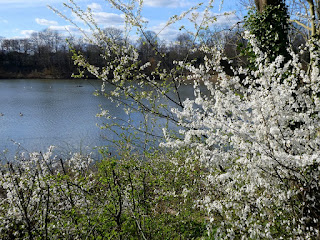
then over the river to the Leg of Mutton nature reserve, whitethorn blossom providing contrast among the reeds
and above the water.
First of the Peacock Butterflies fluttering around and settling on the headstones in the graveyard of my old haunt All Saints Banstead, on a visit to see my ma, such a warm day for 30 March.
1 April, and some of the blossom was now reaching peak form back at Kew
along with the magnolias - Stellata pictured here.
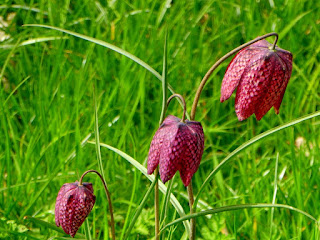
Finally, too, it was fritillary time in the neighbouring meadow (quite early, I think - early May is the usual).
And the pulsatillas were no longer isolated clumps, but abundant.
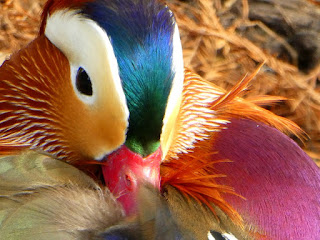
Couldn't resist the plumage of this male Mandarin Duck
and at home, on the fence between the back yards and the school playground, a goldfinch was showing itself to best advantage.
Tulip and pear blossom time back at the Fulham Palace Walled Garden
and cowslips at the Wetland Centre
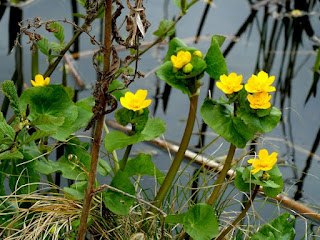
Yellow season much enriched, too, by marsh marigolds.
Gunnera incipient in the Pantanal zone.
This is really the home of the adorable Whistling Ducks and Screamers, though the most interesting activity was the nest-building activity of a moorhen couple:
First time I'd been here in the spring, so I was surprised to come across more fritallaries sharing swampy ground with more marsh marigolds on the south walk.
Kew's more manicured fritillary meadow again - 16 April - not sure how we came to miss a Friday -
the arrival of the tulips in the meadows either side of the prunus avenue
and more blossoming in the orchards between the Temperate House and the Pagoda, though not evenly so (the great glory of 2020, the Yoshino cherry, was not so spectacular this year).
My first acquaintance with a real oddity (to me), Cornus 'Ormonde', in a glade beyond the larches,
and first sign of leafing in the avenue of horse chestnuts leading to our usual entrance/exit.
Can't resist the interlude of a mackerel sky above Old Brompton Cemetery
where I first heard, and finally saw, a Great Spotted Woodpecker.
So to the glorious 23rd April, everything along the river and at Kew waxing lyrical. The beginnings of the finest wisteria blossom along Chiswick Mall
though it has to be said that a more sheltered specimen against a white wall was doing better at this point.
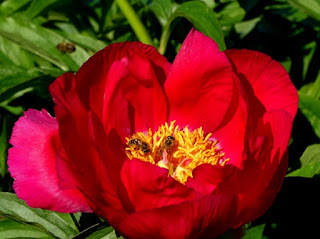
At Kew, first of the peonies were flourishing - bee-kissed Paeonia cambesedesii by the Alpine House
as well as these in the Alpine rockery proper
The rockery lushed up last year better than I can ever remember it doing before,
including among the bloomers an oddity I hadn't seen before, the Cuban Lily (Scilla peruviana).
and the vegetable beds the other side of the wall showed first signs of life with the fruit trees along the edges
with tulips in serried ranks further north - these beds awakening at last from their long winter sleep.
Bluebells at last in the woodland zone.
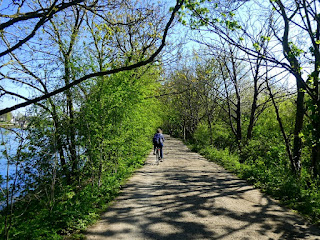
The cycles to and fro along the Surrey side of the Thames reminded me how far the trees had come into leaf since we started our excursions at the beginning of the year.
More abundance: horse chestnuts and early moonrise in front of the Chelsea Hospital.
Meanwhile, another back yard regular returned, or made self manifest, the Dunnock. A family was soon evident.
Last Kew trip of April, on the 30th, and first proper visit of the year to the beds of the Duke's Garden, which would offer the biggest profusion within weeks. For now, some of the peonies both here and further north had emerged.
All greenhouse remained closed during the semi-lockdown, so we could only peer through the windows at the Amazonicas in the Waterlily House.
Bluebells, Spanish chestnuts and beeches in the woods had come on magnificently
and the ongoing glories of the orchards near the pagoda made for an extended idyll (fell asleep on a nearby bench in the sun).
On the return route, a very high tide at Chiswick Mall opposite the eyot made for a welcome lingering, and the approach of a fearless swan.
May Day morning turned about to be an ideal choice for 4am rising and five hours around the dawn chorus experience at the Leg of Mutton reserve, about which I wrote closer to the time. The month continued to do what we expect of it. Cycling back to Kew on the 7th, I found the Chiswick Mall wisteria in its full glory
and the eyot duly lushing up.
Newly flourishing in the rock garden, sundry aquilegias, foreground to ferns and peonies.
Hadn't expected to see a yellow tree peony this late, but here's one at the foot of the temple knoll.
At last the glorious Judas Trees are in full bloom - first encounter with this one in the Mediterranean garden zone. The hair colour of one of these ladies seemed too irresistible a complement not to sneak a shot.
One step further for the tulips of the cherry tree avenue
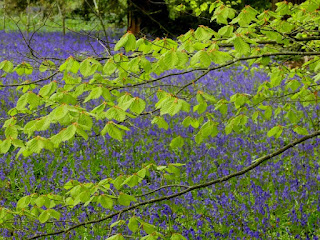
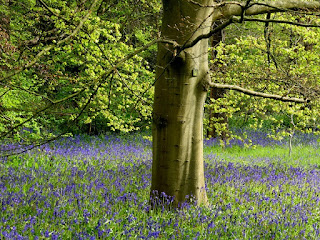
and further loveliness of beech leafing against the bluebells.
There was an unexpected paeonian bonus just before we left, actually near the toilets on the north side. This looks like a peony, but its designation is Solanum jasmanoades,
while its equally big and blowsy neighbour is Paeonia suffruticosa.
Abundant peonies by now available to adorn the home. This bunch has a version of our good friend Marcelle Hanselaar's 'White Collar Man' behind it.
The yard at last began to thrive. The patio quince put forth flowers
and even the sporadic bee population seemed to be on the increase, here on the latest addition to the geranium family out back,
while I'd almost forgotten about the two irises under the weeping mulberry tree, but parted the leaves and found them thriving
Iris time, too, in the formal gardens of Hyde Park - here's one gorgeous speciment fully open
and another budding
while a ubiquitous parakeet makes for interesting colour co-ordination in a nearby tree.
I'm so glad our good friend Deborah joined me on the opening of the Glyndebourne season (20 May), because she's an orchid expert and immediately, very excitedly, identified a batch of Common Twayblades (Neottia ovata) which I would have overlooked by the edge of the lake.
Other, more familiar emergents were the over 100 year-old wisteria in Fulham Palace's Walled Garden
and the dark colombines in our bedroom windowbox.
On 28 May, downpours threatened, so we weathered it at Cally's before setting out to a nearer location, Chiswick House Gardens. But I'd never been in the newly-restored Walled Garden there, so there were plenty of treats here: the white wisteria on the outside wall,
rows of colourful planting on one side of the main avenue, irises abundant,
Phacelia tanacetifolia, much loved by bees and abundant,
ditto a lupin (mine in the back yard failed this year - unless I buy them advanced in growth, the snails get them).
Waterfowl life on the lake was much as usual, including the coots who nest in the same places every year, but this time there was a small addition, much treasured, I guess, because few of the chicks that hatch survive - too often the herons get them,
Late May seems prime time for the young 'uns. These kid grebes in Battersea Park were enchanting
and nearby, close to a swan's nest which had been deserted - one fellow visitor was concerned, but as soon as she'd gone, another assured me that the brood had hatched and swum off with mum and dad - another resourceful moorhen was raising young.
By the Serpentine on 30 May there was more avian family action. Greylag parents steered their broad successfully through the pedestrians to the water
while a mother swan gave her two cygnets the cue to rest
before the father appeared to accompany them on the Serpentine.
1 June reminded us of the first days when Kew reopened to the public the previous year (pictured at the end of this 2020 chronicle), and this day was just as glorious. Peonies back then were nearly at an end, but everything was a couple of weeks behind last June, so the Duke's Garden was still yielding wonders. If anything, the beds were now even more spectacular, with irises and lupins adding to the colour-layers.
Abundant in the rock garden were Mediterranean tulips and Californian poppies
along with Ochagavia elegans.
Bees love the giant echiums in flower.
Peak season on the other side of the wall - more bee action on abundant 'Scarlet O'Hara'
and more serried ranks of irises.
Nearby was a loner, not one I'd seen before - 'Tol long'.
At last we were readmitted to the water lily house, where the Amazonicas were doing their stuff. Having just watched how brutal they can be in shutting out the light from other plants fighting for life in the excellent Green Planet, it's as well there are experts to hand to make sure the lilies also thrive.
Resident peacock of the Japanese garden (which Cal had got to display by some embarrassing but effective singing several weeks earlier) offsetting azaleas,
colourful fungus on a tree stump (don't ask me what),
and a bee on a flower (Deborah has identified it as Camassia Leichtlinii alba) in a white and green meadow near the oak zone.
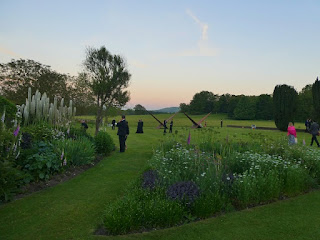
First visit of the season to Garsington's home on the Wormsley Estate, with the obligatory visit to the glorious walled garden (walkable, and we've wandered back, but they insist you take the coach from the cricket pavilion).
Not entirely characteristic sightings back at the Wetlands Centre on 8 June - a moth which doesn't appear in my Collins guide, and yet I saw it in several different locations around this time,
orchids (Southern Marsh?) by one of the smaller ponds
ubiqtuitous (but always cheering) Lapwing on one of the flowered islets
and frilly giant poppies in abundance
Last year, the English Garden in Battersea Park was a lavish joy, having been rather unattended in 2020, though lilies on the pond are always profuse.
Roses in abundance, too, this flower with a sleeping bee inside.
The final visit to Kew in this batch, on 11 June, included J and Maxine Braham to celebrate the half-year of Fridays along with us. Here they are in the Waterlily House
A fresh batch of flowering
and water droplets on a lotus leaf.
Again we were able to compare with this time the previous year - when J and I visited in 2020 on the day after reopening, 2 June, the tulip trees were in bloom. This was the first Friday when we saw the flowers, so roughly 10 days behind.
Likewise only white peonies were still in flower back in early June 2020; now most of the rest were still thriving
though I remember the lupins near the peony garden from before,
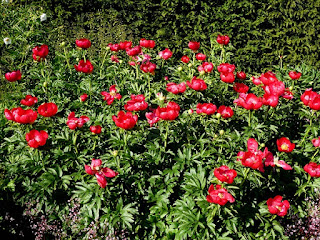
Our white peony finalists were all doing well in the Duke's Garden
though the star attraction here was the humming of innumerable bees among the ?Salvia nemorosa? Only a film does justice to this abundance, but these stills must suffice.
Star unknown (to me) of this visit was a Japanese Snowbell tree (Styrax japonica), spectacular in full flower.
Second visit of the season to Glyndebourne was on my birthday; the concert conducted by Robin Ticciati was a stunner - first Mahler symphony (Four) I'd heard live in at least a year and a half - and so was the day. More orchids were to be found in the meadows and by the lake, where the last of the twayblades could still be found if you looked hard enough.
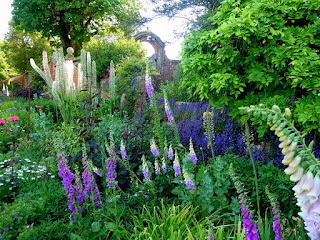
Meanwhile the formal beds were thriving with irises, poppies, lupins, foxgloves and a very handsome robinia (opposite where we dined in the interval, at table 59, a significant number for the day).
Heading towards the longest day of the year, we still had the sunset to enjoy after the symphony's childlike view of heaven.
The weather wasn't quite so clement on my one visit last year to Grange Park, but a circuit around the fields revealed an unusual visitor - a black bee? Certainly I've not seen one like this before.
Meanwhile, the goldfinches continued their feeding down in the back yard (view from bedroom window)
and even had some babies (if I make this out aright, there are two with their mother).
I even got to see the goldfinches moult in late summer, but there's been no sign of them for months. But the days are getting longer, the sun came out halfway through the week and nature is slowly coming back to fuller life.




















 Posts
Posts



