Showing posts with label Sibelius. Show all posts

Saturday, 25 June 2022

And the Best Tatyana Letter Scene winners are...


...as far as Tchaikovsky's opera is concerned, two: still,  on DVD and in the opera house, Yelena Prokina for Graham Vick at Glyndebourne back in 1994. Here's the reaction of some of the students on my Opera in Depth course after I'd played it to them on Monday. I've cut down the bigger picture to focus on the best responses. One lovely person with a lifetime of astonishing musical experiences recalled emotionally what having seen it at Glyndebourne meant, and how happy she was to see it again now that she and her husband can't get there any more.

Two hours still weren't quite long enough on what turns out to be so many people's favourite operatic scene. Sound recording only wise, there was a strong positive reaction to my personal favourite here, Gabriela Beňačková in a Supraphon disc of Czech and Russian opera arias - I picked it up for a dollar when we spent a New Year in Prague a year after the Velvet Revolution. Vaclav Neumann conducts the Czech Philharmonic.

Parallel with the opera, we're also listening to some of the Pushkin text, in both the English translation of Charles Johnston and the Russian original, in two recordings featuring the very beautiful incidental music provided by Prokofiev for a 'stage realisation' of the verse novel intended for the centenary year of Pushkin's death, 1937, but destined never to see the light of day (Prokofiev repurposed much of the music in War and Peace as well as several other later scores). 

We treasure the reading of Wests Timothy and Same, and Niamh Cusack as Tatyana, in Edward Downes' realisation on Chandos, but I thought it might be most interesting for you to hear Tatyana's letter to Onegin as read by Chulpan Chamatova, with the late Mikhail Jurowski conducting the Berlin Radio Symphony Orchestra in the music that occasionally punctuates the text. You can have your English translation to hand if you need it. I originally found the recording broken into tracks, which would have been most convenient but doesn't work in this format. Here's the whole thing. The Letter begins at 15m32s.

Meanwhile on Thursdays, the Sibelius course is taking us all deeper and broader than I could ever have imagined. The most recent class, 8, featured not only the String Quartet 'Voces Intimae', which I'm getting to know and admire better, but three orchestral works I love most of the so-called tone poems, all composed within a relatively short space of time. I am now obsessed with hearing them all in a single Sibelius half of a concert programme. Luonnotar for soprano and orchestra is the creation myth, and could be followed by The Bard, a voiceless singer strumming his lyre until the sound of primitive lurs summons him, a kind of Ragnarok that goes profoundly within; and then one could have the purification of water in The Oceanides

Well, I can dream, can't I? Now there are four more summer term Zoom classes to go, then a break, then the Wagner Society of Scotland wants me to start up with Die Meistersinger on 3 August, another luxuriant course of 10 classes. More of that shortly.

Thursday, 21 April 2022

Zooming Sibelius


After four in-depth Zoom terms on Russian music, one on the Czechs and the most recent on the Hungarians, I decided that Finland had to be next. And while there are plenty of other fascinating musical voices, the name of Jean Sibelius towers above all others. While he only started learning to speak Finnish aged 9 at one of the country’s first national schools – Swedish was his mother tongue – Sibelius’s musical consistency is absolute, from the early masterpieces of the 1890s through to his turning away from all major works in the 1920s.

We’ll be following the adventure from its bracing start - including the programme symphony based on the exploits of one of the many ill-fated heroes in the national epic the Kalevala, Kullervo (depicted above on his way to war by Finland's greatest 19th centurty artist Akseli Gallen-Kallela, like the portrait-plus below, hanging in wonderful house-museum Ainola) through to the supreme concentration of the Seventh Symphony and Tapiola, with excursions to the music of other Finnish composers both contemporary with Sibelius and of later generations.

Hopes are high for the kind of special guests who’ve been a feature of earlier courses – among them conductors Paavo Järvi, Vladimir Jurowski, Antonio Pappano and Robin Ticciati; pianists Pavel Kolesnikov, Alexander Melnikov, Steven Osborne and Samson Tsoy; violinists Alina Ibragimova and Josef Špaček; and harpist Jana Boušková. Certainly I'm wondering if the exceptionally busy Klaus Mäkelä can be persuaded to come along again after his energetic contribution to a Bartók class just before I heard him conduct the suite from The Miraculous Mandarin in Oslo. My rave for his new Sibelius symphonies set with the Oslo Philharmonic, now incontestably one of the world's top orchestras, should be out in the BBC Music Magazine soon. But there already fine cycles to choose from, including those by Berglund (twice), Järvis Neeme and Paavo, Kamu, Oramo and Saraste.

A wide range of works will be illustrated with excerpts on CD, DVD and YouTube. We begin next Thursday (28 May) at 2.30pm with the first of 10 two-hour classes. You don't have to attend live - you can received the video the day after. Either way, the fee is a modest £100 for the whole term (not bad at £5 an hour - and often we take the luxury of running on longer if the case, or the special guest, so demands). Email me at david.nice@usa.net ASAP to confirm a place

Saturday, 17 August 2019

The many faces of Yannick Nézet-Séguin


Was there ever a more perfect array of expressions to match the music than those of the wondrous Canadian? The shaping and body movements are totally eloquent, as they have to be, but the many faces prove that this man lives what he conducts without affectation or excess. BBC Proms hero the photographer Chris Christodoulou caught him in many moods at the first of the Bavarian Radio Symphony Orchestra concerts; between us Sebastian Scotney and I managed to put up quite a few shots in our respective reviews (mine is here). Chris wrote to me:' I have just finished editing 264 images of him alone - and only rejected at a push 22!' Thanks to him for supplying a few more here.


Chris also tells me that how people behave backstage is an eye-opener, and that  YNS is really out there, shaking hands and hugging people. Clearly a Mensch as well as a seriously great conductor.


It's a real shame the BBC didn't want shots at the second BRSO concert; the partnership with Gil Shaham, a late replacement for Lisa Batiashvili in Prokofiev's Second Violin Concerto as YNS was for Mariss Jansons in the two concerts, proved another joy to watch and hear. Despite an ineffable lightness of touch, the team got at the essential seriousness I've always maintained is there in all three movements, the finale an increasingly manic danse macabre like Shostakovich's and Lorca's characterisation of the Malagueña in the Fourteenth Symphony ('death moves in and out of the tavern').


My colleague in the pre-Prom talk for that evening, Ariane Todes, didn't agree with me on the heart of darkness, opening apart, even after the performance, but that's fine - all part of Prokofiev's amazing ambiguity. We got on very well, and Martin Handley is a true knowledgeable pro; I didn't actually miss anything in the edited version brought out in time for the interval, so skilfully did he steer us to the main points both about the Russian school of violin playing and the concerto itself. Take a listen while you can on the iPlayer, both to the concert and to the talk (which starts at 46m25s).


I must admit the tempi YNS took in those infuriatingly music-minus-two and -three sequences in the annoying Rosenkavalier Suite could not have been sustained by any singer, but it was worth it to hear the necessarily exaggerated swoon of the waltzes (and the ratchet rattling in the Albert Hall). Brilliant idea, too, to give Sibelius's near-contemporary, couldn't-be-more-different Valse triste as the encore.


That's become an encore speciality of the Estonian Festival Orchestra and Paavo Järvi, who gave their best performance yet, of the ones I've heard, at the end of this year's Pärnu Festival; but YNS and the Bavarians yielded nothing in terms of character. Two very great orchestras and conductors - I wish Mariss Jansons back to full health after his absence, but I wonder if the (relatively) young Canadian could be next in line of succession in Munich.

Friday, 2 November 2018

Two Thursdays in Birmingham


Three cheers for Chiltern Railways, is the first thing to note. Leaving from one small and charming station, London's Marylebone, travelling in comfort through pleasant countryside and arriving in another gem, Birmingham's Moor Street, is a much needed easing into the concrete jungle that is the centre of the city. The original building could so easily have been lost, but it's had a nostalgic face-lift, which includes the signage, and it has a very good coffee shop. Turn left and you hit the insoluble mess of the Bull Ring, but if you cross the road and head up the hill, you can be in the square around the Cathedral in minutes.


On my first visit, I was looking for a bite to eat before heading to see the final rehearsal of friend Susie Self's new opera, Quilt Song, at the Old Rep Theatre where her grandfather John Drinkwater's play Abraham Lincoln had been premiered 100 years ago to the day of her own first performance. The extra prompt to go and lend support came from Nina Stemme, to one of whose children Susie is a godmother, who when I met her in Stockholm and mentioned Susie, immediately asked 'when are you going to Quilt Song - 19th or 20th?' (she went on the Saturday, between performances in the Royal Opera Ring. Quite a friend).

More on that in a moment, but I should add that next to the rather stylish old pub opposite the Cathedral I'd visited before there had opened a Syrian eatery, Damascena, rather like our own beloved Jaffa Bake House on the North End Road in that it evokes similar such establishments in Syria and Lebanon. I returned the following Thursday for an early lunch, and it was just as good and even livelier.


Quilt Song is an ambitious project. Quite apart from the fact that Susie is composer, singer, co-director, conductor (of all those scenes in which she doesn't appear) and video artist, the work itself runs the gamut of styles in its inclusivity.


There are pop songs for the 'Universal Choir' and students from Birmingham's Ormiston Academy, incorporating some rather portentous words from Drinkwater's play,


some intricate instrumental music for the core ensemble of 12 players and the loveliest writing, I think, for the Alma Guitar Trio, working for their degree at the Birmingham Conservatoire by performing together.


Maureen Brathwaite sings Rosa Parks, chief subject of the opera's motto 'we have more in common than that which divides us' - epitomised also by another great woman who gave expression to it, Jo Cox, "drawn" as the Muse of the Poet (John Drinkwater, no less, embodied by Susie). She's sung by soprano Elizabeth Cragg, already pursuing a successful career. Brathwaite and Cragg pictured with members of the chorus on the 'bus' below.


The other solo voice belongs to James Blake, the bus driver who ordered Rosa Parks to move from her seat to make way for white people, sung by tenor Tristan Stocks, who also doubles as the Jo Cox figure's murderer.


He's allowed his transformation in a very Tippettesque second part where as Charon he rows souls across the river Styx to a street party.


Bear in mind that I only saw the final rehearsal. It did, though, allow me to send Susie a string of notes which I hoped would be helpful. Clearly as it stood - and I had to leave shortly before the end to catch my train back to London - the show was about 15 minutes too long, and Susie did in fact make a cut before the first of the two official performances where I thought it should be, in the 'Street Party' sequence. I hope she also got the other singers to clarify the text more; she herself, a superb mezzo, is always exemplary in that respect. She puts much of this down to her teacher, Josephine Veasey. As she wrote, 'I literally speak on the pitches rather than employ a singing mode. This is totally radical and for some singers too controversial an approach. They like singing too much!'

Otherwise, bravi tutti for giving so professional account of a big and at times complicated work. I thought Susie's videos especially striking and though I wasn't too sure about co-director and dancer Marina White Raven's later interjections - as the bird of death? - I found her physical expression in the opening sequence striking.


A week later, I returned to Birmingham - this time arriving before noon - to give a pre-performance talk at Symphony Hall on Sibelius and his First Symphony, taking a journey around it and the works that led up to it. I was amazed by the crowd assembled on the second foyer level (rehearsal was ongoing in the auditorium so the usual venue wasn't available, and I much preferred the alternative). Sitting on chairs and on the floor, standing, looking up from below (the microphone made it all audible from other foyer spaces), they were amazingly attentive and asked interesting questions. I told one or two that we don't get this level of attendance in London, probably because we have five orchestras and thus a less loyal following; the response was that the audience feels part of the CBSO family. Splendid.

As was the first half of the concert: to hear the orchestra in that best of venues is always like encountering music with the lid off, and Wagner's Flying Dutchman Overture as conducted by Vasily Sinaisky made a superb start. Then Benjamin Grosvenor (pictured below by Patrick Allen/Opera Omnia) in Mozart's C major Piano Concerto, K467.  He has it all - the most elegant trilling after Paul Lewis, a crisp, beautiful treble and a rich bass in perfect counterbalance, originality but never eccentricity of phrasing, an ear for what the orchestra's doing.


Alas, I couldn't stay for the Sibelius; I had to get back and prepare for the next day's start of talks around Shostakovich's fifteen quartets. Which took me back to Birmingham, this time Grand Central, and on to Bromsgrove. But that's another story, due a post soon.

Sunday, 17 September 2017

Rouvali electrifies in Sibelius's Kullervo


It's clearly the start of a new golden age for the Gothenburg Symphony Orchestra (Göteborgs Symfoniker). While the UK establishment was going ape over Rattle's first official night at the helm of the London Symphony Orchestra on Thursday, I still guess I was getting a better deal over on the west coast of Sweden, where the GSO has appointed 31-year old Finn Santtu-Matias Rouvali as its chefdirigent (pictured above by Ola Kjelbye). Exactly the sort of new adventure on which I'd hoped the LSO would embark - Ticciati would have been my ideal choice - before it settled for our most famous, and only fitfully brilliant, cultural export to Berlin, now back with fanfares galore. Name recognition, I guess. As it is, I reckon the Philharmonia is a more exciting London orchestra with Esa-Pekka in charge, Rouvali and another brilliant younger-generation spark, Jakub Hrůša as principal guest conductors (both appointed, I gather, with Salonen's input alongside the players').


My report of first acquaintance with Rouvali was going to tie in with a very quirky interview which will appear on The Arts Desk before his first Philharmonia concert of the season on 5 October. But I can't contain my excitement about the concert in question until then. It was, in any case, quite an emotional visit - though I've returned to Sweden many times in recent years, I hadn't been to Gothenburg since 1990. The previous year I was invited there to leave with Neeme Järvi and the orchestra on tour to Estonia, the first time he'd been back to his homeland since he in essence defected with his family in 1980. The next trip was to hear him recording Prokofiev's The Fiery Angel. Järvi's momentous tenure in Gothenburg lasted from 1982 - I actually heard the team for the first time in London in 1980, first remembered here - to 2004. I was happy to see a bust of the great man in the Konserthuset foyer


not far along from Nielsen and Grieg (Stenhammar is also here, of course, represented both as composer and as the GSO's principal conductor between 1907 and 1922).


Järvi's successor, Mario Venzago, left little impression; Dudamel was snapped up in 2007 and gave some excellent concerts with the orchestra but his heart was still in Venezuela and LA. The principal post remained unfilled for five years, until now.

The bar for Sibelius's first authentic large-scale work was set impossibly high: nothing could surpass the Kullervo of Sakari Oramo, the BBC Symphony Orchestra and a wall of stalwart Finnish male voices with the BBC Singers at the 2009 Proms, my highlight of that season (and now on one of the best BBC Music Magazine cover discs ever). Read all about it alongside an illustrated population of cats and dogs from the Kalevala here. This was simply on the same extraordinary level, and stupendous on very different terms (since it would not be possible to surpass what Oramo and his team achieved).  Rouvali's precise beat combined with a dance-like bendiness means that everything is riveting; there's no such thing as peaks and troughs - even the few pianissimos buzzed with inner life. Only in the battle sequence, potentially repetitive, did he grade the intensity.


The reaction may also have something to do with where I was sitting - in the middle of the raised seats at the back of Gothenburg's magnificent 1935 concert auditorium, 'a crab in a rectangle,' as architect Nils Einar Eriksson described it in relation to its outer shell. The sound is very in-yer-face there, with woodwind sounding individually spotlit (the repeated-note oboe figures in the second movement were disconcerting, but in the right way). Sibelius's telling of a typical unhappy-hero sage from the Kalevala is unique, rough and direct, full of startling sounds and balances that need to be carefully worked through (Rouvali had made some of his own emendations to the score to foreshadow stuff in the symphonies to come - more on that in the interview).

So the orchestral playing was magnificent. Leading question, though: could the men of the famous Orphei Drängar from Uppsala possibly match the impact of the Finns at the Proms? They did - I have it on good authority that their Finnish articulation was impeccable - and similarly raised goosebumps on their first entry, tears at the last. Here are two of them walking towards the hall not long before the performance.


The weather, incidentally, was magnificent each day until late afternoon - more on my time by a Swedish lake and in town anon. Just as a taster, this is what I was doing on the morning of the concert, some way north.


But I digress, with the hope that Sibelius might approve. To return to the concert, the big central drama, where Kullervo seduces a maiden who turns out to be his own long-lost sister, an unhappy twist on the Siegmund-Sieglinde predicament, seemed more operatic than ever. Real-life sister and brother Johanna and Ville Rusanen entered from opposite sides during the kick-off, and the soprano suggested that she would already make a magnificent Brünnhilde (she also sang Kullervo's Sister for Oramo). In the absence of a professional photographer, I took one curtain call shot which is OK enough to use here.


I felt as if I'd lived through a big Wagnerian experience every inch as involving as that of the Budapest Ring. But Sibelius is not in thrall to Wagner, or Bruckner; if anything, this 1892 work anticipates Janáček's originality by nearly a decade. And you'll have gathered that the performance was well worth the trip. It should be back up on the orchestra's excellent website not too long after the livestreaming of the Saturday performance. In the meantime, take a look there (scroll down) at Rouvali's performances of other Sibelius, Stravinsky's Petrushka and Janáček's Taras Bulba - the last two only available until 1 October - and watch this 360 degree experiment in which first horn Lisa Ford introduces Rouvali in a rehearsal of Smetana's "Vltava" from Má vlast before the complete live experience (at around the five-minute mark, if you don't want the chat). It makes Rouvali's special qualities very clear.


Exciting times for orchestras all around the world at the moment with so many new major talents popping up everywhere.

Tuesday, 11 July 2017

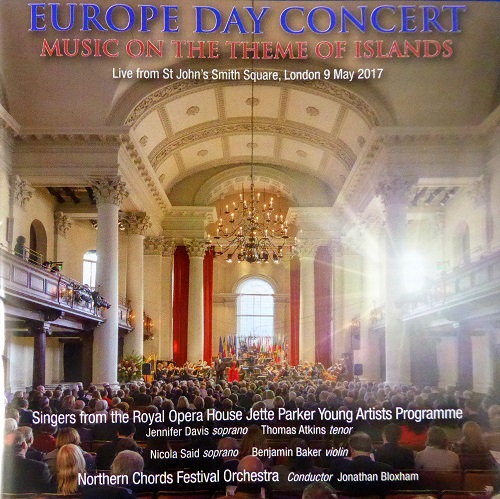
Europe Day Concert CD: it's here


Delighted we are with it, too. Simon Weir, the producer at Classical Media, has done a grand job with sound that's very present - though it's odd to learn that St John's Smith Square has problems of dryness, since it never feels like that from where one's sitting. I think the small body of strings (5.5.3.3.2) mostly works in favour of the transparency I hear right from the start.


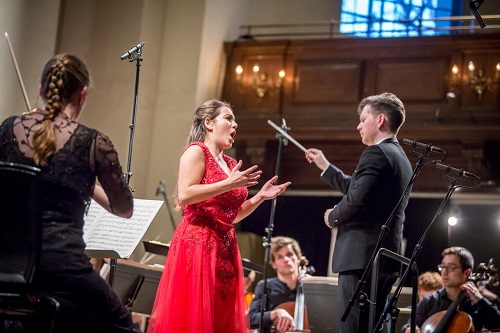
There's not much more to add to my report of the very rich and moving event, except to say that personal favourites remain the Martinů Ariane monologue, where you can really hear Nicola Said going for it (let's have another of Matt Smith's photos from the concert, below), true goosebump time, and the Sibelius Tempest numbers - I really don't know better performances of the movements in question on any other recordings, thanks partly to the exquisite wind playing and especially to Jonathan Bloxham's subtle work with clarinettists Joe Shiner and Greg Hearle in 'Song II', which may be my favourite minute of music ever.


Matt Kaner's new 'Brexit' piece Stranded still sounds fabulous, of course; I hope Matt and violinist Ben Baker can make good use of it. The biggest surprise was how totally gorgeous the Pearl Fishers Leila/Nadir duet comes across on the recording; it was good in performance, but I didn't realise how good. I repeat myself, but we're ready to see Jennifer Davis's Micaëla and Thomas Atkins' Don José right now (there they are on 9 May below, at the anxious stage of the duet). They're in the Jette Parker Young Artists Summer Performance on Sunday along with the four others I heard at St Clement Danes - looking forward to that.


I actually took a week off from concert and opera going after the East Neuk Festival - 11 events in three and a bit days needed proper digestion, and hopefully the results on The Arts Desk, if necessarily a bit telegraphic in the overall 1500 words, do it justice. I did, though, catch a lunchtime event by serendipity. Joined our nearly nonagenarian friend Edward at Chelsea and Westminster Hospital to be there for him before and after an endoscopy.

At first I just sat in the waiting area - a pleasant space, like most in that admirably designed building - but started to fulminate at the telly: it was Trump's big-scare speech in Warsaw about defending white Western civilization, and the droning of platitudes became too much. I asked the nice receptionist if she knew when Edward would be out. '1.45' came the answer. So I popped out, bought a sandwich, came back and found a flute-and-piano recital in full swing in the ground floor atrium.


This was thanks to hospital charity CW+ and the Concordia Foundation: a concert every Thursday lunchtime. Good music, good art: this is a place that's a dream of what an NHS hospital can be like. My experiences there have all been good; a friend who was a cancer patient there had a less good time of it. Depends on the medical team in question, I guess. But anyway, the fascination of this event was watching all those who came, stayed, stood for a bit, danced around, walked past either with smiles on their faces and as if nothing was happening.


And the playing was top-notch: flautist Sophia Castillo and pianist Marie Otaka, both prizewinning student at the Royal College of Music. I caught the end of their selection from Bach's Second Orchestral Suite, a very evocative piece by Ian Clarke called Orange Dawn, a very surprising transcription of Lensky's Aria, the show-offy Monti Czardas, 'Morning' from Peer Gynt and an also surprising Carmen Fantasy put together by Francois Borne. It sent me back to the ward lighter of heart, even if I then had to sit for another hour with intermittent Sky highlights of that abysmal Trump speech.

Tuesday, 16 May 2017

Europe Day Concert 2017: depth and range


There, bang in the middle of what by common consent turned out to be the best Europe Day Concert to date, was the world premiere of a piece which went as deep and as high as anything on the programme: Stranded by Matthew Kaner, in which the solo violinist finally breaks away from the combative orchestra and walks offstage, still playing. A surprise which no-one expected and which in the programme note the composer hadn't divulged, but everyone got the point. Arriving at St John's Smith Square halfway through the afternoon rehearsal to hear the already great Benjamin Baker and conductor Jonathan Bloxham - my favourite twentysomething musicians* and I pictured at the after-concert party below -


rehearsing the new work with the Northern Chords Festival Orchestra, I was taken aback by the ravishing beauty of the sound (Matt's orchestration is a wonder) and the impact of the playing.


An email comment, one of many from friends, sums it up: 'a superb band - quite the best I've heard in its depth and range'. Photos here all by Jamie Smith, with the exception of the below, composer concentrating at the rehearsal, by me.


And it all went beautifully. People wept, and not just at the emotion of standing, as we always do, for Beethoven's Ode to Joy at the end of the concert (I have to add that the orchestral statement of the Ninth Symphony's big tune has never sounded better either, even if it had an extra kick after Macron used it two days earlier). The emotional depths were especially sounded in 'The Oak Tree' from Sibelius's peerless incidental music to The Tempest, Ariane's Farewell from Martinů's eponymous late masterpiece with Maltese soprano Nicola Said rising to divadom - how she's come on even in the year since I saw her perform the role at the Guildhall School -


and the metamorphosis/resurrection, Respighi's 'The Birth of Venus' from his Botticelli Triptych, swelling and all-enveloping.  Again, an e-mail accolade is worth reproducing: 'it was an extraordinary evening, beautiful, at times so exquisite (Martinů's aria) it actually hurt, dignified, wrenching'.


The theme was 'islands', Malta currently holding the presidency (the opening speeches, from Norman Hamilton, Maltese High Commissioner, and Christine Dalby, Acting Head of the European Commission Representation in the UK, were succinct and very much to the point). The programme looked good on paper. But in practice it went further than expected - so much could be taken as metaphor for the tragedy of the UK's imminent departure, even if it wasn't consciously planned as such. Again there was general agreement that not a piece failed to make its mark.

Even Maltese composer Charles Camilleri's 'Nocturne' from the Malta Suite - not the piece originally desired - provided a melancholy showcase for Jonathan's wonderful strings, making so much sound for the grouping 5.5.3.3.2 and all the nimbler as a result, as the iridescent variety of Mendelssohn's The Hebrides Overture immediately established. Communication and flexibility, assets which Jonathan has developed amazingly quickly - he's now assistant to Mirga Gražinytė-Tyla at the City of Birmingham Symphony Orchestra - caught everyone around me, I could see, and didn't let go until over an hour later. Sounds as if I'm exaggerating but I speak the truth when I say I haven't heard a livelier or more gorgeous-sounding performance of the Mendelssohn classic.


The strings were lovely and bouncy for Mozart, too, and we had absolute top quality from two singers currently on the Royal Opera's Jette Parker Young Artists Programme, Irish soprano Jennifer Davis and tenor Thomas Atkins (a Kiwi, like Ben). He took the less florid version of Idomeneo's 'Fuor del mar' but still adorned the da capo with extra flashes of brilliance; Jennifer had Ilia's tender-sad Act Three aria 'Zeffiretti lusinghieri', a neat follow-on to the natural settings of the soprano and tenor numbers from Nielsen's Springtime on Funen. That was deliciously done, too - Siri Fischer Hansen, administrator of JPYAP, attested to the excellent delivery of her native Danish - and turned out to be the favourite of quite a few folk in the audience. One spectator pointed out that it was all the more beautiful for being accompanied by the almost rustic vision of trees and sinking sun through the big window behind the orchestra.


Soprano and tenor rose to the French ardour of the Act 2 love duet for Nadir and Leila in Bizet's The Pearl Fishers, too - Thomas is going to be singing Don José in the Royal Opera's Peter Brook Tragédie de Carmen, and I can hear an ideal Micaëla in Jennifer already.

I still think there's no greater demonstration of genius than Sibelius's distillation of a lifetime's experience in the Tempest music. He was such a master of the miniature, and to my mind Song II, a canny orchestral adaptation of Ariel's 'Where the bee sucks', is its epitome: two short verses, the second first abbreviated and then given a surprise extension, wryly singing on two clarinets with the lightest string bounce underneath, all in a minute. Joe Shiner, destined to be either a soloist or an outstanding principal in one of the world's best orchestras (or both), and his colleague Greg Hearle brought more subtlety to their parts than I've ever heard on recorded interpretations, and Joe's belated solo in The Hebrides, as in his performance with the London Firebird Orchestra last year, brought tears to the eyes; Jonathan let him take all the time in the world over it. Joe was also the orchestral fixer, working flat out beyond the call of duty.


Flautist Alena Lugovkina - on trial, I understand, for the Royal Opera Orchestra - also excelled, and leader Zoë Beyers got to take over from Ben at key points in Stranded. Quite apart from the beauty of seeing a group of young players really enjoying and putting across their artistry - they later said how struck they were by the quiet intensity of the audience and the ecstatic reception it gave them - they were truly representing Europe, with an Estonian violinist (Marike Kruup), a Bulgarian cellist (the outstanding Michael Petrov), a Polish harpist (Zuzanna Olbrys), a Spanish first horn (Francisco Gomez Ruiz) and other nationalities in the mix (I haven't pinpointed them all). Delighted also that the other good friend I've made from first acquaintance at the Pärnu Festival in 2015, Sophia Rahman, was the pianist.


Everything went smoothly, receptions included. Now everyone can enjoy the aftermath of a job superbly done and look forward to the CD.

*Left out one other - the prodigiously talented Ed Picton-Turbervill, formerly organ scholar at St John's Cambridge who graduated with a Double First in Music, celebrating the launch of his book on the trees of the Backs by playing the Goldberg Variations this coming Saturday. The Bach evensong following an afternoon picnic and the launch at St John's may involve him too, I don't know. Genius, anyway. Ought to include my dearly beloved godson Alexander Lambton, too, whose sax contributions to various classy bands are well above the average.

Tuesday, 22 December 2015

Brave new (musical) world


I mean that in the genuine original sense of Shakespeare's Miranda, not ironically like Huxley. Among the many good deeds in a naughty world - and it's never seemed more horrible, in my lifetime, than this year - are the enterprises of young musicians like violinist Ben Baker and conductor/cellist Jonathan Bloxham. It's been my greatest pleasure to follow the trail from the East Neuk Festival, where, having arrived the night before the Retreat players' second concert, I only just met Ben, via Pärnu, where he was playing in the superlative Festival Orchestra along with Jonathan who was also on the conductors' course, to Southrepps and several Wigmore Hall recitals.

In all of which there was no need to talk of promise: the complete, sophisticated musicianship is totally there already. And it made a nice farewell to a great musical year earlier this month to attend their 'Christmas Charity Concert' in The Warehouse, Waterloo (both photos of orchestra, conductor and soloist by Boris Bizjak). Voluntary donations were to go to as fine a charity as any worth your attention, Migrant Offshore Aid Station (MOAS), to which I'm also going to give all the money we save on stamps and cards by sending e-season's greetings.


The young - in some cases very young - orchestra of students and graduates made as fine a job as any I've heard of Mozart's Figaro Overture, Barber's Adagio for Strings and Haydn's 'Surprise' Symphony, with Sibelius's Valse Triste as an encore (Jonathan following in the footsteps of master Paavo Järvi in Pärnu). All the more remarkable on three hours' rehearsal that afternoon. Jonathan has an elegant conducting style and is getting to grips with the individual rubato so essential to conductors of quality (several famous ones don't have it, and never will). Ben played the second of Beethoven's Romances for Violin and Orchestra, usually a bit mundane but not in the hands of this supreme, understated master. Friends I'd invited along were wild with enthusiasm at the quality.


I'm not sure that goddaughter Mirabel (pictured above with Jonathan, Estonian violinist Marike, mum Edwina and friend Caroline) would have gone quite that far, but in attending her first grown-up concert - an hour without interval seemed manageable, and so it proved - she took it all in, especially the 'surprise' of Haydn's slow movement, such a brilliant symphonic treat. Having won the hearts of several girls in the concert with the big eyes noted by Jonathan and Ben, she was also perfectly socialised in the after-concert drinks, running up to the box and putting in extra pound coins, chatting to perfect strangers. She's also more recently, courtesy of John Savournin, had 'Happy Birthday' sung to her by the cast of Charles Court Opera's panto Mirror Mirror at the King's Head Theatre, about which I've heard great things and which I can't wait to see in the interstices between Xmas and New Year.

Ben will be playing the Beethoven Violin Concerto at the next Warehouse concert, 28 February, 6.30pm.