Showing posts with label Northern Chords Festival Orchestra. Show all posts

Tuesday, 27 April 2021

Europe Day Concert 2021 - London livestream


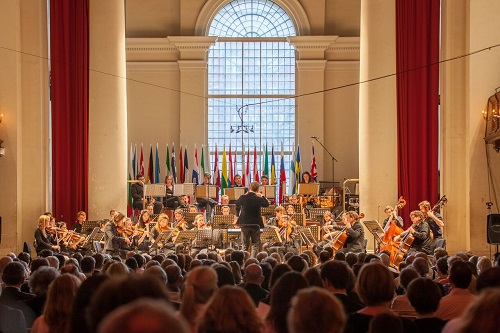
Sadly for the first time it will be without a live audience - we miss the cautious opening-up on 17 May by not much more than a week - but it's way better than nothing (the situation last year). Jonathan Bloxham will actually be playing the cello on the 17th in a Newcastle concert with tenor Ben Johnson and pianist Martin James Bartlett, in that same light and airy church where I so relished a day of events last autumn. Before that, he takes charge of this, his fourth Europe Day Concert and the 12th since the series began. We need your (free) viewing to convince the bureaucrats of its worth and support. And how could it not be superb, given what Jonathan and his Northern Chords Festival Orchestra of top young professionals - Thomas Gould will again be the leader, as he was in 2018* - achieved in those previous concerts?

My genuinely eulogistic words about delicious prospects have gone up on various slices of publicity, including this one, which gives a link to watching the concert on 9 May at noon UK time, but there's no harm in expanding here. I should at least reiterate that the star soloist, since Portugal holds the presidency, is tenor Luis Gomes, former Royal Opera Jette Parker protege now singing Verdi's Alfredo and Puccini's Rodolfo around the world.

Here's the full programme, which I'm proud to have worked on (as a pure labour of love, of course) with Jonathan. The 'journeys' theme is reflected throughout.

Sibelius: Scènes historiques 2 – 'All’ouvertura: La chasse'

Verdi:  Simon Boccanegra – ‘Inferno!’(Gabriele's aria)

Mendelssohn: Calm Sea and Prosperous Voyage  –

Elgar: Variations on an Original Theme, ‘Enigma’ – Variation XIII: ‘***’

Benjamin Godard: Dante – ‘Ah! De tous mes espoirs’

Ester Mägi (b.1922): The Sea

Meyerbeer: L’Africaine (Vasco da Gama) -  ‘O Paradis’  

Johann Strauss II: Vergnugungszug (Excursion Train) Polka 

Dvořák : Symphony No. 9, ‘From the New World’ - Finale  

Beethoven: Ode to Joy (The European Anthem) 

I'm especially happy with the sub-theme following Dante's Divina Commedia in three arias loosely connected to Inferno, Purgatorio and Paradiso. It was Luis who came up with the aria from Godard's Dante, and we're hugely grateful to the Palazetto Bru Zane, a wonderful and obviously well-funded enterprise, for being so obliging with the music. I realised I had the recording sitting at home so far unheard. and it's a pleasure throughout.

Godard was a musical conservative, proud of never having opened a Wagner score, and his trump card is a kind of virginal candour which works well with the character of Beatrice. The last act is the best, with good parts for four singers, the third - attempting to do a whistlestop tour of Inferno and Paradiso - the weakest, Our aria is good, if not the absolute highlight. The singing and playing in the above performance, recorded live in concert, are top notch

Also of such swift help in getting hard-to-find music was Mariliis Valkonen of the Estonian Music Information Centre. Thanks to her I now have both the only recording and the score of Ester Mägi's The Sea. The grand old lady of Estonian music is now 99. Here's a lovely photo of her with my treasured friends Andres Kaljuste and Sophia Rahman and, yes, Arvo Pärt, her junior by not so very many years, after a concert in the beautiful centre bearing his name on the Lohusalu peninsula, then newly opened.

As Sophia sent me a selection of photos from that occasion, many of which I hadn't seen, here are two more: in the hall after the performance

and Mägi as one of the first to stand on the top of the observation tower which was one of Arvo's conditions for the Centre - it's in woods, and only from a height can you see the sea. So this shot is very appropriate in the light of the work that's to be played.


Finally, although it's embedded within the publicity I linked to above, here's the 2018 Europe Day Concert performance of the European Anthem, aka Beethoven's Ode to Joy, in my books the only anthem worth standing for, The silence at the end was completely unexpected: we were mourning for what we were going to lose. It continued for a minute until someone's mobile phone went off. The infallible Simon Weir of Classical Media has captured some of it in the film.

*Great news just in that Sini Simonen, Finnish first violinist of the brilliant young Castalian Quartet, will be joining him on the front desk of first violins.

Thursday, 23 May 2019

Europe Day Concert 2019: past midnight, still alive


And kicking, or rather dancing and riffing, in the most electrifying official finale we've had at St John's Smith Square in the past 11 years, a fine way to celebrate the fact that the UK didn't leave the European Union on 29 March. When Jonathan Bloxham, our superlative conductor, announced a Norwegian soloist for the wacky arrangement by Cristian Lolea (violin and strings) of Enescu's First Romanian Rhapsody, I ummed about the nation - not exactly EU. Then he told me it was Eldbjørg Hemsing, who wowed both live (in Bodø) and on her CD championing a concerto by compatriot Borgstrøm (the coupling on the disc is a first-rate performance of Shostakovich's First Concerto). Top notch, pure class, with a poignant unaccompanied encore of Grieg's 'The Last Spring'. The fact that she was playing with young equals, the pan-Europeans of Jonathan's Northern Chords Festival Orchestra, led to improvisatory fireworks with leader Agata Darashkaite and cellist Sébastien van Kujik.


The theme was '25 and under: young European composers', because youth seemed like a timely theme for celebration. No shortage of great examples here: Jonathan opened with the Rossini-esque first movement of Schubert's delicious Third Symphony, one of the six he completed in his teens, and as mid-point we had Mendelssohn's Legend of the Fair Melusine, the water-music of which indisputably influenced Wagner when he started his Ring in the depths of the Rhine. Both catered for a brilliant regular, first clarinettist Joe Shiner, whose first solo CD is due out soon. The wind as a whole were superb, as they have been for the past three years; flautist Sarah Miller, oboist James Hulme, bassoonist Carys Ambrose Evans and horn-player Stephen Craigen joined Joe for the best performance I've heard of Estonian Erkki-Sven Tüür's Architectonics I. Erkki-Sven had been dubious about unearthing this relatively early piece of his, describing it as 'naive', but the response of so many in the audience proved its durability.


The interpretation of Lili Boulanger's D'un matin de printemps also left others I'd come across way behind; I heard this delicate fantasy in a completely different light. Sure, it sounds like filtered Debussy, but also has more of an identity of its own than I'd thought. The other favourite choice of people I spoke to - musicians and not - was soprano Valentina Farcas's exquisite delivery of the aria 'Dopo l'oscuro nembo' from Bellini's first opera Adelson e Salvini, later reworked for Giulietta in I Capuleti e i Montecchi. Valentina was representing her native Romania, which currently holds the EU Presidency. I heard her float a gorgeous line in 'Ihr habt nun Traurigkeit', for me the highlight of the 150th anniversary performance of Brahms's Ein Deutsches Requiem in its original location, Bremen Cathedral, with Paavo Järvi conducting the Deutsche Kammerphilharmonie (Matthias Goerne was at his most committed, too).


That gave plenty of promise for true bel canto style, and the way emotion informed what was sung brought tears to my eyes in a way that rarely happens for me with Bellini or Donizetti. Rossini is in a league apart, though, and Valentina returned to treat us to Amenaide's big scena 'Giusto Dio' from Tancredi. She was very sincere in her praise for the way that Jonathan provided perfect stylistic support in this repertoire, in a way - she said - that many top names on the podium have not. In fact his adaptability never ceases to amaze me. This time I didn't attend the afternoon rehearsal, so each performance gave fresh cause for wonder. A personal favourite, Elgar's 'Fairy Pipers' from the first Wand of Youth Suite, brought more period-conscious yet breathing portamento then I've heard before. So exquisite, and counterbalanced by the rugged string sound for Bartók's Romanian Dances and the Enescu.


And finally, the European Anthem, this time more truly an Ode to Joy after last year's unanticipated minute's silence at the end. The Romanian Ambassador's speech came at the end, rather than at the beginning as is customary, and gifts were distributed.


A few post-show party shots (like all the rest, with the exception of the first singer-orchestra-conductor photo, by Jamie Smith). Two Estonians, cellist and agent Maarit Kangron and violinist in the orchestra Marike Kruup, with Jonathan's girlfriend Jess Wadey;


two Bulgarians, composer Dobrinka Tabakova whose work Bell Tower in the Clouds gave such zest to last year's programme and assistant conductor Dorian Todorov;


and Jonathan - who was at his happiest this year, having hand-picked all the players he wanted and feeling more relaxed about his relationship to the music - with Eldbjørg, whom I'll see next in Svalbard.


Only sorry I didn't take a photo of my 88-year-old mum, who gamely arranged to be driven up from Banstead and back to attend her first Europe Day Concert, lovingly cared for by her goddaughter Sara while I flitted about. It was, unlike last year which had an elegiac tone, the jolliest of occasions. We're not out yet, the European Commission Representation in London lives to fight another day, and we're feeling more optimistic. Please get out and VOTE for a pro-Remain party today, those of you who can. I'm popping round to the local polling station before I depart for Sweden - alas not, like admirable Greta Thunberg, on the train. Transport around Europe is going to need some serious rethinking over the next year.

Friday, 18 May 2018

The last Europe Day Concert in London?


Maybe on this scale. If all goes according to the most badly-laid of all plans, the UK will be out of the European Union on 29 March 2019 and the European Commission Representation in London, which has mounted these concerts for the past decade, will be dissolved. Even if that happens, we can't let the youthful talent which came together to give us the two best concerts of the series in 2017 and 2018 disappear from our ken. Dobrinka Tabakova, whose Bell Tower in the Clouds proved a huge hit last Wednesday with everyone I spoke to, MUST be commissioned to write Brexit Piece No. 2 (Matt Kaner's Stranded in 2017 turned out, quite without warning, to be the first), and Jonathan Bloxham with his Northern Chords Festival Orchestra (pictured above) must be involved once more. Funds CAN be raised.


That's Dobrinka pictured above in Bulgarian green after the concert by me - all event pics by Jamie Smith - in the company of compatriot conductor-composer Dorian Dimitrov and my other New Best Friends, BBC Young Musician winners Martin James Bartlett and Lara Melda, whom I met at the Proms launch and promptly invited. Congratulations, by the way, to this year's laureate, 16-year-old Lauren Zhang. I haven't yet had time to watch the final, but I'll be doing so here, and very curious to know what she made of Prokofiev's titanic Second Piano Concerto. Wouldn't necessarily have chosen her from the piano final, the only strand I've seen so far, but all the competitors were phenomenally gifted and showed a staggering level of technical wizardry.

Meanwhile, it's too soon to think of 2019 now. Of one thing everyone who was present must be sure: the whole concert worked at the very highest level of engagement, professionalism and sheer love. Only at the very end was there a chance to mourn - which the audience seemed to do, totally spontaneously, with their 90-second silence at the end of a beautifully-phrased Ode to Joy, for which we always stand.


The film, part of the complete concert which will follow in due course, has already had 27,000 hits on the EC's Facebook page - if you haven't already seen it, here's the place.

Otherwise, this year's programme was more celebratory and exultant than the last one, which I think came off equally brilliantly but had a more elegiac tone (not least Martinů's Ariane threatening to throw herself off a cliff, which resonated unexpectedly with Brexit). What more effervescent way to start than with Mozart's Overture to The Marriage of Figaro, a performance of which better articulated at high speed I've never heard? And it ticked so many boxes of the 'crossing borders' theme - operatic treatment by an Austrian composer of a French play set in Spain with an Italian libretto. Matching it for sheer brio were the two numbers from Massenet's ballet music in his underrated opera Le Cid. Getting the dance idiom right is tough - I had the Israel Philharmonic/Martinon classic in my head - but Jonathan and Co pulled it off at the highest level.

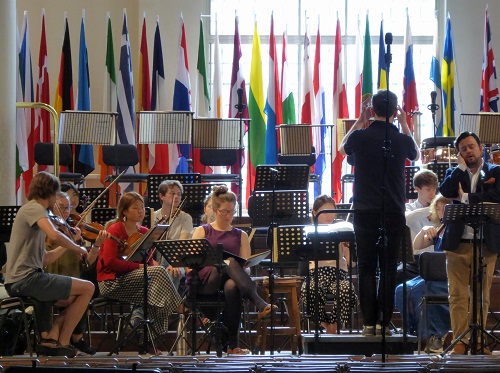
At the rehearsal - let's have two shots I took in the afternoon sunshine -


I was stunned by the strings' imitation of far-flung trumpets at the start of Britten's Les Illuminations. This may have been the best group yet; engaging leadership by Thomas Gould, leader of the Britten Sinfonia and a well-established soloist in his own right (well netted, Jonathan; TG pictured below with another born leader, Agata Darashkaite, on the right) certainly helped, and it was so good to see him looking back to the second deskers from time to time.


Tenor Ben Johnson (pictured below) is a justly celebrated Britten interpreter. He certainly knew what to do to press the right tonal buttons and to put across the text - wittily so in 'Royauté,' with rapturous wonder in my favourite song from the cycle, 'Antique,' the A major lovesong Britten composed, along with Young Apollo, while under the spell of 17-year-old Wulff Scherchen.


Ben's protegée, soprano Jenny Stafford, sang 'Villes' and 'Marine' in this first half of the work - an experiment based on the fact that Britten wrote Les Illuminations for Sophie Wyss, but it was his long-term companion Peter Pears who immortalised it. The floridity suited Jenny well, and later she faced the many challenges of Donna Anna's 'Non mi dir' with high style - vivid, meaningful recit and expressive plangency made of the tricky rapid runs towards the end.


 Ben prefaced it with a lovely performance of 'Take a pair of sparkling eyes' from Gilbert and Sullivan's The Gondoliers. I'd already twice admired his funny, touching and diction-perfect Lord Mountararat in ENO's Iolanthe. He has such a gift for comedy and applied it, too, in the midst of the pathos of the Fiordiligi-Ferrando duet here.


Jonathan is a gifted Mozartian, but he had to embrace a whole lot more here. He told me after the rehearsal that changes between styles were exhausting, but he and the orchestra brought them all off with magnificent focus, and I can't imagine even the most unmusical member of the audience finding anything boring or otiose. The rich orchestral sound at the start of Bruch's Adagio on Celtic Themes took the breath away; young Bulgarian cellist Michael Petrov brought tears to the eyes with his first entry. My companion Edwina with her artist's eye noted how he never looked at his instrument, and engaged with his conductor very lovingly (they've know each other since student days, and Jonathan himself is a top-notch cellist who's duetted perfectly with Michael in Vivaldi).


Dobrinka's piece impressed everyone - not just the ethereal bell sounds, but also the precision with which the Northern Chords strings placed their vigorous pizzicati within intense rhythmic passages. And the darkness-to-light finale from Brahms's First Symphony was a total triumph in more than one sense. Never heard the horns play their Alpine counterpart more convincingly (the first horn is on trial with, I think Jonathan said, the Philharmonia) nor the trombones intone the chorale better. And the big melody was done with grace and smiles.


An appropriate height to hit before the apparent requiem of silence that greeted the European Anthem. With folk like this involved, how can one be bleak about the future? Very best wishes, meanwhile, to Jonathan's Northern Chords Festival, which launches tonight with many of the same artists; if only I could be there.

Wednesday, 27 September 2017

Mastery in two bars


And by two exceptional, mature artists still in their twenties, my (now) good friend the New Zealand violinist Benjamin Baker and Hungarian-born pianist Daniel Lebhardt. It's slightly frustrating that I can't with a good conscience review Ben's concerts on sites like The Arts Desk any more - last time I legitimately did so was here - but this is my blog, so my rules, and you can believe what I write or not.

What I do know is that after 30-plus years in the business, I can tune into what's truly exceptional from a performer pretty quickly - whether it's in the all-ears circumstances of a recital or on those occasions where I put a CD on for pleasure, not for review - though there is pleasure, of course, in that too, but I'm always sitting there with a score, which in the former instance isn't usually the case. There something idiosyncratic and strongly communicative in the playing makes me stop and listen more intently. A PR sent me some Beethoven violin sonatas discs on DG featuring an artist she thought I might like to interview, Francesca Dego. Perfectly cultivated playing, nothing special, so - no thanks. Whereas in Ben's and Daniel's performance of Beethoven's "Kreutzer" Sonata in a Young Classical Artists Trust Wigmore lunchtime recital last Tuesday, there was individuality from the start. And, it especially struck me, in two specific bars, starting with the last one here.


You couldn't take them in isolation; all musical argument springs from the relationship between one note and another. I was just wondering at the way both achieved a unanimous, atmospheric diminuendo on the final unison F of the central Andante con variazioni (above), fading to nothing, when Lebhardt burst in with the ff A major chord that launches the Presto finale.


Perfect timing, and the essence of drama in musical extremes.

It was a perfect pairing with Janáček's typically fierce, jagged and shining Violin Sonata (remember that Janáček also based his First String Quartet on the horrific drama of Tolstoy's novella The Kreutzer Sonata - I'm hoping that Ben's pal from Yehudi Menuhin School days, Jonathan Bloxham, might feature Terje Tønnesen's string orchestra arrangement of that in next year's Northern Chords Festival, with Ben and Daniel on hand to play the Beethoven original. Violinist and conductor/cellist teamed up, of course, at this year's superlative Europe Day Concert).

Fierceness and painful beauty were in perfect balance here - and the duo have been playing it a lot recently, not least on a tour of China. The encore was a surprise, serious and not showy - I was guessing some homage to Tchaikovsky or other, but by whom I couldn't guess. It turned out to be a Dumka by the young Janáček. Here's a film of Ben in the Sonata with another partner, Shir Semmel, at Ravinia's Steans Music Institute.


Ben's next London concert sees him tackling another Everest - Berg's Violin Concerto - in a fabulous programme from the Salomon Orchestra at St John's Smith Square on 16 October which also include's Schmidt's Fourth Symphony. Having heard the Second at the Proms - Vienna Phil under Bychkov, embodied now in a sensational recording - I can't wait to experience that one live, too.

Tuesday, 16 May 2017

Europe Day Concert 2017: depth and range


There, bang in the middle of what by common consent turned out to be the best Europe Day Concert to date, was the world premiere of a piece which went as deep and as high as anything on the programme: Stranded by Matthew Kaner, in which the solo violinist finally breaks away from the combative orchestra and walks offstage, still playing. A surprise which no-one expected and which in the programme note the composer hadn't divulged, but everyone got the point. Arriving at St John's Smith Square halfway through the afternoon rehearsal to hear the already great Benjamin Baker and conductor Jonathan Bloxham - my favourite twentysomething musicians* and I pictured at the after-concert party below -


rehearsing the new work with the Northern Chords Festival Orchestra, I was taken aback by the ravishing beauty of the sound (Matt's orchestration is a wonder) and the impact of the playing.


An email comment, one of many from friends, sums it up: 'a superb band - quite the best I've heard in its depth and range'. Photos here all by Jamie Smith, with the exception of the below, composer concentrating at the rehearsal, by me.


And it all went beautifully. People wept, and not just at the emotion of standing, as we always do, for Beethoven's Ode to Joy at the end of the concert (I have to add that the orchestral statement of the Ninth Symphony's big tune has never sounded better either, even if it had an extra kick after Macron used it two days earlier). The emotional depths were especially sounded in 'The Oak Tree' from Sibelius's peerless incidental music to The Tempest, Ariane's Farewell from Martinů's eponymous late masterpiece with Maltese soprano Nicola Said rising to divadom - how she's come on even in the year since I saw her perform the role at the Guildhall School -


and the metamorphosis/resurrection, Respighi's 'The Birth of Venus' from his Botticelli Triptych, swelling and all-enveloping.  Again, an e-mail accolade is worth reproducing: 'it was an extraordinary evening, beautiful, at times so exquisite (Martinů's aria) it actually hurt, dignified, wrenching'.


The theme was 'islands', Malta currently holding the presidency (the opening speeches, from Norman Hamilton, Maltese High Commissioner, and Christine Dalby, Acting Head of the European Commission Representation in the UK, were succinct and very much to the point). The programme looked good on paper. But in practice it went further than expected - so much could be taken as metaphor for the tragedy of the UK's imminent departure, even if it wasn't consciously planned as such. Again there was general agreement that not a piece failed to make its mark.

Even Maltese composer Charles Camilleri's 'Nocturne' from the Malta Suite - not the piece originally desired - provided a melancholy showcase for Jonathan's wonderful strings, making so much sound for the grouping 5.5.3.3.2 and all the nimbler as a result, as the iridescent variety of Mendelssohn's The Hebrides Overture immediately established. Communication and flexibility, assets which Jonathan has developed amazingly quickly - he's now assistant to Mirga Gražinytė-Tyla at the City of Birmingham Symphony Orchestra - caught everyone around me, I could see, and didn't let go until over an hour later. Sounds as if I'm exaggerating but I speak the truth when I say I haven't heard a livelier or more gorgeous-sounding performance of the Mendelssohn classic.


The strings were lovely and bouncy for Mozart, too, and we had absolute top quality from two singers currently on the Royal Opera's Jette Parker Young Artists Programme, Irish soprano Jennifer Davis and tenor Thomas Atkins (a Kiwi, like Ben). He took the less florid version of Idomeneo's 'Fuor del mar' but still adorned the da capo with extra flashes of brilliance; Jennifer had Ilia's tender-sad Act Three aria 'Zeffiretti lusinghieri', a neat follow-on to the natural settings of the soprano and tenor numbers from Nielsen's Springtime on Funen. That was deliciously done, too - Siri Fischer Hansen, administrator of JPYAP, attested to the excellent delivery of her native Danish - and turned out to be the favourite of quite a few folk in the audience. One spectator pointed out that it was all the more beautiful for being accompanied by the almost rustic vision of trees and sinking sun through the big window behind the orchestra.


Soprano and tenor rose to the French ardour of the Act 2 love duet for Nadir and Leila in Bizet's The Pearl Fishers, too - Thomas is going to be singing Don José in the Royal Opera's Peter Brook Tragédie de Carmen, and I can hear an ideal Micaëla in Jennifer already.

I still think there's no greater demonstration of genius than Sibelius's distillation of a lifetime's experience in the Tempest music. He was such a master of the miniature, and to my mind Song II, a canny orchestral adaptation of Ariel's 'Where the bee sucks', is its epitome: two short verses, the second first abbreviated and then given a surprise extension, wryly singing on two clarinets with the lightest string bounce underneath, all in a minute. Joe Shiner, destined to be either a soloist or an outstanding principal in one of the world's best orchestras (or both), and his colleague Greg Hearle brought more subtlety to their parts than I've ever heard on recorded interpretations, and Joe's belated solo in The Hebrides, as in his performance with the London Firebird Orchestra last year, brought tears to the eyes; Jonathan let him take all the time in the world over it. Joe was also the orchestral fixer, working flat out beyond the call of duty.


Flautist Alena Lugovkina - on trial, I understand, for the Royal Opera Orchestra - also excelled, and leader Zoë Beyers got to take over from Ben at key points in Stranded. Quite apart from the beauty of seeing a group of young players really enjoying and putting across their artistry - they later said how struck they were by the quiet intensity of the audience and the ecstatic reception it gave them - they were truly representing Europe, with an Estonian violinist (Marike Kruup), a Bulgarian cellist (the outstanding Michael Petrov), a Polish harpist (Zuzanna Olbrys), a Spanish first horn (Francisco Gomez Ruiz) and other nationalities in the mix (I haven't pinpointed them all). Delighted also that the other good friend I've made from first acquaintance at the Pärnu Festival in 2015, Sophia Rahman, was the pianist.


Everything went smoothly, receptions included. Now everyone can enjoy the aftermath of a job superbly done and look forward to the CD.

*Left out one other - the prodigiously talented Ed Picton-Turbervill, formerly organ scholar at St John's Cambridge who graduated with a Double First in Music, celebrating the launch of his book on the trees of the Backs by playing the Goldberg Variations this coming Saturday. The Bach evensong following an afternoon picnic and the launch at St John's may involve him too, I don't know. Genius, anyway. Ought to include my dearly beloved godson Alexander Lambton, too, whose sax contributions to various classy bands are well above the average.

Monday, 8 May 2017

À la joie/To Joy/An die Freude


Update (10/5) - the Europe Day concert preview had to be temporarily removed yesterday, but here it is again, with a footnote to the effect that the quality of last night's playing, singing and the music itself - including the stunning new work by Matt Kaner - went deeper and higher than I could possibly have imagined. Everyone I spoke to was profoundly moved, and absolutely everything worked. More on that anon. Now, back to the original post.


For me, the moment when a tear came to the eye: Macron took to the podium to the strains of the European anthem, Beethoven's setting of Schiller's Ode to Joy in his Ninth Symphony. Tomorrow at the Europe Day concert in St John's Smith Square, we'll be standing for it with a special emotion. Happy to repeat this rather unusual arrangement by Andrew Manze when Rachel Podger led the European Union Baroque Orchestra - leaving its UK base thanks to Brexit - at last year's concert.


And I think the programme will please: on a theme of islands, since Malta holds the presidency at the moment. As well as a movement from the Malta Suite of Charles Camilleri, we'll be hearing island music from Mendelssohn (Overture The Hebrides), Mozart (two arias from Idomeneo), Nielsen (two songs from Springtime on Funen), Sibelius (five pieces from his incidental music to The Tempest), Bizet (the Act 2 Love Duet from The Pearl Fishers), Martinů (the final monologue from Ariane), Respighi ('The Birth of Venus' from the Trittico Botticelliano) and a new piece by composer Matt Kaner for violin and orchestra, Stranded. A truly European menu.


There are four splendid soloists - soprano Jennifer Davis and tenor Thomas Atkins from the Royal Opera's Jette Parker Young Artists Programme, Maltese soprano Nicola Said to reprise the Callas-alike Ariane she sang at the Guildhall last year (pictured above with Josep-Ramon Olivé as Thesée by Clive Barda) and the supremely cultured violinist Benjamin Baker. Jonathan Bloxham, currently assistant to Mirga Gražinytė-Tyla at the City of Birmingham Symphony Orchestra, conducts his Northern Chords Festival Orchestra. What can I add except to say that I'm very excited at the prospect. And in the meanwhile, it's Springtime for France (and thankfully not for Hitler, though Madame will still be causing trouble in the years to come). How better to mark it than with the beautiful paulownia tree outside La Cité metro a couple of weeks back?


Meanwhile the stranded monsters gaping lie, but still capable of great harm. Their provenance is wittily suggested by this juxtaposition - by whom, I know not, but it attracted quite a bit of attention when I put it up on LinkedIn. Well done, whoever.