Showing posts with label Ben Johnson. Show all posts
Friday, 18 May 2018
The last Europe Day Concert in London?
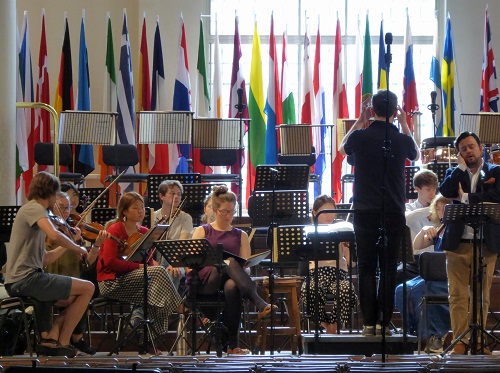
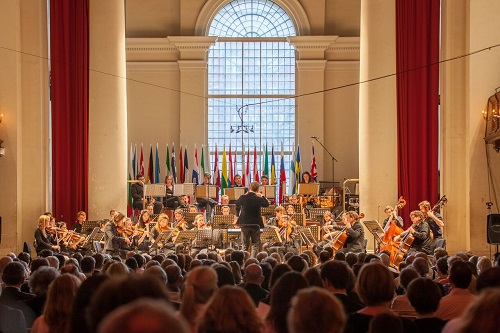
Maybe on this scale. If all goes according to the most badly-laid of all plans, the UK will be out of the European Union on 29 March 2019 and the European Commission Representation in London, which has mounted these concerts for the past decade, will be dissolved. Even if that happens, we can't let the youthful talent which came together to give us the two best concerts of the series in 2017 and 2018 disappear from our ken. Dobrinka Tabakova, whose Bell Tower in the Clouds proved a huge hit last Wednesday with everyone I spoke to, MUST be commissioned to write Brexit Piece No. 2 (Matt Kaner's Stranded in 2017 turned out, quite without warning, to be the first), and Jonathan Bloxham with his Northern Chords Festival Orchestra (pictured above) must be involved once more. Funds CAN be raised.
That's Dobrinka pictured above in Bulgarian green after the concert by me - all event pics by Jamie Smith - in the company of compatriot conductor-composer Dorian Dimitrov and my other New Best Friends, BBC Young Musician winners Martin James Bartlett and Lara Melda, whom I met at the Proms launch and promptly invited. Congratulations, by the way, to this year's laureate, 16-year-old Lauren Zhang. I haven't yet had time to watch the final, but I'll be doing so here, and very curious to know what she made of Prokofiev's titanic Second Piano Concerto. Wouldn't necessarily have chosen her from the piano final, the only strand I've seen so far, but all the competitors were phenomenally gifted and showed a staggering level of technical wizardry.
Meanwhile, it's too soon to think of 2019 now. Of one thing everyone who was present must be sure: the whole concert worked at the very highest level of engagement, professionalism and sheer love. Only at the very end was there a chance to mourn - which the audience seemed to do, totally spontaneously, with their 90-second silence at the end of a beautifully-phrased Ode to Joy, for which we always stand.
The film, part of the complete concert which will follow in due course, has already had 27,000 hits on the EC's Facebook page - if you haven't already seen it, here's the place.
Otherwise, this year's programme was more celebratory and exultant than the last one, which I think came off equally brilliantly but had a more elegiac tone (not least Martinů's Ariane threatening to throw herself off a cliff, which resonated unexpectedly with Brexit). What more effervescent way to start than with Mozart's Overture to The Marriage of Figaro, a performance of which better articulated at high speed I've never heard? And it ticked so many boxes of the 'crossing borders' theme - operatic treatment by an Austrian composer of a French play set in Spain with an Italian libretto. Matching it for sheer brio were the two numbers from Massenet's ballet music in his underrated opera Le Cid. Getting the dance idiom right is tough - I had the Israel Philharmonic/Martinon classic in my head - but Jonathan and Co pulled it off at the highest level.
At the rehearsal - let's have two shots I took in the afternoon sunshine -
I was stunned by the strings' imitation of far-flung trumpets at the start of Britten's Les Illuminations. This may have been the best group yet; engaging leadership by Thomas Gould, leader of the Britten Sinfonia and a well-established soloist in his own right (well netted, Jonathan; TG pictured below with another born leader, Agata Darashkaite, on the right) certainly helped, and it was so good to see him looking back to the second deskers from time to time.
Tenor Ben Johnson (pictured below) is a justly celebrated Britten interpreter. He certainly knew what to do to press the right tonal buttons and to put across the text - wittily so in 'Royauté,' with rapturous wonder in my favourite song from the cycle, 'Antique,' the A major lovesong Britten composed, along with Young Apollo, while under the spell of 17-year-old Wulff Scherchen.
Ben's protegée, soprano Jenny Stafford, sang 'Villes' and 'Marine' in this first half of the work - an experiment based on the fact that Britten wrote Les Illuminations for Sophie Wyss, but it was his long-term companion Peter Pears who immortalised it. The floridity suited Jenny well, and later she faced the many challenges of Donna Anna's 'Non mi dir' with high style - vivid, meaningful recit and expressive plangency made of the tricky rapid runs towards the end.
Ben prefaced it with a lovely performance of 'Take a pair of sparkling eyes' from Gilbert and Sullivan's The Gondoliers. I'd already twice admired his funny, touching and diction-perfect Lord Mountararat in ENO's Iolanthe. He has such a gift for comedy and applied it, too, in the midst of the pathos of the Fiordiligi-Ferrando duet here.
Jonathan is a gifted Mozartian, but he had to embrace a whole lot more here. He told me after the rehearsal that changes between styles were exhausting, but he and the orchestra brought them all off with magnificent focus, and I can't imagine even the most unmusical member of the audience finding anything boring or otiose. The rich orchestral sound at the start of Bruch's Adagio on Celtic Themes took the breath away; young Bulgarian cellist Michael Petrov brought tears to the eyes with his first entry. My companion Edwina with her artist's eye noted how he never looked at his instrument, and engaged with his conductor very lovingly (they've know each other since student days, and Jonathan himself is a top-notch cellist who's duetted perfectly with Michael in Vivaldi).
Dobrinka's piece impressed everyone - not just the ethereal bell sounds, but also the precision with which the Northern Chords strings placed their vigorous pizzicati within intense rhythmic passages. And the darkness-to-light finale from Brahms's First Symphony was a total triumph in more than one sense. Never heard the horns play their Alpine counterpart more convincingly (the first horn is on trial with, I think Jonathan said, the Philharmonia) nor the trombones intone the chorale better. And the big melody was done with grace and smiles.
An appropriate height to hit before the apparent requiem of silence that greeted the European Anthem. With folk like this involved, how can one be bleak about the future? Very best wishes, meanwhile, to Jonathan's Northern Chords Festival, which launches tonight with many of the same artists; if only I could be there.
Friday, 19 August 2016
Southrepps Festival trios
These three - violinist Agata Daraskaite, pianist Martin James Bartlett and my cellist/conductor pal Jonathan Bloxham - were central in both senses to the trio of concerts I caught at tenor/conductor Ben Johnson's Southrepps Classical Music Festival in deepest Norfolk, as world-class this year as it was when I discovered it for the first time last August. I couldn't even regret halving a differently wondrous experience at Leif Ove Andsnes's Rosendal Festival, two hours' boat ride from Bergen up the Hardangerfjord in Norway. You might think I was nuts to change this landscape prematurely (sneak preview of a high valley walk I should wax lyrical about at greater length anon)
for this.
But Southrepps, two miles from the North Norfolk coast, has its very English charms (and the, in my view, very substantial bonus of being a Lib Dem/Remain pocket in a sea of Brexiters). This particular lane is my favourite of many routes that can be taken between the village and the sea, and we caught it on a specially beautiful late afternoon/early evening.
But I pre-empt, since the purpose is to hymn the praises of the archetypal small-festival success story, as I did last year on the Other Site, which alas rather discourages such coverage for reasons I won't broadcast here; needless to say I profoundly disagree with them. It's worth drawing attention to a more wide-ranging piece which should have gone there but owing to last autumn's kerfuffle ended up on the blog, a set of articles on how to go about and promote small festivals like this, curated by Sophia Rahman - I got to know her, along with Jonathan, at last summer's Pärnu Festival, a big 'un in a relatively miniature gem of a setting.
Pleased with myself that I caught Saturday evening's concert: quite an achievement, courtesy of timely connections which include boat (this shortly after 9am, leaving Rosendal),
bus, plane, tube, foot and two trains. If this Saturday night wasn't quite the unalloyed pleasure that last year's strings-and-piano spectacular certainly was, that had to do with the tricky business of getting a chorus of opera singers who'd participated in Ben's masterclasses to blend. Which, let's be honest, they did not in Handel's Dixit Dominus. What we did get was the shock of the new in the 22-year-old composer's central sequence and some impressive runs from Mrs Johnson, the excellent Susanna Hurrell.
More consistently fine things followed in conductor Johnson's beautifully programmed second half. The choral blend was so much better in Bruckner's Locus iste - for which I have a special fondness, having sung it at the wedding of another Mr and Mrs Johnson, Stephen and Kate, in another beautiful place, Colwall, Herefordshire - and Stanford's Beati quorum via (a favourite of my All Saints Banstead youth). The strings did a fine job on one rarity I'd never heard before, Vaughan Williams' arrangement (with Arnold Foster) of Bach's so-called 'Giant' Fugue and on another I heard for the first time at last year's festival, Harold Darke's VW-worthy Meditation on 'Brother James's Air'; this time we heard the original before it, perfectly intoned by the three sopranos.
The official finale was a gift to the 16 singers on the week-long course, Vaughan-Williams' Serenade to Music arranged (very successfully) for strings and piano. There were some outstanding lines here, but the thing was the work itself, which always leaves me wishing it would float on for 10 more minutes. Brahms's earliest accompanied choral song, the Geistliches Lied, made a touching envoi.
Last year's Sunday morning chamber concert was one I'll never forget - a performance of Schubert's String Quintet which made me hope I wouldn't have to hear that profound masterpiece live again for another five years (I have, twice, in the intervening year, but the next one forced me to flee, pleading unwellness, after the first movement, and last Friday's Rosendal performance was rendered fascinating only by what the utterly compelling, but not show-offy, Sol Gabetta made of the second cello part). This year's double whammy offered different revelations. It began with my first live hearing of Vaughan Williams' Five Mystical Songs, sung with dedication by baritone Jonathan McGovern backed up by soulful string quartet and festival co-host Tom Primrose (who for some reason seems to be missing from the above photo, where McGovern is flanked by Rowan Bell, Jessica Wadey, Elitsa Bogdanova and Jonathan Bloxham).
I'd been unlucky enough to miss solo recitals by poet of the guitar Sean Shibe (pictured above with Ben, who also supplied this picture), whose Britten Nocturnal had held a Wigmore audience spellbound last year, and by BBC Young Musician of the Year 2014 Martin James Bartlett. Yet Bartlett was bound to shine in the extraordinarily difficult piano part of Mendelssohn's D minor Trio, and he did, to breathtaking effect.
Violinist and cellist play second fiddles, as it were, to the pianist, as Mendelssohn dictates, in the exquisite 'song without words' of the second movement and the fairy-music scintillation of yet another one of his unique scherzos, but Agata and Jonathan duetted perfectly, the ideal chamber musicians. If they'd made a recording and sold it on the door, I'd have bought it, no doubt. What a revelation this year has been for me so far in terms of Mendelssohn's chamber music, even if I had to make do with three out of the six string quartets in the Calidores' stunning East Neuk cycle. Here's a shot Ben J sent me of McGovern with the trio - and yes, MJB is of an age to be allowed a drink.
After that we shared a fine lunch with Jonathan in the garden of the Vernon Arms - first-class fish and chips, friendly service, and a wonderful hub for the musicians - and I chatted to a few other folk, including MJB and his mum. It was clearly such a good thing for the enchanting young fellow to be among friendly musicians performing chamber music; the concert soloist's life could be a lonely one if the balance isn't right. He said - and clearly he's sincere- he wanted to come back next year. Brahms or Schumann for chamber elevenses, perhaps?
Home to Lower Southrepps/Lower Street for an afternoon nap, then around the lanes towards the sea, passing barn swallows on a roof (these are only a few of quite a gathering)
and a collared dove perched irresistibly on a dead branch.
Haystacks
and a furrowed field behind the church
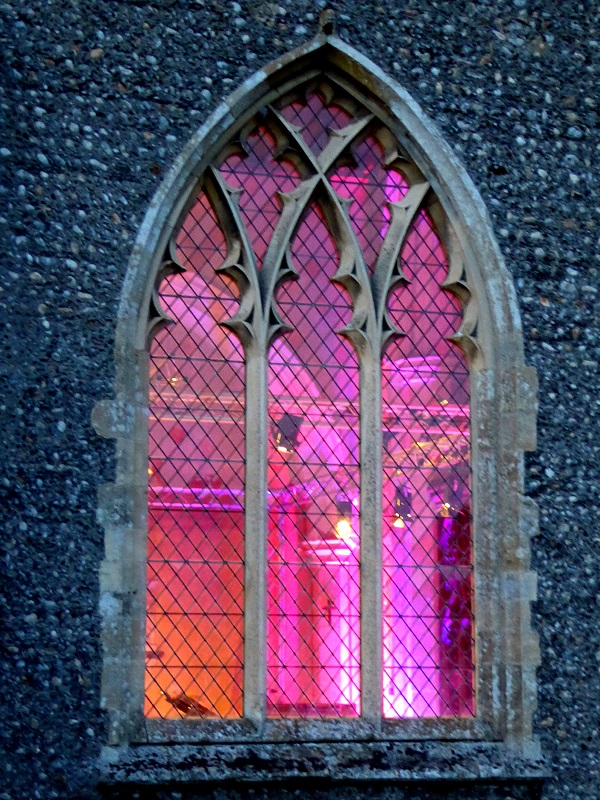
before arriving at St James at around 7pm.
Last year I showed the cockleshell frieze around the base of the church, sneaking in a shot with poetic licence on the chronicle of our later Norfolk churches walk, but I hadn't noticed the rather more recent specimen on the gate,
nor the nearby weathervane.
Every concert is full, but the Saturday evening finale was overflowing so we sat in the bell tower
in the company of the lighting designer and a delightful local man who'd been bellringing for decades.
First half was, by tradition, operatic excerpts and songs with Primrose as sprightly accompanist. Ben sang Massenet, Susanna Rosalinde's Czardas; they excelled in the Figaro Act 1 Trio - BJ has such a gift for comedy - and in the Watch Duet from Fledermaus. No wonder it was so vivid and funny; they've just finished a run in the Opera Holland Park production. Now wishing I hadn't missed it; I laughed out loud at the gags and the translation, which hasn't happened in any Fledermaus staging I've seen (though I love my Boskovsky recording). Of the rest, mezzo Claire Barnett-Jones may well become a dramatic mezzo of stature, though Humperdinck's Witch didn't show off the full lustre. The other voice which sounded like a superb instrument - though all sang musically and had clearly been well coached - was that of baritone Henry Neill, a precociously convincing Figaro Count.
A few interval shots:
And then the apotheosis, kept as a surprise, though the two pianos and the music stands might have given it away: the original version of Saint-Saëns' Carnival of the Animals, which I'm not sure I ever heard in a concert hall before. Master of Ceremonies was the third of the Southrepps triumvirate, Daniel Goode, a born Savoyard, a silent Cherubino (!) in the aforementioned Figaro trio, an English Tom Lehrer for 'Poisoning Pigeons in the Park' and now a very funny narrator, mixing a low quotient of Ogden Nash's verses with his own. But of course the laughs are there in the music, too, especially from Primrose and Bartlett as zoo-specimen 'Pianists' - they were both consummate elsewhere, Primrose matching MJB for virtuosity in the Presto furioso of 'Wild Asses' - and from Agata as one of the 'Personages with Long Ears'. It beats me why Saint-Saëns should have ever suppressed the score in his lifetime, fearing it might overshadow his more 'serious' work: there's mysterious poetry in 'Aquarium' and 'Cuckoo in the Wood' - yes, they imported a clarinettist as well as a flautist, though a glock had to make do as usual for the fishy glass harmonica - and when done as classically as it was by Bloxham, Bartlett and Primrose, 'The Swan' is exquisite.
We had a leisurely morning-after, with a short stroll past the neighbouring house with this super weathervane
around Southrepps Commons, beautifully managed by a local trust.
Then we walked along the lane to catch the train from Gunton to Norwich - with Jonathan and Jess, as it turned out - and stopped in that splendid town to have lunch with friends Kate and Fairless in their new old-rectory home. Back to Liverpool Street, and an equally interesting walk from there to the Southwark Playhouse for the well-done but predictable disappointing Rodgers and Hammerstein Allegro, an interesting turkey. It's been a bit quieter since those mad five days. I'll leave you with a neat little film put together after last year's festival. I'd love the whole of that Schubert Quintet on film, but you can get a sense of it here.
Subscribe to:
Posts (Atom)