Showing posts with label St John's Smith Square. Show all posts

Sunday, 9 May 2021

About some of today's players


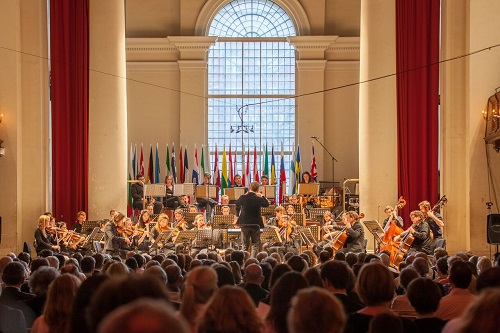
Happy Europe Day! Please tune in to the 12th Europe Day Concert livestreaming from St John's Smith Square. This is Jonathan Bloxham's fourth as conductor, and he's assembled an army of generals. Many are as much stars in their own right as our tenor, Luis Gomes. As I was climbing the spiral staircase to the gallery for yesterday's afternoon rehearsal - as co-curator I had the privilege to join a handful of others - I heard Luis let rip with a golden top note in the aria from Godard's Dante. and the tears started to flow (quite apart from anything else, I haven't heard live music other than five singers in a church since December).  

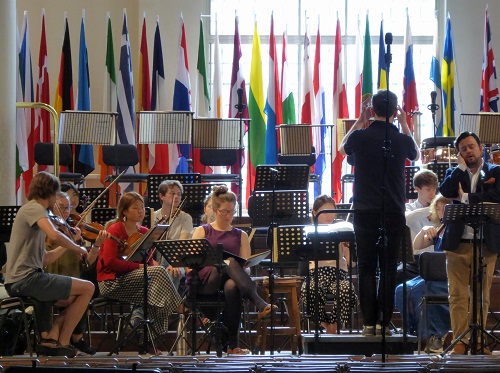
So let's meet some of the talent. Pictured above with the heads of Luis and Jonathan are Thomas Gould of the Aurora Orchestra and Sini Simonen of the Castalian Quartet (Finnish). Kate Suthers leads the seconds as she does those of the City of Birmingham Symphony Orchestra. Here's a ten-second clip of violins blazing in a well-known passage during the rehearsal: Jonathan worked so hard on projection in this official finale.


Principal viola is Tetsuumi Nagata of the Piatti Quartet, who often plays with the Nash Ensemble, Cellist 1 Tim Posner, sometime principal of the Deutsche Kammerphilharmonie Bremen. The double basses are Estonian Siret Lust, regularly in the Philharmonia, and Thomas Wynter whom I last saw online in Chineke!'s Wigmore chamber concert. They're pictured below with Lorraine Hart playing the cor anglais and cellists Steffan Morris and Peteris Sokolovskis.

Flautist 1 is Amy Yule, just appointed principal of the Hallé Orchestra, and oboist 1 Olivier Stankiewicz is co-principal of the London Symphony Orchestra. 

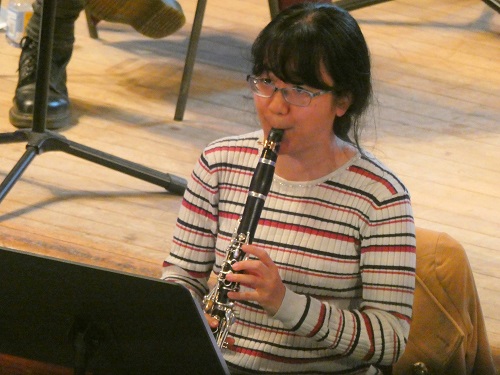
Clarinettist Anna Hashimoto is a rising star soloist. 

Nikolaj Henriques (so young looking!) is principal bassoon of the City of Birmingham Symphony Orchestra; he also played in an earlier Europe Day concert when he was principal of the European Union Youth Orchestra. Among the brass - with the luxury of four horns this year, essential for the Sibelius stunner which launches the programme, trumpeter Richard Blake, also CBSO section leader and trombonist Pete Moore, LSO co-principal and once youngest ever BBC Young Musician of the Year.

12 European countries are represented within the orchestra, and nine European composers in the programme. It's going to be glorious. Be there online at the time if you can; if not, watch later.

Tuesday, 27 April 2021

Europe Day Concert 2021 - London livestream


Sadly for the first time it will be without a live audience - we miss the cautious opening-up on 17 May by not much more than a week - but it's way better than nothing (the situation last year). Jonathan Bloxham will actually be playing the cello on the 17th in a Newcastle concert with tenor Ben Johnson and pianist Martin James Bartlett, in that same light and airy church where I so relished a day of events last autumn. Before that, he takes charge of this, his fourth Europe Day Concert and the 12th since the series began. We need your (free) viewing to convince the bureaucrats of its worth and support. And how could it not be superb, given what Jonathan and his Northern Chords Festival Orchestra of top young professionals - Thomas Gould will again be the leader, as he was in 2018* - achieved in those previous concerts?

My genuinely eulogistic words about delicious prospects have gone up on various slices of publicity, including this one, which gives a link to watching the concert on 9 May at noon UK time, but there's no harm in expanding here. I should at least reiterate that the star soloist, since Portugal holds the presidency, is tenor Luis Gomes, former Royal Opera Jette Parker protege now singing Verdi's Alfredo and Puccini's Rodolfo around the world.

Here's the full programme, which I'm proud to have worked on (as a pure labour of love, of course) with Jonathan. The 'journeys' theme is reflected throughout.

Sibelius: Scènes historiques 2 – 'All’ouvertura: La chasse'

Verdi:  Simon Boccanegra – ‘Inferno!’(Gabriele's aria)

Mendelssohn: Calm Sea and Prosperous Voyage  –

Elgar: Variations on an Original Theme, ‘Enigma’ – Variation XIII: ‘***’

Benjamin Godard: Dante – ‘Ah! De tous mes espoirs’

Ester Mägi (b.1922): The Sea

Meyerbeer: L’Africaine (Vasco da Gama) -  ‘O Paradis’  

Johann Strauss II: Vergnugungszug (Excursion Train) Polka 

Dvořák : Symphony No. 9, ‘From the New World’ - Finale  

Beethoven: Ode to Joy (The European Anthem) 

I'm especially happy with the sub-theme following Dante's Divina Commedia in three arias loosely connected to Inferno, Purgatorio and Paradiso. It was Luis who came up with the aria from Godard's Dante, and we're hugely grateful to the Palazetto Bru Zane, a wonderful and obviously well-funded enterprise, for being so obliging with the music. I realised I had the recording sitting at home so far unheard. and it's a pleasure throughout.

Godard was a musical conservative, proud of never having opened a Wagner score, and his trump card is a kind of virginal candour which works well with the character of Beatrice. The last act is the best, with good parts for four singers, the third - attempting to do a whistlestop tour of Inferno and Paradiso - the weakest, Our aria is good, if not the absolute highlight. The singing and playing in the above performance, recorded live in concert, are top notch

Also of such swift help in getting hard-to-find music was Mariliis Valkonen of the Estonian Music Information Centre. Thanks to her I now have both the only recording and the score of Ester Mägi's The Sea. The grand old lady of Estonian music is now 99. Here's a lovely photo of her with my treasured friends Andres Kaljuste and Sophia Rahman and, yes, Arvo Pärt, her junior by not so very many years, after a concert in the beautiful centre bearing his name on the Lohusalu peninsula, then newly opened.

As Sophia sent me a selection of photos from that occasion, many of which I hadn't seen, here are two more: in the hall after the performance

and Mägi as one of the first to stand on the top of the observation tower which was one of Arvo's conditions for the Centre - it's in woods, and only from a height can you see the sea. So this shot is very appropriate in the light of the work that's to be played.


Finally, although it's embedded within the publicity I linked to above, here's the 2018 Europe Day Concert performance of the European Anthem, aka Beethoven's Ode to Joy, in my books the only anthem worth standing for, The silence at the end was completely unexpected: we were mourning for what we were going to lose. It continued for a minute until someone's mobile phone went off. The infallible Simon Weir of Classical Media has captured some of it in the film.

*Great news just in that Sini Simonen, Finnish first violinist of the brilliant young Castalian Quartet, will be joining him on the front desk of first violins.

Tuesday, 8 October 2019

Once more into the flames with Wotan


I did it - sent Brünnhilde to sleep on the rock surrounded by fire after nearly 20 hours of lectures and screenings for the Wagner Society of Scotland at crumbling but magnificent Gartmore House in the Trossachs near Stirling. For that greatest of final scenes - possibly the richest in all opera - it had to be Donald McIntyre (pictured above) and Gwyneth Jones within the surprising glow of Boulez's interpretation  and Patrice Chéreau's lacerating direction. Die Walküre is the most flawless of his four Ring stagings, starting with pure heat between the best-looking Volsung twins you'll ever see on a stage (Peter Hoffmann and Jeanine Altmeyer; Kaufmann and Westbroek, looking too glossy in Lepage's Met production, don't begin to compare, even though they're second best).


Steeped as I was in Bartók quartets, having finished off the last of the notes for the LSO St Luke's series just before I took the train for Scotland, I wondered if I'd get back into the Wagner world mentally and emotionally. It only took a class... And this year's group, with many faces from last year, was a joy, constantly enquiring and giving back a great deal in their comments - starting with stalwart Joy Millar, who after I'd played Goodall's Sadler's Wells recording of Siegfried's Funeral March (to set up all the Volsung themes) told me that she and friends had arranged to take the first trombonist on that recording to Bayreuth this summer, since he'd never been.

I had a prime view over the grounds from my three-windowed room. Each morning was different, and somehow chimed with Wagner's nature-pictures (how much more so will that be the case when we go into the woods with Siegfried next September). Following on from my end-of-August sojourn in Edinburgh, the Borders and Perthshire/Fife, it was HOT again for the first two days. Morning mists set up the magic


and after breakfast, with 10 minutes to go to the first lecture of the day at 9.15am (ouch!), had withdrawn to this:


We were prepared for rain on the Sunday, but that meant red sky in the morning, a very different and equally captivating scene.


And the Trossachs in the wet have their magic too (Monday morning, just before leaving).


Back in town, Hunding's Watch from Götterdämmerung was the last thing I expected in a charity gala to raise funds for St John's Smith Square in peril. I'll say we got our moneysworth in a stocking full of plums, outstandingly so from my New Best Friend Anush Hovhannisyan and true mezzo-contralto Angharad Lyddon (idiomatic in French songs and arias). Sir John Tomlinson had to, shall we say, crank up his vintage bass to Liza Lehman's 'Myself When Young' in the first half, but the beginning of the second was somewhat more idiomatic, and inky-black scary as one would expect from one of the finest Hagens probably ever. Malcolm Martineau intensified the atmosphere: boy, did he need to be versatile that night.


Dame Felicity Lott only had to extend an arm to exude her natural charm duetting with JT in a nicely pitched 'I Remember It Well', and the evening ended officially with the bass previewing his Mikado, which will be a star attraction of ENO's umpteenth Miller revival. Here are the golden oldies with Anush.


The laurels of the new season so far seem to have been going not to ENO, with fell reports of its first two Orpheus productions, but to English Touring Opera. As I'm spending two Mondays of my Opera in Depth class on it, I had to catch the second Hackney Empire performance last night of The Silver Lake, Kurt Weill's third collaboration with George Kaiser - not quite a Brecht, to put it mildly. The 'singspiel', originally four hours text to 85 minutes' music, didn't work, and even in a better production than James Conway's, which made the mistake of going back to Brechtian Verfremdunseffekt with way too many banners and placards, I don't think one would be totally gripped. In that respect, I'm in agreement with Boyd Tonkin, who went to see it with proper consideration, as always, while I was heading back from Estonia, and wrote it up for us on The Arts Desk. Production images by Richard Hubert Smith.


Weill's music, though, is uniformly magnificent, and I guess he sussed that, Nazi ban or not, the score wasn't going to take hold, and repackaged a lot of the style and substance into an unquestionable masterpiece, The Seven Deadly Sins.


Even so, there are quite a few numbers which are very much sui generis, and they were all well delivered by a uniformly strong cast including three very different tenors (David Webb as Severin, Ronald Samm as alter ego Olim, pictured above, and James Kryshaw, a Jimmy Mahoney in the making, surely, doubling Lottery Agent, pictured below, and corrupt Baron).


Amazing results, too, from the small orchestra under a master of this music, James Holmes, with special credit to the first trumpet (Ruth Ross, I think). Thanks at least for the opportunity, ETO.

Friday, 18 May 2018

The last Europe Day Concert in London?


Maybe on this scale. If all goes according to the most badly-laid of all plans, the UK will be out of the European Union on 29 March 2019 and the European Commission Representation in London, which has mounted these concerts for the past decade, will be dissolved. Even if that happens, we can't let the youthful talent which came together to give us the two best concerts of the series in 2017 and 2018 disappear from our ken. Dobrinka Tabakova, whose Bell Tower in the Clouds proved a huge hit last Wednesday with everyone I spoke to, MUST be commissioned to write Brexit Piece No. 2 (Matt Kaner's Stranded in 2017 turned out, quite without warning, to be the first), and Jonathan Bloxham with his Northern Chords Festival Orchestra (pictured above) must be involved once more. Funds CAN be raised.


That's Dobrinka pictured above in Bulgarian green after the concert by me - all event pics by Jamie Smith - in the company of compatriot conductor-composer Dorian Dimitrov and my other New Best Friends, BBC Young Musician winners Martin James Bartlett and Lara Melda, whom I met at the Proms launch and promptly invited. Congratulations, by the way, to this year's laureate, 16-year-old Lauren Zhang. I haven't yet had time to watch the final, but I'll be doing so here, and very curious to know what she made of Prokofiev's titanic Second Piano Concerto. Wouldn't necessarily have chosen her from the piano final, the only strand I've seen so far, but all the competitors were phenomenally gifted and showed a staggering level of technical wizardry.

Meanwhile, it's too soon to think of 2019 now. Of one thing everyone who was present must be sure: the whole concert worked at the very highest level of engagement, professionalism and sheer love. Only at the very end was there a chance to mourn - which the audience seemed to do, totally spontaneously, with their 90-second silence at the end of a beautifully-phrased Ode to Joy, for which we always stand.


The film, part of the complete concert which will follow in due course, has already had 27,000 hits on the EC's Facebook page - if you haven't already seen it, here's the place.

Otherwise, this year's programme was more celebratory and exultant than the last one, which I think came off equally brilliantly but had a more elegiac tone (not least Martinů's Ariane threatening to throw herself off a cliff, which resonated unexpectedly with Brexit). What more effervescent way to start than with Mozart's Overture to The Marriage of Figaro, a performance of which better articulated at high speed I've never heard? And it ticked so many boxes of the 'crossing borders' theme - operatic treatment by an Austrian composer of a French play set in Spain with an Italian libretto. Matching it for sheer brio were the two numbers from Massenet's ballet music in his underrated opera Le Cid. Getting the dance idiom right is tough - I had the Israel Philharmonic/Martinon classic in my head - but Jonathan and Co pulled it off at the highest level.

At the rehearsal - let's have two shots I took in the afternoon sunshine -


I was stunned by the strings' imitation of far-flung trumpets at the start of Britten's Les Illuminations. This may have been the best group yet; engaging leadership by Thomas Gould, leader of the Britten Sinfonia and a well-established soloist in his own right (well netted, Jonathan; TG pictured below with another born leader, Agata Darashkaite, on the right) certainly helped, and it was so good to see him looking back to the second deskers from time to time.


Tenor Ben Johnson (pictured below) is a justly celebrated Britten interpreter. He certainly knew what to do to press the right tonal buttons and to put across the text - wittily so in 'Royauté,' with rapturous wonder in my favourite song from the cycle, 'Antique,' the A major lovesong Britten composed, along with Young Apollo, while under the spell of 17-year-old Wulff Scherchen.


Ben's protegée, soprano Jenny Stafford, sang 'Villes' and 'Marine' in this first half of the work - an experiment based on the fact that Britten wrote Les Illuminations for Sophie Wyss, but it was his long-term companion Peter Pears who immortalised it. The floridity suited Jenny well, and later she faced the many challenges of Donna Anna's 'Non mi dir' with high style - vivid, meaningful recit and expressive plangency made of the tricky rapid runs towards the end.


 Ben prefaced it with a lovely performance of 'Take a pair of sparkling eyes' from Gilbert and Sullivan's The Gondoliers. I'd already twice admired his funny, touching and diction-perfect Lord Mountararat in ENO's Iolanthe. He has such a gift for comedy and applied it, too, in the midst of the pathos of the Fiordiligi-Ferrando duet here.


Jonathan is a gifted Mozartian, but he had to embrace a whole lot more here. He told me after the rehearsal that changes between styles were exhausting, but he and the orchestra brought them all off with magnificent focus, and I can't imagine even the most unmusical member of the audience finding anything boring or otiose. The rich orchestral sound at the start of Bruch's Adagio on Celtic Themes took the breath away; young Bulgarian cellist Michael Petrov brought tears to the eyes with his first entry. My companion Edwina with her artist's eye noted how he never looked at his instrument, and engaged with his conductor very lovingly (they've know each other since student days, and Jonathan himself is a top-notch cellist who's duetted perfectly with Michael in Vivaldi).


Dobrinka's piece impressed everyone - not just the ethereal bell sounds, but also the precision with which the Northern Chords strings placed their vigorous pizzicati within intense rhythmic passages. And the darkness-to-light finale from Brahms's First Symphony was a total triumph in more than one sense. Never heard the horns play their Alpine counterpart more convincingly (the first horn is on trial with, I think Jonathan said, the Philharmonia) nor the trombones intone the chorale better. And the big melody was done with grace and smiles.


An appropriate height to hit before the apparent requiem of silence that greeted the European Anthem. With folk like this involved, how can one be bleak about the future? Very best wishes, meanwhile, to Jonathan's Northern Chords Festival, which launches tonight with many of the same artists; if only I could be there.

Wednesday, 9 May 2018

Happy Europe Day


Let's just celebrate it to the full while we can - probably for the last time on the scale of the usual Europe Day Concerts held in St John's Smith Square for the past ten years. Do stay with the above film until it breaks out into Andrew Manze's Lully/Rameauification of Beethoven's 'Ode to Joy' setting*. We were lucky to have the brilliant Rachel Podger with us in 2016, and I'm happy to share another piece of good news today: Irish soprano Jennifer Davis (pictured below at the 2017 Europe Day Concert), who sang Nielsen, Mozart and Bizet so well alongside tenor Thomas Atkins as our Royal Opera Jette Parker Young Artists participating last year, is to take on the role of Elsa in the RO's new production of Wagner's Lohengrin next month.


Very sorry for the delightful Kristine Opolais, who's had to pull out and has had a tough time of it recently, but hoping this will launch Jennifer properly on the international scene.

We'll also be waiting with nervous anticipation to discover how the best guitarist I've ever heard, Sean Shibe, fares at tonight's Royal Philharmonic Society Music Awards: he's been nominated as one of three in two of the categories. We hope he'll hotfoot it over for the post-concert party at St John's, but if not, we'll raise a toast, whether he wins or not.**.


Tonight's programme is about 'Crossing Borders' - Mozart into Spain and Italy, with tenor Ben Johnson and soprano Jenny Stafford also sharing half of Britten's homage to Rimbaud, Les Illuminations, Dobrinka Tabakova transporting us to the Dolomites with her Bell Tower in the Clouds, fellow Bulgarian Michael Petrov as soloist in Bruch's Adagio on Celtic Theme for cello and orchestra, Massenet in Spain, Sullivan in Venice and a grand final flourish from Jonathan Bloxham and the Northern Chords Festival Orchestra, superlative last year, in Brahms - the homaging of Swiss alphorns is the pretext for the finale of his First Symphony. Its big theme will set us up nicely for the model, Beethoven's, always an anthem worth standing for.

*Most recent update (11/5): this year's Ode to Joy and a bit of the intense silence after it is now up and running as a film here. The rest will follow in due course.

**Brief update (10/5): Sean won the RPS Young Musician award. Congratulations, and what great choices throughout (meaning that I agree with them). Meanwhile, a phenomenally well executed Europe Day Concert at St John's hit the heights before ending on an elegiac note as the Ode to Joy was followed by a one-minute-plus silence, ended only by someone's mobile phone going off. We vowed that there will be another next year, however difficult it may be to raise the money.

Full report of the latest Europe Day Concert ere long.

Saturday, 21 October 2017

Europe Day Concert stars: progress report


Well, two of the many twentysomethings who made this 9 May in St John's Smith Square the best yet, at any rate (pictured above at the event by Jamie Smith). Our conductor Jonathan Bloxham, now in his second year as assistant conductor to Mirga Gražinytė-Tyla at the City of Birmingham Symphony Orchestra, set St Paul's Covent Garden alight with the London Firebird Orchestra - young professionals, see here - in one of the two best Beethoven Seventh Symphonies I've heard live (the other was Haitink's with the Concertgebouw, so not bad going). My thanks to John Naulls for stills from his film of the concert, which I've used wherever possible.


And violinist Benjamin Baker, soloist in what turned out to be the first serious Brexit piece, Matt Kaner's Stranded and recently covering himself in glory along with pianist Daniel Lebhardt in the Wigmore Hall, essayed his first Berg Violin Concerto with the enterprising Salomon Orchestra back in St John's Smith Square.


That's Ben above with fellow Kiwi and conductor Holly Mathieson in St John's Footstool after the concert. While I felt that all she could do with her amateur players, given limited rehearsal time, was to keep them together in the Berg - one of the casualties with such a group is dynamic nuance, though Ben's work was assured and beautifully focused throughout - I can't thank her enough for letting us hear Franz Schmidt's Fourth Symphony. I'm totally in love with the E flat major Second after Bychkov's Vienna Philharmonic Prom performance and the subsequent recording- which should be BBC Music Magazine disc of the year if I have anything to do with it (and I do, on the team of judges for the forthcoming awards) -


and so I was looking forward to this.

And it has to be said that what the Salomons do especially well is create the warm, rich kind of ensemble ideal for late-romantic works (boding well if Jonathan can get his way and conduct them in Strauss's An Alpine Symphony next year). The brass are rather splendid, the strings make a cohesive sound and Mathieson seemed in perfect command of the Fourth's stately progress (afterwards, she said tellingly that she realised she'd applied too much rubato in her previous performance of the work - it just goes). Not having heard it on CD for years, nor consulted the programme note, I found it a magnificent, slowly dying beast, briefly rallying in a fantastical scherzo (the least successful movement for the Salomons, for obvious reasons of nimble manouevres). It turns out to be a memorial for his daughter Emma, who had died in childbirth the previous year (1932), but it's also one of the very last flourishes of a vanishing age - only Strauss had more to offer, right up to 1949.


Schmidt was also seriously ill when he composed the symphony, but he lived on until 1939, which is unfortunate since it left him under the shadow of the Nazis in more ways than one. Born in Pressburg/Pozsony/Bratislava - now, of course, the capital of Slovakia, but then essentially Hungarian, as were Schmidt's mother and his half-Hungarian father - he was Mahler's favourite cellist in the Vienna Court Orchestra (though not the leader of the cello section, he played most of the solos). His output is small but everything I've heard is individual and quickly recognisable (not least in the Magyar/Roma gruppetti or turns, more profoundly in the startling harmonic progressions and the catering, in the orchestral works, to what I think of as the Vienna Philharmonic sound).

Unfortunately he got taken up by the Nazis, though seemingly with no desire for it, and left a cantata for them unfinished in favour of two chamber works for the one-armed pianist Paul Wittgenstein. I can only think that this is why he's been seriously underrated as a symphonist. The Fourth, certainly, doesn't 'whore after the public taste', as Ingmar Bergman put it, and is even uningratiating, but it has total integrity, and I can't thank Mathieson (pictured below) and the Salomons enough for letting us hear it live.


Jonathan Bloxham must take up the baton for Schmidt, too - he's interested - and he has to join Ben in the Berg, with such supreme orchestral musicians as clarinettists Joe Shiner and Greg Hearle, whose sensitivity would be crucial in many of the dialogues with the violin. There was certainly another remarkable partnership on display the previous Tuesday, with Belarus(s)ian cellist Aleksei Kiseliov in Saint-Saëns' First Cello Concerto.


What an adorable and concise piece this is, with its startling central minuet led by muted strings (neoclassicism in 1873!) Kiseliov was so nimble and personable; the orchestra flowed with him to perfection, I have to say that Jonathan as cellist made an even better job of 'The Swan', his encore, at last year's Southrepps Festival, but then Kiseliov was probably knackered by then, and it always sounds better with the original piano accompaniment.

It was a big programme. Must say I was more impressed by the first oboe (James Hulme) than the perfectly good flute in Debussy's Prélude à l'après-midi d'un faune, but the woodwind were uniformly fine as before. Soprano He Wu has ideal stage presence but a rather fast vibrato for the line of Leila's aria from Bizet's The Pearl Fishers, and though her comedy was spot-on in Offenbach's Doll Song (pictured below) - rhythmically timed eyelash-flutters included - I'm not convinced she's a natural coloratura. One who is, incidentally, Maltese soprano Nicola Said, who moved everyone so much as Martinů's Ariane in the Europe Day Concert, will be singing her first Lucia with Fulham Opera next month.


Beethoven Seven, though, induced the delirium it should. For some, it was too fast in parts, but I admired it all - the second-movement Allegretto needs to remain of a piece with the rhythmic bounce of the other movements - and Jonathan conducted with attaccas for each movement throughout. Mirga, whose Beethoven Five at the Proms has the same freshness and focus, would have been delighted (hope she gets to see the film).


Detail could have been blurred at such speeds but never was; articulation, not all of it as expected, proved flawless throughout. Perhaps a mistake to add an encore downer, Sibelius's Valse Triste, but then Jonathan does like to follow in Paavo Järvi's footsteps. Not his fault if I've heard it too often in the past two months. Still, the exhilaration remained - huge congratulations to all.

Tuesday, 16 May 2017

Europe Day Concert 2017: depth and range


There, bang in the middle of what by common consent turned out to be the best Europe Day Concert to date, was the world premiere of a piece which went as deep and as high as anything on the programme: Stranded by Matthew Kaner, in which the solo violinist finally breaks away from the combative orchestra and walks offstage, still playing. A surprise which no-one expected and which in the programme note the composer hadn't divulged, but everyone got the point. Arriving at St John's Smith Square halfway through the afternoon rehearsal to hear the already great Benjamin Baker and conductor Jonathan Bloxham - my favourite twentysomething musicians* and I pictured at the after-concert party below -


rehearsing the new work with the Northern Chords Festival Orchestra, I was taken aback by the ravishing beauty of the sound (Matt's orchestration is a wonder) and the impact of the playing.


An email comment, one of many from friends, sums it up: 'a superb band - quite the best I've heard in its depth and range'. Photos here all by Jamie Smith, with the exception of the below, composer concentrating at the rehearsal, by me.


And it all went beautifully. People wept, and not just at the emotion of standing, as we always do, for Beethoven's Ode to Joy at the end of the concert (I have to add that the orchestral statement of the Ninth Symphony's big tune has never sounded better either, even if it had an extra kick after Macron used it two days earlier). The emotional depths were especially sounded in 'The Oak Tree' from Sibelius's peerless incidental music to The Tempest, Ariane's Farewell from Martinů's eponymous late masterpiece with Maltese soprano Nicola Said rising to divadom - how she's come on even in the year since I saw her perform the role at the Guildhall School -


and the metamorphosis/resurrection, Respighi's 'The Birth of Venus' from his Botticelli Triptych, swelling and all-enveloping.  Again, an e-mail accolade is worth reproducing: 'it was an extraordinary evening, beautiful, at times so exquisite (Martinů's aria) it actually hurt, dignified, wrenching'.


The theme was 'islands', Malta currently holding the presidency (the opening speeches, from Norman Hamilton, Maltese High Commissioner, and Christine Dalby, Acting Head of the European Commission Representation in the UK, were succinct and very much to the point). The programme looked good on paper. But in practice it went further than expected - so much could be taken as metaphor for the tragedy of the UK's imminent departure, even if it wasn't consciously planned as such. Again there was general agreement that not a piece failed to make its mark.

Even Maltese composer Charles Camilleri's 'Nocturne' from the Malta Suite - not the piece originally desired - provided a melancholy showcase for Jonathan's wonderful strings, making so much sound for the grouping 5.5.3.3.2 and all the nimbler as a result, as the iridescent variety of Mendelssohn's The Hebrides Overture immediately established. Communication and flexibility, assets which Jonathan has developed amazingly quickly - he's now assistant to Mirga Gražinytė-Tyla at the City of Birmingham Symphony Orchestra - caught everyone around me, I could see, and didn't let go until over an hour later. Sounds as if I'm exaggerating but I speak the truth when I say I haven't heard a livelier or more gorgeous-sounding performance of the Mendelssohn classic.


The strings were lovely and bouncy for Mozart, too, and we had absolute top quality from two singers currently on the Royal Opera's Jette Parker Young Artists Programme, Irish soprano Jennifer Davis and tenor Thomas Atkins (a Kiwi, like Ben). He took the less florid version of Idomeneo's 'Fuor del mar' but still adorned the da capo with extra flashes of brilliance; Jennifer had Ilia's tender-sad Act Three aria 'Zeffiretti lusinghieri', a neat follow-on to the natural settings of the soprano and tenor numbers from Nielsen's Springtime on Funen. That was deliciously done, too - Siri Fischer Hansen, administrator of JPYAP, attested to the excellent delivery of her native Danish - and turned out to be the favourite of quite a few folk in the audience. One spectator pointed out that it was all the more beautiful for being accompanied by the almost rustic vision of trees and sinking sun through the big window behind the orchestra.


Soprano and tenor rose to the French ardour of the Act 2 love duet for Nadir and Leila in Bizet's The Pearl Fishers, too - Thomas is going to be singing Don José in the Royal Opera's Peter Brook Tragédie de Carmen, and I can hear an ideal Micaëla in Jennifer already.

I still think there's no greater demonstration of genius than Sibelius's distillation of a lifetime's experience in the Tempest music. He was such a master of the miniature, and to my mind Song II, a canny orchestral adaptation of Ariel's 'Where the bee sucks', is its epitome: two short verses, the second first abbreviated and then given a surprise extension, wryly singing on two clarinets with the lightest string bounce underneath, all in a minute. Joe Shiner, destined to be either a soloist or an outstanding principal in one of the world's best orchestras (or both), and his colleague Greg Hearle brought more subtlety to their parts than I've ever heard on recorded interpretations, and Joe's belated solo in The Hebrides, as in his performance with the London Firebird Orchestra last year, brought tears to the eyes; Jonathan let him take all the time in the world over it. Joe was also the orchestral fixer, working flat out beyond the call of duty.


Flautist Alena Lugovkina - on trial, I understand, for the Royal Opera Orchestra - also excelled, and leader Zoë Beyers got to take over from Ben at key points in Stranded. Quite apart from the beauty of seeing a group of young players really enjoying and putting across their artistry - they later said how struck they were by the quiet intensity of the audience and the ecstatic reception it gave them - they were truly representing Europe, with an Estonian violinist (Marike Kruup), a Bulgarian cellist (the outstanding Michael Petrov), a Polish harpist (Zuzanna Olbrys), a Spanish first horn (Francisco Gomez Ruiz) and other nationalities in the mix (I haven't pinpointed them all). Delighted also that the other good friend I've made from first acquaintance at the Pärnu Festival in 2015, Sophia Rahman, was the pianist.


Everything went smoothly, receptions included. Now everyone can enjoy the aftermath of a job superbly done and look forward to the CD.

*Left out one other - the prodigiously talented Ed Picton-Turbervill, formerly organ scholar at St John's Cambridge who graduated with a Double First in Music, celebrating the launch of his book on the trees of the Backs by playing the Goldberg Variations this coming Saturday. The Bach evensong following an afternoon picnic and the launch at St John's may involve him too, I don't know. Genius, anyway. Ought to include my dearly beloved godson Alexander Lambton, too, whose sax contributions to various classy bands are well above the average.