Showing posts with label Jonathan Bloxham. Show all posts

Sunday, 9 May 2021

About some of today's players


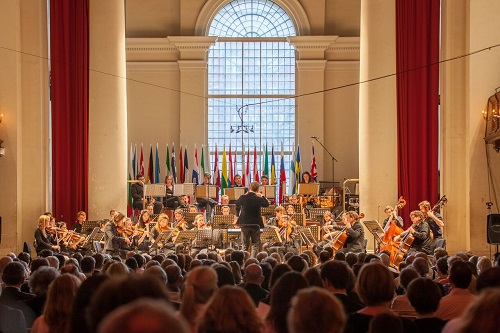
Happy Europe Day! Please tune in to the 12th Europe Day Concert livestreaming from St John's Smith Square. This is Jonathan Bloxham's fourth as conductor, and he's assembled an army of generals. Many are as much stars in their own right as our tenor, Luis Gomes. As I was climbing the spiral staircase to the gallery for yesterday's afternoon rehearsal - as co-curator I had the privilege to join a handful of others - I heard Luis let rip with a golden top note in the aria from Godard's Dante. and the tears started to flow (quite apart from anything else, I haven't heard live music other than five singers in a church since December).  

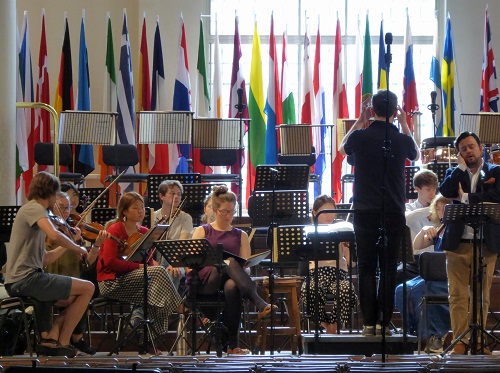
So let's meet some of the talent. Pictured above with the heads of Luis and Jonathan are Thomas Gould of the Aurora Orchestra and Sini Simonen of the Castalian Quartet (Finnish). Kate Suthers leads the seconds as she does those of the City of Birmingham Symphony Orchestra. Here's a ten-second clip of violins blazing in a well-known passage during the rehearsal: Jonathan worked so hard on projection in this official finale.


Principal viola is Tetsuumi Nagata of the Piatti Quartet, who often plays with the Nash Ensemble, Cellist 1 Tim Posner, sometime principal of the Deutsche Kammerphilharmonie Bremen. The double basses are Estonian Siret Lust, regularly in the Philharmonia, and Thomas Wynter whom I last saw online in Chineke!'s Wigmore chamber concert. They're pictured below with Lorraine Hart playing the cor anglais and cellists Steffan Morris and Peteris Sokolovskis.

Flautist 1 is Amy Yule, just appointed principal of the Hallé Orchestra, and oboist 1 Olivier Stankiewicz is co-principal of the London Symphony Orchestra. 

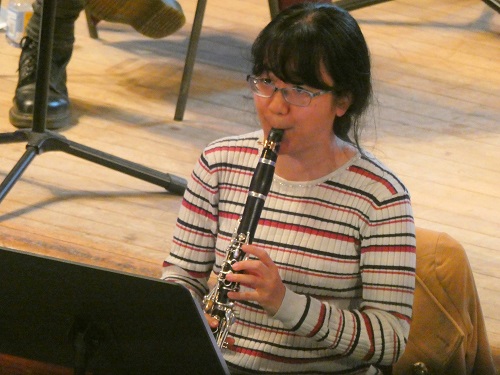
Clarinettist Anna Hashimoto is a rising star soloist. 

Nikolaj Henriques (so young looking!) is principal bassoon of the City of Birmingham Symphony Orchestra; he also played in an earlier Europe Day concert when he was principal of the European Union Youth Orchestra. Among the brass - with the luxury of four horns this year, essential for the Sibelius stunner which launches the programme, trumpeter Richard Blake, also CBSO section leader and trombonist Pete Moore, LSO co-principal and once youngest ever BBC Young Musician of the Year.

12 European countries are represented within the orchestra, and nine European composers in the programme. It's going to be glorious. Be there online at the time if you can; if not, watch later.

Tuesday, 27 April 2021

Europe Day Concert 2021 - London livestream


Sadly for the first time it will be without a live audience - we miss the cautious opening-up on 17 May by not much more than a week - but it's way better than nothing (the situation last year). Jonathan Bloxham will actually be playing the cello on the 17th in a Newcastle concert with tenor Ben Johnson and pianist Martin James Bartlett, in that same light and airy church where I so relished a day of events last autumn. Before that, he takes charge of this, his fourth Europe Day Concert and the 12th since the series began. We need your (free) viewing to convince the bureaucrats of its worth and support. And how could it not be superb, given what Jonathan and his Northern Chords Festival Orchestra of top young professionals - Thomas Gould will again be the leader, as he was in 2018* - achieved in those previous concerts?

My genuinely eulogistic words about delicious prospects have gone up on various slices of publicity, including this one, which gives a link to watching the concert on 9 May at noon UK time, but there's no harm in expanding here. I should at least reiterate that the star soloist, since Portugal holds the presidency, is tenor Luis Gomes, former Royal Opera Jette Parker protege now singing Verdi's Alfredo and Puccini's Rodolfo around the world.

Here's the full programme, which I'm proud to have worked on (as a pure labour of love, of course) with Jonathan. The 'journeys' theme is reflected throughout.

Sibelius: Scènes historiques 2 – 'All’ouvertura: La chasse'

Verdi:  Simon Boccanegra – ‘Inferno!’(Gabriele's aria)

Mendelssohn: Calm Sea and Prosperous Voyage  –

Elgar: Variations on an Original Theme, ‘Enigma’ – Variation XIII: ‘***’

Benjamin Godard: Dante – ‘Ah! De tous mes espoirs’

Ester Mägi (b.1922): The Sea

Meyerbeer: L’Africaine (Vasco da Gama) -  ‘O Paradis’  

Johann Strauss II: Vergnugungszug (Excursion Train) Polka 

Dvořák : Symphony No. 9, ‘From the New World’ - Finale  

Beethoven: Ode to Joy (The European Anthem) 

I'm especially happy with the sub-theme following Dante's Divina Commedia in three arias loosely connected to Inferno, Purgatorio and Paradiso. It was Luis who came up with the aria from Godard's Dante, and we're hugely grateful to the Palazetto Bru Zane, a wonderful and obviously well-funded enterprise, for being so obliging with the music. I realised I had the recording sitting at home so far unheard. and it's a pleasure throughout.

Godard was a musical conservative, proud of never having opened a Wagner score, and his trump card is a kind of virginal candour which works well with the character of Beatrice. The last act is the best, with good parts for four singers, the third - attempting to do a whistlestop tour of Inferno and Paradiso - the weakest, Our aria is good, if not the absolute highlight. The singing and playing in the above performance, recorded live in concert, are top notch

Also of such swift help in getting hard-to-find music was Mariliis Valkonen of the Estonian Music Information Centre. Thanks to her I now have both the only recording and the score of Ester Mägi's The Sea. The grand old lady of Estonian music is now 99. Here's a lovely photo of her with my treasured friends Andres Kaljuste and Sophia Rahman and, yes, Arvo Pärt, her junior by not so very many years, after a concert in the beautiful centre bearing his name on the Lohusalu peninsula, then newly opened.

As Sophia sent me a selection of photos from that occasion, many of which I hadn't seen, here are two more: in the hall after the performance

and Mägi as one of the first to stand on the top of the observation tower which was one of Arvo's conditions for the Centre - it's in woods, and only from a height can you see the sea. So this shot is very appropriate in the light of the work that's to be played.


Finally, although it's embedded within the publicity I linked to above, here's the 2018 Europe Day Concert performance of the European Anthem, aka Beethoven's Ode to Joy, in my books the only anthem worth standing for, The silence at the end was completely unexpected: we were mourning for what we were going to lose. It continued for a minute until someone's mobile phone went off. The infallible Simon Weir of Classical Media has captured some of it in the film.

*Great news just in that Sini Simonen, Finnish first violinist of the brilliant young Castalian Quartet, will be joining him on the front desk of first violins.

Thursday, 23 May 2019

Europe Day Concert 2019: past midnight, still alive


And kicking, or rather dancing and riffing, in the most electrifying official finale we've had at St John's Smith Square in the past 11 years, a fine way to celebrate the fact that the UK didn't leave the European Union on 29 March. When Jonathan Bloxham, our superlative conductor, announced a Norwegian soloist for the wacky arrangement by Cristian Lolea (violin and strings) of Enescu's First Romanian Rhapsody, I ummed about the nation - not exactly EU. Then he told me it was Eldbjørg Hemsing, who wowed both live (in Bodø) and on her CD championing a concerto by compatriot Borgstrøm (the coupling on the disc is a first-rate performance of Shostakovich's First Concerto). Top notch, pure class, with a poignant unaccompanied encore of Grieg's 'The Last Spring'. The fact that she was playing with young equals, the pan-Europeans of Jonathan's Northern Chords Festival Orchestra, led to improvisatory fireworks with leader Agata Darashkaite and cellist Sébastien van Kujik.


The theme was '25 and under: young European composers', because youth seemed like a timely theme for celebration. No shortage of great examples here: Jonathan opened with the Rossini-esque first movement of Schubert's delicious Third Symphony, one of the six he completed in his teens, and as mid-point we had Mendelssohn's Legend of the Fair Melusine, the water-music of which indisputably influenced Wagner when he started his Ring in the depths of the Rhine. Both catered for a brilliant regular, first clarinettist Joe Shiner, whose first solo CD is due out soon. The wind as a whole were superb, as they have been for the past three years; flautist Sarah Miller, oboist James Hulme, bassoonist Carys Ambrose Evans and horn-player Stephen Craigen joined Joe for the best performance I've heard of Estonian Erkki-Sven Tüür's Architectonics I. Erkki-Sven had been dubious about unearthing this relatively early piece of his, describing it as 'naive', but the response of so many in the audience proved its durability.


The interpretation of Lili Boulanger's D'un matin de printemps also left others I'd come across way behind; I heard this delicate fantasy in a completely different light. Sure, it sounds like filtered Debussy, but also has more of an identity of its own than I'd thought. The other favourite choice of people I spoke to - musicians and not - was soprano Valentina Farcas's exquisite delivery of the aria 'Dopo l'oscuro nembo' from Bellini's first opera Adelson e Salvini, later reworked for Giulietta in I Capuleti e i Montecchi. Valentina was representing her native Romania, which currently holds the EU Presidency. I heard her float a gorgeous line in 'Ihr habt nun Traurigkeit', for me the highlight of the 150th anniversary performance of Brahms's Ein Deutsches Requiem in its original location, Bremen Cathedral, with Paavo Järvi conducting the Deutsche Kammerphilharmonie (Matthias Goerne was at his most committed, too).


That gave plenty of promise for true bel canto style, and the way emotion informed what was sung brought tears to my eyes in a way that rarely happens for me with Bellini or Donizetti. Rossini is in a league apart, though, and Valentina returned to treat us to Amenaide's big scena 'Giusto Dio' from Tancredi. She was very sincere in her praise for the way that Jonathan provided perfect stylistic support in this repertoire, in a way - she said - that many top names on the podium have not. In fact his adaptability never ceases to amaze me. This time I didn't attend the afternoon rehearsal, so each performance gave fresh cause for wonder. A personal favourite, Elgar's 'Fairy Pipers' from the first Wand of Youth Suite, brought more period-conscious yet breathing portamento then I've heard before. So exquisite, and counterbalanced by the rugged string sound for Bartók's Romanian Dances and the Enescu.


And finally, the European Anthem, this time more truly an Ode to Joy after last year's unanticipated minute's silence at the end. The Romanian Ambassador's speech came at the end, rather than at the beginning as is customary, and gifts were distributed.


A few post-show party shots (like all the rest, with the exception of the first singer-orchestra-conductor photo, by Jamie Smith). Two Estonians, cellist and agent Maarit Kangron and violinist in the orchestra Marike Kruup, with Jonathan's girlfriend Jess Wadey;


two Bulgarians, composer Dobrinka Tabakova whose work Bell Tower in the Clouds gave such zest to last year's programme and assistant conductor Dorian Todorov;


and Jonathan - who was at his happiest this year, having hand-picked all the players he wanted and feeling more relaxed about his relationship to the music - with Eldbjørg, whom I'll see next in Svalbard.


Only sorry I didn't take a photo of my 88-year-old mum, who gamely arranged to be driven up from Banstead and back to attend her first Europe Day Concert, lovingly cared for by her goddaughter Sara while I flitted about. It was, unlike last year which had an elegiac tone, the jolliest of occasions. We're not out yet, the European Commission Representation in London lives to fight another day, and we're feeling more optimistic. Please get out and VOTE for a pro-Remain party today, those of you who can. I'm popping round to the local polling station before I depart for Sweden - alas not, like admirable Greta Thunberg, on the train. Transport around Europe is going to need some serious rethinking over the next year.

Friday, 18 May 2018

The last Europe Day Concert in London?


Maybe on this scale. If all goes according to the most badly-laid of all plans, the UK will be out of the European Union on 29 March 2019 and the European Commission Representation in London, which has mounted these concerts for the past decade, will be dissolved. Even if that happens, we can't let the youthful talent which came together to give us the two best concerts of the series in 2017 and 2018 disappear from our ken. Dobrinka Tabakova, whose Bell Tower in the Clouds proved a huge hit last Wednesday with everyone I spoke to, MUST be commissioned to write Brexit Piece No. 2 (Matt Kaner's Stranded in 2017 turned out, quite without warning, to be the first), and Jonathan Bloxham with his Northern Chords Festival Orchestra (pictured above) must be involved once more. Funds CAN be raised.


That's Dobrinka pictured above in Bulgarian green after the concert by me - all event pics by Jamie Smith - in the company of compatriot conductor-composer Dorian Dimitrov and my other New Best Friends, BBC Young Musician winners Martin James Bartlett and Lara Melda, whom I met at the Proms launch and promptly invited. Congratulations, by the way, to this year's laureate, 16-year-old Lauren Zhang. I haven't yet had time to watch the final, but I'll be doing so here, and very curious to know what she made of Prokofiev's titanic Second Piano Concerto. Wouldn't necessarily have chosen her from the piano final, the only strand I've seen so far, but all the competitors were phenomenally gifted and showed a staggering level of technical wizardry.

Meanwhile, it's too soon to think of 2019 now. Of one thing everyone who was present must be sure: the whole concert worked at the very highest level of engagement, professionalism and sheer love. Only at the very end was there a chance to mourn - which the audience seemed to do, totally spontaneously, with their 90-second silence at the end of a beautifully-phrased Ode to Joy, for which we always stand.


The film, part of the complete concert which will follow in due course, has already had 27,000 hits on the EC's Facebook page - if you haven't already seen it, here's the place.

Otherwise, this year's programme was more celebratory and exultant than the last one, which I think came off equally brilliantly but had a more elegiac tone (not least Martinů's Ariane threatening to throw herself off a cliff, which resonated unexpectedly with Brexit). What more effervescent way to start than with Mozart's Overture to The Marriage of Figaro, a performance of which better articulated at high speed I've never heard? And it ticked so many boxes of the 'crossing borders' theme - operatic treatment by an Austrian composer of a French play set in Spain with an Italian libretto. Matching it for sheer brio were the two numbers from Massenet's ballet music in his underrated opera Le Cid. Getting the dance idiom right is tough - I had the Israel Philharmonic/Martinon classic in my head - but Jonathan and Co pulled it off at the highest level.

At the rehearsal - let's have two shots I took in the afternoon sunshine -


I was stunned by the strings' imitation of far-flung trumpets at the start of Britten's Les Illuminations. This may have been the best group yet; engaging leadership by Thomas Gould, leader of the Britten Sinfonia and a well-established soloist in his own right (well netted, Jonathan; TG pictured below with another born leader, Agata Darashkaite, on the right) certainly helped, and it was so good to see him looking back to the second deskers from time to time.


Tenor Ben Johnson (pictured below) is a justly celebrated Britten interpreter. He certainly knew what to do to press the right tonal buttons and to put across the text - wittily so in 'Royauté,' with rapturous wonder in my favourite song from the cycle, 'Antique,' the A major lovesong Britten composed, along with Young Apollo, while under the spell of 17-year-old Wulff Scherchen.


Ben's protegée, soprano Jenny Stafford, sang 'Villes' and 'Marine' in this first half of the work - an experiment based on the fact that Britten wrote Les Illuminations for Sophie Wyss, but it was his long-term companion Peter Pears who immortalised it. The floridity suited Jenny well, and later she faced the many challenges of Donna Anna's 'Non mi dir' with high style - vivid, meaningful recit and expressive plangency made of the tricky rapid runs towards the end.


 Ben prefaced it with a lovely performance of 'Take a pair of sparkling eyes' from Gilbert and Sullivan's The Gondoliers. I'd already twice admired his funny, touching and diction-perfect Lord Mountararat in ENO's Iolanthe. He has such a gift for comedy and applied it, too, in the midst of the pathos of the Fiordiligi-Ferrando duet here.


Jonathan is a gifted Mozartian, but he had to embrace a whole lot more here. He told me after the rehearsal that changes between styles were exhausting, but he and the orchestra brought them all off with magnificent focus, and I can't imagine even the most unmusical member of the audience finding anything boring or otiose. The rich orchestral sound at the start of Bruch's Adagio on Celtic Themes took the breath away; young Bulgarian cellist Michael Petrov brought tears to the eyes with his first entry. My companion Edwina with her artist's eye noted how he never looked at his instrument, and engaged with his conductor very lovingly (they've know each other since student days, and Jonathan himself is a top-notch cellist who's duetted perfectly with Michael in Vivaldi).


Dobrinka's piece impressed everyone - not just the ethereal bell sounds, but also the precision with which the Northern Chords strings placed their vigorous pizzicati within intense rhythmic passages. And the darkness-to-light finale from Brahms's First Symphony was a total triumph in more than one sense. Never heard the horns play their Alpine counterpart more convincingly (the first horn is on trial with, I think Jonathan said, the Philharmonia) nor the trombones intone the chorale better. And the big melody was done with grace and smiles.


An appropriate height to hit before the apparent requiem of silence that greeted the European Anthem. With folk like this involved, how can one be bleak about the future? Very best wishes, meanwhile, to Jonathan's Northern Chords Festival, which launches tonight with many of the same artists; if only I could be there.

Monday, 5 February 2018

Pärnu friends reunited


Not all at once, mind you. Musicians I got to know, to a greater or lesser degree, at the Pärnu Festival (first report of three to date here) are playing, or have played, in various events spanning just over a week as follows: clarinettist Matt Hunt and bassoonist Amy Harman in one of Ensemble 360's Wigmore concerts (not Matt, alas, in the second, which I caught on Sunday morning - though there he is below, anyway, with Amy as pictured by top Estonian photographer Kaupo Kikkas - they've given duo programmes too), violinist Ben Baker and cellist-conductor Jonathan Bloxham, our Europe Day 2017 duo, at Kings Place; still to come, Estonian Festival Orchestra leader Florian Donderer with Christian Tetzlaff and company next Sunday, and horn-player Alec Frank-Gemmill with the Scottish Chamber Orchestra winds the following lunchtime.


Pictured up top are Ben, Jonathan and Ben's regular duo partner Daniel Lebhardt. Their Sunday evening concert at Kings Place, held under the auspices of the London Chamber Music Society, was a showcase for the astounding chamber music to be heard at Jonathan's Northern Chords Festival. The addition for the third of three great works was viola-player Eivind Holtsmark Ringstad (pictured below by Nikolaj Lund), whose playing first impressed me when he was introduced by Leif Ove Andsnes at the Dulwich Picture Gallery as one of two outstanding young Norwegian performers. His first CD is just out, of the Walton and Sinding viola concertos - can't wait to hear it.


He had, relatively speaking, the easiest deal of the evening, Ben and Daniel the toughest since they played in all three works - and the piano parts in both the rippling Mendelssohn Second Piano Trio and Brahms's G minor Piano Quartet are absolute killers; Lebhardt hardly seemed to break a sweat as he played with both weight and total clarity, sounding fabulous in Kings Place acoustics and never overpowering the strings (and oh, those light rapid runs in Brahms's Rondo alla zingarese!). In both the enigma of Janáček's Violin Sonata, the elusive ideal fading to a ghost voice, and the Mendelssohn uncannily perfect movement endings and transitions were the signs of absolute mastery, chamber musical playing of the highest order. And the articulate energy could take the breath away in the two tidal waves of Mendelssohn's opening movement as well as the fairy music of his scherzo. The arrival of the chorale in the finale is always such a great moment, too - shall never forget how it followed on the heels of the muezzin's call to evening prayers in an open-air concert at the D-Marin Festival in Turkey the summer before last.


With Brahms, it's the barline-dissolving genius of his unique songs without words that I get to love ever more; the greatest miracle in that respect, shared between Lebhardt and strings, is the Intermezzo's second melody which breaks into laughing triplets. But the revelation of the day was the Andante, un poco adagio of the Piano Quintet as played in the Wigmore morning coffee concert by - yes, these superb artists in Ensemble 360's army of generals all have to be named - Benjamin Nabarro, Claudia Ajmone-Marson, Ruth Gibson, Gemma Rosenfeld (pictured above, I think, also by Kaupo) and Tim Horton. This is a song that just goes on into seeming infinity, and its little adornments make the heart leap. Another one you can play at my funeral. I must have heard the work before, because I remember the vintage Brahms shadowy/big-boned scherzo; but the performance can't have been anywhere near as good as this otherwise the slow movement would have been carved on my heart back then.

No less miraculous is Martinů's Nonet. The more I hear of his huge output, the more I'm in awe: is there actually a dud? Certainly not among the later pieces, and this one is vintage in its wavering between major and minor tonality, the harmonic no-man's-lands, the sudden shafts of sunlight which quickly go behind the clouds (especially in the emotional slow movement).


The above photo looks like it must be of the Nonet, but of course with Matt playing clarinet rather than Tim Orpen (the other musicians not so far encountered are double-bassist Laurène Durantel, very much the central underpinner, oboist Adrien Wilson and horn-player Naomi Atherton). Apparently the Estonian Festival Orchestra's international treasure had had to fly off in the small hours after Saturday evening's concert, which I had to miss in favour of the musically less rich LPO Stravinsky launch. That did at least mean that I got a double helping of the sublime Juliette Bausor, recently appointed the orchestra's principal flute, and a better is not to be found anywhere (though Philharmonia principal Samuel Coles was also amazing in Paavo Järvi's Thursday Dvořák).


In a serendipitous footnote - which I hope didn't come across to our flautist as potential stalking - I'd brought along a second-edition copy of Martinu's Julietta in the Supraphon recording for my concert companion David Thompson  (I already have the original CD format). He'd bought it only a couple of weeks earlier, so I thought - Juliette/Julietta for Juliette Bausor? Why not, as a tribute to the exquisite playing? And she was very gracious and natural about accepting it, didn't seem to think me weird at all. Anyway, I was careful not to outstay my welcome in the Green Room, but quickly took my leave after exchanging a few words with Amy. The main point is that I've now heard Ensemble 360 for the first time - resident as they are in South Yorkshire, we don't get to witness them much down south - and it was love at first sight-and-sound.

Wednesday, 17 January 2018

BWV 3


Having got the long-festering cri de coeur of the previous entry off my chest (forgive the mixed topography), let's turn the water into wine by backtracking (or Bachtracking) to Wedding at Cana day (detail above from Duccio; below, Tintoretto's version). Last Sunday's Bach cantata looks from the numbering like it might be an early one, but it continues the strain I've been finding especially wonderful in the new works for the Leipzig year of 1725.

Like BWVs 123 and 124, for Epiphany and the first Sunday thereafter, 'Ach Gott, wie manches Herzeleid' begins with  a choral movements offering heavenly roles for oboe(s) d'amore. And maybe it's only because I heard this one recently that I think it the most amazing of all. Maze-y, too; though the cantus firmus of the basses is doubled with trombone, what goes on above and around includes some of Bach's most giddying harmonic progressions. I'd call it gorgeous and sensual, though it's essentially there to underline the 'deep affliction' and 'sorrow' out of which mankind must struggle. Nevertheless the key is that bright A major which will return in the duet of soprano and alto before the final chorale (Gardiner calls that the 'most winning music' of the cantata, but I disagree again - it's chaste compared to the opening number, for all the dancing vigour of a typical upper-voices duet, and the oboes d'amore double the violin line).


The water which must be turned into wine - Bach doesn't even make a passing reference in this cantata for the day of the Cana reading - is there, in complex form, in the recitatives and the bass aria, deliberately uneasy in its writing, with plenty of minor seconds and accents on 'angst' and 'pein'. It's so beautifully negotiated by the finest bass-baritone on Rilling's set, Philippe Huttenlocher, whom I also remember as an excellent Papageno. Though I'm equally happy to visit Gardiner's set now for Gerald Finley.


More revolutionary, if not necessarily greater, is another No. 3, Beethoven's 'Eroica' Symphony. I joke with my young pal Jonathan Bloxham that I'm collecting his Beethoven cycle; 6 and 7 he conducted with shining graduates, while this excellent concert in the beautifully situated church of St Mary-at-Hill down Lovat Lane close to the Monument was with the hard-working mostly amateur players of the Hertfordshire Chamber Orchestra.


Still, he got the same energy levels, powerful accents - those repeated chords in the first movement I've never found more impressive -  and some fine phrasing, while the general approach is one I like best, fast-moving but never rushed. What's interesting is where the challenges lie for amateurs - all those pattery string notes in the scherzo, the constant chatter of the finale, which meant the first half of the symphony, the 'heroic' side, was better than the second. But it was all good.


Fabulous, too, to hear Jonathan as cellist-conductor duetting with his confrere at the Yehudi Menuhin School and the Guildhall Michael Petrov in Vivaldi's G minor Concerto for two cellos (amazing finale, sounds like syncopated Elgar). Michael, who came here from Bulgaria as a teenager and seems to me to have unaccented English, has a natural projection and golden sound which bode well for his appearance at what may be the last Europe Day Concert on 9 May - Bulgaria has just taken up the Presidency of the European Council (and the first and third photos were taken by Jonathan's assistant Dorian Todorov, another Bulgarian and forging a parallel career as conductor). Full steam ahead now.


Brilliant Bulgarians marked the new Presidency of the European Council, also at St John's Smith Square, on 9 January.  Mastery in any sphere is to be applauded, and though I'm not sure I would sit through more than about 45 minutes of a jazz duo like the Wladigeroff Brothers, I found the sound if not always the substance (the compositions were mostly theirs) compelling - not least because St John's, from the back row at least, turns out to be a fabulous acoustic not just for piano but also trumpet.


Scions of a distinguished composing family - grandfather Pancho is a big figure in Bulgaria - Alexander and Konstantin aren't just brothers; they're identical twins, and the statement that music in their blood isn't just an empty cliche. There were some stunning novelty moments; Alexander at several points played two trumpets at once, in Roma-style thirds (pictured above in the second of three photos by Jamie Smith). The range of 'horns', too, made for some surprising changes of timbre, along with some splendid forays into 5/4 and 7/8 time.


Even so, it was just as well that they were offset by the London Bulgarian Choir. An amateur group, its women have been trained by the vivacious Dessislava Stefanova to sing in that open manner familiar in many eastern folk choirs (I missed the throat singing at the beginning). Brave of them and the Wladigeroff Brothers to try their own, poppy version of the Ode to Joy sung in three languages, but the musical highlight of European co-operation for me was one on film, Swiss animation brilliantly timed to a very lively number.


Meanwhile, BWV 3 seems to be one of the few from the Rilling cantatas series on YouTube. I see from the last time I tried to embed performances that many eventually vanish. And I do recommend that you buy the big 71-CD box. But this will show you why I like the interpretations so much.

Saturday, 21 October 2017

Europe Day Concert stars: progress report


Well, two of the many twentysomethings who made this 9 May in St John's Smith Square the best yet, at any rate (pictured above at the event by Jamie Smith). Our conductor Jonathan Bloxham, now in his second year as assistant conductor to Mirga Gražinytė-Tyla at the City of Birmingham Symphony Orchestra, set St Paul's Covent Garden alight with the London Firebird Orchestra - young professionals, see here - in one of the two best Beethoven Seventh Symphonies I've heard live (the other was Haitink's with the Concertgebouw, so not bad going). My thanks to John Naulls for stills from his film of the concert, which I've used wherever possible.


And violinist Benjamin Baker, soloist in what turned out to be the first serious Brexit piece, Matt Kaner's Stranded and recently covering himself in glory along with pianist Daniel Lebhardt in the Wigmore Hall, essayed his first Berg Violin Concerto with the enterprising Salomon Orchestra back in St John's Smith Square.


That's Ben above with fellow Kiwi and conductor Holly Mathieson in St John's Footstool after the concert. While I felt that all she could do with her amateur players, given limited rehearsal time, was to keep them together in the Berg - one of the casualties with such a group is dynamic nuance, though Ben's work was assured and beautifully focused throughout - I can't thank her enough for letting us hear Franz Schmidt's Fourth Symphony. I'm totally in love with the E flat major Second after Bychkov's Vienna Philharmonic Prom performance and the subsequent recording- which should be BBC Music Magazine disc of the year if I have anything to do with it (and I do, on the team of judges for the forthcoming awards) -


and so I was looking forward to this.

And it has to be said that what the Salomons do especially well is create the warm, rich kind of ensemble ideal for late-romantic works (boding well if Jonathan can get his way and conduct them in Strauss's An Alpine Symphony next year). The brass are rather splendid, the strings make a cohesive sound and Mathieson seemed in perfect command of the Fourth's stately progress (afterwards, she said tellingly that she realised she'd applied too much rubato in her previous performance of the work - it just goes). Not having heard it on CD for years, nor consulted the programme note, I found it a magnificent, slowly dying beast, briefly rallying in a fantastical scherzo (the least successful movement for the Salomons, for obvious reasons of nimble manouevres). It turns out to be a memorial for his daughter Emma, who had died in childbirth the previous year (1932), but it's also one of the very last flourishes of a vanishing age - only Strauss had more to offer, right up to 1949.


Schmidt was also seriously ill when he composed the symphony, but he lived on until 1939, which is unfortunate since it left him under the shadow of the Nazis in more ways than one. Born in Pressburg/Pozsony/Bratislava - now, of course, the capital of Slovakia, but then essentially Hungarian, as were Schmidt's mother and his half-Hungarian father - he was Mahler's favourite cellist in the Vienna Court Orchestra (though not the leader of the cello section, he played most of the solos). His output is small but everything I've heard is individual and quickly recognisable (not least in the Magyar/Roma gruppetti or turns, more profoundly in the startling harmonic progressions and the catering, in the orchestral works, to what I think of as the Vienna Philharmonic sound).

Unfortunately he got taken up by the Nazis, though seemingly with no desire for it, and left a cantata for them unfinished in favour of two chamber works for the one-armed pianist Paul Wittgenstein. I can only think that this is why he's been seriously underrated as a symphonist. The Fourth, certainly, doesn't 'whore after the public taste', as Ingmar Bergman put it, and is even uningratiating, but it has total integrity, and I can't thank Mathieson (pictured below) and the Salomons enough for letting us hear it live.


Jonathan Bloxham must take up the baton for Schmidt, too - he's interested - and he has to join Ben in the Berg, with such supreme orchestral musicians as clarinettists Joe Shiner and Greg Hearle, whose sensitivity would be crucial in many of the dialogues with the violin. There was certainly another remarkable partnership on display the previous Tuesday, with Belarus(s)ian cellist Aleksei Kiseliov in Saint-Saëns' First Cello Concerto.


What an adorable and concise piece this is, with its startling central minuet led by muted strings (neoclassicism in 1873!) Kiseliov was so nimble and personable; the orchestra flowed with him to perfection, I have to say that Jonathan as cellist made an even better job of 'The Swan', his encore, at last year's Southrepps Festival, but then Kiseliov was probably knackered by then, and it always sounds better with the original piano accompaniment.

It was a big programme. Must say I was more impressed by the first oboe (James Hulme) than the perfectly good flute in Debussy's Prélude à l'après-midi d'un faune, but the woodwind were uniformly fine as before. Soprano He Wu has ideal stage presence but a rather fast vibrato for the line of Leila's aria from Bizet's The Pearl Fishers, and though her comedy was spot-on in Offenbach's Doll Song (pictured below) - rhythmically timed eyelash-flutters included - I'm not convinced she's a natural coloratura. One who is, incidentally, Maltese soprano Nicola Said, who moved everyone so much as Martinů's Ariane in the Europe Day Concert, will be singing her first Lucia with Fulham Opera next month.


Beethoven Seven, though, induced the delirium it should. For some, it was too fast in parts, but I admired it all - the second-movement Allegretto needs to remain of a piece with the rhythmic bounce of the other movements - and Jonathan conducted with attaccas for each movement throughout. Mirga, whose Beethoven Five at the Proms has the same freshness and focus, would have been delighted (hope she gets to see the film).


Detail could have been blurred at such speeds but never was; articulation, not all of it as expected, proved flawless throughout. Perhaps a mistake to add an encore downer, Sibelius's Valse Triste, but then Jonathan does like to follow in Paavo Järvi's footsteps. Not his fault if I've heard it too often in the past two months. Still, the exhilaration remained - huge congratulations to all.