Showing posts with label Brahms. Show all posts

Monday, 9 December 2024

YouTube Xmas concert at Greenacres Care Home

Here's my 93 year old ma being wheeled by my cousin Diana and her husband Lee to the conservatory of her care home. Marvellous Greenacres mover and shaker Sarah, who's managed to fill a whole month of special events for the residents, asked if I'd repeat the format I'd used for my previous hour of YouTube clips, rather chaotic in the lounge of mum's Cornflower Wing, but in the bigger room with the bigger telly so people might be more attentive. So I braved it through Storm Darragh, and the trains and buses all obliged. Frankly I was fine with whatever happened, but the crowd stayed and folk I've never heard talk before were very effusive at the end.

I thought it might be worth repeating what I showed here, so you can enjoy your own quality hour of concerts, ballet and opera. How better to start than with the opening of Bach's Christmas Oratorio? I like the old film with Harnoncourt conducting especially because it includes the Tölz Boys' Choir.


You can, of course, enjoy well beyond what I actually played. Next, an absolute winner: the lovely Wallis Giunta singing Brahms' 'Geistliches Wiegenlied' while holding her viola-player's very attentive baby. Wallis brought her own six-month-old, Bonnie, to one of the Zoom classes on Bernstein's A Quiet Place.

Another musician I adore as a person, though I haven't seen her for years, is the personable violinist Dunja Lavrova. I love her transcription of Tchaikovsky's 'Miniature Overture' from The Nutcracker, and her explanation of why she made it.

Then, of course, we had to have Tchaikovsky's original, followed by the glowing 'Decoration of the Christmas tree' and March. You can enjoy the whole ballet score here lovingly conducted by the vivacious Yannick Nézet-Séguin during his time in Rotterdam.

Taking a break before some Nutcracker dancing, I thought it was time for more choral music. First, my absolute favourite among Christmas anthems, the 'Shepherds' Farewell' from Berlioz's L'enfance du Christ, that unforced masterpiece with which I ended this Zoom term's 'Later Berlioz and Beyond' (having moved on to Saint-Saëns, Fauré, Franck, Chabrier and Chausson, I went back to the 1850s for a seasonal finale). At Greenacres, I used the Conlon performance from St-Denis, but it's blocked for reproduction elsewhere, so here's the excerpt from back in the day when Gardiner got on with the Monteverdi forces. You can see the whole thing on YouTube - Herod is none other than the magnificent young bass Will Thomas, whose socking at JEG's hands triggered the disgrace.

A carol from King's, of course - the one I used was from 2020, with lockdown conditions still pertaining up to a point, but the filming of one of the world's great buildings is such a pleasure. Again, there's a blocking of wider use, so I'll show another.

Then the grand Pas de deux from The Nutcracker in the traditional and gaudy but still classy Royal Ballet production with my favourite of the company's ballerinas, Marianela Núñez and Vadim Muntagirov. Heard it played with such panache by the Bournemouth Symphony Orchestra and its new Chief Conductor, Mark Wigglesworth, at Portsmouth Guildhall last Thursday.

'

I wanted to show a stretch of Richard Jones's Humperdinck from the Met, but there wasn't time, so for operatic brevity I ended with a nice potpourri from Rimsky-Korsakov's Christmas Eve as directed by Christof Loy in Frankfutt.

Footnote: I originally had the below on the list, would have squeezed in a woman composer, and not just for the sake of it: Augusta Holmès was a revelation of the 'After Berlioz' course for the incredible vigour of her symphony Roland Furieux. The version I used, with the splendid Marie-Nicole Lemieux, has been taken down, so this will do.


Happy viewing - you have potentially many hours there rather than just the one I filled at Greenacres.

Wednesday, 6 May 2020

Zooming the symphony, from Haydn to Adams


A colleague once said he used his blog as a kind of shop window for his work. Although it's absolutely not my aim here - there are no barriers, I write about what I want to and see it more as a kind of public diary - this is one of those shop-window posts. Certainly not born out of need to try and hook more punters to a course which already has so many signed up - the response from my regular list of students was very surprising, since it's usually easier to 'sell' opera than orchestral music - but out of a genuine sense of excitement about where the 11 classes might take us.

Mastering Zoom is easy - even my senior students, up to the age of 95, can manage it - but there was quite a bit of stress before I settled in the second of my Opera in Depth classes the Monday before last. First, not being able to find the camera on my computer, which took five hours of collaborative searching here at home - even my techno-wizz spouse was foxed - before it appeared after a re-start. Then the awful quality of the sound clips, which could have been solved if my two tech-savviest students had joined the test class. They showed me what to do et voilà - state-of-the-art sound for all, best using headphones.


So two out of the three (out of five) OiD classes on Strauss's Elektra so far have gone like a dream - beyond my wildest expectations in one sense, since Susan Bullock - a top Elektra all round the world, and now singing the other most challenging role, Klytemnestra - was there for most of the second class and the whole of the third, bringing extraordinary insights to every scene (for the above photo, I return to Frontline Club days, when she and Anne Evans - on the left - came to talk Isolde). The students thought our double act went very well. She'll be back, and for Madama Butterfly in the second batch of five classes. I've also just heard that Ermonela Jaho, the heartbreaker of the Royal Opera production who should have been reprising the role this summer (pictured below by Bill Cooper), will also be joining us.


Having established the special guests there, I thought I could also call upon conductors I know and respect. So delighted to say that Mark Wigglesworth, who's just conducted a Beethoven cycle in Adelaide, chose to make his appearance in the 'Eroica' class. Again I return to Frontline days and a visit which was photographed by professional (and, briefly, student) Frances Marshall.


Three other stars are expected, but not confirmed yet, so I won't pre-empt. STOP PRESS: Ian Page, who's recording a Sturm und Drang series with his Mozartists orchestra, will be with us tomorrow. ADDITIONAL STOP PRESS: so is Jonathan Bloxham, inspirational founder of the Northern Chords Festival and its superb young professional orchestra who conducted our last three Europe Day Concerts (read all about the 2019 one here).

Below are the plans for all 11 classes, just so that I have them in something I can link to rather than just on an attachment. Message me if you'd like to join for all or some: it's a bargain (I halved the usual fees because I don't have room hire expenses and Zoom is, after all, not live with great equipment to hand, so it's £10 a class, ie £5 an hour. We meet on Thursdays as from tomorrow, 3.30-5.50pm. and if anyone misses a class or has connection/sound issues their end, I can send on a recording of the whole thing. Send me a message with your email and I won't publish it, but I'll be sure to get back to you.

This list has now been updated in the light of how we progressed, and who came to visit.

1: Sonata form and instrumental novelty   7 May
Selected movements/snippets from Haydn symphonies - 22,  31, 45, 70, 83 and 101; Mozart 41, 'Jupiter' (1788) Special guests: Jonathan Bloxham and Ian Page.

2: A new and noble scale  14 May
Beethoven's Third Symphony, 'Eroica' (1803-4). Special guests: Mark Wigglesworth and Jonathan Bloxham.


3: Follow that! Scaling up and down after Beethoven  21 May
Berlioz's Symphonie fantastique (1829-30) and Schumann's Second (1845-6). Special guest: Nicholas Collon.

4: Songs for Clara  28 May UPDATED
Schumann's Second (continued) and Brahms's First Symphony (1875-6). Special guest: Catherine Larsen-Maguire.

5: New/old approaches to the finale  4 June UPDATED
Brahms's Fourth (1885) andTchaikovsky's Sixth Symphony, 'Pathétique' (1893). Special guest: Vladimir Jurowski.

6: The world in a symphony   11 June
Mahler's Third Symphony (1895-6). Special guest: Paavo Järvi.

7: Imagining cataclysms   18 June
Mahler's Ninth Symphony (1909-10) and Elgar's Second (1911). Special guest: Vasily Petrenko.


8: Mosaic tiles from heaven   25 June
Sibelius's Fifth Symphony in its original (1914-15) and final (1919) versions. Special guests: Kristiina Poska and Andres Kaljuste.

9: The finale question: 1920s, 1940s  2 July
Nielsen's Fifth Symphony (1921-2); Martinů's Third Symphony (1944-5), Vaughan Williams's Sixth (1944-7) and Prokofiev's Sixth (1947). Special guest: Sir Mark Elder.

10: Endgame   9 July
Shostakovich's Fifteenth Symphony (1971). Special guests: Elizabeth Wilson and Peter Manning.

11 Symphonies in all but name   16 July
John Adams's Harmonielehre (1985) and Naive and Sentimental Music (1999). Special guest: Catherine Larsen-Maguire.

Saturday, 18 April 2020

To those who still buy CDs...


...you could support our stalled, languishing and penniless (though still ever creative) musicians at this time. Remember that all the from-home concerts they do are for the love of it, to feel that they're still performing and reaching out even if that 'magic triangle' of live music as defined by Britten - composer, performer(s), audience - has temporarily vanished.


This ties in well enough with some of the discs I've been listening to over the past weeks. Perhaps it shouldn't come as a surprise that Bach, being both of the essence and worth hearing over long sequences, has been top of the list, and the absolute highlight I wrote about yesterday on The Arts Desk - 90 glorious minutes of Jeremy Denk taking us through the workings of five Preludes and Fugures from The Well-Tempered Clavier. I didn't know about it when I worked my way through the five CDs of the two books just released on the Orchid label by a pianist I hadn't heard of before, George Lepauw.

These are very personal readings, full of rubato and the kind of tense-and-release which won't please those who like their Bach crisp and even. But somehow with this composer you always know when his interpreters are in a deeper zone. I've said it before, but much as I like Vikingur Ólafsson's intelligent programming on his Bach disc, I wouldn't have given it the kind of awards it garnered. At the time I went straight across to hear young Martin James Bartlett and grand maître (no need to call her maitresse) Idil Biret, and there was the thing-in-itself, the very essence, reached as in the best of transcendental meditations. Denk is there, too; I've written more than I should about his inspiring masterclass, so just go over to The Arts Desk, read if you like and if you don't, just click on the link. As I also wrote there, I suspect that were Denk to record all 48, that would probably push aside all the other Well-Tempered Claviers I have, just as his Goldberg Variations did - until Beatrice Rana came along. There are, in any case, infinite varieties of interpretation in this endlessly re-discoverable music; it just depends on which appeals most to your temperament. And Lepauw was also filmed in Weimar's Jakobskirche; I've yet to see the online documentary/performances.


Orchid, the CD label which took on this project, seems to hit the nail on the head every time. I have friendly email exchanges with its main man, the excellent violinist Matthew Trusler, and so I'm maybe partisan; but every CD that comes along strikes a chord, makes me sit up and listen even if I'm dipping in casually. When Matthew told me that fellow violinist Jack Liebeck's Brahms was exceptional, I listened - and I agree (I haven't plucked up the courage to listen to the companion Schoenberg Concerto yet; I need time and a score). Such perfect intonation, just the right degree of fantasy. And the oboe playing of Alison Teale in the slow movement - the players of the BBC Symphony Orchestra under Andrew Gourlay are all credited in the booklet - is superlative, and it all sounds so good (no surprise when it turns out the producer was Andrew Keener). The cover photo, by the way, and the ones of JL in the booklet, are by my good friend Kaupo Kikkas, inspired as usual, in this case to include Jack's adorable dog.


It was a coup for Orchid to 'get' Gabriela Montero, possibly because it agreed to her own Piano Concerto No. 1, 'Latin', appearing on the disc alongside Ravel's G major - and whilst the latter is impeccably detailed and alive, rich and full, the Montero work is also beguiling, immediately communicative. I like the programming of Yu Kosuge, too; she's halfway through her 'Four Elements' series with 'Fire', taking us from hearthside meditations by Tchaikovsky and Reger to the more dangerous flames of Liszt, Scriabin, Falla and Stravinsky; there were some real rarities on the 'Water' disc too.


Trusler buys into the quirky: Kottos is a quartet of accordion (Bjarke Mogensen, whose duet arrangement with Rasmus Schjærff Kjølle of Stravinsky's Petrushka on the same label is a firm favourite), recorder (Pernille Petersen), cello (Josefine Opsahl) and bouzouki (Christos Farmakis), in beguiling arrangements of Skalkottas, Lyadov (quirky choice, the Eight Russian Folksongs), Grieg, Bartók and Vaughan Williams, inter alia. It works!


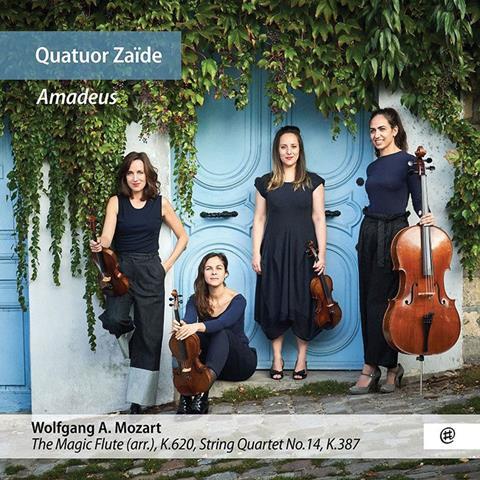
But enough spotlight on Orchid. Another CD of a transcription that works superbly was given to me at the end of Quatuor Zaïde's wonderful concert with Fiachra Garvey in the small but perfectly-formed first Vauxhall Festival. They featured a 1792 quartet arrangement of the Queen of the Night's second aria in their Mozart first half, and it turns out it's one of 19 movements selected from The Magic Flute, featured on a disc which also has the nuance-perfect interpretation of the bold G major Quartet, K387 I heard in the concert. If this clip doesn't sell the Flute idea to you, nothing will.


The Zaïdes make the G major masterpiece sound incredibly modern, but what they do is nearly all in the score. I look forward to their next CD, which will follow a similar format with a Beethoven quartet (one of the first, Op. 18 set, I think) followed by the stunningly effective string quintet arrangement of the 'Kreutzer' Sonata I heard played by Sheku Kanneh-Mason and friends at the Highgate Festival. Sheku, by the way, is still staying loyal to the groups he played with before he became really famous: he'll be trying out the Dvořák Cello Concerto for the first time in October with the Fantasia Orchestra conducted by Tom Fetherstonhaugh, with whom I heard him play the Haydn C major.


Sticking with quartets - of which I've played a lot in lockdown, trying to stick to quieter music out of consideration for my neighbours (though there's no placating the passive-aggressive lady downstairs, who goes to the council and the estate office before she speaks to me) - there's a mellow beauty from the Stamic Quartet, showing what a superb craftsman and original melodist was Karel Kovařovic in his three works for that format (he's usually only known as the conductor who initially failed to recognise Janáček's genius). Easy listening, in a sense, but none the worse for that. My thanks to an incredibly generous Czech friend, who deserves a medal for his services to Czech music as he sends me and The Arts Desk's Saturday classical CDs columnist all the latest (I've also been spellbound by a disc of Janáček piano works from Jan Bartoš, and Martinů's "Incantation" Concerto from Ivo Kahánek with the Bamberg Symphony Orchestra under peerless Jakub Hrůša ).

Symphonic music has been in abeyance, for neighbourly reasons given above, other than the discs I've been reviewing for the BBC Music Magazine and a chance to correct the unpleasant flavour left by Maxim Emelyanychev's over-speedy-to-breathlessness performances of Beethoven Five and Seven with the Scottish Chamber Orchestra (my last excursion, to Edinburgh in early March). The players clearly love ME, and their recording together of Schubert's Great C major Symphony helped me to understand why.


It's full of personality, but (unlike the Beethovens) never too wayward. So I'd better give the team another chance. Ticciati he is not, but he's clearly a force to be reckoned with - though in the hit-and-miss Currentzis league. To watch both in action is almost unbearable. Meanwhile, I hope the rather better all-rounders among young conductors I know will be able to pick up where they left off, along with all other musicians and performers in general. This is a very hard time for them and I suggest you donate if you can to a relevant set-up of your choice; my favoured targets so far have been the City Music Foundation and the National Youth Orchestra. Meanwhile I leave you with an earworm from a disc I've played two and a half times in recent weeks: from Shai Wosner's marvellously programmed 'Impromptu' CD, Gershwin's Impromptu in Two Keys. It's accompanied here by a neat little film which has a special poignancy now that stricken New York is in lockdown. Those streets were made for walking...


Tuesday, 29 January 2019

Johnson and Carduccis play Johnson


As in our national treasure clarinettist Emma Johnson (pictured right) and the Carducci Quartet (above, Matthew Denton, Eoin Schmidt-Martin, Michelle Fleming and Emma Denton) giving the world premiere last Thursday of Angel's Arc by my very good friend Stephen (no relation to Emma). This was his second big event at the Cadogan Hall; back in 2016 his orchestral homage to Bulgakov's cat-demon, Behemoth Dances, was performed here by the Moscow State Symphony Orchestra and Pavel Kogan following its Russian first performance. I couldn't make it, but I've since heard a recording.


Apart from its strange and reflective inner core, Behemoth Dances couldn't be more different from the quintet for clarinet and strings. Obviously the forces make a difference, but this is somehow more personal, Stephen reflecting back on his troubled teens from the perspective of a more recent grief . Placed after Brahms's Clarinet Quintet and an interval, and before Mozart's great example, it had a different dynamic, the clarinet more apart and clearly leading in a very vocal way (how many other composers today make the instrument sing like the human voice? I'd love to hear a soprano or tenor-and-string-quartet work from SJ) To me the strings were more bent on effects to create atmosphere, though there's a lively central section with a riff passed around the players - Behemoth inside out - which Stephen calls 'a nocturnal scherzo, whose sweet-sour alternations recall the moods (and some of the colours) of Mahler's haunted symphonic scherzos'; what came to my mind was more the extraordinary boogie-woogie-plus-tappings core of Shostakovich's Thirteenth Quartet.

But I don't want to do the usual critical thing of citing influences, other than those Stephen intended; I certainly caught a paraphrase of several bars from the Andante con malinconia of Walton's First Symphony, which he did mention in the note (and we both know a bit about malinconia). I was so proud of my perceptive artist companion, Pia Östlund, who 'got' and encapsulated the bigger picture much better than I did, and with little knowledge of the background; she described it as personal and introspective, but at the same time so spacious. We both agreed that the ending was pure metaphysical poetry. Stephen hoped it would convey gratitude as well as grief, and it does. I'm sure he couldn't have wished for a better performance, and the players were all so subtly fused in the Brahms and Mozart (loved the little transcription of Mozart's 'Ave verum corpus' as the encore, too).


Without being told I wouldn't have got the hidden reference which connects to Behemoth Dances through cats: in this case the most undemonic and human cat I've ever met, the late Agatha (I always called her A-GAAA-ta as in the Freischütz heroine), one of the few who could turn my dog-loving head. Expanding on his original programme note in a blog guestpost for Jessica Duchen, Stephen noted how Agatha's death triggered off recent griefs for his splendid father-in-law Canon Harold Jones and his aunt, Elizabeth Johnson. 'Playing around on the piano it struck me that I could make a kind of Schumann/Shostakovich-style cipher out of the letters of Agatha's name: with Te (sol fa) representing B, plus H from German notation, it gave A-G-A-B-B-A - a chant-like motif very like the haunting plainsong phrase "Lux aeterna" I'd used in Behemoth Dances.' Agatha, you will never be forgotten (cue repeat pic above).

Quality time with Agatha staying at the Johnson-Jones residence in Sutton St Nicholas was interspersed with hearty walks. And this connects very much with the new work, because Angelzarke on the West Pennine Moors was a favourite walking and cycling haunt of the young Johnson. Now he walks with greater peace of mind, for the most part, with Kate at his side. Another personal shot, then, from a May 2011 (!) ramble we took with the JJs up and around and down Skirrid Fawr.


I have to evoke those bluebells seen from the lower slopes again, because they offer promise of the spring which seems so far away still.


Even so, the snowdrops were out in force around some of the Brompton Cemetery graves as I cycled to yet another appointment at Chelsea and Westminster Hospital yesterday - as far as I'm prepared to go on a bike at the moment -


and someone had thoughtfully placed a bunch of daffs through the arm of a stone angel.


Praying I'll have had my op - still not scheduled - and be free of the stent when spring does arrive, so I can walk much further than I do now.

Wednesday, 10 October 2018

12 talks in two grand houses


Over a fortnight ago, I was honoured to be part of the Hatfield House Chamber Music Festival, giving two talks in this splendid remnant of the Tudor palace where the future Elizabeth I grew up


and two in the glorious Marble Hall of Robert Cecil's house - still in the hands of his descendants the Salisburys. This exterior shot by the always friendly Jo Johnson, who was up there helping with the admin. She'll get a 'JJ' from now on when I'm using her photos.


The previous weekend I was up in the Trossachs at Gartmore House, 18 miles from Stirling: eight talks of an hour and a half apiece, from Friday evening to Sunday afternoon, to the Wagner Society of Scotland.


Both engagements meant stepping in to the shoes of distinguished but indisposed speakers at relatively short notice. I can't say how sorry I am that Derek Watson, who had been due to carry on his exploration of Wagner's life up in Gartmore, died on the Monday, having gone in to hospital for one thing but kept in for another which proved to be fatal. I never met him, but my 'students' told me a lot about him. There's a brief appreciation on the Society's website.


The only reason I was able to fill the gap, with less than a week to prepare, was because I could adapt and  add to the classes on Das Rheingold I'd given as part of my Opera in Depth one-a-year survey of the Ring. Some members weren't sure they wanted to go into any one work in detail, but only one pulled out - and the rest told me they were happy to have found a new way of listening and of making connections with other music. Here we are at the end of it all.


Gartmore accommodation was simple, comfortable and quiet, with fine views of nothing but green through the windows. It did tend to be through, because the rain was frequent. I had two hours between lunch and my afternoon session to walk, and was glad I'd brought my waterproofs. I must write up a mycological trail in a subsequent blog. As far as the students went - what a delightful and original group of people. Singers, academics, a professional, a forensic psychiatrist, a retired sinologist: all so interesting and friendly to talk to. Here's my perspective from above the teaching zone. Apart from a few classes at my friend Chris's, with my goddog Teddy making a fuss of everyone and then slinking under the sofa, his favourite habitat, to sleep, it's the first time I've given lectures with a dog present, but Natasha's Zippy was attentiveness itself - head cocked when music was played, but no barking or even growling.


As for the music, I found myself drawn in afresh to key performances - above all the dramatic perceptions and brilliance of the Chéreau Bayreuth Rheingold, noticeably more involving after we'd watched a scene from the Lepage staging at the Met - good for the bigger picture, weak on the personenregie, which between Stephanie Blythe's Fricka and Bryn Terfel's bad-hair-day Wotan was more or less non-existent. And then, Zednik's Loge at Bayreuth: comic genius, but not without a serious edge.

At a later stage I had an excuse to play my most recent favourite among Wotan's Farewell (in a look ahead to Die Walküre justified by a class on the elements - here, of course, Loge as pure fire): Norman Bailey, perhaps the most god-like Wotan I've ever heard, with Klemperer and the New Philharmonia. I left the students to watch the Kupfer Rheingold in its entirety on Sunday evening while I got a late flight back from Edinburgh in order to get back to The Rake's Progress in my Opera in Depth class the following day.

Then three without talking much, and off to Hatfield - so much closer but by no means simple to reach owing to train chaos - for Thursday evening's opener (the talks courtesy of my dear friend Stephen Johnson, who asked to hand them over to me). There I met our charming host, Festival planner and participant Guy Johnston, a really nice chap with no side to him, pictured on the left here with his very talented violinist brother Magnus (JJ),


and gave my first 20-minute lecture - short, but all the harder to say much in that time (also JJ).


I needed to connect both with the overall them of 'Brahms and Friends' and the immediate concert - a chamber-orchestra-sized programme of Mendelssohn's Hebrides Overture, Brahms's Double Concerto with the Johnstons and the First Symphony, all marvellously well handled by Mark Austin conducting the young professionals of the locally-based Faust Chamber Orchestra. Thought it was a nice idea to make sure everyone had a postcard with Mendelssohn's watercolour of Lucerne, its lake and the Rigi on one side


and Brahms's Rigi greeting to Clara Schumann on the other


I thought our short spot should be dedicated to 'Brahms the melodist' with the following excerpts (I'll give them for all four, since some folk didn't get the handout at the final talk and may like to see them here).

Attempted singing of the main theme in the central movement of the Double Concerto, Op. 102 (1888) and the words Brahms set, in a postcard to Clara Schumann, to the alphorn call he heard on Mount Rigi – transformed as the horn call in the finale of the First Symphony, Op. 68 (1876)

‘Sapphische Ode’ and ‘Kein Haus, Keine Heimat’ from Five Songs, Op. 94 (1884)   Thomas Quashtoff, Justus Zeyen (Deutsche Grammophon)


‘Alpenlied auf Rigi’   Angelo Lottaz, Male Voice Choir of Thun


The performance of the Double Concerto was the perfect chamber-musical conversation, a far cry from the usual heavy weather you get in the concert hall, the Johnstons never trying to dominate. And if Austin's interpretation of the symphony didn't break out into unbridled exhilaration, as Jonathan Bloxham's had with the Northern Chords Festival Orchestra at our Europe Day Concert, his instincts were all right, his discipline perfect. Soloistic star for me was the superb principal oboist, Katie Bennington.

Only after the concert was I able to find the key to my lodgings, serendipitously only two minutes down the hill from one of the house's gates. The owners, John Mark Ainsley and William Whitehead, had tried to get us to come to the festival the previous year; now here I was, awaiting their return, and J due on Saturday lunchtime. I woke up to this - a garden not overlooked by anybody -


and had a blissful time exploring locally, including the church. I think I ought to blog about the sightseeing elsewhere, but I must of course introduce a figure very much part of all proceedings in the main house's Marble Hall, Gloriana in the famous and slightly enigmatic 'rainbow portrait'.


It's one of two in the house, the other upstairs in the Picture Gallery and attributed to Hilliard.


But the rainbow queen has the more supernatural impact. You know that old cliche about portraits, 'the eyes follow you round the room'? Well, these seemed to, and you could kid yourself that the Queen was mighty pleased with what she was hearing.


The lunchtime recital - for which the above, pictured Vermeerishly by JJ, was the rehearsal - featured Guy with the very individual Melvyn Tan - whose work up to this point tends to have been mostly on period instruments rather than the sonorous Fazioli, a point of contact with the Suoni dal Golfo Festival in Lerici, and less with chamber music - and clarinettist Julian Bliss, who's very good but a tad too reserved for my taste. How could I feel any differently having been under the spell of maybe the greatest of them all, Matt Hunt, at the Pärnu Festival? Still, it was good to hear all the works on the programme, especially so as to get to know the late Brahms Trio the better.


My (slightly longer - half-an-hour) talk, of which there is the above record by audience member Sue Forbes, for which I'm grateful since I wanted to be photographed with Queenie, needed to set up the evening programme. That took us beyond Brahms, so the excerpts I played were:

Double Concerto (1888) – slow movement   Jitka Čechová. Jan Páleníček, Hradec Králové Philharmonic Orchestra/Ondřej Kukal (Triart) as echoed in

Julius Röntgen: String Trio No. 6 (1919) – opening  Lendvai Trio (Champs Hill – our wonderful group have recorded all 16 trios, unearthed in a Dutch archive and due to be published thanks to their championship)

Elgar: Piano Quintet (1918) – Brahmsian theme in first movement and its transformation   Bernard Roberts, Chilingirian String Quartet (EMI) 


Brahms (1863) arr Schoenberg (1939): Piano Quartet in G minor – Rondo all’Ungarese (excerpt) London Symphony Orchestra/Neeme Järvi (Chandos)

The splendid Lendvais - Dutch violinist Nadja Wijzenbeek, Swedish viola-player Yivali Ziliacus and British cellist Marie Macleod - chose the fourth Röntgen Piano Trio, a waltz suite, for the concert. I imagine a little goes a long way, but the 16 trios are quite a discovery, a perfect enrichment of the repertoire for string trio.


We heard, of course, the original G minor Piano Quartet, fine and rewarding to watch, though one sensed that Tan, who made so many beautiful and original sounds on the Fazioli, wasn't quite expansive enough to let the strings breathe.


That was clearly not going to be a problem for the phenomenal Tom Poster, who plays in the Aronowitz Ensemble of which the Johnstons are also sometime members. The Saturday afternoon concert in which he teamed up with Ziliacus, the outstanding violinist Elena Urioste and Guy was, for me, sheer perfection of a kind you don't often get even in the rarefied world of chamber music.


If, taken as a whole, Fanny Mendelssohn's works show greater originality than Clara Schumann's, the central of the latter's Three Romances is an airborne masterpiece, one I wanted to hear again the minute Urioste and Poster had finished playing it. And while Schumann's Piano Quartet sounds modest between the two Brahms giants, he hit the right note even when not aiming as high as he does in the Piano Quintet. Lovable, every moment of it, in these hands.

John Mark and William were now back, complete with adorable vizsla Radish, most vocal and engaging company. Family portrait essential, I think, with their permission.


They both came to the evening concert, and I was delighted that William came away as bowled over by the Brahms A major Piano Quartet as I was. This was the real pay-off in preparing the talks. How surprising to find that a work which begins in serene introspection, the opposite of the G minor's cloudy start, rises to even more challenging heights. Every theme, every transformation, could only be by Brahms, laying to rest the ghost of Beethoven and taking on the mantle of Schubert (my personal preferred choice every time). With Poster at the piano and the admirable string group from the Aronowitz Ensemble of Wijzenbeek, Tom Hankey and Macleod, the payoff of the performance was simply colossal. Here they are rehearsing as shot from above by JJ.


I'm going to pass on saying anything about the first half, Lieder by Clara, Brahms and Schumann performed with his customary audience engagement by James Gilchrist in a familiar partnership with Anna Tilbrook. There was something in all this that didn't quite ring true to me, but any attempts to reach out communication-wise should always be applauded.

The preceding talk was an attempt to cover several bases: Clara and her youngest son Felix; Wagner and Brahms; and the A major Quartet's relationship to its immediate predecessor. So make what you will of the sequence here.

Wagner: Die Meistersinger von Nürnberg (1864) – Fliedermonolog, Act 2, excerpt   Norman Bailey, Vienna Philharmonic Orchestra/Georg Solti (Decca)

Piano Sonata No. 3 in F minor (1854) – end of slow movement   Maurizio Pollini (DG)

Brahms arr. Schoenberg: Piano Quartet in G minor – finale (except)   LSO/Järvi (Chandos)

Piano Quartet in A major (1863) – opening    Gautier Capuçon, Gérard Caussé, Nicholas Angelich, Renaud Capuçon (Virgin)

Symphony No. 2 in D major (1877) – violins close to opening   Berlin Philharmonic Orchestra/Wilhelm Furtwängler (EMI)

Symphony No. 1 in C minor – opening    Vienna Philharmonic Orchestra/Furtwängler (EMI)


Sunday morning continued the wind and rain of soggy Saturday, but at 3pm, just after J had left, the sky cleared and I did a healthy circuit around the park. I'd given the midday concert a miss partly because of social lunching, but also had to stay true to the vow I'd made after Hunt and Co in Pärnu not to hear the Brahms Clarinet Quintet played by anyone else for at least five years.


I did, however, want to hear the legendary Brett Dean as viola-player as well as composer, pictured above second from the left with Tan, Brett's daughter Lotte Betts-Dean, Poster and Johnston. Dean's Hommage à Brahms left little impact, I fear, as [played by Tan; it may seem reactionary of me but I'd much rather have heard the whole of Op. 119, which the homages were designed to weave between, rather than just Nos. 1 and 4 (how could anyone miss out the vintage masterpiece that is No. 2?)

Brett and Lotte were performing together for the very first time. She's a promising mezzo: super engagement, an undeniably individual and rich instrument, but much work is still to be done and a more secure technique should free things up. Let's leave it at that; I wish her every success.


So to the last hurdle, back in the Old Palace Hall. My sincere thanks to all those lovely people who came up to talk in between and enriched my knowledge from their various perspectives. It's rare to have such an interactive audience, but then again I guess as there wasn't time for questions more casual meetings were the only option. Ein Deutsches Requiem was on the cards, so I was able to talk about the curious Bremen premiere of all but the soprano-solo movement. Hence these excerpts, framed by the mighty Ferrier, which also allowed me to touch on Brahms's neo-Baroque aspect.

Bach:
St Matthew Passion (1727) – ‘Es ist vollbracht’ (sung in English)    Kathleen Ferrier, London Philharmonic Orchestra/Adrian Boult (Decca)

Handel:
Messiah (1741) ‘I know that my Redeemer liveth’   Lynne Dawson, Les Musiciens du Louvre-Grenoble/Marc Minkowski (Archiv)

Ein Deutsches Requiem (1869) – ‘Ihr hab nun Traurigkeit’    Dorothea Roschmann, Berlin Philharmonic Orchestra/Simon Rattle (EMI)

Brahms (1862) arr. Rubbra (1938):
Variations and Fugue on a Theme by Handel – conclusion of fugue-finale   LSO/Järvi (Chandos)

Four Serious Songs (1896) – ‘O Tod, wie bitter bist du’   Ferrier, John Newmark (Decca)


Austin once again did the work to hand proud, with the necessary sense of forward movement that keeps the German Requiem from getting stodgy. There was again a marvellous power from the three double basses which helped out the many smokier sounds. Good soloists, a fine amateur choir - though I'd still have liked more words, even if there was more operatic drama than we got from the professional choir in Bremen. But I must say I was tired by the halfway mark. And I went and blotted my copybook, not having done anything wrong during my stay, by waltzing off with John Mark's wallet and leaving mine in my raincoat hanging up in the porch. Anyway, a Tuesday lunchtime meeting with William at Kew - he'd been playing for a funeral nearby - meant I finally took a holiday and spent a brilliantly sunny afternoon in the Gardens.

Wednesday, 9 May 2018

Happy Europe Day


Let's just celebrate it to the full while we can - probably for the last time on the scale of the usual Europe Day Concerts held in St John's Smith Square for the past ten years. Do stay with the above film until it breaks out into Andrew Manze's Lully/Rameauification of Beethoven's 'Ode to Joy' setting*. We were lucky to have the brilliant Rachel Podger with us in 2016, and I'm happy to share another piece of good news today: Irish soprano Jennifer Davis (pictured below at the 2017 Europe Day Concert), who sang Nielsen, Mozart and Bizet so well alongside tenor Thomas Atkins as our Royal Opera Jette Parker Young Artists participating last year, is to take on the role of Elsa in the RO's new production of Wagner's Lohengrin next month.


Very sorry for the delightful Kristine Opolais, who's had to pull out and has had a tough time of it recently, but hoping this will launch Jennifer properly on the international scene.

We'll also be waiting with nervous anticipation to discover how the best guitarist I've ever heard, Sean Shibe, fares at tonight's Royal Philharmonic Society Music Awards: he's been nominated as one of three in two of the categories. We hope he'll hotfoot it over for the post-concert party at St John's, but if not, we'll raise a toast, whether he wins or not.**.


Tonight's programme is about 'Crossing Borders' - Mozart into Spain and Italy, with tenor Ben Johnson and soprano Jenny Stafford also sharing half of Britten's homage to Rimbaud, Les Illuminations, Dobrinka Tabakova transporting us to the Dolomites with her Bell Tower in the Clouds, fellow Bulgarian Michael Petrov as soloist in Bruch's Adagio on Celtic Theme for cello and orchestra, Massenet in Spain, Sullivan in Venice and a grand final flourish from Jonathan Bloxham and the Northern Chords Festival Orchestra, superlative last year, in Brahms - the homaging of Swiss alphorns is the pretext for the finale of his First Symphony. Its big theme will set us up nicely for the model, Beethoven's, always an anthem worth standing for.

*Most recent update (11/5): this year's Ode to Joy and a bit of the intense silence after it is now up and running as a film here. The rest will follow in due course.

**Brief update (10/5): Sean won the RPS Young Musician award. Congratulations, and what great choices throughout (meaning that I agree with them). Meanwhile, a phenomenally well executed Europe Day Concert at St John's hit the heights before ending on an elegiac note as the Ode to Joy was followed by a one-minute-plus silence, ended only by someone's mobile phone going off. We vowed that there will be another next year, however difficult it may be to raise the money.

Full report of the latest Europe Day Concert ere long.

Sunday, 1 May 2016

Requiem for ENO?


I sincerely hope not, and I still want to keep the flame of hope alive by continuing to help fight where possible for the survival of a full company as well as a full season. It seems from what chorus members told me on Friday night after their stunning third performance of Brahms's A German Requiem at St John's Waterloo - my colleague Alexandra Coghlan captured the atmosphere of the first event beautifully here - that new Artistic Director Daniel Kramer wants a full season too. I've stated as much in an article on The Arts Desk giving a cautious welcome. Sincere good luck to him if he, too, is sincere - I'd be amazed if he succeeded where Mark Wigglesworth failed in persuading the intransigent CEO that only by such means can a true English National Opera keep up its superlative, award-winning work.

This German Requiem, performed in the version in English with two pianists at one keyboard - the form it took at its 1871 London premiere - transfigured a work which can seem too gloomy and gloopy in the wrong hands. It still felt a bit that way to J, hearing it for the first time, but I assured him that no-one could have done more to strip away the layers of thick paint than Wigglesworth. Yes, the fugal passages were fast, the last stupendously so, but it never felt rushed even though it clocked in at around the 55 minute mark.


The harmonic relationships between movements were helped by no long pauses; the text was clear and meaningful - with the exception of Eleanor Dennis's radiant but more or less wordless solo; Benedict Nelson's contribution was of a piece with the chorus - simply because Wigglesworth made sure his chorus shaped each phrase towards its natural stress. Nothing could have been more momentous than the 'joy everlasting's of the second movement. Everything was tied together most movingly in the final 'Blessed are the dead', emphasising the sheer strength of the individual sections and with some spectacularly powerful unisons. And one hardly missed the orchestra in the flawless piano duo of ENO music staff treasures Kate Golla and Chris Hopkins (bowing with their bouquets in the second image from the gallery above).

Emotional meetings afterwards. I met up with Jane Livingston, the best of press officers during her long years of service for ENO, to collect my rose oil from Kashan (I'd asked her to get one for me on her recent trip to Iran; my tiny bottle of purest attar from the Kashan bazaar long having been used up, and a replacement not found in any of London's Iranian shops). It might have been a bit de trop of me to make Richard Jones, Mark and his wife Annemieke sniff it ('Turkish delight?' guessed Richard - close, of course). Was also delighted to see the chorus members who had helped me put their side of the argument on The Arts Desk, and to meet face to face at last the joint recipients of the Mackerras Conducting Fellowship I'd helped to adjudicate, Toby Purser and Matthew Waldren.


One familiar face from the chorus said that he'd never before encountered a conductor who could change the entire sound with a flick of the wrist. As postscript to return the compliment, I want to include some wonderful lines from two conductors. From Mark Wigglesworth, first in the programme, following carefully-selected observations on the work being performed:

An opera chorus spend their working lives revealing the full range of humanity on the stage. I know no finer exponents of this than the Chorus of English National Opera. I would like to take this opportunity to pay tribute to them and to thank especially their manager David Dyer and their Chorus Master Stephen Harris. It was their ideas that were the inspiration for these concerts and it is their leadership that continues to inspire us all.

And in private, reproduced with his consent, he wrote that he was

Conscious of what we have lost but right now even more conscious of the extraordinary relationship that has developed between the choristers and me. No-one can or will take that away from us.

Finally, from Toby Purser, again made privately and given with his consent:

To see a chorus in tears of emotion at the end of a performance, with a level of communication, respect and integrity almost impossible to imagine, is breathtakingly inspiring, but also a genuine torture - like having a glimpse of the ultimate artistic potential, only to see it withdrawn afterwards. 

Amen to that, and let's live in hope that the knight on his white charger mentioned by one of the chorus members and quoted in the Kramer piece will come riding back in glory. We can dream, can't we?