Showing posts with label Gershwin. Show all posts

Saturday, 18 April 2020

To those who still buy CDs...


...you could support our stalled, languishing and penniless (though still ever creative) musicians at this time. Remember that all the from-home concerts they do are for the love of it, to feel that they're still performing and reaching out even if that 'magic triangle' of live music as defined by Britten - composer, performer(s), audience - has temporarily vanished.


This ties in well enough with some of the discs I've been listening to over the past weeks. Perhaps it shouldn't come as a surprise that Bach, being both of the essence and worth hearing over long sequences, has been top of the list, and the absolute highlight I wrote about yesterday on The Arts Desk - 90 glorious minutes of Jeremy Denk taking us through the workings of five Preludes and Fugures from The Well-Tempered Clavier. I didn't know about it when I worked my way through the five CDs of the two books just released on the Orchid label by a pianist I hadn't heard of before, George Lepauw.

These are very personal readings, full of rubato and the kind of tense-and-release which won't please those who like their Bach crisp and even. But somehow with this composer you always know when his interpreters are in a deeper zone. I've said it before, but much as I like Vikingur Ólafsson's intelligent programming on his Bach disc, I wouldn't have given it the kind of awards it garnered. At the time I went straight across to hear young Martin James Bartlett and grand maître (no need to call her maitresse) Idil Biret, and there was the thing-in-itself, the very essence, reached as in the best of transcendental meditations. Denk is there, too; I've written more than I should about his inspiring masterclass, so just go over to The Arts Desk, read if you like and if you don't, just click on the link. As I also wrote there, I suspect that were Denk to record all 48, that would probably push aside all the other Well-Tempered Claviers I have, just as his Goldberg Variations did - until Beatrice Rana came along. There are, in any case, infinite varieties of interpretation in this endlessly re-discoverable music; it just depends on which appeals most to your temperament. And Lepauw was also filmed in Weimar's Jakobskirche; I've yet to see the online documentary/performances.


Orchid, the CD label which took on this project, seems to hit the nail on the head every time. I have friendly email exchanges with its main man, the excellent violinist Matthew Trusler, and so I'm maybe partisan; but every CD that comes along strikes a chord, makes me sit up and listen even if I'm dipping in casually. When Matthew told me that fellow violinist Jack Liebeck's Brahms was exceptional, I listened - and I agree (I haven't plucked up the courage to listen to the companion Schoenberg Concerto yet; I need time and a score). Such perfect intonation, just the right degree of fantasy. And the oboe playing of Alison Teale in the slow movement - the players of the BBC Symphony Orchestra under Andrew Gourlay are all credited in the booklet - is superlative, and it all sounds so good (no surprise when it turns out the producer was Andrew Keener). The cover photo, by the way, and the ones of JL in the booklet, are by my good friend Kaupo Kikkas, inspired as usual, in this case to include Jack's adorable dog.


It was a coup for Orchid to 'get' Gabriela Montero, possibly because it agreed to her own Piano Concerto No. 1, 'Latin', appearing on the disc alongside Ravel's G major - and whilst the latter is impeccably detailed and alive, rich and full, the Montero work is also beguiling, immediately communicative. I like the programming of Yu Kosuge, too; she's halfway through her 'Four Elements' series with 'Fire', taking us from hearthside meditations by Tchaikovsky and Reger to the more dangerous flames of Liszt, Scriabin, Falla and Stravinsky; there were some real rarities on the 'Water' disc too.


Trusler buys into the quirky: Kottos is a quartet of accordion (Bjarke Mogensen, whose duet arrangement with Rasmus Schjærff Kjølle of Stravinsky's Petrushka on the same label is a firm favourite), recorder (Pernille Petersen), cello (Josefine Opsahl) and bouzouki (Christos Farmakis), in beguiling arrangements of Skalkottas, Lyadov (quirky choice, the Eight Russian Folksongs), Grieg, Bartók and Vaughan Williams, inter alia. It works!
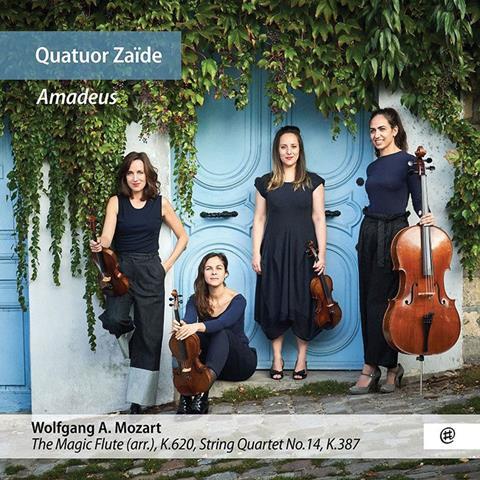

But enough spotlight on Orchid. Another CD of a transcription that works superbly was given to me at the end of Quatuor Zaïde's wonderful concert with Fiachra Garvey in the small but perfectly-formed first Vauxhall Festival. They featured a 1792 quartet arrangement of the Queen of the Night's second aria in their Mozart first half, and it turns out it's one of 19 movements selected from The Magic Flute, featured on a disc which also has the nuance-perfect interpretation of the bold G major Quartet, K387 I heard in the concert. If this clip doesn't sell the Flute idea to you, nothing will.


The Zaïdes make the G major masterpiece sound incredibly modern, but what they do is nearly all in the score. I look forward to their next CD, which will follow a similar format with a Beethoven quartet (one of the first, Op. 18 set, I think) followed by the stunningly effective string quintet arrangement of the 'Kreutzer' Sonata I heard played by Sheku Kanneh-Mason and friends at the Highgate Festival. Sheku, by the way, is still staying loyal to the groups he played with before he became really famous: he'll be trying out the Dvořák Cello Concerto for the first time in October with the Fantasia Orchestra conducted by Tom Fetherstonhaugh, with whom I heard him play the Haydn C major.


Sticking with quartets - of which I've played a lot in lockdown, trying to stick to quieter music out of consideration for my neighbours (though there's no placating the passive-aggressive lady downstairs, who goes to the council and the estate office before she speaks to me) - there's a mellow beauty from the Stamic Quartet, showing what a superb craftsman and original melodist was Karel Kovařovic in his three works for that format (he's usually only known as the conductor who initially failed to recognise Janáček's genius). Easy listening, in a sense, but none the worse for that. My thanks to an incredibly generous Czech friend, who deserves a medal for his services to Czech music as he sends me and The Arts Desk's Saturday classical CDs columnist all the latest (I've also been spellbound by a disc of Janáček piano works from Jan Bartoš, and Martinů's "Incantation" Concerto from Ivo Kahánek with the Bamberg Symphony Orchestra under peerless Jakub Hrůša ).

Symphonic music has been in abeyance, for neighbourly reasons given above, other than the discs I've been reviewing for the BBC Music Magazine and a chance to correct the unpleasant flavour left by Maxim Emelyanychev's over-speedy-to-breathlessness performances of Beethoven Five and Seven with the Scottish Chamber Orchestra (my last excursion, to Edinburgh in early March). The players clearly love ME, and their recording together of Schubert's Great C major Symphony helped me to understand why.


It's full of personality, but (unlike the Beethovens) never too wayward. So I'd better give the team another chance. Ticciati he is not, but he's clearly a force to be reckoned with - though in the hit-and-miss Currentzis league. To watch both in action is almost unbearable. Meanwhile, I hope the rather better all-rounders among young conductors I know will be able to pick up where they left off, along with all other musicians and performers in general. This is a very hard time for them and I suggest you donate if you can to a relevant set-up of your choice; my favoured targets so far have been the City Music Foundation and the National Youth Orchestra. Meanwhile I leave you with an earworm from a disc I've played two and a half times in recent weeks: from Shai Wosner's marvellously programmed 'Impromptu' CD, Gershwin's Impromptu in Two Keys. It's accompanied here by a neat little film which has a special poignancy now that stricken New York is in lockdown. Those streets were made for walking...



Sunday, 24 February 2019

Rachvelishvilimania


How many true Verdi mezzos are there in a generation? There was Olga Borodina, just a little contained but the real deal, and Luciana D'Intino stole the show, as the best Amnerises have a habit of doing, in a Zurich Aida. Some years later, along came Ekaterina Semenchuk, whose Azucena was subtle as well as bold and inflammatory in the Royal Opera Trovatore (in an inventive production I liked, as many did not). Now we learn that Elīna Garanča, who started out with Rossini and 18th century coloratura, is heading towards Eboli in Don Carlo, and from the evidence of her stunning Wigmore recital last Sunday, that sounds completely plausible. I haven't heard Georgian Anita Rachvelishvili in the rep, but from witnessing her on stage for the first time, diva to the life, in Rachmaninov songs with Antonio Pappano and the Royal Opera Orchestra the other Friday, I have no doubt that she'll cut the Verdian mustard, as she seems to be doing mostly at the Met.


Had as a result to hear her new CD, images for which by Gregory Regini are featured above. Star discs of bits and pieces don't usually hold much of a thrill, but when it's the music being served rather than just the singer, there can be exceptions. And this is one such special case from Sony, with a slight studio gloss but good partners in the RAI Symphony Orchestra and Giacomo Sagripanti. A light and very French sounding Carmen - kicking myself for not bothering to go and see another revival here with her in it - sits compellingly alongside the explosions of Azucena and Massenet's Charlotte. The inward spell she cast so beguilingly in the Rachmaninov sequence bewitches in the mostly unaccompanied song, Lyubasha's party turn in Act 1 of Rimsky-Korsakov's The Tsar's Bride. This looks like a Tcherniakov production, though I'm not sure.


You want the blood and thunder? Rachvelishvili apparently stole the show - from the never quite spot-on Anna Netrebko - at the Met earlier this year as the fiery Princesse de Bouillon in Cilea's Adriana Lecouvreur. This, her electrifying first appearance, explains why.


I was very sceptical of even looking at a YouTube clip of the mezzo tackling 'Summertime', but in this version with fine jazz musicians and the Georgian Philharmonic, she absolutely gets the nightclub style. Do give it a try.


So, very much the complete artist already. That I heard her and then Garanča in little over a week made me feel very privileged indeed. Great times - but then aren't there always great singers around, whatever the nostalgists might say? And how to account for the innate gift that goes with all the hard work? It's still a mystery.

Wednesday, 9 September 2015

Chchug* and stride


It's that time of year again when I begin the *church charity mug and we prepare to join what they call the annual Ride and Stride for the Norfolk Churches Trust (as walkers, needless to say). May the shell of St James, alternating with shields on the lower frieze of the church of that name in our base of Southrepps, be metaphorically pinned to our hats as we attempt our 18-or-so-mile pilgrimage of sorts. Only connect: a couple of weeks ago I was stunned by the cathedral at Le Puy, one of the starting points for the camino to Santiago de Compostela.


I appreciate that asking for donations of any sort isn't going to seem so very pertinent when more money should be sent to help the appalling refugee crisis, so wretchedly handled here in the UK, but I suppose I could rather opportunistically invoke IS's destruction of two temples in Palmyra, which we remember with such sadness, as a symbol of 'what's gone is gone forever' - and many of these churches must be repaired or crumble and 'die'. If you want to send a cheque, contact me (since I'm now very liberal, it seems, with shelling out my email) at david.nice@usa.net. You can sponsor by the church - I think we aim to see at least 14 this time - or in a lump sum.


Last Thursday we enjoyed a little ceremony at the Tower of London, courtesy of J's raising the most money of all riders and striders last September and as a result being presented with a certificate signed by Charles (I've been slightly tongue in cheek calling it his 'Prince of Wales Award'). For its sake I was happy to postpone my visit to the Lahti Sibelius Festival, catching a plane out that night for the last couple of days. The hermit-like diplomate, though his photo will be in some East Anglian paper, won't allow the appearance here of a splendid one of him on Tower Green with two Beefeaters and General Lord Richard Dannatt (Sir, Baron, you name it, he's been decorated with it), Constable of the Tower and President of the Norfolk Churches Trust, so instead we have the latter and NCT Chair Sara Foster with the certificate. Though obscured by figures and flash, that's an 18th century painting of the Tower behind them.


It was worth the excursion. General Lord Dannatt received us in the Queen's House, which of course no tourists usually get to see, lodgings for, inter alia, the young Elizabeth and Sir Thomas More, into whose wretched prison zone we were allowed to take our glasses of champagne (the television serialisation of Hilary Mantel's Wolf Hall wasn't filmed here, but they got the light and the space right, like so much else).


Plenty of hurly-burly surrounded us. We didn't return to the Chapel of St Peter ad Vincula because every quarter of an hour or so a great group of guided tourists filed in, and there wasn't time to jump into a gap. Some unfortunate visitor had fallen and broken his/her wrist by the site of the block - jinxed? - hence the ambulance.


Then Jill and Cally went off to see the Crown Jewels and I returned home to pack for the flight.

This year we'll be walking in a different part of Norfolk from our usual Burnhams/Fens/western zones, since the chief organiser of our foursome has moved from King's Lynn to Lower Southrepps. Jill was hard at work singing in our enterprising friend the mezzo, composer and conductor Susie Self's Gershwin show at the Granary Theatre in charmingly old-fashioned Wells next the Sea. So we managed to combine a visit to a matinee before Jill nobly ferried us back to Southrepps for an evening concert.


Susie had marshalled three excellent singers, including a Frenchman with an uncanny resemblance to George (though you had to pardon his English. When I find the programme I'll credit all three). The pianist was composer Michael Finnissy no less, consummate in this music and weaving in a couple of rarities as well as accompanying Susie in a deft cross-cutting between Berg's 'Nacht' and snatches of Gershwin hits ('Summertime' provided a remarkable correspondence). There was also an opportunistic star turn from Susie and Michael's totally adorable border terrier Tristan (I want one, always have). Here he is afterwards trying to lick Jill's ear before howling along to his owners' tormenting songs.


I fell in love with the Southrepps area when we went up for part of its serendipitous and superlative music festival last month, commandeered by top tenor Ben Johnson (read all about it on The Arts Desk). For TAD I was lucky to get screenshots of the concerts from the nice man filming them, but here's just one of some stands for the out-of-this-world Schubert Quintet we heard on Sunday morning.


I'll save snaps of the church's few treasures for the blog entry on this year's walk - we start at Cromer and end up at Southrepps for an evening meal in the excellent pub, by which time St James's may well be closed - but as a taster of the area here are a few shots of a much shorter route we took that Sunday afternoon: only a couple of miles to the sea, viewed from above because here are cliffs (not had those on any of the previous walks).


We came out on the coast road at a very pretty coastal village called Trimingham, its church a pilgrim site because of the head of John the Baptist (hence 'San Giovanni Decollato'); more will be revealed when we go inside on Saturday.


The walks to and fro are across very secretive-feeling farmland with an abundance of oaks - I loved it all - and back at Lower Southrepps there's a well-done boardwalk around a locally-maintained common which is a perfect sanctuary for birds.


Much more to come some time after the big day. Chronicle of last year's walk is here, with links back to 2008.
