Showing posts with label Verdi. Show all posts

Wednesday, 28 September 2022

Kosky's Meistersinger: falling at a late hurdle

Wednesday afternoon sees the 10th and final class in my Zoom course on Wagner's Die Meistersinger von Nürnberg, and the end should crown the work, as well as our grand finale: our special guest is Ben Heppner, who for me sings the most beautiful Prize Song of any I've heard (on the Sawallisch EMI recording: glorious sound, though my overall favourite on CD is Kubelik's. The below film is clearly from a gala, but it will certainly do). 

We've also spent a wonderful hour with Mark Wigglesworth, who conducted one of the Royal Opera revivals of Graham Vick's splendid production, and while Jane Eaglen (whom I saw as Eva at ENO, one of her first major roles for the company) had to pull out of a chat because of a crucial meeting about fundraising - she'll visit some other time - John Tomlinson will give of his time when he comes back from holiday, a very welcome postscript.

I previously covered Meistersinger when the course ran at the Frontline Club and Richard Jones's WNO production - still the best I've ever seen - was pending; he also came to talk to us. But every time it just gets richer. I don't look at previous course notes; it's important to start from scratch. This time we've been more preoccupied with the question of Wagner and antisemitism because, although I don't think it figures in this work (the comic villain Beckmesser is seen as a target, but that's been ignored by most UK directors, Jones included), Barrie Kosky, as the first Jewish director of the opera at Bayreuth, felt he had to tackle it. And I felt we had to follow some of the scenes in the DVD of his production (it's also on YouTube, by the way, but only with German subtitles). 

Felt the Wahnfried tableau restricted the scope of the Prelude, and it sets massive problems to solve: Sachs, Walther AND David among multiple Wagners; Cosima as Eva; Pogner as Liszt; Beckmesser as Hermann Levi. To his credit, Kosky makes the scenes between Beckmesser and Sachs laugh-out-loud funny. The ever- brilliant Johannes Martin Kränzle is at his most outrageous in this production. He's not at any point a Jewish stereotype, but Kosky makes the laughter freeze when the crowd turns him in to one. Personally, I'm happier with a view which treats Beckmesser as a Malvolio within a Shakespearean comedy. But I do understand why, in Bayreuth of all places, the peripheral questions need addressing. 

The point where I lose faith is when Eva enters Sachs's study - here the room in which the Nuremberg Trials were held - in Act Three. We lost the sentiment in favour of swift humour in the comparable Act 2 scene, but although I adore Anne Schwanewilms, the silly mock-girlish skipping she's asked to do defuse all the emotion in the situation. And if Michael Volle's Sachs and Klaus Florian Vogt's Walther are both aspects of Wagner, where's the crucial love triangle? I turned back to Lehnhoff's stripped-back production for Zurich Opera, and having doubted the scene's power, the tears flowed again. It was with good reason that Strauss and Hofmannsthal saw in this a blueprint for the Marschallin-Octavian-Sophie triangle in Der Rosenkavalier.

Excellent cast. Real-life couple Peter Seiffert and Petra-Maria Schnitzer keep it real, too. Some find José Van Dam's Sachs too dour, but I like the introspection, the pain is real, and he's very much an attractive older man.

Every class has brought big emotions. As Mark pointed out, every transition is a thing of wonder, and strictly speaking you could say it's ALL transition. I'm especially happy with the two hours we spent on the Act Three Prelude and the Wahnmonolog, with the help of Brian Magee's eloquent words on the Schopenhauer connection in Wagner and Philosophy to help us out. There's also another of the few really good books on Wagner which I re-read with pleasure, because all the elementary points in it are put so well - this brief but pithy journey through the opera by Catholic priest, professor and author of numerous books on literature and music M. Owen Lee. 

The art, ultimately is what matters, and among the many miracles of this great masterpiece is how it bears out all its claims with musical chapter and verse - everything is perfectly executed. Can it really be, as Mark wrote he was inclined to believe, in our initial email exchange, 'western civilization's greatest achievement'? While engaged on it, I'm inclined to believe so, Bach Passions and Mozart operas notwithstanding.

Verdi's Aida, of course, is a different case - the kind of plot all too familiar from early 19th century Italian opera, but ah, the music, the orchestration, the great string of duets! The writing is as masterly as that of its late successors Otello and Falstaff. I've had trouble persuading some students we should spend five Mondays on it, still more that G&S's The Yeomen of the Guard deserves two (I'm splitting the second half of term between that and Britten's The Rape of Lucretia

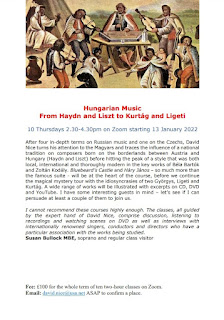
We start tomorrow (Monday 3 October), probably hitting 'Celeste Aida' before we get to 'Morgenlich leuchtend' on Wednesday. Full details here - click to enlarge.

Thursday's non-operatic course this term is devoted to the symphonies of Elgar, Vaughan Williams (the bulk of the classes) and Walton. I thought after the Russians, Czechs, Hungarians and Finns it was time for British - I hesitate to say Engish - music to have a look in. I wanted some words of commendation different to Sue Bullock's for the opera course - and Mark wrote what I'm sure he thinks, so proud of that. Again, click to enlarge.

Onwards! I hope a few more will be tempted to join up; good numbers for the opera course, fewer for the symphonies, but that's always been the case.

Sunday, 9 January 2022

Opera in Depth on Zoom: the oddballs term


After an obsessively wonderful term entirely Czechia-centric - in the opera class, Janáček's Jenůfa and Martinů's Julietta, the bigger picture from Smetana onwards for the Thursday course - it's time to cast the net wider for Spring 2022. Though I was disappointed by much in Oliver Mears' new Royal Opera production of Verdi's Rigoletto at the start of the season - it returns this year with a different cast - Antonio Pappano certainly highlighted the astonishing originality of so much in it. So it's time to return to that masterpiece. And to Britten's Peter Grimes, which inevitably cropped up a lot during our half-term on Albert Herring.  

The logistics: 10 two-hour Monday afternoon classes, running from 2.30pm to 4.30pm and starting tomorrow. £100 for the course. If you can't attend in person, I send out videos the morning after. Leave a message here if interested, or use the email in the reproduced flyer for the Hungarian music course below, and I'll get back to you.

On Thursdays we turn from Czechia to Hungary. The details for that are reproduced below. They should be readable if you click on the image for a larger size.

Sunday, 24 February 2019

Rachvelishvilimania


How many true Verdi mezzos are there in a generation? There was Olga Borodina, just a little contained but the real deal, and Luciana D'Intino stole the show, as the best Amnerises have a habit of doing, in a Zurich Aida. Some years later, along came Ekaterina Semenchuk, whose Azucena was subtle as well as bold and inflammatory in the Royal Opera Trovatore (in an inventive production I liked, as many did not). Now we learn that Elīna Garanča, who started out with Rossini and 18th century coloratura, is heading towards Eboli in Don Carlo, and from the evidence of her stunning Wigmore recital last Sunday, that sounds completely plausible. I haven't heard Georgian Anita Rachvelishvili in the rep, but from witnessing her on stage for the first time, diva to the life, in Rachmaninov songs with Antonio Pappano and the Royal Opera Orchestra the other Friday, I have no doubt that she'll cut the Verdian mustard, as she seems to be doing mostly at the Met.


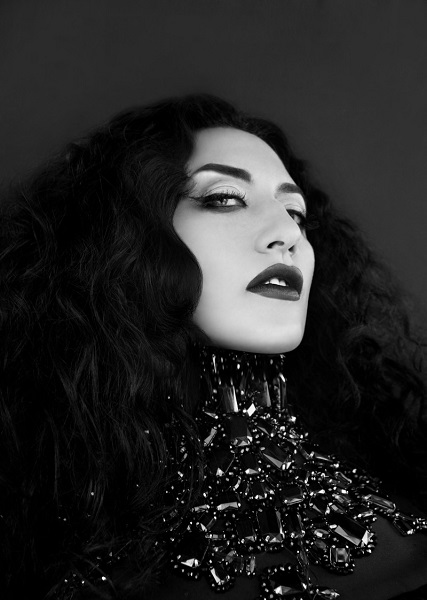
Had as a result to hear her new CD, images for which by Gregory Regini are featured above. Star discs of bits and pieces don't usually hold much of a thrill, but when it's the music being served rather than just the singer, there can be exceptions. And this is one such special case from Sony, with a slight studio gloss but good partners in the RAI Symphony Orchestra and Giacomo Sagripanti. A light and very French sounding Carmen - kicking myself for not bothering to go and see another revival here with her in it - sits compellingly alongside the explosions of Azucena and Massenet's Charlotte. The inward spell she cast so beguilingly in the Rachmaninov sequence bewitches in the mostly unaccompanied song, Lyubasha's party turn in Act 1 of Rimsky-Korsakov's The Tsar's Bride. This looks like a Tcherniakov production, though I'm not sure.


You want the blood and thunder? Rachvelishvili apparently stole the show - from the never quite spot-on Anna Netrebko - at the Met earlier this year as the fiery Princesse de Bouillon in Cilea's Adriana Lecouvreur. This, her electrifying first appearance, explains why.


I was very sceptical of even looking at a YouTube clip of the mezzo tackling 'Summertime', but in this version with fine jazz musicians and the Georgian Philharmonic, she absolutely gets the nightclub style. Do give it a try.


So, very much the complete artist already. That I heard her and then Garanča in little over a week made me feel very privileged indeed. Great times - but then aren't there always great singers around, whatever the nostalgists might say? And how to account for the innate gift that goes with all the hard work? It's still a mystery.

Saturday, 14 November 2015

Farewell Katerina, welcome Leonora


Prefatory note: this was mostly written before I heard the news today. Not that there's anything to say except, thoughts not just to Paris but to the families of everyone blown up or mown down indiscriminately in tens and thousands around the world so far this terrible century. It's almost too much to bear..

As on the stage of the London Coliseum, so in my Opera in Depth course - we've said our goodbyes to Shostakovich's Lady Macbeth of Mtsensk (ENO production image by Clive Barda) after six Monday afternoons and found ourselves hooked by Verdi's La Forza del destino (or rather "Force" as they have to call it at ENO, though I'd be happier with The Power of Fate as an English title. All ENO photos by Robert Workman). We had a very distinguished transitioner, new ENO chief conductor Mark Wigglesworth, to talk us through a retrospective on Lady M and what to expect from his second opera of the season. He's generous with his time, candid and of course absolutely the best thing that could have happened to ENO after Edward Gardner, able to apply his own deep sound to an orchestra (and chorus, too) in top shape.


Even more amazing is that I asked him if he'd mind mentioning to American soprano Tamara Wilson, making her London debut and giving possibly the operatic performance of the year as Verdi's Leonora, that we'd like her to visit us at the Frontline. She said she'd come, with wit and verve, and so Monday 23 November will be a love-in with La Wilson. If you'd like to attend this one-off, contact me at david.nice@usa.net. I've even been able to schedule an extra class at the end of term so we don't miss out on going through the opera (and four two-hour sessions still aren't enough).


I'm able to divulge what I thought of Force now that my Radio 3 Music Matters chat with Tom Service, who was very much on the same wavelength, has been broadcast; it's up on the iPlayer and as podcast here*. As expected, Calixto Bieito's production was a maddening mix of woolly, repetitive grimness and the odd scene of penetrating brilliance. Certainly I wept and was left shaken when our pitiable heroine seeks consolation in a monastery and meets - wrench of Verdi's intention, this, I know - only sadism and brutality. But as this is the Spanish Catholic church, is it that surprising? Coincidentally, I've just been reading in Glenn Watkins' beautifully written The Gesualdo Hex a document testifying to Spanish monks' infinite misogyny (we're talking Civil War with Bieito, though it's too much to the fore rather than providing a context for the private pursuit of revenge).


Bieito, as usual, overstates that misogyny; there's hardly a scene where a woman isn't on her knees having her hair pulled, or worse - and the expensive set on the revolve isn't usually as effective as it looks above, though the video projections are always impressive. But thanks to Wilson's magnetic acting with voice, face and body, and her fusion with Wigglesworth's phenomenally dramatic and stage-attuned conducting, pity and terror were the keynotes at the end of ENO's first half. There are plenty of hallucinatory moments, like 'Piu tranquillo l'alma sento' and the ghostly clarinet and violin solo reprises of the big phrase in the preceding aria. James Cresswell played his metallic-grim bass part in this superbly: could he play Wotan to Wilson's Brünnhilde, if she stays the course and develops as expected? Mark MUST do a new Ring at ENO, and Richard Jones has said he's willing to look at it again after one and a half productions, so how about it?


We have, of course, to wait another act and a half for Leonora to return, whereupon the tension levels rise again, and the floating of the lines in the great trio of Verdi's revision banish regrets that Bieito didn't go with the first version, very much his line with two corpses and Alvaro throwing himself off a rock cursing God. The other payoff is the most intensely quiet of pianissimos from the ENO Orchestra. Heck, they could all do Aida *now*.

For me, neither of the genre scenes works. Bieito insists on decontextualising them, replacing the old messes of his Don Giovanni et al with chorus stock still in lines; the patchy lighting means you can't often see who's singing when. Predictably, every moment is brutal here, no light and shade (though I wouldn't condone a completely cosy Preziosilla either). Andrew Shore was presumably engaged to make a funny Melitone, but he's just horrid according to Bieito.


The two principal men don't blend well, though each is good. Gwyn Hughes Jones, as we know from his Walther in the ENO Mastersingers, is tireless but a bit bright and underballasted for a tenor of his build; Anthony Michaels-Moore is now merely solid in middle range, inaudible below - I used to like him a lot. Still, he plays the war-crazed veteran compellingly in a Klaus Kinski kind of way. Bieito doesn't help the two stagewise, keeping them apart until Alvaro rants about pulling a knife on Carlo when he's pinioned under him with no chance of doing so. GHJ does fire on all cylinders in the last act, though.

Mark prepared us well the Monday before. Interestingly he had been engaged, before his big appointment, to conduct the opening opera of the season, but that had changed to Carmen. And he was already down to return for another Lady Macbeth. I can't remember everything he said - should have recorded the talk - but among the most interesting observations was one in which he said that while singers will do anything a director asks - because they've come from a musical, rather than a theatrical training, and lack the confidence to speak out - they won't take notes from the conductor half so readily. Though I imagine Wilson did both, so closely bound to her orchestra in sense and intensity, so committed to the sometimes cruel hoops through which Bieito put her, did she seem.

In the first hour of that class, we finished off Lady Macbeth of Mtsensk - or rather Katerina Izmailova, since it was Shostakovich's revision, further cut, which Mikhail Shapiro used in his 1964 film. Mark came in to see the very end, Vishnevskaya so devoted as Katerina that she was prepared not to have a body double for her character drowning self and fellow convict Sonyetka in the Volga.


Memorably she spoke about it some years back - 'weather very cold, water very wet' - and writes in Galina: A Russian Story of how because a reel had been lost the scene had to be re-filmed, not in warm water near Odessa but in the much chillier Gulf of Finland. Well, it was worth it. We also used scenes from Martin Kušej's Amsterdam production with Eva-Maria Westbroek and Christopher Ventris; the class agreed that the wedding scene was more convincing than it had been in Tcherniakov's ENO staging. Otherwise, I beg to differ with some of them that his Act Four was unsatisfactory; for me, that was pure genius.


In the meantime, Georg Friedrich Haas's Morgen und Abend really worked for me at its Royal Opera world premiere last night (we're back to the great Clive Barda for the last image, of Sarah Wegener as Signe and Christoph Pohl as her dead, or departing, father Johannes). Wish we could have asked Graham Vick back to talk about it; apparently he adores the music, and I can well see how it would get under one's skin. Haas is fascinating talking to Tom on that same Music Matters episode: the notion that if you love something enough, there will aways be people in the audience who love it too is beautifully put.

*And/or you might like to listen to Tom Jones interviewed by Cerys Matthews on the BBC World Service. Total tonic on a day bleak in more ways than one.

Monday, 6 October 2014

Go, Girl


Puccini's La fanciulla del West certainly went for gold on the first night of Richard Jones's new production for English National Opera. There's not much I can add to my Arts Desk review, or the BBC Radio 3 Music Matters chat with Tom Service and Alexandra Wilson, about Minnie's return to the original Americanization of David Belasco's The Girl of the Golden West. One thing I ought to admit in a marginally more private sphere is that, once past the thrill of being hurtled into Puccini's sheer showmanship in as brilliant a grab-you-by-the-throat start as any he composed, I wept to the point of sobbing at the miners' yearnings for the folk back home, and at the sheer candid insecurity of Susan Bullock's Minnie (pictured above by Robert Workman for ENO at the end of Act Two with Peter Auty's half-dead Ramerrez and Craig Colclough as the defeated Ramerrez glowering through the window) in the beautifully paced, clinch-postponed scene with the man she loves at the end of the First Act. I love it that Richard, in his typically pithy responses for the Music Matters slot, described the plot as being about 'three people with very low self-esteem'.

The key word about Jones's careful stagecraft is truthfulness, not easy in a piece which can slide into hammy melodrama. It's overwhelmed me to the point of obsessiveness since I saw the show on Thursday, reminding me that any imperfections in the purely vocal qualities of the principals can be far outshone by the lasting impression of a terrific piece of staging. For vocal thrills untroubled by questions of dramatic fidelity onstage, you still have to go back to peerless Birgit Nilsson* on the 1958 studio recording with Teatro alla Scala forces. Her tenor, the now more or less unremembered João Gibin, ain't bad either. But what surely makes this one of the great opera recordings is the perfect theatricality of Lovro von Matačić's conducting. It's all here on YouTube.


What some top-notch singing can be without staging of Jones's peerless know-how and thoughtfulness struck me all too forcibly when I went to see ENO's other new production of the season so far, of Verdi's Otello, two evenings later. I don't doubt that Stuart Skelton will make a great Otello sooner or later. But David Alden's was not the production to help him. Maybe it was an especially lethargic, energy-dimmed Saturday night, but I didn't even get the sense of any outsider status in this tormented warrior to make up for an avoidance of the elephant in the room, the racial issue (which matters less in the opera, certainly, than in Shakespeare, who makes Othello's apartness the crux of Iago's manipulation).

Sadly, there was little dramatic spark until Skelton's protagonist fell to his knees and launched into a suddenly thrilling 'Si, pel ciel marmoreo giuro' (or whatever that is in the rather dreary, antiquated-sounding English translation). Veteran Jonathan Summers backed him up and suddenly we were experiencing again the true theatrical spark (the two below pictured by Alastair Muir for ENO).


For me, that was it. No doubt it wasn't Summers' fault but the production's that Boito's text for Iago's Credo just struck me as downright silly. I didn't see or hear the feistiness many had detected in Leah Crocetto's Desdemona, either. She can do the works, the top and the pianissimi, but I didn't hear much pathos or lower tones in the bright, well-schooled soprano voice; not was there the bearing which can make Desdemona effective even when the voice is lacking (as it certainly wasn't with Crocetto). Alden's mise en scene conveyed very little to me, but the real death blow was the fatal unpaciness of Edward Gardner's conducting. Yes, the orchestra delivered all the detail on top form, but why did we come away at the interval - despite that duet-finale - feeling so torpid? The score should fly like an arrow until the bedchamber scene, which was neither set where it needs to be nor affecting in any way. Here was a case where fine singing and playing didn't constitute the musical supremacy which might have made up for the sheer incoherent movement and apparent indiscipline of the dramatic picture.

Back to school tomorrow - or rather today, since it's now past midnight - but no longer to the City Lit; slight regrets about having sacrificed Fanciulla, which was on the menu there before it all went pear-shaped, in favour of Prokofiev's War and Peace, so as not to be accused of replication. My Opera in Depth course at the Frontline Club kicks off at 2.30pm, and I'm confident about the fabulous resources of the place; this was the right choice. Loyal students, and some new faces, have helped to make it happen. And I'd particularly like to acknowledge the generous support of David Pickard, Laura Jukes and James Hancox at Glyndebourne in giving the course a big push in the house's October e-newsletter which went out on Saturday. On Thursday we'll see how the Nielsen/Sibelius course works at St Andrew's Fulham Fields; for the first week we'll be in the church proper while there's a winetasting in 'our' lecture room.


One disappointment was that the BBC Symphony Orchestra management came back to me, after three weeks of persistent e-mailing on my part (some staff were away, others weren't) to check whether we could have the usual student discount, to tell me that wasn't possible for 'privately-run courses'. So with the agitated action that I've been prone to since having to start afresh, I approached the London Philharmonic Orchestra and they'll give us 50 per cent discount on selected concerts next year. I've opted for two classes on 12 and 19 March to cover three Ballets Russes scores being conducted by Jurowski - Ravel's Daphnis and Chloe on the 14th, excerpts from Prokofiev's Chout and Stravinsky's complete 1911 Petrushka on the 21st. One of Bakst's paintings associated with his designs for the original production of Daphnis pictured below.


Then on 23 April we anticipate the last concert in Jurowski's Rachmaninoff: Inside Out series on 29 April. So that's a new start, and I may well add other one-off classes depending on how things go. But it's a fun adventure so far, not least to discover that I can administer my way out of a paper-bag; I have the internet, and xls, to thank for that. Again, my e-mail, if you'd like further details: david.nice@usa.net.

*This is serendipity, since I'm off to Stockholm for the Birgit Nilsson Prize, recipients the Vienna Philharmonic who'll be playing under Muti. I look forward to hearing the reasoning.

Monday, 20 January 2014

Addio to the master


I can add little more to the Guardian obit now up, various blog posts and Arts Desk features - a joint tribute with Ed Seckerson being the latest - jammed with superlatives about Claudio Abbado, who has died surrounded by his family in Bologna at the age of 80. His Indian summer with the Lucerne Festival Orchestra yielded simply the best Mahler I've ever heard: I got myself out there on the strength of the Second Symphony on DVD, to be stunned first by the Seventh, later by the First; as for the Ninth, it was simply an out of body experience.

Likewise, surprisingly, Tchaikovsky's The Tempest in Rome with another super-orchestra made up of the Orchestra Mozart based in his home town of Bologna and the Accademia di Santa Cecilia. Abbado's Tchaikovsky Sixth with the Simon Bolivar then-still-Youth Orchestra in Lucerne was only part of a poleaxing programme. Bruckner Five at the Festival Hall didn't quite do it for me - blame my problems with the piece - but the preceding Schumann Piano Concerto with Mitsuko Uchida was one of THE great partnerships. Both concert photos here by the great Chris Christodoulou.


All the qualities which made these performances peerless I've ennumerated elsewhere, not least in the obit -  strange to think it was begun before the Lucerne dream took wing - but I'll just recall a few more. Live, way back, Debussy and Tchaikovsky with the LSO, more recently, Brahms with the Berlin Phil. On CD, the early Prokofiev Romeo and Juliet and Chout excerpts, Verdi's Simon Boccanegra with a dream cast, a Wagner disc with Bryn Terfel.  


Later: in the City Lit class, too swamped by Abbadiana to do justice to Tippett's King Priam, I put together a sequence, mostly operatic to suit the students:

Wagner, Prelude to Act 1 of Lohengrin  Vienna Philharmonic Orchestra (Arthaus Music DVD of the 1990 Vienna production)

Verdi, Prelude to Aida  Berlin Philharmonic Orchestra (DG CD, 1997)

Prokofiev: Dance with Mandolins from Romeo and Juliet and Final Dance from Chout  London Symphony Orchestra (Decca CD, 1966)

Berg: Lulu Suite (first three movements) Anna Prohaska, Simón Bolívar Symphony Orchestra (Accentus Music DVD of  2010 Lucerne concert with encore: 'Ach, ich fühls' from Mozart's Die Zauberflöte). To my amazement, I see the entire performance is there on YouTube. It starts with the most blistering opener ever, 'The Adoration of Veles and Ala' launching Prokofiev's Scythian Suite, and ends with a great Tchaikovsky Pathétique. I remarked at the time that Abbado brought his own sound with him, especially in the beauty of the Berg, and that was especially evident when Dudamel took over the following night, good as he was.


Then there should have been something from the Rossini Il Viaggio a Reims, but time was short.

Finally, Mahler: Symphony No. 4 - third and fourth movements  Juliane Banse, Gustav Mahler Youth Orchestra (Medici Arts DVD of 2006 Vienna Musikverein concert).


And what could have been more appropriately bittersweet than that?

Anyway, I wish Abbado had recorded more Wagner - it's criminal that we don't have his Parsifal preserved for posterity - and my one great regret is that he never tackled the two Elgar symphonies, for which his own supreme gift of the most flexible rubato in the business would seem to have been made. Back now, anyway, to listen to the Mendelssohn A Midsummer Night's Dream music which he performed with the Berlin Philharmonic last year (friend Debbie was first soprano in 'Ye spotted snakes'). I was so looking forward to hearing the same with the Orchestra Mozart in Dresden's Frauenkirche this June; sadly it's not to be, but we've had our visions. Though we'll hugely miss him, there's nothing to regret: no-one lived a fuller life, one so much longer than illness would have led anyone to expect.

Thursday, 12 December 2013

On the day they booed Zuma


...I was summoned with three hours' notice to the BBC News 24 studios. The reason was loosely connected, I guess, with that surprising incident at what turned out to be a big party to celebrate Nelson Mandela's life (and incidentally I can't see under such circumstances why the hypocritical Daily Mail, glimpsed this time in the back of the cab they sent to ferry me back and forth, is at it again, condemning Obama's 'selfie', aligned with glamorous Danish PM and not so glam Cam, after he'd given such a wonderful speech).

So to the cause of my command performance. There had been booing at La Scala - che sorpresa - following what looked like a rather inventive new production of La traviata by hit-and-miss genius Dmitri Tcherniakov, and the news folk seemed most interested in the fact that tenor Piotr Beczala (pictured below by Johannes Ifkovits) had also got a boo or two. Full focus was on him, apparently, because he Facebooked that he'd never return to sing in Italy after that experience. 13/12 Inside information tells me that it happened because he wouldn't pay a claque to cheer him, so they booed instead. I did raise this possibility on the telly, but dismissed it because it seemed unlikely that, say, he and Damrau could possibly have been at loggerheads - and the claque phenomenon usually involves one leading singer hiring folk to diss the other.


I explained that as I hadn't been in Milan or at the livescreening I couldn't comment authoritatively, but they wanted me there all the same for a live sequence at 4.17pm and drummed up George Loomis, who had attended, to appear in the Paris studio. He looked comfortable there with a lovely view of the Eiffel Tower, whereas I was a bit overawed by the new television centre headquarters behind the much more familiar (to me) old Broadcasting House. My own shots are all a bit fuzzy as I didn't want to disturb with flash.


There were hordes of people around reception, plus paparazzi outside waiting for Katy Perry (about whom I know only the name and what she does). Then I was whisked down a corridor overlooking the largest newsroom in Europe - impressive and Metropolis-y - towards the studio where Tim Willcox was sitting behind a familiar desk.

To makeup first, and a chat with a lovely lady who told me how they're all on freelance contrasts, shocking. And then to the vast studio where there were only a man who pinned on my mike, two cameramen and Tim. I never spoke to him properly, got a nod as I sidled into a chair beside him and double-checked the pronunciation of 'Beczala' (Bechawa). I'd hoped there would be more about Tcherniakov, but it was mostly about tenors and why this one was booed.

From the excerpts on YouTube, I've no idea (why): Beczala, as I know, has style and musicianship most tenors with voices anywhere near as good as his completely lack. 'De' miei bollenti spiriti' is lovely, and done while rolling out pastry with Damrau's Violetta, a perfect image of domesticity (though as with other supposed soliloquies in the opera Tcherniakov breaks the rules and gives the singer a springboard for reaction). If anything's to be criticised it would be the heavier of conductor Daniele Gatti's tempi, though the Italians don't seem to have noticed those.


Despite pushing the voice dangerously in the public denunciation of Violetta, Beczala didn't crack - though he does on a wicked clip from a 2012 production of Gounod's Romeo et Juliette in a YouTube series called 'Perle nere' - 'black pearls'. Botha is on there too so Beczala is in fine company; it happens to the best. I want to see the whole of the show now - especially intrigued why Damrau is fancy-wigged as Jean Harlow in Act One and as 1970s Bette Midler in II.ii when the essential look is contemporary.


Anyway, I was walking back to the taxi from the rather intimidating TV HQ when nice co-ordinator Victoria Sill ran after me. BBC World Service had seen the live couple of minutes, liked it and wondered if I'd come back in to do a radio slot. Great: this would at least double my earnings (£50 'disturbance fee' for the telly). Typically, this interview was more relaxed and I had fun chatting to Newshour presenter Tim Franks.

Wonder if anyone saw the News 24 snippet - I just have, since Victoria very efficiently sent me the film without my even having to ask - but the radio chunk, neatly edited, is downloadable here (my bit's right at the end of the 'US Cuba Handshake' instalment). Probably the iPlayer version is the better long-term bet as the big programmes tend to be up for a year. For the next two and a half days, there's also Radio 3 iPlayer access to my chat with treasured colleague Marina Frolova-Walker and Music Matters presenter Tom Service on Stephen Walsh's excellently written but oddly marketed/presented book about Musorgsky and the Five.


Not much to add about mighty and compassionate Madiba, except that while dining on superb Indian dishes at friends Anupam and Paul on Sunday I brought up Peter Tatchell's equivocal response - which was that Mandela was unquestionably a great man, but from the great we expect so much, and he could have done more when it came to speaking out against Mugabe -  apparently he never did - and dealing with HIV/AIDS in South Africa. To which Chris Smith, aka Baron Smith of Finsbury, the first out gay MP and so a bit of a hero of mine*, responded that the day after he'd proclaimed his own HIV status, he got a message asking him to call Nelson Mandela and on ringing the number found the man himself on the end of the line. No other major figure showed that kind of solidarity at the time.

When I emailed Chris to ask if he'd mind my mentioning and/or naming him - and of course he didn't - he added: 'one of the things that had prompted me to say something publicly...was his speech after his son's death when he said we can only defeat HIV by being open about it, and talking about it'.

That personal touch sounds typical - lovely slot in the middle of Tuesday's World Service coverage - yes, I'm a fan of that station, for all its recent changes - where the daughter of a white activist remembers Mandela not only coming to their Camden home at the time of her father's funeral, but staying for tea and interrupting a speech to say hello to a neighbour he knew. At last tears did come to my eyes after all the generalised - if well deserved - eulogising. There's a fine tribute from colleague Jillian Edelstein on The Arts Desk, describing her experience of photographing Mandela in 1997. Here's her shot of a man we usually see smiling and extrovert rather than pensive.


10.10am: Jillian just emailed back with another image, which appeared in today's Guardian. Of course we need to see both sides of the great man.


Well, he is gone, but this great one isn't, and continues to do active good in the world. As, I think we're agreed but with greater reservations, is Time Magazine's figure of the year, humble Francis.

*Speaking out against a possible ban on gay employees in Rugby, he said: 'Good afternoon, I'm Chris Smith, I'm the Labour MP for Islington South and Finsbury. I'm gay, and so for that matter are about a hundred other members of the House of Commons, but they won't tell you openly'.

Sunday, 13 October 2013

Flittermousing around


Been flapping pipistrelle-like to chatter about town all week, from the Austrian Cultural Forum in Knightsbridge on Sunday to the City Lit Monday and Tuesday, the London Coliseum on Wednesday and Western House, BBC outpost behind Langham Place, on Friday. Plus Kew on Thursday not to talk but to be talked to by an enthusiastic mycologist on Thursday, but that's for another entry.

Not at all sure I would have gone to see Christopher Alden's largely slated production of Die Fledermaus at English National Opera had I not been included in the latest of Christopher Cook's tight little pre-performance packages before the show, turned as before into the podcast you can listen to here (second entry down). It was better than I'd anticipated, but still not as good as I would have liked. Yet again a heavy-hearted directorial hand sinks a maybe unstageable operetta gaiety.

I determined not to see it before I spoke, hoping to keep the door open on the possibility of something good stagewise after Richard Jones's self-confessed failure of an ENO predecessor and Harry Kupfer's lift-dominated Komische Oper production, which we left halfway through on my birthday back in 1996.


It all works beautifully on the recording which was my first boxed-set purchase in my early teens, Boskovsky's Vienna sparkler with a sardonic Falke from Fischer-Dieskau, Gedda's foppish Eisenstein, experienced Viennese bass buffo Walter Berry, the classy Anneliese Rothenberger's Rosalinde and - peerless, surely - Brigitte Fassbaender's dyke-of-delight Orlofsky. Plus all dialogue masterfully directed by Otto Schenk, whom we last saw in his cups as Lady Bracknell in Vienna's Leopoldstadt Theatre for an all-male production of Bunbury, oder wie wichtig ist es Ernst zu sein and who plays Frosch as a very convincing drunk on the recording.

I snapped the box cover and put the picture up when marking the death of Rothenberger at the age of 85, but no harm in repeating it here as I took it along as a kind of talisman to the talk. Of which more briefly later. The show? Well, Alden C, like his brother, is no stranger to nightmare scenarios - the schoolyard one applied to Britten's A Midsummer Night's Dream perhaps the most successful 'rewrite' I've seen - and this was Rosalinde's as set up in the overture and controlled throughout by Dr Falke as Freud (Richard Burkhard, one of the better voices on display, pictured below in the first of Robert Workman's images).


A production should be clear in the telling and not need explaining, but the excellent cover Adele, Clare Eggington, and the Frosch, Austrian actor Jan Pohl, who joined us along with assistant conductor and repetiteur Murray Hipkin enriched our understanding by talking of the three eras: repressed 19th century, unconscious-released Freudian early 20th and totalitarian-nightmare 30s.

Problem? It ain't funny, really, ever. I laughed a bit at some of the wit in the translation by Stephen Lawless and Daniel Dooner, which is much better than many critics have declared (and infinitely better than Pountney's appalling, antique job for the Fidelio). Although I lost the will to live - maybe the point - soon into the party act, I did laugh nervously when Adele slapped Eisenstein about as she worked her way down the staircase with her Laughing Song.


Rhian Lois, though not exactly possessed of a voice you'd like to hear on a recording, is a fabulous musician, hits all the top notes - as had Clare in her two numbers for the talk - and holds her poise throughout. Not so Tom Randle's Eisenstein, who seems lost throughout - though at least shows us what good physical shape he's in when the errant husband strips off to mirror lover Alfred in the reconciliation. And Edgaras Montvidas probably gave the classiest singing of the evening running through a rep which featured, of course, Fidelio and Madama Butterfly, the operas surrounding this one at ENO. Suitably sexy, too, in an offbeat, parodied kinda way.


Poor Julia Sporsén, a fine Julietta last season, didn't do too well with Rosalinde's ought-to-be creamy upper register; surely she's a mezzo? Jennifer Holloway looked good as Orlofsky but had too many embarrassing manic-depressive routines. Even Andrew Shore didn't carry off his humour too successfully as transvestite prison governor Frank - pictured here with Holloway -


and the conducting from Eun Sim Kim was much zestier than I'd been led to believe but lacked the true Viennese lilt. As usual. Lovely wacky party costumes by Constance Hoffman,


especially striking when the entire group of decadents sits on a vast prison bench in the production's main twist, stripping away the curtains to show the bleak reality of 1930s Germany.


But did Alden really have to make Pohl do so many weird epileptic routines alongside the usual Nazi-officer cliches? Sorry: I really can't say you should go as I did in the case of the Fidelio, worth it in several coups which don't really happen here. And is there anything in the music which prompts the darkness? Possibly only in the Act 3 Melodrama for Frank's return to his prison; elsewhere not at all. In his little talk demo, Hipkin pointed out that when we first hear the plaintive oboe tune in the Overture, so beautifully decorated in its reprise, we have no idea it's the mock-sadness of Rosalinde in the Act One Trio. He also revealed to me how all three strains of Alfred's Drinking Song are popular 3/4 dances, from quasi-minuet with strong first beat to Ländler and the true Viennese sugariness in 'Glücklich ist, wer vergisst' (and this kind should always have a rush up to the second beat if I understand correctly).

One of many interesting points I dug out for my intro, based on very little deep knowledge of Strauss family history, comes from a rather academically jargonsome article in an excellent special edition of the Österreichische MUSIKZEITschrift by Professor Moritz Csáky, Chair of Austrian History at Graz University:

Some listeners in the already well-educated bourgeois audience were apparently able to recognize the concealed borrowing in the libretto of Die Fledermaus...from Baldasar Gracian's Oracolo manual, recently translated into German by Arthur Schopenhauer: 'Happy he who forgets what can no longer be changed'. As Hermann Bahr [Viennese playwright whom R Strauss originally asked to be the librettist for Intermezzo] and others have stressed, Schopenhauer's works enjoyed a secure place in every bourgeois library 'in which, under the pressure of fashion, every Viennese read Schopenhauer, but not without always listening to a waltz at the same time'.


Other strange but true facts:

Strauss was pulled into the Viennese operetta picture because Offenbach was getting so expensive. First wife Jetty drove him to it because stage works brought royalties and the dance music which all three Strauss brothers wrote for the court balls did not.

I knew he conducted the first ever public performance of a work by Tchaikovsky, the Characteristic Dances, at Pavlovsk in 1865, but not that he gave the Viennese premiere of Wagner's Tannhäuser Overture.

How are these statistics? At Boston's International Peace Jubilee 20,000 singers, 10,000 orchestral musicians and 100 sub conductors tackled waltz arrangements with choral additions.

Mahler's conducting of Die Fledermaus in 1897, his first year as chief conductor of the Vienna Hofoper, won a personal message of congratulations by the Waltz King, then celebrating 50 years of composing. Mahler thought Strauss waltzes brought 'large bills and small change' - unlike Brahms and Wagner, who both adored them - but in 1899 upbraided a tenor who sniffed at having to play the role of Eisenstein thus:

An operetta is simply a small and gay opera, and many classical works come under this heading. The fact that mediocre compositions have been given this title recently makes no difference. Johann Strauss II's work surpasses them in every way, notable in its excellent musical diction, and that is why the administration has not hesitated to include it in its repertoire.


I found what I believe to be many interesting connections, too, in the Sunday study day on 'Mahler and opera', starting with Suppé, whose Die schöne Galathee overture has a gorgeous waltz theme quoted, I believe, towards the end of Das Lied von der Erde's great 'Abschied'. It's very likely the young Mahler conducted the 'mythological operetta' in his first conducting post at the spa town of Hall in the summer of 1881, though we don't know the works he did conduct (the intendant had it in his repertoire). I didn't know Die Drei Pintos, Weber's very incomplete opera for which Mahler composed so much wonderful music; now I do and I want the old recording with Prey and the divine Lucia Popp.

I did know about Mahler's love for The Merry Widow and I had my own connections to make between Verdi, Wagner and the Eighth Symphony before moving on to Mahler's influence on Britten: the Fifth Symphony's second movement and Grimes's pre-storm monologues, the Tenth and the epilogue of Death in Venice.


Back to BBC Radio 4's Woman's Hour and my heroine the great Dame Jenni Murray on Friday morning to talk about Verdi just after his 200th birthday. Amused to arrive at Western House among crowds battling for glimpses of Robbie Williams - who escaped out the back - and, can you believe (crowds, I mean), for David Jason, who was going into the studio next to mine. I got three bites of the cherry: on Elisabetta 'I Will Survive' de Valois in Don Carlo, a heroine I wanted to add to the mix; on the Merry Wives of Falstaff; and on the great sopranos in Verdi today (a huge gap of not-great-enough between Freni and now - well, listen: it's on this Friday edition. Jenni does a helpful review of the other Verdi slots of the week at 30m42s; Dr Jane Rutherford and I are introduced at c33m40s).

One of the fun spinoffs from appearing on this still much-loved programme, is getting surprise messages from erstwhile ones such as our beloved Linda Esther Gray, who e-mailed from Oklahoma where she's following in her tutor Eva Turner's footsteps as college voice tutor. More from her anon. I thought I'd sign off by doing what others did on the bicentenary birthday day proper, choosing a favourite slice of YouTube Verdi, but as the Abbado or Toscanini recordings of Falstaff Act 1 Scene 2 aren't there - and a fizzing ensemble seemed fairest - I'll have to pass on that one.

Just in case you missed the change up top, the podcast of the ENO Fledermaus pre-performance event chaired by Christopher Cook is now available to listen to here.

Thursday, 9 May 2013

A diva for Europe


It's Europe Day today, and with senses still reeling from Saturday's Don Carlo at the Royal Opera, I propose that as a German Greek, already legendary soprano Anja Harteros (photographed here by Catherine Ashmore for the Royal Opera) should sing a great hymn of reconciliation - probably by that other, self-styled German Greek by temperament rather than by blood Richard Strauss. We'll have four for the price of one to conclude.

This woman is phenomenal. Everything I wrote about her Covent Garden debut in 2008 still holds good: the spinto strength, the Desdemona-perfect floating of Verdi's more ethereal high lines, the grace and focus of the acting. I expressed my anguish then that she wasn't signed up on the spot for the role of Elisabetta di Valois in Verdi's most comprehensive operatic masterpiece. Until last week, we had to endure the very fitful, unsteady technique of Marina Poplavskaya in the role (alas, the first run of Hytner's production, which grows on me, was the one to be filmed*). At last, five years later, Harteros's Elisabetta joined Kaufmann's infante for what turned out to be one night only


as well as the top-notch Philip of Ferruccio Furlanetto and Marius Kwiecien's legato-miraculous Posa (actually looking at the nationalities of the principals - German, German-Greek, French, Polish, Italian, British - aligns well with today). That most attractive baritone seemed happy to put a Brokeback spin on the buddy relationship, and why not? Let's have a solo shot of Kwiecien too, since we can.


I'll add no more to what I wrote, trying to keep superlatives to a minimum, on The Arts Desk except to echo a commenter on the Royal Opera website who declared that the penultimate scene of Kaufmann's Carlo and Harteros's Elisabetta sitting on the monument of Carlo V rather like weary children, cautiously joining hands and almost whispering their final hopes of meeting in a better world, would remain with him forever.

Unfortunately the phenomenon is not to be repeated this run; after that precious evening came the announcement that Harteros had acute tonsillitis and would not be fulfilling her remaining two scheduled performances. She is not, alas, part of the Royal Opera's plans for the next five years.

I've already put the YouTube excerpts from Act V in the much less interesting Bavarian State Opera production up on The Arts Desk, but - this time skipping the aria, which is less perfect than it was on Saturday night - there's no harm in enshrining that great final duet here.


At the risk of repeating myself, I have to note that 'Ma lassù ci vedremo in un mondo migliore' usually makes me weep - even with Poplavskaya and Villazon - because when Mattila and Alagna sang it in the Bondy production, I was there in the company of my dear friend Trude Winik. She used her National Socialist Compensation Fund money from the Austrian government - a long overdue gesture to the loss of her family in Treblinka - to buy two boxes at the opera for her closest friends (the rest of the money went to Save the Children). It was her last outing; she died at the age of 87 some time afterwards.

I'm off this evening to a Hibernian-inspired potpourri celebrating the Irish Presidency of the EU, from Flotow and Wallace to Grainger's Molly on the Shore and Wagner's Liebestod, that last utterance of a wilde Irische magd. The classy visitors are the singers from the European Opera Centre and the European Union Youth Orchestra conducted by Laurent Pillot.


Which makes this a good place to point out that most of  the pleas to sign petitions I get from Avaaz and Greenpeace are to support European laws which the UK government constantly seeks to block - the latest being the move to veto pesticides which are held responsible for the dramatic decline of bee populations. The following is part of what James Sadri of Greenpeace wrote in his victory letter of 'the world's first continent-wide ban on these chemicals'. Text in bold is his doing.

'Someone who has nothing to be proud of is the UK environment minister Owen Paterson, who not only voted against the ban, but lobbied on behalf of chemical giants Syngenta and Bayer to try and stop it going through. Paterson in a private letter even promised Syngenta that his "efforts would intensify" in the run-up to the vote.

'Well, Mr Paterson, you lost. The bees won.

'We know the current UK government has a disastrous track record on protecting our world - from climate change to bees. That's why so much of our work on this campaign has focused on mainland Europe, where we managed to shift big countries like Germany who yesterday gave the ban their critical backing.'


Let's hope it holds good beyond the two-year moratorium. In the meantime, remember Teresa May wants us to be the only country other than BELARUS not to be part of the European Convention on Human Rights (I don't know what's happened to this, but I do know that the Queen's Speech yesterday included May's other proposal to restrict NHS access to migrants. Cameron's much-vaunted bill for same-sex marriage was nowhere to be found, a special pity since it would have been fun to hear the words fall from the old queen's lips).

Remember also that George Osborne stood alone against 26 other EU finance ministers who voted to cap bankers' bonuses. Remember the neo-Nazis and defecting BNP supporters behind the smug grinning face of Nigel Farage, who seems to charm the journos into thinking he's a Good Bloke (though they might recall this. UKIP probably think it shows statesmanship; I find it abusive and bullying).


Just remember. These are difficult, dangerous times, and it's all too easy to scapegoat the EU for sundry woes (actually, why not just try the bankers?) But I would recommend all protest voters - probably not readers of this blog - to look at the small print of what they might be getting instead.

But enough. Let's have that German Greek hymn of harmony from Harteros and Strauss. I was going to leave it at 'Frühling' from the Four Last Songs,  in consonance with this especially beautiful late spring/early summer we're having, and thought the final sunset might not be appropriate for Europe. Unfortunately the first song's not embeddable by itself, so be compelled by Harteros with Jansons conducting the Bavarian Radio Symphony Orchestra and stay the course.


*which rules out a DVD this time round. But why not a CD set? Pappano has the clout with EMI, though it would be costly to take it into the studio. But by then Christine Rice might be well enough to have a shot at Eboli, as originally intended. I think, against the odds, she could actually be rather good.