Showing posts with label Lucerne Festival Orchestra. Show all posts

Tuesday, 20 January 2015

Remembering Claudio Abbado


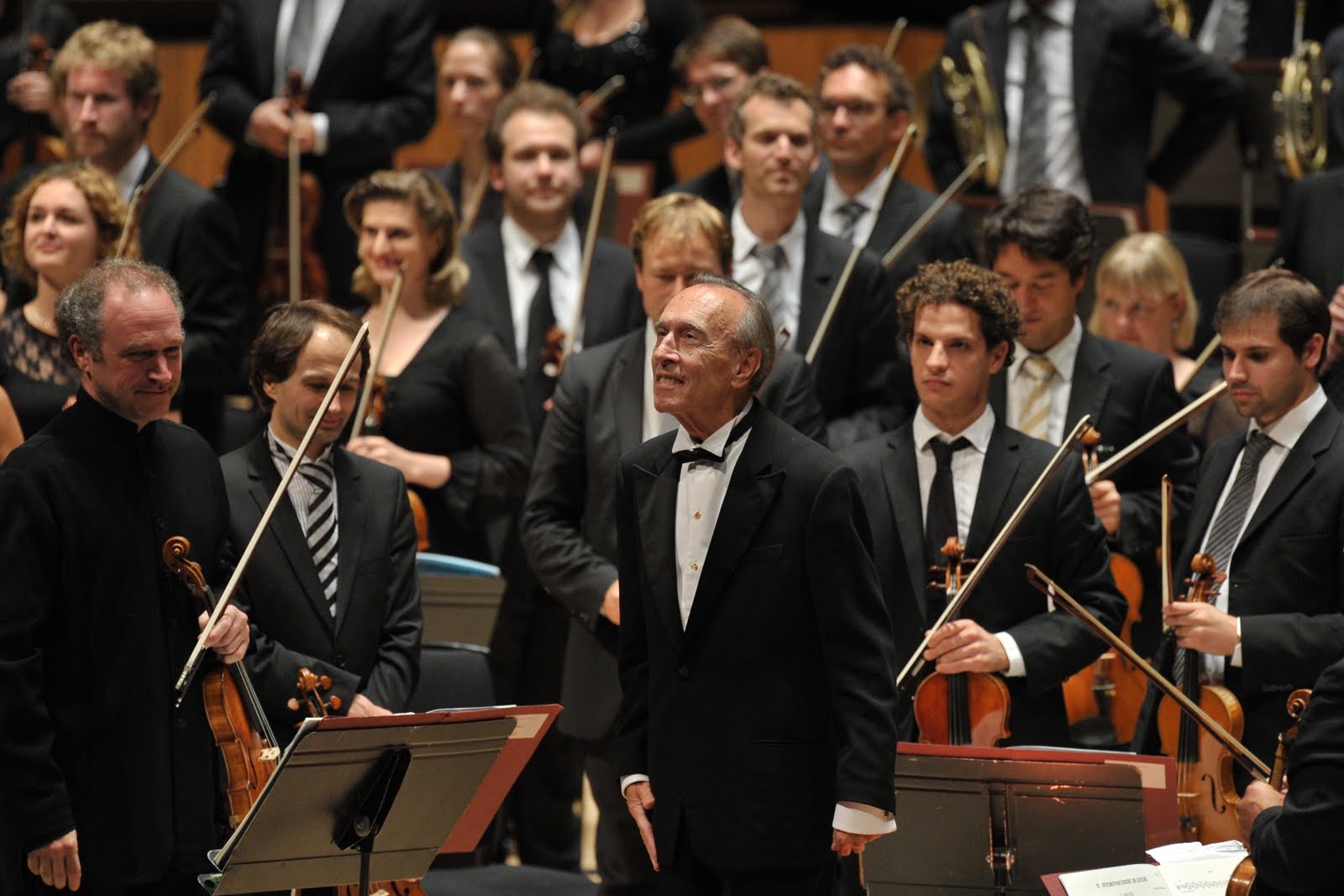
How could I forget? The greatest conductor of recent times died a year ago today, having given us a last decade with his Lucerne Festival Orchestra of the most extraordinary concerts I've ever experienced (Abbado in one of them pictured above by Peter Fischli). That his transcendentalism lives on is demonstrated to a remarkable degree in the Accentus Music film of the Lucerne memorial concert given on 6 April 2014.


I was very honoured to write the notes on the strength of a Guardian obit, and in one respect I had an advantage with the test pressing which the viewer won't enjoy: to experience the openings of the Berg Violin Concerto and the Adagio from Mahler's Third Symphony without voices over.

Yes, they've done the crazy thing of approaching those two performances with footage from other memorial tributes. I was very moved indeed to see the packed crowd in front of Milan's Teatro alla Scala for the Beethoven 'Eroica' funeral march conducted in Abbado's honour by Barenboim - sorry, there's just no comparison between those two - where the doors were thrown open to the wider public. Can you imagine a similar show of popular feeling for any musician in the UK? Ditto the Bologna lying-in-state for which musicians played around the clock.

Unfortunately the finished product brings on the music while all this is being shown, a terrible mistake in my opinion - especially when the Mahler finale, even without the string note gliding into the silence following the fourth movement's angelic conversation, needs the magic of its starting point.


What's invaluable in the DVD is to have the words of the wonderful Isabelle Faust, soloist in the Berg, and of veteran viola-player Wolfram Christ, testifying to Abbado's abiding presence in the orchestra, both as invisible guide while they play the first movement of Schubert's 'Unfinished' Symphony without a replacement and in the hearts and minds of the musicians.


The musicality of Hölderlin's verses for 'Brot und Wein' as read by Bruno Ganz is spellbinding - in the booklet note I've written about my own assumptions of the connection between the lines and Abbado's spirit - and here, too, is Andris Nelsons as one of a number of younger-generation spirits who may rise to Abbado's level. Indeed, the Mahler finale has a special intensity in its perfect pacing I've only heard twice before - from Abbado himself with the Berlin Philharmonic and from Jiří Bělohlávek with the BBC Symphony. 

Boy, did we need it the evening we settled down in front of the telly. I urged it on J because we'd just watched a remarkably horrible film, Calvary


The acting, led by Brendan Gleeson (pictured above with Kerry Reilly as the priest's daughter), is perfect, the cinematography very beautiful, but 20 minutes into the mannered script (which begins with the line spoken by a parishioner in confession to the priest 'I first tasted semen at seven years old'), I began to have the horrible sensation I'd been here before. Namely in the ugly thriller In Bruges, similarly unredeemed for me in that case by the lovely Colin Farrell. Sure enough, the director and writer of Calvary, John Michael McDonagh, is the brother of the screenplay author for In Bruges, Martin McDonagh. These siblings had a very strange upbringing, which may account for the negativity of their Weltanschaaung.

Such grotesquerie might work on stage - I've not seen The Pillowman - but it's at odds with cinematic naturalism. And when you have such visual beauty from the scenes along the Sligo coast, with - I'm assuming - Yeats's Ben Bulben in the distance, how come there's no spirituality at all in the film, not a single human mixture of good and bad in the whole community? Which was why I thought we needed a spiritual dimension to wash away the nasty taste left by Calvary. And we got it, in tearful infinity, from the memorial concert.


Meanwhile, the horrors of this temporal world are never far away. Also on 20 January 2014,  street fighting in the Kiev protests was reported to have escalated. And where are we now? Still being haunted by even more horrific scenes of destruction around Donetsk airport as Russian-armed insurgents and possibly Russian forces fight on in breach of the ceasefire which, it seems, Ukraine has tried to honour. News continues to trickle in of Russian soldiers sent on 'secret' missions to Eastern Ukraine and killed in the conflict: the mother of one 20 year old has been brave enough to speak out. So Putin will continue to lie - and Hollande says he has no reason to disbelieve him?

I've read only one eye-witness account in detail - the brilliant Ukrainian Russian novelist Andrey Kurkov's Ukraine Diaries, which run from 21 November 2013 to 24 April 2014. Much of what you need to know about the complexities of the conflict is here, in startling proximity to the unfolding events.


Here's part of just one pertinent entry, from 20 February 2014. Kurkov is telling us how the then opposition leaders and radical nationalists like Pravy Sektor jumped on the spontaneously launched bandwagon. The complete paragraph seems to me like a paradigm of most revolutions.

...recently, the only way to distinguish a radical from a peaceful protestor is to see whether or not they [sic - put it down to slack translation] have a Molotov cocktail in their hand.

The protestors have already been through all the stages: from the romantic phase, where everyone thought they could achieve their aims within a few days, to a premoniition of war, with revolutionaries covering their faces with balaclavas, wielding baseball bats and  metal riot shields stolen from the police. Now we have entered a new phase, which can be summarised in five words: 'The bridges have been burned!' And many protestors on the barricades in Hrushevkoho street have removed their masks, no longer afraid to show their faces.

Monday, 20 January 2014

Addio to the master


I can add little more to the Guardian obit now up, various blog posts and Arts Desk features - a joint tribute with Ed Seckerson being the latest - jammed with superlatives about Claudio Abbado, who has died surrounded by his family in Bologna at the age of 80. His Indian summer with the Lucerne Festival Orchestra yielded simply the best Mahler I've ever heard: I got myself out there on the strength of the Second Symphony on DVD, to be stunned first by the Seventh, later by the First; as for the Ninth, it was simply an out of body experience.

Likewise, surprisingly, Tchaikovsky's The Tempest in Rome with another super-orchestra made up of the Orchestra Mozart based in his home town of Bologna and the Accademia di Santa Cecilia. Abbado's Tchaikovsky Sixth with the Simon Bolivar then-still-Youth Orchestra in Lucerne was only part of a poleaxing programme. Bruckner Five at the Festival Hall didn't quite do it for me - blame my problems with the piece - but the preceding Schumann Piano Concerto with Mitsuko Uchida was one of THE great partnerships. Both concert photos here by the great Chris Christodoulou.


All the qualities which made these performances peerless I've ennumerated elsewhere, not least in the obit -  strange to think it was begun before the Lucerne dream took wing - but I'll just recall a few more. Live, way back, Debussy and Tchaikovsky with the LSO, more recently, Brahms with the Berlin Phil. On CD, the early Prokofiev Romeo and Juliet and Chout excerpts, Verdi's Simon Boccanegra with a dream cast, a Wagner disc with Bryn Terfel.  


Later: in the City Lit class, too swamped by Abbadiana to do justice to Tippett's King Priam, I put together a sequence, mostly operatic to suit the students:

Wagner, Prelude to Act 1 of Lohengrin  Vienna Philharmonic Orchestra (Arthaus Music DVD of the 1990 Vienna production)

Verdi, Prelude to Aida  Berlin Philharmonic Orchestra (DG CD, 1997)

Prokofiev: Dance with Mandolins from Romeo and Juliet and Final Dance from Chout  London Symphony Orchestra (Decca CD, 1966)

Berg: Lulu Suite (first three movements) Anna Prohaska, Simón Bolívar Symphony Orchestra (Accentus Music DVD of  2010 Lucerne concert with encore: 'Ach, ich fühls' from Mozart's Die Zauberflöte). To my amazement, I see the entire performance is there on YouTube. It starts with the most blistering opener ever, 'The Adoration of Veles and Ala' launching Prokofiev's Scythian Suite, and ends with a great Tchaikovsky Pathétique. I remarked at the time that Abbado brought his own sound with him, especially in the beauty of the Berg, and that was especially evident when Dudamel took over the following night, good as he was.


Then there should have been something from the Rossini Il Viaggio a Reims, but time was short.

Finally, Mahler: Symphony No. 4 - third and fourth movements  Juliane Banse, Gustav Mahler Youth Orchestra (Medici Arts DVD of 2006 Vienna Musikverein concert).


And what could have been more appropriately bittersweet than that?

Anyway, I wish Abbado had recorded more Wagner - it's criminal that we don't have his Parsifal preserved for posterity - and my one great regret is that he never tackled the two Elgar symphonies, for which his own supreme gift of the most flexible rubato in the business would seem to have been made. Back now, anyway, to listen to the Mendelssohn A Midsummer Night's Dream music which he performed with the Berlin Philharmonic last year (friend Debbie was first soprano in 'Ye spotted snakes'). I was so looking forward to hearing the same with the Orchestra Mozart in Dresden's Frauenkirche this June; sadly it's not to be, but we've had our visions. Though we'll hugely miss him, there's nothing to regret: no-one lived a fuller life, one so much longer than illness would have led anyone to expect.

Tuesday, 11 October 2011

Maestrissimo Claudio and crazy Anton


Here he is at the Festival Hall rehearsal, in one of four characteristically superb shots by Chris Christodoulou: Claudio Abbado, the greatest, with the score of one of the 19th century's weirdest symphonies, Bruckner's Fifth. Its wackiness can only seem the more pronounced in a performance of such freedom, suppleness and colour-consciousness as the one we got last night from Abbado's ever-flexible Lucerne Festival Orchestra on the Southbank: indeed, that made me wonder if there wasn't a case for going even further, totally over the top, because I nearly laughed out loud at several spots in the outer movements.

Just as well, anyway, because I can't take solemn, ponderous Bruckner interpretations. His individuality seems to me to lie in his riven quality, the way religious assurances always crumple. In the Fifth, the usually problematic (for me, again, I stress) Bruckner finale is replaced by a brilliant solution: first the clarinet's cheeky broom sweeping the old ideas away, then the tear-jerking brass chorale at the point when everything seems to have run out of steam. Abbado made no attempt to paper over the cracks, but he did pursue the chamber-musical quality that had been the chief virtue of the Schumann Piano Concerto in the first half.


As in a late Mozart concerto, Schumann's woodwind have as much of the glory as the soloist, and Mitsuko Uchida is too good a listener and collaborator not to let the fabulous Jacques Zoon and his fellow-flautist shine. The Lucerne Festival Orchestra has certainly got through first oboists - first Albrecht Mayer, then Kai Frombgen, now Lucas Marcias Navarro (wasn't there a Berlin veto thing which led to the calling upon the Concergebouw principal?) - but they're all the world's best and Marcias Navarro led the way with incredible projection last night.

If Mitsuko occasionally charged with just a hint of panic at the thicker flurries, her sensitivity and clarity of phrase-turn made it all worthwhile. And it was surely a lucky escape that Abbado had fallen out with the unmusical Helene Grimaud before the festival performances - what a substitute!


I'm coming to love most in Bruckner those twilight zones where only a handful of woodwind play. Again, Zoon had the dove's share of the best, supported only by two clarinets and bassoon at one point in the slow movement, sharing a chuckle with first violins where you really couldn't see the joins. That came in the Scherzo's trio, a Landlerish miracle as it dewily came across last night which I'd rather hear repeated than the whole damned outer portion: it's at points like this that I cry out inwardly for Mahler's constant evolution.

But Bruckner is what he is, and as Sibelius - another true original - pointed out, it may be messy, but it's always authentic. As was this interpretation (authentic, that is, never messy) from the greatest conductor-orchestra team of our time. Look at the photogenic players, who glowed and hugged each other with genuine warmth as they always do after every performance with Abbado.


Wish I could go again tonight, when Mozart's 'Haffner' Symphony replaces the Schumann, but, alas, I'm teaching - Bruckner 4, as it happens, in preparation for Belohlavek's BBC Symphony performance next week*. Less of a rush, deo gratias, than yesterday, where I biked in to meet the players of the Pacifica Quartet (more on them anon) in the Wigmore at 3, taught my Passenger class at the City Lit, whizzed back to the Wigmore to do the pre-performance talk with the Pacificas, then pedalled off to the Southbank. Only Abbado could have made me miss the first instalment of the PQ's Shostakovich cycle, but I'll catch the second on Thursday.

*later - ouch: my students reminded me it's tomorrow (Wednesday 12). Just as well they did as I'm supposed to be giving the pre-performance talk...Fortunately there's just enough time to prepare.

Saturday, 26 February 2011

A week in Mahler


Barely a month goes by at the BBC Music Magazine* without a new Mahler recording or two to review, and the releases have been accumulating in the second of the two anniversary years. Do I ever get sick of the limited diet? Hand on heart, no, since these symphonies remain the supreme challenge of the orchestral repertoire - unless the performance happens to be lifeless from the start, which means there's an awful lot of unsatisfying listening ahead.

In terms of live performances, it's as well to ration, which means choosing wisely. I knew, for instance, that Belohlavek's Sixth would be the one to hear this year, since his long-term BBC Symphony Orchestra cycle has been so uniformly excellent, considered and - unusual for the unassuming Czech - exciting in spurts. This week there have been three concert events I'd have been stupid to miss, even at the cost of having to interweave them with three recordings in what might have been Mahlerian overkill.


After Nezet-Seguin's orchestrally inspiring Das Lied von der Erde last Saturday, the Rattle Berlin cavalcade began, or rather the full-orchestral part of it did, with rather more out-of-this-world Mahler - and Stravinsky - than I'd anticipated. So I was in a state of unnatural excitement about Wednesday's performance of the Third (photo of the morning rehearsal by Alexander Newton - at last I realised why I knew the name of Amihai Grosz, pictured right; he's the very lovely viola player from the Jerusalem Quartet, which he left for the Berlin Phil last autumn, and one of the world's best).

Alas, so perfect was Rattle's latest Mahler Third in detail, so attentive did he prove in getting the best from every orchestral soloist, contralto (the astounding Nathalie Stutzmann) and choirs, and then came that finale. I'd hoped for so much but it just didn't begin to compare with the arching, mobile adagios I'd heard when Belohlavek started his cycle, when Salonen took me by surprise with how far he'd come in an incandescent Philharmonia performance, and of course when the Lucerners included it in their cycle with Abbado.

Even that BPO/Rattle Fourth began to seem just one notch below the flexible best that can be achieved when on the Wednesday I finally caught up with Abbado's Lucerne performance on DVD.


The snag there is a seemingly demented and undersupported Kozena, but I feel I've moaned enough about her here and I get more unfriendly feelings off my chest in the BBCMM review, which will be in the April issue (as I wrote, you can always switch to the bewitching Juliane Banse on Abbado's other DVD Fourth with the superb Gustav Mahler Youth Orchestra, and just ignore the Ruckert Lieder here, which I endured so you don't have to). Curate's egg Jukka-Pekka Saraste completed the roster of the half-dozen performances I experienced this week, with a spacious, lushly phrased and well paced Oslo Sixth undercut by a far less convincing Ninth (guess Saraste has yet to get the measure of his Cologne orchestra). Again, these are BBCMM subjects, so the chapter and verse will eventually follow.


Anyway, at the last minute I decided I still hadn't had enough so we'll be going, after all, to Pappano's espousal of Das Lied in the Schoenberg chamber version at the Cadogan Hall tomorrow, with the little interlude of an American tragicomedy at Covent Garden tonight.

It's a risk above all because I've never liked to hear the mezzo replaced by a baritone - Mahler's second-best option - but, remembering the depths Thomas Hampson achieved with Pappano in the 'Strange Meeting' denouement of the Britten War Requiem (alas, his companion, Bostridge, did not), I reckon it might just work.

*have you voted for their 2011 awards yet? Please do so here, on condition that you take notice when I whisper 'Melnikov', 'Petrenko' and 'Rusalka' in your ear.

Tuesday, 24 August 2010

Abbado: the zenith (2)


Such calibrated yet still white-heat perfection defies us supposed wordsmiths, as I gathered from an awestruck review of the Lucerne Mahler Ninth in the Neue Zurcher Zeitung. Having now seen the livestream and one live performance, I'd better get my own thoughts together. The eight pages in my holiday notebook - taken during the livestream, I'd never do it in the hall - run wild with exclamations and quite a few illegible signs, but it might be worth jotting down a few slightly more finished notes here in a way that proper published reviewing doesn't allow.

Photographs of Abbado were taken during the two performances, reproduced by permission of the Lucerne Festival. Top image is by Priska Ketterer, the second by Peter Fischli and the third by Georg Anderhub (that's the wonderful Kolja Blacher leading the Lucerne Festival Orchestra).


First movement: total silence before it. Abbado comes on, blinks, smiles as he always does so collegially to his handpicked players, and begins. The veiled sound of second violins comes from their placing left behind the firsts, not apparent in filming (the crucial violas led by the superlative Wolfram Christ are to Abbado's right). Every time the 'ewig'-without-the-tonic nocturne returns, the heart leaps: it's to do with what are often the subtlest of Luftpausen. Violas plunging more clearly than I've ever heard before the first big climax, though it's not overdone. The struggles quicken, as they did in Abbado's volatile Berlin interpretation; the collapses aren't overstressed and the balances remain clear, the clamber out of the abyss goes ghostly with the celebrated Abbado pianissimo (the great Natalia Gutman still there among the painfully climbing cellos). Woodwind, Jacques Zoon's flute especially, lead us into chamber music - compassionate, transparent. The first string shock is the 'Leidenschaftlich' writhing (at 211), dark intense sound like I've never heard before, and sustained with a line going through it, even somehow building. The last descent inevitable even after the leaping collapse: the funeral march not overdone, evolving naturally back into the last proud processional with fraught brass clashes (overall the LFO ensemble is integrated beautifully, the brass sound never forced). Warm horn solo from Bruno Schneider, mit innigster Empfindung; final pizzicato-flageolet and piccolo note - the tonic at last - overheard rather than heard. Abbado still keeps something in reserve: I've heard performances of the movement so entire in themselves and so exhausting that I didn't have much energy left for the rest, and in those I felt the final Adagio couldn't, and didn't, live up to the opening Andante. Not so here.

Scherzo: playful-heavy at first rather than dark or sarcastic: Abbado moves in and out of sinister colours with undetectable sleight of hand. I still don't know how he resolved it from the scary penultimate chunterings and stabbings to a witty resolution. Again, seeing the second violins biting into their dance-stomp just after the start highlights the links with the first movement. And the Tempo III Landler treads air. Sabine Meyer leads dark cohorts of clarinets in a uniquely hollow low sound.


Rondo-Burleske: determined, disciplined, not wild until the final speedings. All the counterpoint is deadly clear and ruthlessly well executed. Reinhold Friedrich's trumpet comes truly as a voice from another planet - no slowing from Abbado, rightly, it's all in a tone like none I've ever heard before.

Adagio: yes, here words should fail. It either works totally for me, and I can't remember it doing that since Bernstein, or not really at all until the final whispers. This was the total experience: string playing I've waited all my life, I think, to hear in a concert hall - somehow contained, not passionately emotive at first though rising by degrees to that, weighted by cellos and basses in a way that you can't define to anyone who wasn't in that amazing Lucerne hall. The richer the harmonies and the counterpoints become, the more stops Abbado pulls out. And the line, the line through... In between, sensitive bassoon solos and a cor anglais to break the heart. Everything moves to the final climax, a glimpse of some almighty in the trumpet blaze before the cry of violins: again, never heard it like this before and never will again. Transcendental close, stretched to infinity, going in deeper like the best meditation. Of course I wasn't aware of the length of silence in performance, but I timed it at the end of the livestream: two minutes.

If you don't get all of the above, or think I've waffled unduly, it doesn't bother me. I've had my vision and I'll say it again - I'm happy to have lived in such times to hear such playing. But don't forget that if you can access Arte, it's broadcasting the concert on 19 September.

Friday, 20 August 2010

Abbado: the zenith


Ever since I first clapped eyes and ears on Claudio Abbado's inaugural concerts with the Lucerne Festival Orchestra in 2003, I knew that orchestral music-making never gets better than this. In their annual three weeks of working together, they've given us astounding Mahler, of which I've been uniquely privileged to hear the First and Seventh Symphonies live. All can be seen on expertly directed DVDs, with the exception of the Fourth - surely overdue for release.

Tonight marks what has to be an Alpine peak for both: the Ninth Symphony, written under a sentence of death similar to the one which afflicted great Claudio some years ago, and from which he miraculously emerged, frail in physical terms but stronger than ever interpretatively, capping even his years at the helm of the Berlin Philharmonic with fresh wonders at Lucerne.

Let me simply draw your attention to the Festival's livestreaming in collaboration with Arte tonight (18.30 UK time). I'll go even hyperbolically further and add that if you only see one concert in your life, this has to be the one. And if you miss the live event, don't worry - it should be out on DVD in less than a year. Tschuss.