Showing posts with label Andris Nelsons. Show all posts

Wednesday, 14 March 2018

To the Mendelssohn House


On my first visit to Leipzig back in December - I can't believe it took so long before I saw the city - Bach had to be the priority. And he was a kind of starting-point this time, because the Nikolaikirche was his second home after the Thomaskirche, and I found myself on the fifth floor of a hotel with perhaps the best view I've had in any city; namely of the church, which filled the entire window.


I could see it at sunset


and at sunrise


and besides, the street has a row of wonderful second hand bookshops which I spent some time in on my last visit. The square was now devoid of its Christmas market stalls but there was the solitary palm column mirroring the ones within the Nikolaikirche, its shadow serving as a kind of sundial on the building where Wagner went to school (there's a Wagner Museum in the basement, nicely laid out, but it had no treasures and didn't teach me anything; I whizzed around it rather quickly).


Leipzig would have to be the mecca for musicians in terms of its astounding heritage - Bach, Schumann, Mendelssohn, young Wagner - and it treasures its orchestra. I was here for the inauguration of already-great Andris Nelsons as the 21st Gewandhauskapellmeister, about which I've written on The Arts Desk. Needless to say, the whole city viewed this with pride in a way that would be unimaginable here - can you imagine Simon Rattle plastered over Kings Cross to celebrate his return to the UK as principal conductor of the London Symphony Orchestra?


Note, too, it's 'Andris', like 'Mirga'. A PR friend of mine found this cheesy, but I disagree - it suggests all the breaking down of boundaries since the Call-Me-Maestro era, and Andris is the most genial and natural of conductors.

I had the day of the concert free to cover everything I hadn't seen on that first visit, and I managed a great deal of it. Namely morning in the superbly designed MdBK (Museum der Bildenden Kunste, in other words the main art gallery), for which another blog entry will be necessary, a pausa in the Stadtcafe Riquet


where I couldn't resist a photo of the table with the best Mohntorte (poppyseed cake) I've had next to the Cafe Frauenhuber in Vienna


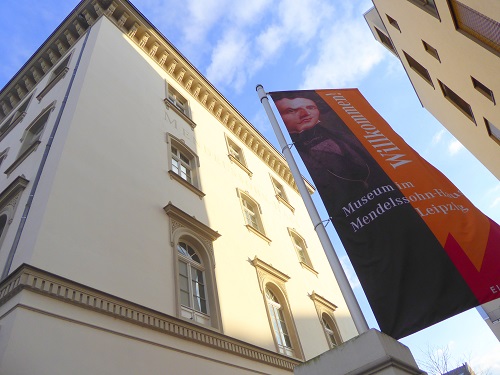
and then an afternoon walk following part of the Leipzig Music Trail, helpfully studded with symbols on every pavement. It led me, about five minutes past the Gewandhaus on the other side of the ring road, to Königstraße 3, a large house built in 1843-4 as part of a new residential district.


In August 1845, the 34-year-old Mendelssohn, who over the previous decade had transformed the Leipzig Gewandhausorchter into a thing of wonder,  moved into the very substantial apartment on the first floor with his wife Cecile and four children. The building and garden were in a fairly ruinous state before the International Mendelssohn-Stiftung took it over and planned a hugely impressive restoration in the 1990s.  I love it that certain parts of the building, namely the old staircase, need careful treading


and the modernisation of the rest, starting with a reception desk and coffee shop manned by really friendly young women, is a treat. The nine main rooms on the first floor have been reconstructed with meticulous taste. It helps that Felix Moscheles left several watercolours of the rooms just after Mendelssohn's death, on Cecile's invitation, including - most important of all - the study where he composed Elijah.


What we have now isn't identical, but the bright yellow combines with the sunshine that flooded the apartment on the freezing cold and ice-windy but brilliant afternoon I visited.

 
It's important to see Mendelssohn's idols in the busts of Goethe and Bach, for whom he did so much during his time in their shared city of music.

 
Much else is in the Biedermeier style. The room opposite has most of the original furniture, including a cabinet containing bronze statuettes of Voltaire (which you can see on the right) and Rousseau

 
and though you can't see it from the way the rooms are arranged and cordoned, a small-scale colour reproduction of Titian's Assumption in Venice's Frari hangs above the recamiere here.


The Music Room which hosts regular events has been lovingly restored in careful application of paintwork, reconstructed stove and chandelier and careful work on the 1830 trumeau.


Objects on permanent loan from the Museum of the History of the City of Leipzig are sensitively presented, many of them in pull-out drawers below some prize exhibits. This is the 16 year old Mendelssohn's translation of Terence's Andria as 'The Maiden of Andros', with which he surprised his teacher Heyse. The work of 'F****' was published by Heyse with an introduction in 1826.


Multitalented Felix was also an accomplished watercolourist, and having seen many of his views of Switzerland in a book of Swiss landscapes given to me by my Zurich-based friend Lottie, I was delighted to see even more of the originals given a room to themselves here. Rather fond of this unfinished view of a tree-lined promenade in Interlaken. Mendelssohn had little confidence in his ability to draw figures, which is why the lady remains sketchy.


A nice creative touch is the use of the kitchen to display Mendelssohn's travels in a series of commemorative plates


with an introduction which made me especially happy:


Upstairs are the Archive devoted to that great man and Gewandhaus presiding genius for many years Kurt Masur


and, more important still, a series of rooms devoted to Felix's fabulously gifted sister Fanny, named throughout as Fanny Mendelssohn-Hensel. Her artist husband gracefully adorned many of her manuscripts,


and I sat in one of the rooms listening to a recording by Lauma Skride (sister of Baibe, who was playing in the Berg Violin Concerto later) of three movements from her piano series Die Jahr, a predecessor of Tchaikovsky's The Seasons (which of course should be The Months). No small talent, this. It is saddening to read in the exhibition of how her brother prohibited her from publishing her music. The same old story of male dominance which pertained to Alma Mahler, whose husband made it clear there weren't room for two composers in one household. That document is highlighted, but there is also plenty of memorabilia here too, not least from time spent in Rome.


The garden has a recent bust of Mendelssohn


and a chastening exhibition in the outbuilding of Mendelssohn and the Nazis. I was saddened to see a picture of Strauss conducting under a giant swastika as late as 1938 - I have been too much the apologist for the extent of his compliance with a regime he hated - and there's also the shocking story of Beecham and the LPO visiting Leipzig in 1936, laying a wreath at the foot of the statue on 9 November, only to return the next day to find it gone. To his credit, the Mayor resigned in protest at this disgrace. A reproduction of the statue was placed in 2008 at the back of the Thomaskirche (this from my first visit last December)


and Mendelssohn has left us a watercolour of the church for which Bach composed so many of his cantata masterpieces.


The Music Trail, meanwhile, leads one on to the Grieg Memorial Centre in the next block. Grieg was the guest of publishers Abraham and Hinrichsen during his Leipzig stays. 


With opening hours limited to Friday afternoons and Saturdays, there was no chance of visiting, so I contented myself with the sight of the plaque and a bust in the neighbouring garden. 


The building which housed the former Peters Music Library is nearby, too, and then you come to the splendid Museum complex including the Museum of Musical Instruments and the graveyard at the back where Bach was originally buried (members of the Mendelssohn family, too), but that was locked and I had no time on this visit to see the oldest fortepiano, so on I pressed to the apartment in which Robert Schumann and Clara Wieck spent the first year of their marriage, on the first floor of Inselstraße 18.


This is a far less lavishly maintained museum than the Mendelssohn-Haus; perhaps more has gone into the Schumannhaus in Bonn. But it had an old-fashioned charm, one of domineering father Wieck's pianos


and a rather less period-conscious assemblage of copies of reproductions favoured by Schumann


as well as an equally well-maintained staircase.


Time for the evening's concert was drawing closer, so I headed back via the Wagner memorial behind the Opera House, surrounded by snowdrops


and the frozen pond below it.


There will be plenty more of that ice in my next photojournal - I've recently returned from Bodø, well above the Arctic Circle in Norway, and that really was a winter wonderland.

Monday, 14 September 2015

Summer epics


Homer would have nodded not in weariness but approval of his Iliad - if indeed there really is a 'he' and 'his' rather a 'they' and 'theirs' - being read aloud, as it originally was, without a break for 16 hours by over 60 actors at the British Museum and later at the Almeida Theatre. Thanks to the wonders of livestream I saw and heard them all, writing up the experience bleary-eyed the next morning on The Arts Desk; hard to choose a best but certainly none was better than Rory Kinnear, pictured above by Helen Maybanks, and - a revelation to me, since I hadn't seen his Hamlet - Tobias Menzies, in a YouTube clip here reading the crucial Book XXII lines 25-404. Yes, he stumbles a bit at the beginning and gets a name wrong, but please have sympathy with the singular situation and stay with him.


The Almeida's website had promised to put up clips in the weeks following this triumph for Rupert Goold, but none has yet materialised, at least that I can find. Thanks to a Menzies fan for the above.

Pursuing the same line, Henry Wood would have been astonished to see how the BBC Proms now fires on every cylinder - populist and deep, on radio, TV and internet - in 76 Albert Hall Proms and eight chamber music events at the Cadogan Hall (the only statistic that's bad is the number of women conductors, still only three, of whom Susanna Mälkki, pictured up top and wonderful in Holst's The Planets, seems to me incomparably the best). I went to 18, participated in a pre-performance talk for one my self-imposed Gergiev veto wouldn't allow me to attend and heard all or parts of nine, including that Prokofiev Concertos evening, on Radio 3.

There weren't many disappointments (can I cite them quickly? The miking and much of the material in the semi-staged Fiddler on the Roof, the waste of time that is Shostakovich's Orango and Marin Alsop's dreadful "interpretation" of Brahms's First Symphony with the Orchestra of the Age of Enlightenment). On the plus side, the mixed bag of Sibelius symphonies - and I persist in admiring the pell-mell nature of Thomas Dausgaard's interpretation of the First - was followed by Kullervo as I've never heard it before from Sakari Oramo and his BBC Symphony Orchestra plus superb Finnnish voices; I've already written about this here. Suffice it to say that when I met the players over breakfast in Lahti five days later, each one I spoke to is head over heels in love with the partnership. Here's Sakari conducting Prom 1, among the splendid selection that the great Chris Christodoulou sent over for The Arts Desk to choose from in its annual gallery of the conducting unexpected.


The Nielsen component did not disappoint. While Hymnus Amoris is youthful stuff with limited supplies of the indelible Nielsen personality, Springtime in Funen is stuff about youth written by a master. Henning Kraggerud did a wonderful job on the free-flowing Nielsen Violin Concerto, but the soloist highlight - for one who missed all the late-night Bach, despite best intentions - came in a concert remarkable less for its Nielsen than for the Nikolaj Znaider partnership with Fabio Luisi and the Danish National Symphony Orchestra in a Brahms Violin Concerto which came up fresher than I've heard it before.


The day after I'd heard Andris Nelson's stunning new Shostakovich 10 on CD with the Boston Symphony Orchestra, I encountered the team live in the best Mahler 6 I've heard in concert (Nelsons above palpably feeling it all, from the last concert of his CBSO tenure which I wish I could have got to). The Vienna Phil under Bychkov redeemed a torpid Brahms Third Symphony with a revelatory Franz Schmidt Second (an utterly original masterpiece, or so it seemed on Thursday night). The St Petersburg Philharmonic/Temirkanov partnership had lost none of its magic even in the most seemingly conventional of Russian programmes, with the great Nikolay Lugansky matching them for you-never-heard-it-like-this-before in, of all things, the Rachmaninov Second Concerto. There must be honourable mentions in this context for Jeremy Denk's string-breaking Bartok Sonata, Elisabeth Leonskaja's Britten cadenzas in her Mozart concerto and Jean-Efflam Bavouzet's scintillating, playful-deep Ravel G major.


I loved the Etude-Tableau encore too - Lugansky has to come and play them all in sequence, as he did the second set of Preludes.

Too many highlights already; on with the new season, where the heart currently seems to be at the Sam Wanamaker Playhouse. Can't wait for Bjarte Eike's two concerts with his Barokksolistene on Sunday and Monday.

One final epic footnote: we covered our 16 Norfolk churches in 17 miles on Saturday. The torrents that threatened on one forecast until 4pm actually eased up by 11am and from lunchtime to the end we walked in fine sunshine. The usual chronicle will appear when I've got all the photos sorted.

Tuesday, 20 January 2015

Remembering Claudio Abbado


How could I forget? The greatest conductor of recent times died a year ago today, having given us a last decade with his Lucerne Festival Orchestra of the most extraordinary concerts I've ever experienced (Abbado in one of them pictured above by Peter Fischli). That his transcendentalism lives on is demonstrated to a remarkable degree in the Accentus Music film of the Lucerne memorial concert given on 6 April 2014.


I was very honoured to write the notes on the strength of a Guardian obit, and in one respect I had an advantage with the test pressing which the viewer won't enjoy: to experience the openings of the Berg Violin Concerto and the Adagio from Mahler's Third Symphony without voices over.

Yes, they've done the crazy thing of approaching those two performances with footage from other memorial tributes. I was very moved indeed to see the packed crowd in front of Milan's Teatro alla Scala for the Beethoven 'Eroica' funeral march conducted in Abbado's honour by Barenboim - sorry, there's just no comparison between those two - where the doors were thrown open to the wider public. Can you imagine a similar show of popular feeling for any musician in the UK? Ditto the Bologna lying-in-state for which musicians played around the clock.

Unfortunately the finished product brings on the music while all this is being shown, a terrible mistake in my opinion - especially when the Mahler finale, even without the string note gliding into the silence following the fourth movement's angelic conversation, needs the magic of its starting point.


What's invaluable in the DVD is to have the words of the wonderful Isabelle Faust, soloist in the Berg, and of veteran viola-player Wolfram Christ, testifying to Abbado's abiding presence in the orchestra, both as invisible guide while they play the first movement of Schubert's 'Unfinished' Symphony without a replacement and in the hearts and minds of the musicians.


The musicality of Hölderlin's verses for 'Brot und Wein' as read by Bruno Ganz is spellbinding - in the booklet note I've written about my own assumptions of the connection between the lines and Abbado's spirit - and here, too, is Andris Nelsons as one of a number of younger-generation spirits who may rise to Abbado's level. Indeed, the Mahler finale has a special intensity in its perfect pacing I've only heard twice before - from Abbado himself with the Berlin Philharmonic and from Jiří Bělohlávek with the BBC Symphony. 

Boy, did we need it the evening we settled down in front of the telly. I urged it on J because we'd just watched a remarkably horrible film, Calvary


The acting, led by Brendan Gleeson (pictured above with Kerry Reilly as the priest's daughter), is perfect, the cinematography very beautiful, but 20 minutes into the mannered script (which begins with the line spoken by a parishioner in confession to the priest 'I first tasted semen at seven years old'), I began to have the horrible sensation I'd been here before. Namely in the ugly thriller In Bruges, similarly unredeemed for me in that case by the lovely Colin Farrell. Sure enough, the director and writer of Calvary, John Michael McDonagh, is the brother of the screenplay author for In Bruges, Martin McDonagh. These siblings had a very strange upbringing, which may account for the negativity of their Weltanschaaung.

Such grotesquerie might work on stage - I've not seen The Pillowman - but it's at odds with cinematic naturalism. And when you have such visual beauty from the scenes along the Sligo coast, with - I'm assuming - Yeats's Ben Bulben in the distance, how come there's no spirituality at all in the film, not a single human mixture of good and bad in the whole community? Which was why I thought we needed a spiritual dimension to wash away the nasty taste left by Calvary. And we got it, in tearful infinity, from the memorial concert.


Meanwhile, the horrors of this temporal world are never far away. Also on 20 January 2014,  street fighting in the Kiev protests was reported to have escalated. And where are we now? Still being haunted by even more horrific scenes of destruction around Donetsk airport as Russian-armed insurgents and possibly Russian forces fight on in breach of the ceasefire which, it seems, Ukraine has tried to honour. News continues to trickle in of Russian soldiers sent on 'secret' missions to Eastern Ukraine and killed in the conflict: the mother of one 20 year old has been brave enough to speak out. So Putin will continue to lie - and Hollande says he has no reason to disbelieve him?

I've read only one eye-witness account in detail - the brilliant Ukrainian Russian novelist Andrey Kurkov's Ukraine Diaries, which run from 21 November 2013 to 24 April 2014. Much of what you need to know about the complexities of the conflict is here, in startling proximity to the unfolding events.


Here's part of just one pertinent entry, from 20 February 2014. Kurkov is telling us how the then opposition leaders and radical nationalists like Pravy Sektor jumped on the spontaneously launched bandwagon. The complete paragraph seems to me like a paradigm of most revolutions.

...recently, the only way to distinguish a radical from a peaceful protestor is to see whether or not they [sic - put it down to slack translation] have a Molotov cocktail in their hand.

The protestors have already been through all the stages: from the romantic phase, where everyone thought they could achieve their aims within a few days, to a premoniition of war, with revolutionaries covering their faces with balaclavas, wielding baseball bats and  metal riot shields stolen from the police. Now we have entered a new phase, which can be summarised in five words: 'The bridges have been burned!' And many protestors on the barricades in Hrushevkoho street have removed their masks, no longer afraid to show their faces.

Wednesday, 24 December 2014

Festive Oslo


Not surprisingly given that Norway furnishes Trafalgar Square's Christmas tree every year,  its capital has a fair share of illuminated firs - no less than seven that I saw outside and within the National Theatre (pictured above, National Opera below the first photo) when I began my Peer Gynt foray for The Arts Desk with a lunchtime performance of Ibsen's flexible epic as adapted by brilliant director Alexander Mørk-Eidem.

I think I've assembled all the details necessary for the big piece, but frustratingly I can't find anything much online about the building or its marvellous collection of portraits beyond the fact that it was the work of Henrik Bull and opened in 1899 with a festive programme which included Ibsen's An Enemy of the People on the first two nights, Bjørnstjerne Bjørnson's Sigurd Jorsalfar on the third. If we know the latter at all, it's through Grieg's heart-of-oak Homage March. So it's odd to see the statues of the two men flanking the building in equal stature. Ibsen's the one we recognise, of course.


The handsome lobby has the fifth tree.


Should have gone round the foyer spaces and staircases during the interval with my notebook, left inside the auditorium. The statue here is of early-ish Ibsen heroine Hjørdis.


Of the actresses featured, I can only tell you that this is Liv Ullmann - I failed to note the artist -


and though I identified a few playwrights and actors, I picture knowingly only a fine portrait of the Master, on loan from the National Gallery I loved so much on my first visit earlier in the year.


Otherwise, all I can do you are people and portraits, the former a very mixed bunch as the matinee was full of school groups, lively and vocal around the performance, extremely attentive during it - as how could they not be, given such a stunning and lively show.


Curiously none of the production pics shows the controversial painting which forms the backdrop for this Peer Gynt's devastating coup, corresponding to the storm for Peer's homecoming in the original. Norwegian-based Vanessa Baird's To Everything There is a Season caused a storm in the wake of the Breivik attacks in the city and on Utøya island, despite the fact that the toppling buildings and falling paper had been painted before it. Debate continues as to whether it should continue to hang in a public space, so all credit to Mørk-Eidem for making it part of his commentary on the point at which Norway could never be the same again. There's a reproduction of part of the original canvas over on the Arts Desk.


 Who knows what Ibsen would have thought of that? I hope he would have welcomed only one of many approaches to his endlessly fascinating myth. This time I got, as originally intended, to the House-Museum, which I've also written about in the Arts Desk piece. Two peripheral pleasures I didn't mention, or expand upon, were the tiles in the gents' loo, including Ibsen's specimens of handwriting,


and another tree or shrub of sorts for the natural ecosystem in Old Ekdahl's loft in The Wild Duck as realised by artist Lucie Noel Thune, who's been a friendly correspondent since my visit.


Only when close up do you realise it's constructed of hundreds of duck eggs. A nice complement to the real wild duck wandering the black glass box of my year's theatrical highlight, Belvoir Sydney's production - another wonderful adaptation - of that great and ambiguous play.


Jüri Reinvere's opera, the premiere of which I saw at the National Opera the following night, makes more explicit reference to the Breivik attacks at the same point as Mørk-Eidem does in his production of the play. Here Peer imagines he takes the Troll King's 'be yourself - and to hell to the rest of the world' to its natural, Breivikian extreme of indiscriminate shooting. The music there is at its most powerful, so I bought it as most of Oslo, apparently less interested in the score than in the situation, has not. I had reservations about some of the work, but I respect Jüri's right to treat it from his own unique perspective. I've met him twice - once through Berlin critic Jan Brachmann, when he came to the local cafe, and a second time after I'd seen the play - informally, not for an interview, though it was helpful to have his perspective in mind.


Then it was off to a splendid theatrical happening rivalling the play Peer Gynt, all thanks to this intriguing screen I saw as I was passing the Norwegian Theatre.


The result was even more amazing than I'd expected, a Hamlet like no other inhabiting a unique world - more about it over on the Arts Desk piece.

There remained only the event for which I'd been invited back to Oslo in the first place. Audience members were invited to a post-show party in the foyer on the first night of the operatic Peer Gynt only to find they had to listen to the speeches without a drink in hand unless anyone had bought one: that's a first for me. Anyway, there was always the tree in the splendid foyer - which I wrote about in my first Arts Desk piece on Oslo - to feast on.


The Thursday of my arrival (at midnight) was one of those crazy excursions I occasionally indulge in. That meant catching a morning train to Birmingham for a lunchtime pre-performance talk for the City of Birmingham Symphony Orchestra before Andris Nelson's afternoon concert of Schumann's Piano Concerto with Stephen Hough and Bruckner's Seventh Symphony, the main thrust of my talk (though I started with Schumann's Rhenish opening as the example of a more usual sort of symphonic start). In a tight schedule, the rehearsal had only just finished when I came on to the concert platform for a brief sound check - and there was Andris discussing a point with CBSO leader Laurence Jackson.


He and Stephen were as friendly as I'd expected from the few words we exchanged. Also had a good chat with my main inviter and now, I hope, friend Richard Bratby who organises the talks; I'll be sorry to see him go early next year but the good thing is that he may be freed up to review CBSO concerts, inter alia, for The Arts Desk. Sadly I couldn't even stay for the first half of the concert as I'd left my passport at home, which in the end meant only a brief excursion before going on to Gatwick for the Oslo flight.. I'd like to have spent longer in Birmingham not only for that but also because the Christmas Fairl there seemed so jolly.


All I had time for was a ridiculously large plate of fried onion flower which caught surprised comments as I stood dipping it in garlic mayonnaise.


Then off to the train, and on to two and a half days in Oslo which were as gloomy as the weather in Birmingham, and of course much colder, with no more than a dusting of the snow which had made the first visit such fun. I can at least say I've seen the sun in that city, if only on rising at 9.30am - as I know from Iceland in January, it's the mornings which remain dark for so long - in my hotel room on the 32nd floor, looking east to the hills


and south to the Opera House and the harbour.


Anyway, we're sitting tight for once over Christmas itself, maybe off for a bit in the New Year. Happy holidays to all, with a final tree, or rather shrub, greeting: for the first time ever, camellia Debbie in the back yard has flowered unseasonably early, allowing me to display it alongside a couple of our Indian hand-painted Santas. An e-card on the same theme will be reaching those whose addresses I've not been able to track down.