On my first visit to Leipzig back in December - I can't believe it took so long before I saw the city - Bach had to be the priority. And he was a kind of starting-point this time, because the Nikolaikirche was his second home after the Thomaskirche, and I found myself on the fifth floor of a hotel with perhaps the best view I've had in any city; namely of the church, which filled the entire window.

I could see it at sunset

and at sunrise

and besides, the street has a row of wonderful second hand bookshops which I spent some time in on my last visit. The square was now devoid of its Christmas market stalls but there was the solitary palm column mirroring the ones within the Nikolaikirche, its shadow serving as a kind of sundial on the building where Wagner went to school (there's a Wagner Museum in the basement, nicely laid out, but it had no treasures and didn't teach me anything; I whizzed around it rather quickly).

Leipzig would have to be the mecca for musicians in terms of its astounding heritage - Bach, Schumann, Mendelssohn, young Wagner - and it treasures its orchestra. I was here for the inauguration of already-great Andris Nelsons as the 21st Gewandhauskapellmeister, about which I've written on The Arts Desk. Needless to say, the whole city viewed this with pride in a way that would be unimaginable here - can you imagine Simon Rattle plastered over Kings Cross to celebrate his return to the UK as principal conductor of the London Symphony Orchestra?

Note, too, it's 'Andris', like 'Mirga'. A PR friend of mine found this cheesy, but I disagree - it suggests all the breaking down of boundaries since the Call-Me-Maestro era, and Andris is the most genial and natural of conductors.
I had the day of the concert free to cover everything I hadn't seen on that first visit, and I managed a great deal of it. Namely morning in the superbly designed MdBK (Museum der Bildenden Kunste, in other words the main art gallery), for which another blog entry will be necessary, a pausa in the Stadtcafe Riquet

where I couldn't resist a photo of the table with the best Mohntorte (poppyseed cake) I've had next to the Cafe Frauenhuber in Vienna

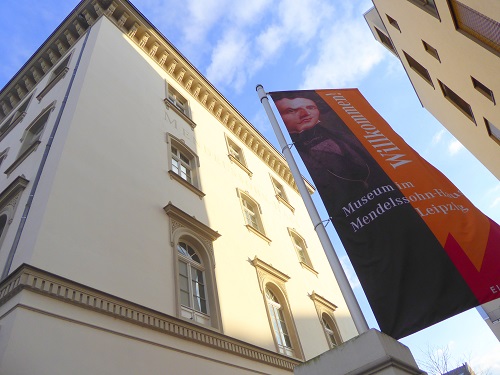
and then an afternoon walk following part of the Leipzig Music Trail, helpfully studded with symbols on every pavement. It led me, about five minutes past the Gewandhaus on the other side of the ring road, to Königstraße 3, a large house built in 1843-4 as part of a new residential district.

In August 1845, the 34-year-old Mendelssohn, who over the previous decade had transformed the Leipzig Gewandhausorchter into a thing of wonder, moved into the very substantial apartment on the first floor with his wife Cecile and four children. The building and garden were in a fairly ruinous state before the International Mendelssohn-Stiftung took it over and planned a hugely impressive restoration in the 1990s. I love it that certain parts of the building, namely the old staircase, need careful treading

and the modernisation of the rest, starting with a reception desk and coffee shop manned by really friendly young women, is a treat. The nine main rooms on the first floor have been reconstructed with meticulous taste. It helps that Felix Moscheles left several watercolours of the rooms just after Mendelssohn's death, on Cecile's invitation, including - most important of all - the study where he composed Elijah.

What we have now isn't identical, but the bright yellow combines with the sunshine that flooded the apartment on the freezing cold and ice-windy but brilliant afternoon I visited.

It's important to see Mendelssohn's idols in the busts of Goethe and Bach, for whom he did so much during his time in their shared city of music.

Much else is in the Biedermeier style. The room opposite has most of the original furniture, including a cabinet containing bronze statuettes of Voltaire (which you can see on the right) and Rousseau

and though you can't see it from the way the rooms are arranged and cordoned, a small-scale colour reproduction of Titian's Assumption in Venice's Frari hangs above the recamiere here.

The Music Room which hosts regular events has been lovingly restored in careful application of paintwork, reconstructed stove and chandelier and careful work on the 1830 trumeau.

Objects on permanent loan from the Museum of the History of the City of Leipzig are sensitively presented, many of them in pull-out drawers below some prize exhibits. This is the 16 year old Mendelssohn's translation of Terence's Andria as 'The Maiden of Andros', with which he surprised his teacher Heyse. The work of 'F****' was published by Heyse with an introduction in 1826.

Multitalented Felix was also an accomplished watercolourist, and having seen many of his views of Switzerland in a book of Swiss landscapes given to me by my Zurich-based friend Lottie, I was delighted to see even more of the originals given a room to themselves here. Rather fond of this unfinished view of a tree-lined promenade in Interlaken. Mendelssohn had little confidence in his ability to draw figures, which is why the lady remains sketchy.

A nice creative touch is the use of the kitchen to display Mendelssohn's travels in a series of commemorative plates

with an introduction which made me especially happy:

Upstairs are the Archive devoted to that great man and Gewandhaus presiding genius for many years Kurt Masur

and, more important still, a series of rooms devoted to Felix's fabulously gifted sister Fanny, named throughout as Fanny Mendelssohn-Hensel. Her artist husband gracefully adorned many of her manuscripts,

and I sat in one of the rooms listening to a recording by Lauma Skride (sister of Baibe, who was playing in the Berg Violin Concerto later) of three movements from her piano series Die Jahr, a predecessor of Tchaikovsky's The Seasons (which of course should be The Months). No small talent, this. It is saddening to read in the exhibition of how her brother prohibited her from publishing her music. The same old story of male dominance which pertained to Alma Mahler, whose husband made it clear there weren't room for two composers in one household. That document is highlighted, but there is also plenty of memorabilia here too, not least from time spent in Rome.

The garden has a recent bust of Mendelssohn

and a chastening exhibition in the outbuilding of Mendelssohn and the Nazis. I was saddened to see a picture of Strauss conducting under a giant swastika as late as 1938 - I have been too much the apologist for the extent of his compliance with a regime he hated - and there's also the shocking story of Beecham and the LPO visiting Leipzig in 1936, laying a wreath at the foot of the statue on 9 November, only to return the next day to find it gone. To his credit, the Mayor resigned in protest at this disgrace. A reproduction of the statue was placed in 2008 at the back of the Thomaskirche (this from my first visit last December)

and Mendelssohn has left us a watercolour of the church for which Bach composed so many of his cantata masterpieces.

The Music Trail, meanwhile, leads one on to the Grieg Memorial Centre in the next block. Grieg was the guest of publishers Abraham and Hinrichsen during his Leipzig stays.

With opening hours limited to Friday afternoons and Saturdays, there was no chance of visiting, so I contented myself with the sight of the plaque and a bust in the neighbouring garden.

The building which housed the former Peters Music Library is nearby, too, and then you come to the splendid Museum complex including the Museum of Musical Instruments and the graveyard at the back where Bach was originally buried (members of the Mendelssohn family, too), but that was locked and I had no time on this visit to see the oldest fortepiano, so on I pressed to the apartment in which Robert Schumann and Clara Wieck spent the first year of their marriage, on the first floor of Inselstraße 18.

This is a far less lavishly maintained museum than the Mendelssohn-Haus; perhaps more has gone into the Schumannhaus in Bonn. But it had an old-fashioned charm, one of domineering father Wieck's pianos

and a rather less period-conscious assemblage of copies of reproductions favoured by Schumann

as well as an equally well-maintained staircase.

Time for the evening's concert was drawing closer, so I headed back via the Wagner memorial behind the Opera House, surrounded by snowdrops

and the frozen pond below it.

There will be plenty more of that ice in my next photojournal - I've recently returned from Bodø, well above the Arctic Circle in Norway, and that really was a winter wonderland.


 Posts
Posts



