Showing posts with label Musorgsky. Show all posts
Tuesday, 10 October 2017
Kikkas and Rouvali: two Nordic masters
Last Thursday I only just had time to pop in to the Estonian Embassy in South Kensington for the launch of Kaupo Kikkas's Treescape exhibition - or rather half of it, since the whole couldn't be housed in the two rooms. Here he is in the centre surrounded by Estonian friends and friends of Estonia (I am, ostensibly nerdily but rather more tongue-in-cheek, displaying my Pärnu Festival bag):
And then I hopped on my bike and only just made it in time for Finn Santtu-Mattias Rouvali's first concert as co-Principal Guest Conductor (with the equally superlative Jakub Hrůša) of the Philharmonia. My photo of him in his conductor's room at the Gothenburg Concert Hall back in September (and a perspective on his Sibelius Kullervo here).
Certainly I'd put these two on the highest artistic level. Kaupo is one of the few who have you answering the perennial 'is photography art?' question with a passionate 'yes' (the contrast I would make might be with the excellent photographs taken by the Frenchman Jérémie Jung of the Kihnu women which ran at Europe House's 12-Star Gallery - superior documentation).
Indeed, the somewhat periphrastic description 'visual artist' fits Kaupo better than 'photographer'. He takes the best shots of classical musicians I know, but this was on a different level. I'd already seen the PDF of what should, must, be a proper book of his Estonian tree photos, but encountering them on the bright white walls of the Embassy in full symmetrical compositions - in two cases, the big image flanked by icon-like photos encased in wood - was something else altogether.
I should reproduce at least part of his accompanying mini-essay, which begins by declaring that he can find no words for what he feels about trees, saying it with a camera instead. He continues:
I am not a tree-hugger, an esoteric or particularly religious, but when I'm standing in the forest, I always get this indefinable feeling and the desire to describe it. I have been aided a lot by the writings of Hermann Hesse [see here, glorious] and Valdur Mikita, or perhaps not the texts themselves but the authors' desire to describe a feeling that cannot be described.
[Writing about his 'great love' of old houses and fishing sheds':] I have also used...wood in my work - in the first hundred years the tree matured, the next hundred years it spent as part of a wall and now that that building has decayed and nature has taken over again, I picked up the old wood and gave it a role in my own story.
In order to stress what is important and to remove as much of the natural environment from the picture as possible, I have chosen the classical black and white medium. The pictures have a lot of texture and patterned dynamics accompanied with several double exposures.
So far I can only gloze superficially - I need to go back and see the pictures without the social context in which I half-glimpsed them last week. But I do know that this chimes with my own tree-love, the reading of Mabey, Deakin, MacFarlane, Picton-Turbervill the Younger et al. Anyway, here below are two of my favourite women, multitaskers extraordinaires but first and foremost a bassoonist and a pianist, Tea Tuhkur and Sophia Rahman, at the table nearest to the camera listening to Kaupo's speech last week. The wonderful Kersti Kirs just behind them; many of the other folk I don't know.
Rouvali's Thursday territory, on the other hand, was almost too known, with the exception of Kabalevsky's Colas Breugnon Overture, an opening glass of champagne which has the right to be called the Soviet Candide or Till Eulenspiegel and which I know from recordings but had never heard in the concert hall before. Rachmaninov's Paganini Rhapsody had much more interest in the orchestra - the typical Rouvali skill of suspending a phrase in mid-air captured by the cor anglais at the end of the variation just before the first appearance of the Dies Irae - than in Denis Kozhukhin's clear but deadpan delivery: no fantasy or flight there.
What was most exciting wasn't so much the superb performance of the Musorgsky/Ravel Pictures at an Exhibition but the way it brought the many teenage school or undergraduate groups in the hall to their feet the minute 'The Great Gate of Kiev' had finished resounding. Rouvali (pictured above by another KK, a Finnish compatriot of Rouvali, I guess, Kaapo Kamu) is one of those conductors, like Jurowski, where what you see is what you get. His hand gestures are both beautiful - especially the circular movements - and meaningful; the rest of him dances. No wonder 'Tuileries' and 'The Ballet of the Unhatched Chicks' scintillated. And this seemed like a different Philharmonia string group from the impassive lot which went along with Salonen's faceless Sibelius the previous week: the unison power of 'Bydlo' and 'Samuel Goldenberg and Schmuyle' was astonishing. So yes, what was already confirmed in Gothenburg had extra impact here given a harder-to-impress London orchestra. Great things ahead.
Saturday, 7 October 2017
Puccini's Café Momus at the Frontline Club
...where the food is possibly better. One of the delights of hosting my Opera in Depth course at the marvellous Frontline is that we can choose our menu from the downstairs restaurant, open to the public, and consume it in the comfort of the club room, with maître d' Tomas, for whom nothing is too much trouble, to tend to our every need. Pictured above: Simona Mihai's Musetta presents her knickers to Mariusz Kwiecień's Marcello at Covent Garden, image by Catherine Ashmore.
Anyway, it's finally time for the new 'academic year', starting later than usual this time - on Monday afternoon, the 9th, to be precise, the first term then running straight through to before Christmas. Richard Jones's Royal Opera production of Puccini's La bohème has been in full spate for some time now, but I chose to spend five weeks on it (again!) because he's vouchsafed to come and talk to us (also again, after fascinating chats on Die Meistersinger, Gloriana, Der Rosenkavalier and Boris Godunov). I hope he still will since in my Arts Desk review, I had to be honest and say that, in the first-cast realisation at least, this didn't strike me as one of his more unusual shows. I know he believes, as any director with any sense should, that Puccini and his librettist leave the minutes details for the scenario and you shouldn't mess with that. But there were some less than fully realised characterisations in the first run, and the Momus act was - again, very surprisingly - a bit of a mess. Troubles with lack of lighting rehearsals, I understand, didn't help.
My second choice in the Autumn term, Musorgsky's Khovanshchina, was made on the strength of realising for the first time what a total masterpiece Shostakovich's performing version is, thanks to Semyon Bychkov's magnificent Proms performance, with a superb cast - possibly my favourite Prom of the year, though it's been very hard to choose (Bychkov pictured above at that Prom by the peerless Chris Christodoulou - don't miss his annual gallery of conductors in action on The Arts Desk). Students can see the WNO production if they're prepared to travel.
Spring operas: the first of four January Ring instalments to tie in with Jurowski's Wagner cycle at the Royal Festival Hall. Das Rheingold will take us into February, and then - finally! - I get to cover Janáček's From the House of the Dead since it's being staged at the Royal Opera for the first time (WNO also has a production coming soon). Best news of all is that Mark Wigglesworth is to conduct in place of the capricious Teodor Currentzis, so we can (I hope) welcome Mark back quicker than we expected.
Summer will see plenty of moonshine in Britten's A Midsummer Night's Dream and Strauss's Salome, for which I have renewed appetite having been very impressed by the theatrical room devoted to it, and Dresden in 1905, in the Victoria & Albert Museum's stunning exhibition Opera: Passion, Power and Politics. There's the room below, picture courtesy of the V&A, but read my review on The Arts Desk today to find out why everything works.
It's been a long time away from lecturing, but to warm up I got to talk to members of the Art Fund at the Royal Over-Seas League last night. This was in connection with the V&A show, but by the time I had to give a clear theme, the details of the exhibition weren't clear. So I thought a general look at how opera swung from strict dramatic principles to display, and back and forth until the end of the 19th century, would allow me to sneak in something of Strauss's Capriccio before homing in on the difference between two Otellos: Rossini's in 1816, and Verdi's in 1887: from bel canto to pure music-theatre. The two scene settings, Willow Songs with Prayers and very different treatments of the fatal last encounter between Otello and Desdemona followed by Otello's suicide would permit some interesting comparisons - not always to Rossini's detriment, though Verdi's penultimate opera is, as we rediscovered with awe during our five weeks on it for Opera in Depth, the perfect masterpiece.
This Opera Rara set is a good resource - negatively for wicked entertainment, showing how not to depend on a tenor who may have the very high notes needed for the daft role of Rodrigo but no musicality whatsoever, positively for Bruce Ford and Elizabeth Futral, and for including an appendix which even gives us the later lieto fine or happy ending drawn from a duet and an ensemble in other Rossini operas.
Needless to say there wasn't nearly enough time to play all the examples I'd intended, but it was crucial to end with the very fine filming of Elijah Moshinsky's Royal Opera Otello with Domingo and Kiri. Not possible to go and see Kaufmann when we were focusing on Domingo on the opera course earlier this summer - and it's very hard for anyone to come anywhere near to Domingo, who simply owned the part.
As I think audiences on both occasions very much agreed. This is the only Otello you'll ever want on DVD, though the choice is wide indeed when it comes to CD (Toscanini, Levine, Karajan with Vickers and Freni, live Carlos Kleiber for starters).
If you're still interested in attending the Opera in Depth course either this term or later, do drop me a note by way of a comment here - I won't publish it, and if you leave me your e-mail, I'll respond.
Saturday, 2 April 2016
Barry and Jones at the Frontline
Alas, a 'Twin Peaks' event, as the composer wryly put it, was not to be. Gerald Barry had a slipped disc so couldn't fly over from Ireland to join us at the Frontline Club* on 14 March, but Richard Jones made it, after rearrangement, an hour earlier than scheduled, since there was a final lighting rehearsal from 3-6pm at the Royal Opera before his new production of Musorgsky's Boris Godunov opened that evening. And very, very grateful we were to him for that.
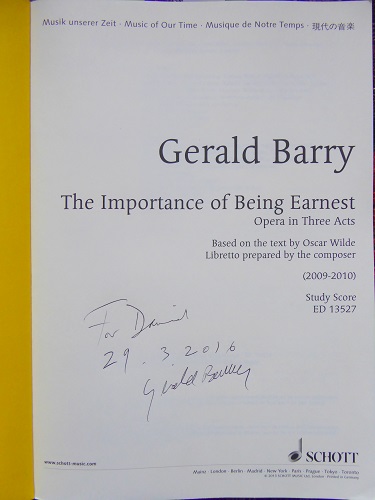
Likewise to Gerald, who came along on 29 March before HIS first night, albeit a revival of The Importance of Being Earnest.
Ask any of the students from my Opera in Depth class who made the talks, and each will tell you both visitors were such fun as well as eye-opening with regard to the mysteries of composing and directing. Let's take the first in order of appearance. Richard, who's visited three times now, still seemed rather startled that we'd spent six weeks on the two versions of Boris (he does bemusement well).
When he summoned me to a preliminary chat about Musorgsky's masterpiece over a year before the production, he was toying with all sorts of ideas, admitted he loved the different atmosphere of the Polish act in the revision, not to mention the Kromy Forest scene which replaced the encounter between tsar and Yurodivy outside St Basil's Cathedral, at least in 1872 (Tarkovsky's so-called 'supersaturated' edition at Covent Garden included both). Ultimately, though, it was Kasper Holten's choice, and he wanted unadulterated 1869 since the Royal Opera hadn't done it. Below: Bryn Terfel as a troubled Boris in the Coronation Scene, one of two images by Catherine Ashmore for the Royal Opera.
My feeling is that too many other companies havc, and Richard admitted that it's quite cerebral, mostly keeping the viewer at an emotional distance - through a glass darkly, as it were. But, struck as I was this morning by watching an interview with Martyn Brabbins, it's clear that what he said about conductors, at least of new works, applies to directors too: they are re-creators, artisans who work with the given material. Jones, of course, is a visionary artisan and only he could take a single line from the text - when Shuisky describes the corpse of the murdered tsarevich Dmitry still clutching a spinning top - to permeate the entire ritual. The killing of a masked, red-headed 'child' is repeated at crucial points, and the parallels with Boris's own son, not always brought out, are marked here both by another red wig and the pathos of a treble to sing Fyodor.
I've written all about this typically thoughtful, engaging and haunting production over on The Arts Desk, so no need to repeat myself here. I should mention, though, that in class I ended up using far more of Calixto Bieito's Munich vision than I'd intended - partly because that's undiluted 1869, unlike every other version which had promised to be so, partly because the relationships seemed so much more real than several of the other DVD versions (though it's always good to reference the post-Chaliapin melodramatic style incarnated in Nesterenko and others). I still think Bieito's productions, with its law of diminishing returns on the violence as usual, has the best Boris death scene thanks to the extraordinary and harrowing portrayal of Alexander Tsymbaluk.
Terfel would certainly repay another look, though, especially in the close-ups of the livescreening (which I guess I can see when it appears on DVD, as it must). Subtle, nuanced, of a piece with Pappano's precise fusion of stage action and orchestral commentary. Richard talked about this essential collaboration, and I don't think it's a betrayal of what he told us to mention that he felt his Gianni Schicchi had worked less well this time simply because the conductor, the very good Nicola Luisotti, was more pit-involved - I got the sense that also meant self-involved - than Pappano had been. After he'd gone, we watched the original Schicchi and I marvelled especially at how superbly the young, handsome tenor playing Rinuccio, Francesco Demuro, used his hands to lead his body and express his lines in a way that only Jones seems to be able to get.
Richard was happy with the performances of his singer-actors in this Boris, especially a very relaxed John Tomlinson and the relationship that Terfel's Boris had developed with John Graham-Hall's Shuisky: they had evolved between them a sense of class distinctions, though their director wasn't quite sure that came across and, costuming apart, it didn't. Otherwise, it seemed to have been a wholly positive experience and I hope we'll have a Khovanshchina from him anon. And I breathe a sigh of relief that the first collaboration between RJ and Mark Wigglesworth at the beginning of ENO's next season - I know what it is but still can't say - should still be going ahead.
It seems to me, the more I study The Importance of Being Earnest in its pared-down but hysteriaed up operatic version, that Gerald Barry composes in one way at least much as Richard Jones directs: he takes a brilliant and original gesture or style and mines but never over-exploits it before moving on to the next idea. Certainly he hates the idea of chaos onstage, and Earnest is anything but. He and RJ worked together on The Bitter Tears of Petra von Kant - wish Richard had been with him to enlarge on that, since he'd told me that the cast spent every day crying, without explanation - and they undoubtedly will again. But possibly not on Barry's Alice opera, which receives its Barbican concert premiere later this year: 'he told me he'd only direct if I didn't put either "Alice" or "Wonderland" in the title'. The latter has been obviated by calling it, as Carroll did his original, Alice's Adventures Under Ground, but can RJ accept the unavoidable name?
Time will tell. Meanwhile, we heard about Barry's surprise at the LA premiere of Earnest when the audience laughed; he had, quite a bit, while working on it, but at first was disconcerted by the noise. He seemed to have a special attachment to Anthony McDonald's Irish-based production among the few to date, but on a second viewing, I still think Ramin Gray's update is very successful and, above all, directly communicative both between singers and orchestra onstage and - crucially - between singers and audience (below image of the entire cast, Hilary Summers' Miss Prism being ganged up on in the denouement, by Stephen Cummiskey). Here's the rave on The Arts Desk. We talked about the very precise if deliberately skewed word-setting, and GB gave us a magnificent demonstration of Lady Bracknell speaking in a monotone. He's a bass, so maybe we'll get his version on stage ere long.
With Gerald's permission, I tried to record the talk, but my mp3 stopped after 30 minutes because I had no idea it was reaching its capacity of interviews and I hadn't wiped any. Might be nice to transcribe what I've got, so maybe I'll wind up here for now. Just to add that, having spent a successful class and a half on the opera before Gerald's visit, once he'd left to go back to his London lodging and change for the evening, I took the liberty of repeating the extraordinary megaphoned spat between Cecily and Gwendolen, as punctuated by the smashing of 40 plates, wind machine(s), jackboots, telephone and gun. Here's the Cecily of Claudia Boyle, the major and splendid new addition to the original cast.
I set it up for comparison with the hit-and-miss version in Anthony Asquith's film, with Dorothy Tutin and the inimitable Joan Greenwood (I saw her once, at the Savage Club's Roy Plomley Memorial Concert, declaiming Liszt melodramas in English with Rhonda Gillespie at the piano. Elisabeth Welch and Frankie Howerd were among the other performers - quite an evening).
Unexpected coda to the Jones 'n Schicchi afternoon was a special guest, my good friend Chris Gunness's 18-year-old nephew Andrew Lavelle, playing movements from Bach Cello Suites as transcribed for viola. This was a spontaneous happening to an audience of five after the rest had left; Andrew had picked up the instrument for trial from a London shop so it was chance that he had it with him. I should add that I didn't take the photo until he'd finished his official mini-concert, just got him to fiddle a bit more for the camera.
Andrew had recently auditioned for the major American music schools and colleges; after he'd returned to Texas, we heard first that Juilliard had offered him a scholarship, then that the New England Conservatory and Cleveland Institute of Music had followed suit. Of course I hope he goes to New York but it depends very much on who's the right teacher for him. He was gratifyingly swept up by the Schicchi film and fascinated, as which true musician wouldn't be, by the infinite possibilities of London. He also took the pics of Richard and me at the end of the talk, for which I'm very grateful.
If you haven't seen or got tickets for the Barbican performances of Earnest, it's being livestreamed on the Royal Opera's YouTube channel tonight and will be available there for the next month. I hold to the belief that it's one of the handful of operatic masterpieces I've experienced in my lifetime close to the premiere - the others are Nixon in China (the other Adams operas come very close) and James MacMillan's The Sacrifice. Time and closer acquaintance only confirm the hunch. Let's hope Alice can make the grade, too. Given Barry's fascination with the balance of fantasy and precision, which he shares with both Wilde and Carroll, it should.
In the meantime, if you're interested, there are still some places available for the summer term of Opera in Depth - 10 glorious weeks on Tristan und Isolde, starting on Monday 18 April, regular time of 2.30-4.30pm. If you don't have my e-mail address, leave me a message with yours, I won't print it and I'll reply in turn.
*In replying to a malicious attack in The Spectator online (who reads it, anyway?), Frontline founder Vaughan Smith provided a good introduction to the Club in a Guardian article here. I need hardly add that I'm very proud to support it by hiring the top floor on Monday afternoons. Whilst I don't get to talk to the other members, the staff have been wonderful throughout and I find it an incredibly welcoming place with the best facilities.
Saturday, 13 February 2016
Tsars now and then
This one
stands roughly in relation to that one
as did Boris Godunov (c.1551-1605)
to Ivan IV, 'the Terrible' (1530-1584)
Why do I make the point? Because until Russian history stops repeating itself, we are likely to go back to truth-telling poets of the past to find the present in what they write. It was a scene in Pushkin's Shakespearean history-drama Boris Godunov not in either of Musorgsky's operatic versions which pulled me up short in the opera class last week. The poet uses one of his ancestors, a not exactly admirable plotting noble, to make the second of the comparisons above. 'He rules as did Ivan,' claims Afanasy Pushkin in James E Falen's admirable trnalsation:
What good that public hangings are no more;
That on a bloody stake, for all to see,
No longer do we sing our hymns to Christ;
That we're not burnt alive upon the square,
The Tsar to rake our ashes with his staff?
Are our poor lives in any way more safe?
We're threatened every day with some disgrace:
Siberia...the dungeon...or the cowl,
And there, in some forsaken place, to die
From hunger or a strangler's knotted rope...
Remove the religious associations - though those, of course, are coming back under a repressive Patriarch - and subtitute the psychiatric ward and the carefully chosen poison* for the cowl and the strangler, and you have a proper equivalent to how Putin wields his power as a Stalin for our times. In one way, it's devilish cunning: as Peter Pomerantsev puts it in his giddying evocation of his recent years in Russia, Nothing is True and Everything is Possible, this political system thrives on 'democratic rhetoric and undemocratic intent'. Plus the belief that if you lie often enough, people might start to believe you (look at Medvedev's bare-faced declaration that Russia is not bombing anybody but IS in Syria, that the west is creating a cold war. The Lithuanian President retorted that Russia is doing everything it can to make this a hot war.
Pomerantsev's subjects are chosen and paraded to give a lurid whirligig of absurdity and horror. He worked on Russian TV documentaries, so he knows that state control of Ostankino is making the country into one big grotesque (non) reality show. He gives us a terrifying portrait of Vladislav Surkov (pictured below speaking for his horrible creation Nashi, the new version of the Hitler Youth), the clever, cynical amoralist who has 'privatised the Russian political system', whose style of authoritarianism 'climbs inside all ideologies and movements, exploiting and rendering them absurd...The Kremlin's idea is to own all forms of political discourse, to not let any independent movement develop outside of its walls. Its Moscow can feel like an oligarchy in the morning and a democracy in the afternoon, a monarchy for dinner and a totalitarian state for bedtime'.
The different aspects are tellingly exemplified: the models and mistresses whose coaches turn back to pumpkins when their multi-timing masters have tired of them, and who turn to the kind of cults not unknown here but operating on a more sinister scale there, a route ending in madness and suicide; the businesswomen who finds herself, totally innocent, caught in the mesh of corruption and an imprisonment which she's told can only be terminated by a large bribe to a lawyer - she turns to another route which only works because of a bigger political expediency; the hood who's a hero in his home town; the brutality facing army conscripts; the Russian 'offshore' in the rest of the world; the very differing fates of the former oligarchs now that all wealth is under state control: and the wholesale destruction of old Moscow - I knew very little about this and haven't been back since 2000 - so all businesses can be physically close to the Kremlin, the dead centre of all things.
What's fast being knocked down is chronicled by one of the few good guys in the book, Alexander Mozhayev, a kind of architectural Pimen (and definitely not to be confused with the pro-Russian separatist). What's going up, in the plethora of kitsch styles, includes such throwbacks to the 1950s as this
and this.
All government-approved politicians are adept at using the jargon of western capitalist companies, a trick learned by the proliferation of the latter in Russia during the 1990s. And everyone plays the game, knowingly or not; a dissident individual or organisation can be given a brief limelight, only to be dragged out of the spotlight the next day.
In fact this is the most potent aspect of the whole thing which reminds me what I read about Stalin's game - the rules could be changed daily or by the week, so that no-one ever knew where they stood. Keep everyone in a state of fear. At the moment, this is why it's impossible to win within the country, though some unimaginably brave individuals still keep on trying. Eventually this madness has to come to an end, but will Putin have succeeded in his biggest wish, to drag down Europe before Russia itself totally implodes? I know this: that I have never lived through worse times for the world. This article on The Interpreter, superbly expressed, offers no comfort at all.
We have our own Surkovs, of course, though they're not as clever. Thankfully we also have the freedom to bring pressure to remove them. It's hard work but it can be done.
Please sign this UK Government and Parliament petition against one of the biggest liars in the Conservative Party (and that's saying something) before he takes our precious NHS beyond repair. A reminder, too, that the ENO needs saving from its own management in a microcosm of what's happening with the junior doctors (chorus and orchestra shouldn't be in the line of fire). If you haven't already done so, sign and comment on The Spirit of Lilian Baylis's petition.
stands roughly in relation to that one
as did Boris Godunov (c.1551-1605)
to Ivan IV, 'the Terrible' (1530-1584)
Why do I make the point? Because until Russian history stops repeating itself, we are likely to go back to truth-telling poets of the past to find the present in what they write. It was a scene in Pushkin's Shakespearean history-drama Boris Godunov not in either of Musorgsky's operatic versions which pulled me up short in the opera class last week. The poet uses one of his ancestors, a not exactly admirable plotting noble, to make the second of the comparisons above. 'He rules as did Ivan,' claims Afanasy Pushkin in James E Falen's admirable trnalsation:
What good that public hangings are no more;
That on a bloody stake, for all to see,
No longer do we sing our hymns to Christ;
That we're not burnt alive upon the square,
The Tsar to rake our ashes with his staff?
Are our poor lives in any way more safe?
We're threatened every day with some disgrace:
Siberia...the dungeon...or the cowl,
And there, in some forsaken place, to die
From hunger or a strangler's knotted rope...
Remove the religious associations - though those, of course, are coming back under a repressive Patriarch - and subtitute the psychiatric ward and the carefully chosen poison* for the cowl and the strangler, and you have a proper equivalent to how Putin wields his power as a Stalin for our times. In one way, it's devilish cunning: as Peter Pomerantsev puts it in his giddying evocation of his recent years in Russia, Nothing is True and Everything is Possible, this political system thrives on 'democratic rhetoric and undemocratic intent'. Plus the belief that if you lie often enough, people might start to believe you (look at Medvedev's bare-faced declaration that Russia is not bombing anybody but IS in Syria, that the west is creating a cold war. The Lithuanian President retorted that Russia is doing everything it can to make this a hot war.
Pomerantsev's subjects are chosen and paraded to give a lurid whirligig of absurdity and horror. He worked on Russian TV documentaries, so he knows that state control of Ostankino is making the country into one big grotesque (non) reality show. He gives us a terrifying portrait of Vladislav Surkov (pictured below speaking for his horrible creation Nashi, the new version of the Hitler Youth), the clever, cynical amoralist who has 'privatised the Russian political system', whose style of authoritarianism 'climbs inside all ideologies and movements, exploiting and rendering them absurd...The Kremlin's idea is to own all forms of political discourse, to not let any independent movement develop outside of its walls. Its Moscow can feel like an oligarchy in the morning and a democracy in the afternoon, a monarchy for dinner and a totalitarian state for bedtime'.
The different aspects are tellingly exemplified: the models and mistresses whose coaches turn back to pumpkins when their multi-timing masters have tired of them, and who turn to the kind of cults not unknown here but operating on a more sinister scale there, a route ending in madness and suicide; the businesswomen who finds herself, totally innocent, caught in the mesh of corruption and an imprisonment which she's told can only be terminated by a large bribe to a lawyer - she turns to another route which only works because of a bigger political expediency; the hood who's a hero in his home town; the brutality facing army conscripts; the Russian 'offshore' in the rest of the world; the very differing fates of the former oligarchs now that all wealth is under state control: and the wholesale destruction of old Moscow - I knew very little about this and haven't been back since 2000 - so all businesses can be physically close to the Kremlin, the dead centre of all things.
What's fast being knocked down is chronicled by one of the few good guys in the book, Alexander Mozhayev, a kind of architectural Pimen (and definitely not to be confused with the pro-Russian separatist). What's going up, in the plethora of kitsch styles, includes such throwbacks to the 1950s as this
and this.
All government-approved politicians are adept at using the jargon of western capitalist companies, a trick learned by the proliferation of the latter in Russia during the 1990s. And everyone plays the game, knowingly or not; a dissident individual or organisation can be given a brief limelight, only to be dragged out of the spotlight the next day.
In fact this is the most potent aspect of the whole thing which reminds me what I read about Stalin's game - the rules could be changed daily or by the week, so that no-one ever knew where they stood. Keep everyone in a state of fear. At the moment, this is why it's impossible to win within the country, though some unimaginably brave individuals still keep on trying. Eventually this madness has to come to an end, but will Putin have succeeded in his biggest wish, to drag down Europe before Russia itself totally implodes? I know this: that I have never lived through worse times for the world. This article on The Interpreter, superbly expressed, offers no comfort at all.
We have our own Surkovs, of course, though they're not as clever. Thankfully we also have the freedom to bring pressure to remove them. It's hard work but it can be done.
Please sign this UK Government and Parliament petition against one of the biggest liars in the Conservative Party (and that's saying something) before he takes our precious NHS beyond repair. A reminder, too, that the ENO needs saving from its own management in a microcosm of what's happening with the junior doctors (chorus and orchestra shouldn't be in the line of fire). If you haven't already done so, sign and comment on The Spirit of Lilian Baylis's petition.
*17/2 Monday's announcement of the death of Nikita Kamayev, former head of Russia's anti-doping agency Rusada, prompts the worst thoughts in the wake of the doping scandal. A heart attack at 52? Well, it's Russia and men die young there, but still...he's the second person in the organisation to disappear conveniently from the picture within the past couple of months.
Sunday, 27 April 2014
Khovanskygate: Utopia, actually
It's been a poleaxing week, in a good way - working backwards, revelatory later Tippett from the phenomenal Steven Osborne and the poised Heath Quartet at the Wigmore last night, an exhausting but instructive and probably unrepeatable double bill of Chekhov's Uncle Vanya and Three Sisters, with many of the same Russian actors in both, on Thursday - and my introduction to the unique world of Graham Vick's Birmingham Opera Group in the Freedom Tent of the People's Park, Cannon Hill on Tuesday. Courtesy of BBC Radio 3's invitation, it was an evening I hope I'll remember clearly for the rest of my life. All the following production photos are by Donald Cooper.
The Utopia I mean certainly isn't the solution of Musorgsky's Old (here True, in other words religious extremist) Believers, a desperate and far from positive mass suicide. In fact all propositions fail in the world of Khovanshchina, set in a time of troubles in some ways like our own transitional, confused and confusing age, as Vick and his translator Max Hoehn understand so well. No, I'm referring to the possibilities realised in this astounding project, above all the unbelievable success of involving local people of all creeds and colours as chorus and actors and bringing us all as standing, shunted-around spectators to the table of a hopeless debate about the future.
Vick's genius, as I said in a rather stunned aftermath recorded for yesterday's Music Matters (also available as a download for the next month), is to save the ubiquitous contemporary references - now obligatory in both Khovanshchina and Boris Godunov, full of tiresome cliches in Calixto Bieito's world-today production now out on DVD - from being just about Russia now, where as Vick points out the past has become the present again. I did feel, incidentally, that as featured on the neat little Radio 3 survey he was a touch craven in interview to say that Britain is actually worse: let him try living under Putin, rather than just dropping in as he's about to for his second production of War and Peace at the Mariinsky, which will have to steer clear of similar controversy* (I was there in 1991, as Leningrad was turning back to being St Petersburg again, for his first).
It was a coup in every way to field four fine black singers, three basses and a tenor, to make the power struggle more suggestive of America (and even of the Middle East: Joseph Guyton's coke-sniffing, gun-toting Andrey could be modelled on the sons of several bloody-handed tyrants dead and alive). As are the Christian fundamentalists, while the protesting men evoke Occupy and our own deep trouble with the bankers.
The European riot police are believable, but it's hard to imagine our own bobbies behaving so wildly. But the scene where the Streltsy are harangued by their wives is fun until it all goes sour, so why not enjoy a bit of fantasy with that? Of course it's anything but fun when the young Peter I's advisers show their fangs and dodgy liberal Golitsyn is sent into exile, forced to strip off as he and his supporters are hustled into a van by all-too-familiar balaclavaed gunmen. Shame there wasn't a publicity shot of this scene; perhaps it wouldn't serve Vick's impending trip to Russia too well. Another clever touch, incidentally: while the True Believers wear T shirts bearing the slogan 'Not In This World', a 'terrorist' takes off his combat gear to reveal the slogan 'In This World'
All this takes place on at least a dozen acting spaces inside the huge tent. But there are none of the compromises you might expect. As far as I could tell - and I don't know the work inside out - this was a complete performing version of Shostakovich's orchestration concluded by the quieter ending Stravinsky and Ravel put together for Diaghilev in 1913. There were no supertitles and no amplification. There was a full City of Birmingham Symphony Orchestra on a raised platform, fluently conducted by Stuart Stratford; the brass made such an immediate impact that I guessed without knowing that we were hearing Shostakovich's unmistakeable work, and the opening 'Dawn on the Moscow River' rose slowly out of the hubbub, soon stilled, like the most beautiful of morning mists.
We get no further respite of that sort until the final gathering of the True Believers, with whom we now sympathise even though we know what they've stood for. The gathering apocalypse is also chillingly evoked in Ron Howell's choreography by the perverted sexuality and forced nightclub dancing of far-right leader Ivan Khovansky's failing campaign before his murder
In the earlier stages there's plenty of spirit and humour. I've always been a bit bored by the opening scene until the big bass and tenor Khovanskys appear; not here with Paul Nilon's superlative Scribe-as-hack-journalist. And the meeting of princes with Old Believer Dosifey in Golitsyn's palace becomes a riveting telly debate with humorous touches from Jeffrey Lloyd Roberts, his every word superbly projected.
Often, of course, you don't get the line up of sacred monsters you'd expect at the Mariinsky or Bolshoy, but each fine singer is totally inside his or her role. Guyton (pictured above) shows huge promise as an Andrey Khovansky verging on heroic-tenor territory, and Claudia Huckle's Marfa, seen below with Keel Watson as 'father' Dosifey, plays the confused young girl with some moral sense superbly. Her pianissimos in the final scene draw us in still further. I'm not entirely sure about the final solution, but you can't really have a big fire in a tent.
So I'm not exaggerating when I say that not only have I never seen a more gripping Khovanshchina, I've also never experienced a more involving or singular evening at the opera. And it really is for everybody, as the reactions of all sorts on the way out proved. I hope it's filmed or televised; but if not, then I bear in mind Richard Jones's wise words about his Welsh National Opera Mastersingers - that theatre should by its nature be both ephemeral and unforgettable. Ironic in retrospect, because that production is being revamped for English National Opera next season (as we know from Wagnerians gathered to raise funds at the Coliseum, though the formal press announcement of the 2014-15 season is due early tomorrow morning).
One final footnote, framed by photos from a second protest outside the Barbican before an LSO/Gergiev concert once again orchestrated by that superb tactician Peter Tatchell: I recommend you read my brilliant colleague Ismene Brown's commentary on and translation of an interview with Vladimir Medinsky, Russia's horrifying 'Culture Minister' (my inverted commas) - the same who said Tchaikovsky was not gay. Read more on the sort of creature we're talking about in this 2012 article - a ridiculous individual in a dangerous position of power not to be confused with the even worse new media controller Dmitry Kisilyov, who is famously on camera declaring that gay people 'should be prohibited from donating blood and sperm. And their hearts, in case they die in a car accident, should be buried or burned as unfit for extending anyone's life.'
So Zhdanovshchina beckons all over again, this time with the veneer of democratic vocabulary Putin has already used to lie and manipulate over Crimea and Eastern Ukraine. Parallels with Hitler's Germany ludicrously exaggerated? I think not.
*It didn't.GV proved courageous in sticking to his contemporary take, and probably won't work in Russia again. He lent me the DVDs of the production, my impressions of which are here, for my Opera in Depth classes, and came to talk to us about it - an inspiring and, of course, at times controversial speaker.
Thursday, 12 December 2013
On the day they booed Zuma
...I was summoned with three hours' notice to the BBC News 24 studios. The reason was loosely connected, I guess, with that surprising incident at what turned out to be a big party to celebrate Nelson Mandela's life (and incidentally I can't see under such circumstances why the hypocritical Daily Mail, glimpsed this time in the back of the cab they sent to ferry me back and forth, is at it again, condemning Obama's 'selfie', aligned with glamorous Danish PM and not so glam Cam, after he'd given such a wonderful speech).
So to the cause of my command performance. There had been booing at La Scala - che sorpresa - following what looked like a rather inventive new production of La traviata by hit-and-miss genius Dmitri Tcherniakov, and the news folk seemed most interested in the fact that tenor Piotr Beczala (pictured below by Johannes Ifkovits) had also got a boo or two. Full focus was on him, apparently, because he Facebooked that he'd never return to sing in Italy after that experience. 13/12 Inside information tells me that it happened because he wouldn't pay a claque to cheer him, so they booed instead. I did raise this possibility on the telly, but dismissed it because it seemed unlikely that, say, he and Damrau could possibly have been at loggerheads - and the claque phenomenon usually involves one leading singer hiring folk to diss the other.
I explained that as I hadn't been in Milan or at the livescreening I couldn't comment authoritatively, but they wanted me there all the same for a live sequence at 4.17pm and drummed up George Loomis, who had attended, to appear in the Paris studio. He looked comfortable there with a lovely view of the Eiffel Tower, whereas I was a bit overawed by the new television centre headquarters behind the much more familiar (to me) old Broadcasting House. My own shots are all a bit fuzzy as I didn't want to disturb with flash.
There were hordes of people around reception, plus paparazzi outside waiting for Katy Perry (about whom I know only the name and what she does). Then I was whisked down a corridor overlooking the largest newsroom in Europe - impressive and Metropolis-y - towards the studio where Tim Willcox was sitting behind a familiar desk.
To makeup first, and a chat with a lovely lady who told me how they're all on freelance contrasts, shocking. And then to the vast studio where there were only a man who pinned on my mike, two cameramen and Tim. I never spoke to him properly, got a nod as I sidled into a chair beside him and double-checked the pronunciation of 'Beczala' (Bechawa). I'd hoped there would be more about Tcherniakov, but it was mostly about tenors and why this one was booed.
From the excerpts on YouTube, I've no idea (why): Beczala, as I know, has style and musicianship most tenors with voices anywhere near as good as his completely lack. 'De' miei bollenti spiriti' is lovely, and done while rolling out pastry with Damrau's Violetta, a perfect image of domesticity (though as with other supposed soliloquies in the opera Tcherniakov breaks the rules and gives the singer a springboard for reaction). If anything's to be criticised it would be the heavier of conductor Daniele Gatti's tempi, though the Italians don't seem to have noticed those.
Despite pushing the voice dangerously in the public denunciation of Violetta, Beczala didn't crack - though he does on a wicked clip from a 2012 production of Gounod's Romeo et Juliette in a YouTube series called 'Perle nere' - 'black pearls'. Botha is on there too so Beczala is in fine company; it happens to the best. I want to see the whole of the show now - especially intrigued why Damrau is fancy-wigged as Jean Harlow in Act One and as 1970s Bette Midler in II.ii when the essential look is contemporary.
Anyway, I was walking back to the taxi from the rather intimidating TV HQ when nice co-ordinator Victoria Sill ran after me. BBC World Service had seen the live couple of minutes, liked it and wondered if I'd come back in to do a radio slot. Great: this would at least double my earnings (£50 'disturbance fee' for the telly). Typically, this interview was more relaxed and I had fun chatting to Newshour presenter Tim Franks.
Wonder if anyone saw the News 24 snippet - I just have, since Victoria very efficiently sent me the film without my even having to ask - but the radio chunk, neatly edited, is downloadable here (my bit's right at the end of the 'US Cuba Handshake' instalment). Probably the iPlayer version is the better long-term bet as the big programmes tend to be up for a year. For the next two and a half days, there's also Radio 3 iPlayer access to my chat with treasured colleague Marina Frolova-Walker and Music Matters presenter Tom Service on Stephen Walsh's excellently written but oddly marketed/presented book about Musorgsky and the Five.
Not much to add about mighty and compassionate Madiba, except that while dining on superb Indian dishes at friends Anupam and Paul on Sunday I brought up Peter Tatchell's equivocal response - which was that Mandela was unquestionably a great man, but from the great we expect so much, and he could have done more when it came to speaking out against Mugabe - apparently he never did - and dealing with HIV/AIDS in South Africa. To which Chris Smith, aka Baron Smith of Finsbury, the first out gay MP and so a bit of a hero of mine*, responded that the day after he'd proclaimed his own HIV status, he got a message asking him to call Nelson Mandela and on ringing the number found the man himself on the end of the line. No other major figure showed that kind of solidarity at the time.
When I emailed Chris to ask if he'd mind my mentioning and/or naming him - and of course he didn't - he added: 'one of the things that had prompted me to say something publicly...was his speech after his son's death when he said we can only defeat HIV by being open about it, and talking about it'.
That personal touch sounds typical - lovely slot in the middle of Tuesday's World Service coverage - yes, I'm a fan of that station, for all its recent changes - where the daughter of a white activist remembers Mandela not only coming to their Camden home at the time of her father's funeral, but staying for tea and interrupting a speech to say hello to a neighbour he knew. At last tears did come to my eyes after all the generalised - if well deserved - eulogising. There's a fine tribute from colleague Jillian Edelstein on The Arts Desk, describing her experience of photographing Mandela in 1997. Here's her shot of a man we usually see smiling and extrovert rather than pensive.
10.10am: Jillian just emailed back with another image, which appeared in today's Guardian. Of course we need to see both sides of the great man.
Well, he is gone, but this great one isn't, and continues to do active good in the world. As, I think we're agreed but with greater reservations, is Time Magazine's figure of the year, humble Francis.
*Speaking out against a possible ban on gay employees in Rugby, he said: 'Good afternoon, I'm Chris Smith, I'm the Labour MP for Islington South and Finsbury. I'm gay, and so for that matter are about a hundred other members of the House of Commons, but they won't tell you openly'.
Subscribe to:
Posts (Atom)