Showing posts with label Philharmonia. Show all posts

Thursday, 13 June 2019

Rouvali: great performances with dodgy endings


I get no medal for having predicted, in my Arts Desk review of Santtu-Matias Rouvali's December 2018 Strauss concert, that either he or Jakub Hrůša would be appointed to succeed Esa-Pekka Salonen as the Philharmonia's Principal Conductor in 2021. Hrůša is the more experienced of the two, and a deep thinker open to ideas in interview - one of the most memorable I've ever had the pleasure to be granted - but apparently the players found him 'too demanding'. So they've gone for the wow factor and the mad hair (straight as a dye in a photo I found of SMR in his student days). All recent images here by Camilla Greenwell for the Philharmonia.

Two further performances in just over a week gave me a chance to discover further what makes Rouvali tick (in interview, he's surprisingly nervy and a bit evasive, or that may be a language thing). Biggest asset: he shows that natural sense of freedom/rubato and the ability to quicken or slow the pulse in an instant. Abbado, Haitink, the Järvis, Mirga Gražinytė-Tyla and Yannick Nézet-Séguin all have it; Rattle and Salonen don't.


The interpretation I heard of my favourite Strauss tone poem, the Symphonia Domestica (alongide Don Quixote, which I know is objectively the finest), launching Gothenburg's fabulous Point Music Festival was mostly miraculous. All the better, too, for coming from that most refined of symphony orchestras - stringwise, to my mind, up there with Berlin, Amsterdam and Vienna - in a hall which really allows big sounds to breathe and not attack you like an angry rice pudding (as my nearest and dearest once said of an Ashkenazy Alpine Symphony in the Royal Festival Hall).

As I've already stated in my Arts Desk roundup, Rouvali's genius was at its brightest in the difficult ebb and flow of the huge slow movement. And then, as the crazy family-reunion grand finale should goes up a notch in fruitcakiness to sehr lebhaft (crotchet = 116), Rouvali kept it steady. No wonder people were criticising the work itself for going on too long. The parody of the Beethovenesque not-knowing-when-to-stop can only succeed if it's wild. Yes, the horns got their insane whoops right, but that's not the point. A fall at the last hurdle. 


The following Thursday, the Philharmonia were using his latest concert here to celebrate the appointment (didn't hang around much at the Ballroom 'welcome', too many platitudes being spouted). It began sensationally, with a deliciously layered account of Adams' perfect curtain-raiser The Chairman Dances. Pekka Kuusisto seemed a bit too muted - not literally - for the overloud brass in the opening movement of Stravinsky's Violin Concerto, and saved heartfelt expression for the beautiful homage to Bach which proves the work has soul. 


Petrushka was bound to be a brilliant showcase for Rouvali's sense of refined colour, as the Musorgsky/Ravel Pictures at an Exhibition had been in an earlier Philharmonia spectacular. He favoured tone-painting and conductor's tricks over storytelling, which was fine on its own terms. All solos were flawless and characterful; the trumpeters were going great guns. Then, after the Rite-ish onrush of the Masqueraders - swelling trill; finish. The concert ending, which I'm sure Stravinsky must only ever have intended for performance of the orchestral 'three pieces'. No pathetic death, no ghost on the roof. 


This shock happened to me only once before, in a BBCSO/Bělohlávek Prom for which I'd prepared the nine-year-old son of a friend I took as guest. I was aghast then that he didn't get the full story, and I went into a spin here. What kind of musician does that? Surely only one without theatrical instinct. Rouvali partly redeemed himself with a virtuoso performance on the 'bones' with Monti's Csardas (accompanied by the wonderful Liz Burley, superb in 'Petrushka's room'). But I'd much rather have had the last five or so minutes of the ballet. My Arts Desk colleague Bernard Hughes hit the nail on the head (which means I totally agree with him). 


Redemption, then, on his SMR's first recording with the GSO, which I finally listened to. Hair standing on end from the first string tremolos of the young(ish) Sibelius's first movement onwards. A magnificent performance from start to finish. Let's hope for more like this, and no deflationary endings. Which reminds me that there won't be anything deflationary about the greatest living conductor, Bernard Haitink (pictured below at the Barbican in March by Mark Allan), bowing out in September. 


He's decided that a Lucerne appearance will be his last, having celebrated his 90th birthday with the LSO in style. Wise self-knowledge to the end (of his professional career, that is; may he enjoy as many more years as he wants feeding his endless curiosity). I'll never forget his totally inspirational masterclasses in Lucerne, his Bruckner 4 or Beethoven 6, among the most recent performances, and so much else going further back.  Don't miss the Vienna Philharmonic Prom on 3 September; queue for an Arena place (£6) from noon if necessary. I did just that for Bernstein and the same orchestra in Mahler Five, and that's a concert which likewise I'll remember as long as I live. 

Tuesday, 10 October 2017

Kikkas and Rouvali: two Nordic masters


Last Thursday I only just had time to pop in to the Estonian Embassy in South Kensington for the launch of Kaupo Kikkas's Treescape exhibition - or rather half of it, since the whole couldn't be housed in the two rooms. Here he is in the centre surrounded by Estonian friends and friends of Estonia (I am, ostensibly nerdily but rather more tongue-in-cheek, displaying my Pärnu Festival bag):


And then I hopped on my bike and only just made it in time for Finn Santtu-Mattias Rouvali's first concert as co-Principal Guest Conductor (with the equally superlative Jakub Hrůša) of the Philharmonia. My photo of him in his conductor's room at the Gothenburg Concert Hall back in September (and a perspective on his Sibelius Kullervo here).


Certainly I'd put these two on the highest artistic level. Kaupo is one of the few who have you answering the perennial 'is photography art?' question with a passionate 'yes' (the contrast I would make might be with the excellent photographs taken by the Frenchman Jérémie Jung of the Kihnu women which ran at Europe House's 12-Star Gallery - superior documentation).


Indeed, the somewhat periphrastic description 'visual artist' fits Kaupo better than 'photographer'. He takes the best shots of classical musicians I know, but this was on a different level. I'd already seen the PDF of what should, must, be a proper book of his Estonian tree photos, but encountering them on the bright white walls of the Embassy in full symmetrical compositions - in two cases, the big image flanked by icon-like photos encased in wood - was something else altogether.


I should reproduce at least part of his accompanying mini-essay, which begins by declaring that he can find no words for what he feels about trees, saying it with a camera instead. He continues:

I am not a tree-hugger, an esoteric or particularly religious, but when I'm standing in the forest, I always get this indefinable feeling and the desire to describe it. I have been aided a lot by the writings of Hermann Hesse [see here, glorious] and Valdur Mikita, or perhaps not the texts themselves but the authors' desire to describe a feeling that cannot be described.


[Writing about his 'great love' of old houses and fishing sheds':] I have also used...wood in my work - in the first hundred years the tree matured, the next hundred years it spent as part of a wall and now that that building has decayed and nature has taken over again, I picked up the old wood and gave it a role in my own story.

In order to stress what is important and to remove as much of the natural environment from the picture as possible, I have chosen the classical black and white medium. The pictures have a lot of texture and patterned dynamics accompanied with several double exposures.


So far I can only gloze superficially - I need to go back and see the pictures without the social context in which I half-glimpsed them last week. But I do know that this chimes with my own tree-love, the reading of Mabey, Deakin, MacFarlane, Picton-Turbervill the Younger et al. Anyway, here below are two of my favourite women, multitaskers extraordinaires but first and foremost a bassoonist and a pianist, Tea Tuhkur and Sophia Rahman, at the table nearest to the camera listening to Kaupo's speech last week. The wonderful Kersti Kirs just behind them; many of the other folk I don't know.


Rouvali's Thursday territory, on the other hand, was almost too known, with the exception of Kabalevsky's Colas Breugnon Overture, an opening glass of champagne which has the right to be called the Soviet Candide or Till Eulenspiegel and which I know from recordings but had never heard in the concert hall before. Rachmaninov's Paganini Rhapsody had much more interest in the orchestra - the typical Rouvali skill of suspending a phrase in mid-air captured by the cor anglais at the end of the variation just before the first appearance of the Dies Irae - than in Denis Kozhukhin's clear but deadpan delivery: no fantasy or flight there.


What was most exciting wasn't so much the superb performance of the Musorgsky/Ravel Pictures at an Exhibition but the way it brought the many teenage school or undergraduate groups in the hall to their feet the minute 'The Great Gate of Kiev' had finished resounding. Rouvali (pictured above by another KK, a Finnish compatriot of Rouvali, I guess, Kaapo Kamu) is one of those conductors, like Jurowski, where what you see is what you get. His hand gestures are both beautiful - especially the circular movements - and meaningful; the rest of him dances. No wonder 'Tuileries' and 'The Ballet of the Unhatched Chicks' scintillated. And this seemed like a different Philharmonia string group from the impassive lot which went along with Salonen's faceless Sibelius the previous week: the unison power of 'Bydlo' and 'Samuel Goldenberg and Schmuyle' was astonishing. So yes, what was already confirmed in Gothenburg had extra impact here given a harder-to-impress London orchestra. Great things ahead.

Thursday, 28 February 2013

Haneke, Bergman and last rites


I finally caught up with Michael Haneke's Amour last night at the Curzon Soho, the first unquestionable masterpiece I've seen in the cinema since Des hommes et des dieux*. Let's first dismiss the Oscars nonsense, written up with a touch of saeva indignatio by the marvellous Matt Wolf: I haven't seen the other 'competitors' in the Best Actress category, but it was absurd that the unsparing, unsurpassable Emmanuelle Riva, just turned 86 when she arrived in Los Angeles, should walk away empty-handed. Actually she should have been up for a joint award with the equally remarkable Jean-Louis Trintignant (pictured with Riva above and below), her loving husband of the watchful gaze in the film. But who cares?


I can't add much of value to what my colleague Emma Simmonds and the first of her commentors write on The Arts Desk. The film is simply note-perfect (well, except in the very minor detail of the right arm placement above hands which we don't see on the piano keyboard - sometimes in the wrong area of the instrument - which is odd, since a very, very fine pianist, Alexandre Tharaud, appears in the film as himself). Having had the humiliating experience of watching Haneke's Hidden from the back row of the Gate Cinema Notting Hill, and not seeing the crucial detail in the tableau at the end, we sat in the front this time and were enveloped by every detail of the old couple's flat in which, after an unforgettable early scene in a concert hall, the film entirely takes place. I wept very nearly uncontrollably when Trintignant's carer tries to get his love to drink water - no more details needed - but came out feeling not exactly purged but clear-headed, almost serene.


Comparisons are odious and probably unnecessary, but I couldn't help wishing my idol Ingmar Bergman in his last film, Saraband, had asked as much of his senior couple, Erland Josephson and Liv Ullmann (pictured; the Fårö post relevant to all this, one which as I think I've written before is closest to my heart, is here). Actually the scenes between them are very touching, but on a first viewing I found some of the old self-disgust packed into the father-son dialogues melodramatic and the handling of music in the film slightly clumsy alongside Haneke's unstinting truth and his less theatrical take on performing artists.


On the other hand, Amour is rather like those earlier Bergman masterpieces Wild Strawberries, Cries and Whispers and Autumn Sonata (Ingmar and Ingrid, no relations and no great friends, pictured above) in that it puts you through the mill and leads you by the hand whole and perhaps a little wiser out the other side. The difference is that you can argue about what you liked or didn't like in Bergman; whereas I should like to meet the individual who finds anything to challenge in Haneke's work of real, honest genius. How amazing that films like this, without any music other than that played in real time, should still be made.

I've been using the word 'flawless' quite a lot over the last couple of weeks: it's also applicable to two concerts I reviewed on The Arts Desk within six days of each other: a brilliantly programmed one by Edward Gardner conducting the Philharmonia Orchestra and another which was simply electric all the way through - despite the challenges of Bloch's not-so-great Schelomo - thanks to conductor Thomas Dausgaard and a simply stunning cellist I've not heard before, Jian Wang (pictured below by Xu Bin).


Double-checked with BBC Radio 3 folk to make sure the cello wasn't miked; from where I was sitting in the hall, the sound was the biggest I've ever heard emanating from that instrument, but so refined. Here's the man I need in order to pay attention to every note of the Bach cello suites. What a happy coincidence with Bergman to find so inward and low-vibrato a performance of the Sarabande from the Second Suite (there was bags of vibrato, incidentally, in his hair-raisingly intense Schelomo, as you would expect, so it's a question of adapting the style).Both film-makers would surely be moved by this, though the Sarabande of Bergman's film is the one from the Fifth Suite.


*If we're including comic masterpieces, and why not, then Julie Delpy's Two Days in Paris qualifies. We soon caught up with the sequel, Two Days in New York, and laughed almost as helplessly in places, though it's such a loss that Delpy's mother died when the filmmaker/actress had already planned out the film, an event which made her change course. The enlarged role for the nightmare sister with an awful boyfriend in tow to some extent fills the gap.

Wednesday, 8 June 2011

Göttingen's sweethearts


The one above celebrated her 110th birthday yesterday. So it's not quite an age-old, but still a charming, tradition that students of Göttingen's Georg August University, Cambridge to Heidelberg's Oxford (or perhaps vice versa), go to the town's main square on receiving their doctorate, kiss the rather beautiful Art Nouveau Gänseliesel or Goosegirl's cheek and leave her flowers and a candle in thanksgiving. I was lucky enough to see the ritual in action, walking through town to catch the 7.55am train to Frankfurt after a happy day and a half at the Göttingen Handel Festival.


These two jolly medics, flanking three girl friends, had just gone through the motions ever so poetically (by the way, I was reminded that a first or second degree doesn't qualify you to kiss the maiden; only a doctorate will do). They hailed me, rather curious to know what anyone else was doing walking the sunny streets of Göttingen so early on a Sunday morning, we chatted and I took their photo (it felt too corny to ask them for historical re-enactment, though you can see the boys were kitted out for it). I don't even know their names, but what an echt farewell it was.

It might seem a bit forced to fanfare the other idol of the town under the 'sweetheart' label, but no doubt about it: the townsfolk love Nicholas McGegan more than ever as he comes to the end of his 20-year tenure powering the Handel Festival.


I'd come chiefly to hear him conduct Teseo in the town's ideally-sized small theatre, and indeed the orchestra was really the thing, though there were two very classy performances from Amy Freston and the flawless Robin Blaze. I also heard two fabulous events in two of the churches.

But more of that in the Arts Desk piece on Sunday. Let's just catch my not-as-good-as-the-professionals glimpse of 'Nic', as they call him, sporting his newly-pinnedVerdienstkreuz am Bande, the Cross of the Lower Saxony Order of Merit.


He's standing on the staircase of the Old Town Hall, and appropriately the furthest of the three figures on the wall to the left has 'ars longa, vita brevis' inscribed above. Although the Town Hall was built on the site of an even older one in 1270, it's gone through various modifications which do nothing more than show its consistent vitality and usefulness, including the plastering of the Great Hall in 1883, and a very fine job the artist has done, I think. The coats of arms above the main friezes are those of the Hanseatic league, to which Göttingen belonged from 1351 to 1572. Lübeck and Braunschweig have the central position, though of course the heraldry stretches further to Riga and my beloved Visby (to which it looks as if we're not destined to return after all this June).


The figures have links to the rooms around which they're positioned. I love the Meistersingerish significance of this craftsman, who could well be goldsmith Veit Pogner.


A minstrel prances down the staircase


and the young newlyweds outside the former registry office might be Eva and Walter.


Not without significance to Wagner's opera, perhaps, since the people's will has usually been paramount here. The citizens rebelled against the councilmen's favourite fountain design at the end of the 19th century and got their way with the Gänselieselbrunnen. By the way, Gottingen was one of the few German towns to be spared flattening in World War Two - so was Heidelberg, leading many to speculate that the Germans left off Oxford and Cambridge in some kind of sick deal - so there's plenty to see. I'll return to churches and housefronts anon.


But I'm still in a Handel mood: it might have been that, or sheer overtiredness, that made me enjoy the Philharmonia concert on Sunday night less than I might have done. The pre-performance talk with Vasily Petrenko went fine, though the fun was a bit more at my expense than I'd anticipated, with VP playing to his Liverpudlian fans who'd come down specially to see him. But I do reckon Simon Trpceski - a pianist I usually love for his brio and communication - whizzed far too much through Tchaikovsky's Second Piano Concerto. And it was unforgiveable of him to insist on the Ziloti two-thirds-cut slow movement, especially as the Philharmonia leader Maya Iwabuchi and her cellist counterpart Karen Stephenson did so gloriously well in what little they had to play.

This morning I listened to 'special guests' Kennedy and Isserlis with Donohoe for Barshai (EMI), which only underlined more than ever what a bad mistake it had been to cut it: the solo strings lead the bullish virtuoso into a whole new world, and he/she needs that time to stay there. Wrong to wrench it out of context, perhaps, but in case anyone's reading who was also there and didn't think it was a great piece, here's a crackly old Melodiya recording of the first violin/cello duet before the piano enters (which is where Sunday night's performance essentially started; and we didn't get the central angst on display here, or the later string cadenzas, either, which you can hear in Part Two).

Monday, 28 June 2010

Travel in a time of football


I haven't seen a good match in years, which is not to say that I wouldn't be drawn in if I were at the house of a friend who wanted to watch the World Cup. But I don't think I'll easily forget where I happened to be when key games took place. How many years ago was it when England played the Cameroons in the quarter-final and I was sitting in the since-defunct Lumiere Cinema with six other people watching Eric Rohmer's A Tale of Springtime?

This year I've been on the move or in a theatre while the action was being played out. On Wednesday I had to give a talk in Leicester - station depicted above - before one of Temirkanov's three major Prokofiev/Tchaikovsky concerts with the Philharmonia (I caught the first programme in London and wrote it up for The Arts Desk; and all I'll say about it here is that the man is surely the greatest Tchaikovsky conductor still living).


So at about 3pm I strolled up to Barons Court tube - too hot to cycle to St Pancras - and caught diverse roars through open windows and outside The Curtains Up pub (never sure how they mean that to be punctuated). But from Barons Court to Kings Cross on a surprisingly packed underground and from St Pancras to Leicester on a fairly busy train, not one whimper of news about the match's progress. As I strode up the hill towards De Montfort Hall, it was impossible to tell who'd won. A couple of twats in tall England hats lurched around noisily, but gave no hint of victory or defeat. It wasn't until I was in the hall that I found out.

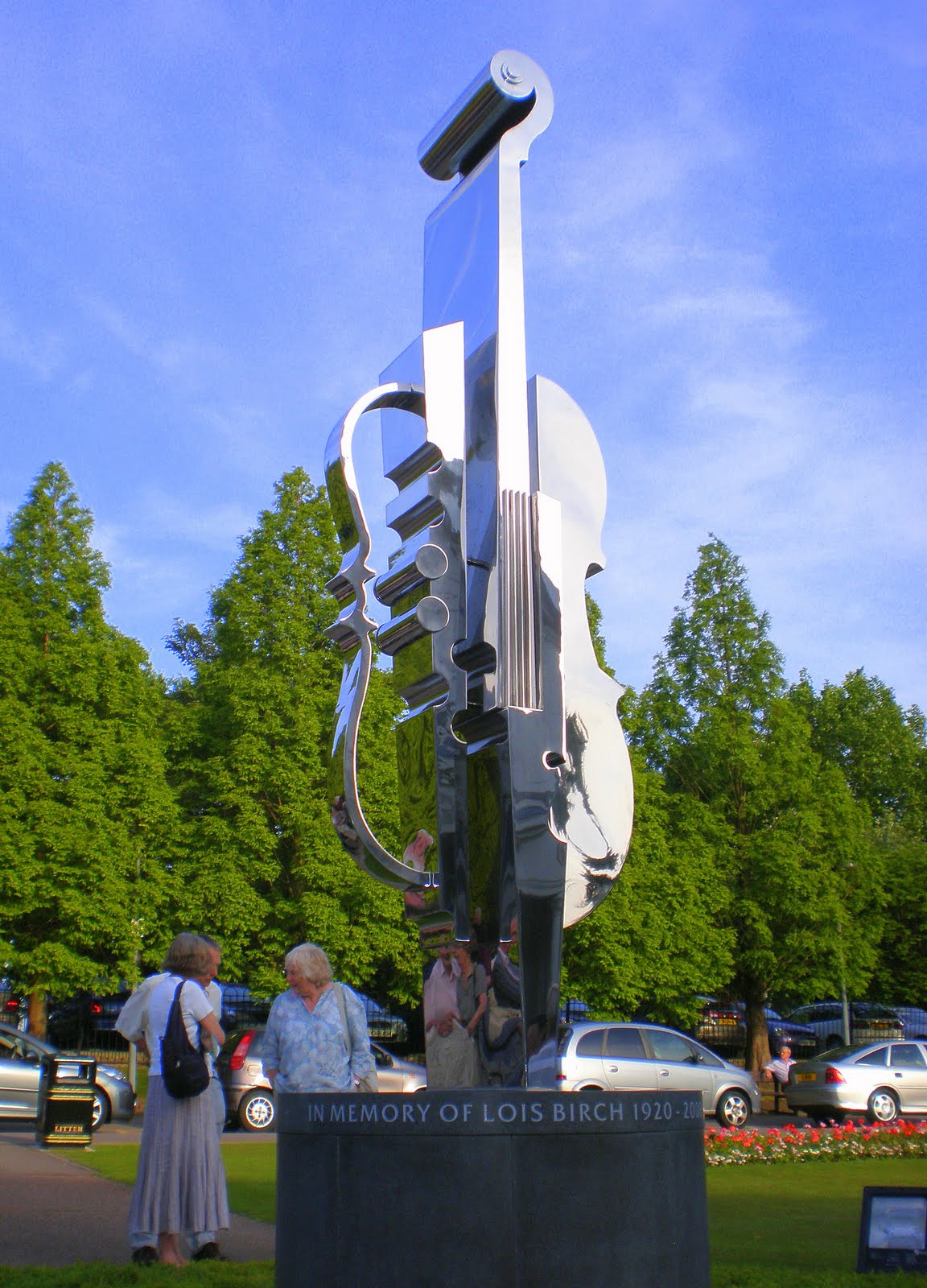
Anyway, Leicester is worth a quick digression, though I still haven't had time to see the Curve (was still in the middle of the Coppelia script on Wednesday, and had to rush back to meet Ruth and friends after her Cork Street opening, more of which anon). The concerts have a loyal if ageing following, and while I spoke they were unveiling a new memorial sculpture in memory of a Philharmonia friend:


The walk to the hall through the back streets is leafy and pleasant, the odd rolling drunk or drug addict excepted. I love the railings of the bizarrely if aptly named Oval Square.


And so back to London that evening in an atmosphere of calm, and a nearly full moon above St James's (the clock time, like the one in the photo further down of Trieste's Caffe San Marco, is of course way out).


There was, though, a midsummer madness in the air around Piccadilly owing to the Cork Street bacchanalia. Doziness reigned the next morning as I pedalled to the BBC to record the Building a Library programme. A white van man nearly knocked me off my bike as he turned without indication across the cycle lane and into Earl's Court. Sundry specimens of erratic driving compounded the feeling that the Englanders were hung over after celebrating the match.

Finally - thank God, they're out now - there was the question of negotiating London before and after the England v Germany match. Our only chance to catch the ENO Tosca, and it started at the memorable hour of 3pm. Must have been more exciting than England's trashing - in fact I was almost delirious after Act One, mostly with the sheer pelt and skill of Puccini's theatricality as projected by Amanda Echalaz and Julian Gavin - unquestionably the most convincing lovers I've ever seen in this opera - and by Ed Gardner's sensuous-pacy work in the pit (what beauty in the orchestral postlude to the love duet).

Act 2, in ex-diva Catherine Malfitano's period setting, went through most of the usual motions but had a few ideas of its own, and Michaels Moore was almost convincing as an elegant, sex obsessed sadist (the basic dark-baritone timbre hasn't weakened over decades, though the detached low notes don't come out well). Loved the way Echalaz's poor girl broke down after the murder and got frightened by the roll of drums anticipating the execution. The line in her 'vissi d'arte' ('love and music' as ever was in Edmund Tracey's well-wearing translation) was a little disrupted by the vibrato which could quickly become a problem, but she soars thrillingly and she's such an intelligent singer. The final touch, an artistic death, was superb and banished memories of Jane Eaglen looking like Robbie Coltrane in drag lumbering up the ramp to flop off (though that was her heyday, and how superbly she acted with the voice then). Both production photos of the current ENO production here by Robert Workman.


Echalaz's was easily the best Tosca I've witnessed since Nelly Miricioiu's in the early 1980s, and I'd love to see her as Salome. Ma guarda, cara, guarda.

By the opera's half way mark, it was impossible to tell whether Julian Gavin's ringing 'vittoria!' ('victorious' in the translation) was being echoed in the streets.


At the second interval it was all a bit quiet to start with. Then police vans started shooting up Charing Cross Road, sirens blaring. The nice man in Pret a Manger told me the bad (good?) news - 4 to Germany, 1 to England. Then we saw a pack of angry youths with feral, scrunched up faces looking for trouble.

Yet I have to say that over in Trafalgar Square after the show, despite the heavy police presence,


if you hadn't known of England's defeat, you'd have thought the fans were celebrating.


Note Yinka Shonibare's splendid newcomer on the Fourth Plinth.

Once through Admiralty Arch, it was the usual summer-in-the-city Sunday scene of brass bands and tourists ambling along the cycle lanes. The hot but glorious weather might just have taken the edge off the disappointment. Well, come on, Ghana.

Monday, 17 May 2010

On the Rach Pag


Spent a jolly, sunny afternoon on the Southbank dialoguing and monologuing on the Rhapsody on a Theme of Paganini in the company of Rachmaninov fans (from the -off Society and the Philharmonia Friends) and the compelling, if controversial Nikolay Lugansky. Let's face it, his manner divides opinions: many find him cold, and I don't understand that at all. All emotion is kept between the lines, with the subtlest of rubato and the ability to change colour on a single note. His performance of the Rhapsody on Saturday evening was crystal clear, beautifully sprung - it was a joy to watch the fingers bouncing off the keyboard - and hitting just the right notes of tenderness in the famous 18th variation - that near-inversion of the Paganini Caprice, as the above example shows, and as Lugansky demonstrated in the talk once we'd persuaded him over to the keyboard - without any excess sentimentality. The art that conceals art.


As a person (above left, beside the grinning, chin-up goon) he is, as I knew he would be, easy to talk to, responsive, enthusiastic, full of interesting ideas. The whole thing, I add rather nervously, was filmed, so no doubt there'll be a post mortem at some point. We locked horns just a bit over whether the Dies Irae, the Latin chant for the day of wrath, links to Russian orthodox znamenny chant or not, in which case you could say that the work has some Russian links (Nikolay insists it's the only one where there are none). But this led to a passionate defence of the free-flow autobiography in the Fourth Concerto, a work to which Lugansky is passionately devoted; and indeed of Rachmaninov's own style as a pianist.

That led me to bring up, mentioning no names at the time, what I thought was the ill-advised attempt of Stephen Hough to resurrect Rachmaninov's fast speeds in interpretation - and quick as a flash, also without naming names (and I've no idea if he knows Hough's versions), Lugansky said he thought it wouldn't work, because you'd only get the leggiero without any of the composer-pianist's phenomenal pesante force at those tempi. Exactly right. I still think Hough shouldn't be playing Rachmaninov and Tchaikovsky at all - at best it's a rush, missing notes blurred by sustaining pedal, at worst a complete dog's dinner (that awful performance of the Rach 2 at the Proms a couple of years ago).

Anyway, we're here to praise Caesars Rachmaninov and Lugansky, not to bury well-meaning Stephen. But I sure would bury Alexander Lazarev on present form. He launched the evening's concert with another interpretation to forget - a Tchaikovsky Serenade for Strings crushed by his completely unnecessary brute force, arms flailing left and right as he gave emphatic cues to violins and cellos they didn't need (and at one point, in the cellos' case, fatally failed to follow properly). Monstrous. As for the pause between Elegie and Finale which brought ill-timed applause and unleashed a battery of latecomers, that was his fault: a sensitive conductor would have gone straight into the slow introduction with the first of Tchaikovsky's Russian themes. The Rach Pag was surprisingly together, but still the orchestra was far too loud. I didn't hang around to hear Lazarev stomp all over Shostakovich 6, especially as I'd heard the Philharmonia give a riveting performance of it with Ashkenazy over at the QEH while the Festival Hall was being renovated.

Other than that sour note, it was a fun day. We heard a great deal from Lugansky about the Rachmaninov country estate of Ivanovka in Tambov province and the amazing moral force of the man who's run it for decades and had it rebuilt according to the original plans.


I sounded off about the Dies Irae from its origins to Berlioz, Liszt (the incredible Totentanz) and the sweep of Rachmaninov's output (with excerpts from his own recordings of The Isle of the Dead, the Vocalise and the Third Symphony). Found Oleg Kagan's recording of the Denisov-arranged Paganini 24th Caprice and Manze/Egarr in the Corelli variations on La Follia, basis for Rachmaninov's own set, which Lugansky thinks is his most difficult and ascetic work (though he plays it superbly alongside the Chopin and Paganini variations on a treasurable disc). Gillian Frumkin, loyal student and Philharmonia Friends dynamo, took me and the super-efficient, friendly girls from the Phil for a plate of pasta at La Strada beneath the hall - a perfect afternoon to sit out and watch the thronging crowds. So let's end with a couple of shots of a rare true May afternoon on the Southbank before the torrential rains of Sunday.


Friday, 14 May 2010

Brodsky's sentimental journey


And the ship sails on - to Venice or Petersburg? Is the exiled poet on board going to see his mother and father again, and will they be dead or alive? The cinema of fluid, dream-like images is established right at the start of 70-year old master-animator Andrey Khrzhanovsky's first feature film, A Room and a Half. A free fantasia taking as its starting-point Joseph Brodsky's memoir of childhood, or rather of being the child of two idiosyncratic parents, it's a total masterpiece, a Gesamtkunstwerk as Vladimir Jurowski wrote to me when I asked if he'd seen it, in which image both real and animated, poetry, magnificently-acted drama and music all knit in a perfect 130-minute whole.

As I think I wrote below, I questioned the wisdom of packing in a film on the evening of Noelle's funeral. But this couldn't have chimed better with the reflective mood, and it all came together in an exquisite epilogue where Brodsky sits round the table with his parents and asks them how they died. And then his mother asks how he died, too. I trust that isn't a spoiler, because it's certainly not the point and follows the logic of the film. The senior Brodskys are superlatively well played by Alisa Freyndlikh and Sergey Yursky. Here's Freyndlikh, a hugely respected actress in Russia, with the great man and their interpreter at Monday's Lumiere screening.


At first you think these two are too old to be the parents of a young boy, but of course that's part of the point: as Brodsky writes in the memoir, 'If my mind gravitates now to their images as old people, it has to do presumably with the knack of memory for retaining last impressions best'.


One of the most touching animation sequences is the scene of two crows watching TV; one tenderly wraps a red scarf around the other. 'There are two crows in my backyard here in South Hadley', writes Brodsky. 'They are quite big, almost raven-size, and they are the first thing I see every time I drive to or leave the house. They appeared here one by one: the first, two years ago, when my mother died; the second, last year, right after my father died. Or else that's the way I noticed their presence'.


But it's not all elegiac. The way Khrzhanovsky films Brodsky's roistering youth makes the Leningrad students on the rooftops seem like participants in a Paris-set nouvelle vague movie


and the scenes where he brings girls back to the 'half' barely partitioned off from the 'room' are witty, too. Above all the flight-sequences, over Petersburg - to which the film is also a lovesong - or Venice


are unforgettable - especially when the Brodskys sell their piano in preparation for the forced Jewish exodus to Siberia, prevented only by Stalin's death, and first the piano and then a whole orchestra flies over the Leningrad rooftops. That sequence is included in the trailer, but it feels completely different due to the musical soundtrack, which in the film is a collage beginning with the funeral procession of Mahler's First Symphony and evolving rather nightmarishly. You'll need to click on the screen again once it starts playing to get the full picture over on YouTube.


Music is vitally important to Khrzhanovsky, and he never strikes a false note in his use of it here. What I really wished I'd seen at the Schnittke Festival was the animated film The Glass Harmonica, heavily censored in the late 1960s and with a wonderful score by the composer. Ah well, we'll catch up some other time. But do see this haunting work of genius while you can: I believe it's still on at the Curzon Mayfair at the time of writing.

Quick newsflashes on other great Russian artists, two of them properly covered over on The Arts Desk: the Minervaesque Elisabeth Leonskaja (born in Georgia to Russian parents, since some have asked) went deep as ever in Schumann's Piano Concerto and a Chopin encore at the Barbican last Saturday; on Wednesday Vadim Rapin stunned alongside Gergiev and the LSO in the new MacMillan Violin Concerto, a work that's here to stay; and before a more trad programme tomorrow (Saturday evening), I'm getting to talk to the great Nikolay Lugansky about Rachmaninov's Rhapsody on a Theme of Paganini, and sounding off my own thoughts on this fascinating piece, too.


Do come along - it's a real bargain, a full afternoon's entertainment - 2-4pm, Chelsfield Room, Festival Hall - for a tenner. Tickets available on 0800 652 6717. End of plug.